
Bad storage slowly turns bright, fresh essential oils into flat, oxidized liquid that does not match the original scent or benefits.
Amber or opaque glass bottles with compatible closures protect essential oils best from light, oxygen, and terpene attack, while PET can work in short B2B logistics when exposure time is controlled.
The bottle is not just “packaging”. For essential oils it is part of the preservation system. Color, coatings, closures, and even temporary PET options all decide how much active aroma reaches your customer.
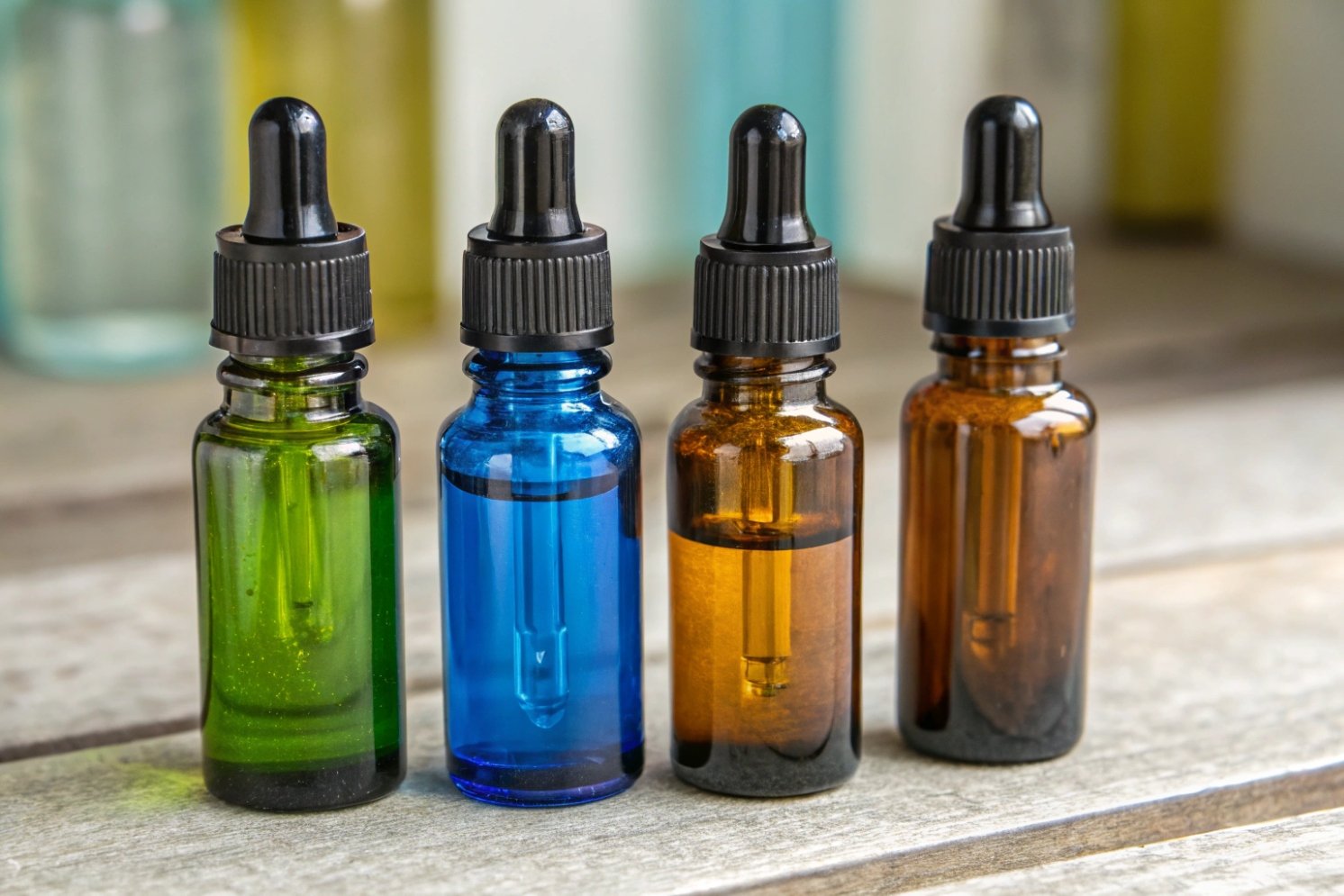
Amber vs. cobalt: which blocks more UV for essential oil stability?
Many brands love cobalt blue on shelf, but lab data often tells a different story about long-term stability.
Amber glass blocks more UV and blue light than cobalt, so it is the safer standard for long-term essential oil storage; cobalt is better for display or less sensitive, faster-moving products.
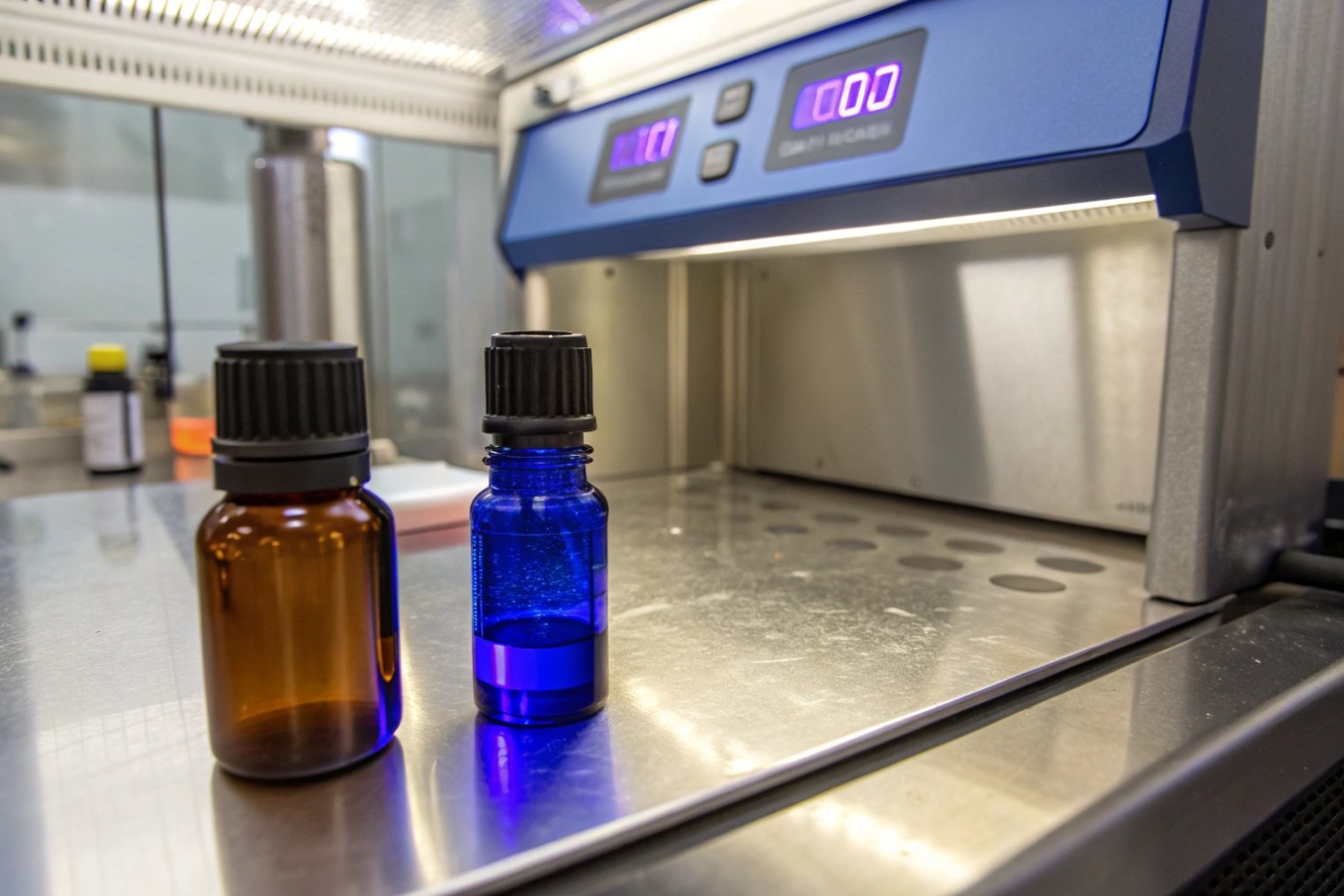
Light, especially UV and high-energy blue light, speeds up the oxidation of terpenes under light exposure 1 inside essential oils. Citrus, conifer, and many floral oils are photosensitive. Once broken down, they lose brightness and can form irritant by-products. This is why pharmacy and aromatherapy suppliers almost always start with dark glass.
How colors compare for light protection
Amber glass absorbs a wide band of UV and much of the blue region. Packaging guidance commonly notes that amber glass absorbs wavelengths shorter than ~450 nm 2. Cobalt mainly filters part of the visible spectrum; it is weaker in deep UV. Green improves slightly over clear, but still cannot match amber. Clear glass does almost nothing against light and depends fully on storage conditions.
A simple overview:
| Glass color | UV blocking (relative) | Typical use for essential oils |
|---|---|---|
| Clear flint | Very low | Lab tests, short-term samples, dark warehouse only |
| Light green | Low | Short-term blends, not ideal for pure EOs |
| Cobalt blue | Medium | Retail display, faster-moving or less sensitive oils |
| Amber / brown | High | Standard for most pure essential oils |
| Black / opaque | Very high | Highly photosensitive or premium preservation |
| Violet / UV glass | Very high (select bands) | Specialty long-term storage for sensitive oils |
In practice, the best choice is often amber in-mass colored glass. Because the color goes through the full wall, protection remains even if the bottle gets minor scratches. The color itself comes from colored glass chemistry 3 added during manufacturing, not just surface treatment. Cobalt bottles can work well if the supply chain keeps them away from strong light and the oil sells quickly.
Bottle size also matters. Smaller amber bottles (5–30 ml) reduce headspace and limit total light dose per use. For bulk sizes, extra care with storage, drums, and decanting is needed to keep the same sensory profile all the way to the final bottle.
Do opaque or sprayed coatings improve light protection over tints?
Brands sometimes want stronger protection but also want specific colors beyond standard amber. Sprayed coatings seem like an easy way to get both design and performance.
Opaque, fully covered coatings on glass can block more light than plain tints, but in-mass dark glass stays safer if coatings chip; for maximum protection, combine dark glass, coatings, and secondary packaging.
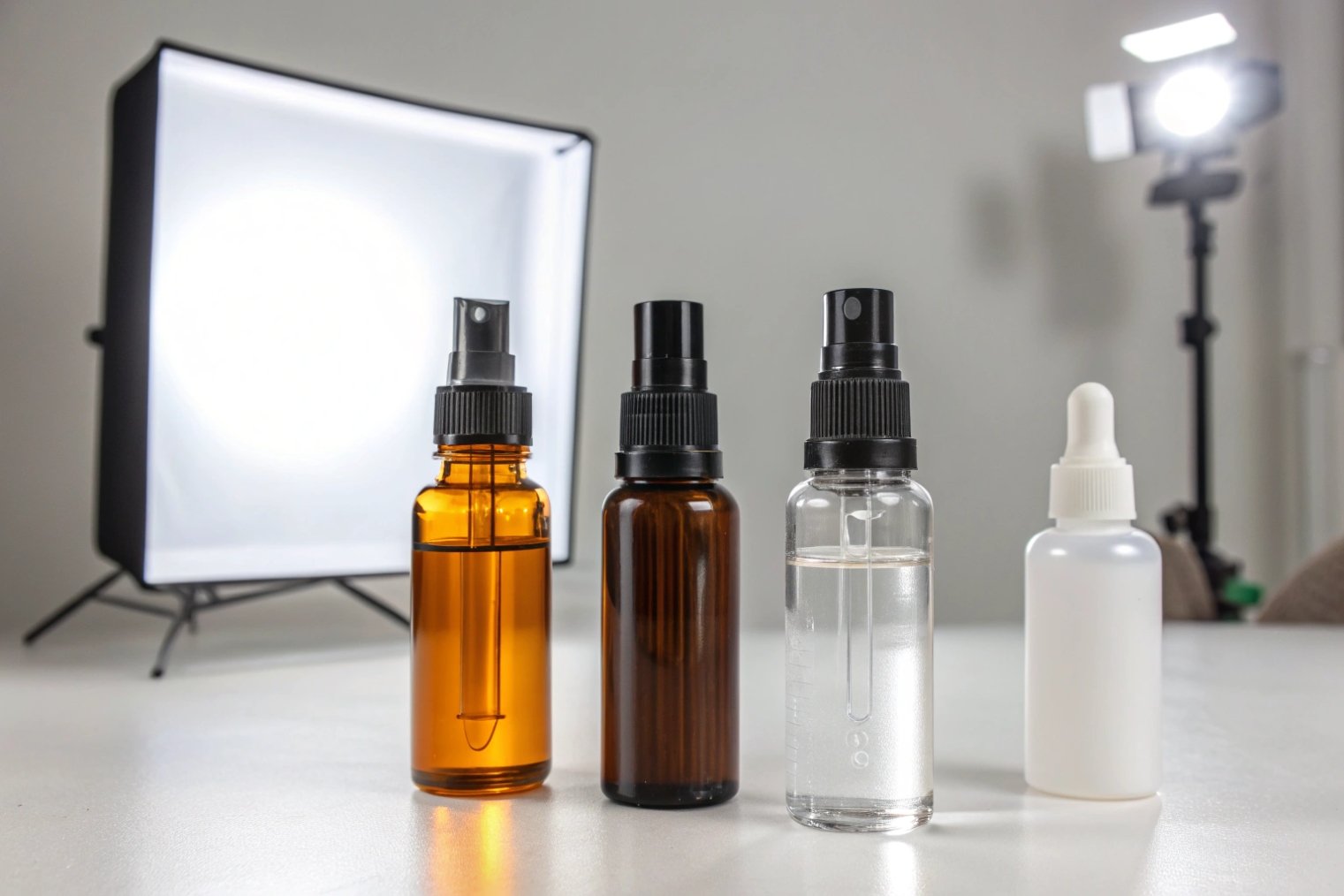
In-mass color vs. external coatings
There are two main ways to darken a bottle:
- In-mass colored glass: color is part of the melt (amber, green, cobalt).
- Sprayed or lacquer coatings: clear glass with paint or lacquer on inner or outer surface.
In-mass amber gives stable, permanent light protection. Even if the surface is scuffed, the interior still blocks UV. Sprayed coatings depend on layer integrity. If they chip, scratch, or wear through, clear “windows” appear where light enters freely.
However, sprayed coatings can be more opaque than standard tints. A full black or white exterior paint can block almost all visible light, even on clear glass. This can be useful when a brand needs a very specific color language or when they want to hide minor sediment or color differences in natural oils.
Building a light-protection strategy
The best option often layers several defences:
-
Dark base glass
Start with amber or dark tinted glass for a strong baseline. -
Optional coating
Add a sprayed or UV-curable coating for design, full opacity, or brand color. Test it with real oils to make sure it does not soften or taint over time. -
Secondary packaging
Use cartons, sleeves, or tubes to keep bottles in the dark during shipping and on shelf.
A comparison:
| Approach | Light protection | Risk points |
|---|---|---|
| Amber glass only | High | Neck / shoulder still see some light |
| Clear + colored spray | Depends on color, medium–high | Chips expose clear glass |
| Amber + black/opaque spray | Very high | Chips smaller risk, still decorate |
| Amber + carton / tube | Very high | Needs user to keep carton |
Opaque or black glass, whether in-mass or with stable coating, gives the strongest defence for very fragile oils (for example some citrus, conifer, and CO2 extracts). For most standard essential oils, amber alone, used with cartons and good storage, delivers strong enough protection while keeping costs and MOQs realistic.
Some specialty preservation concepts also use a violet glass light transmission profile 4 to strongly filter visible light while letting selected wavelengths through, but this is usually a premium niche choice.
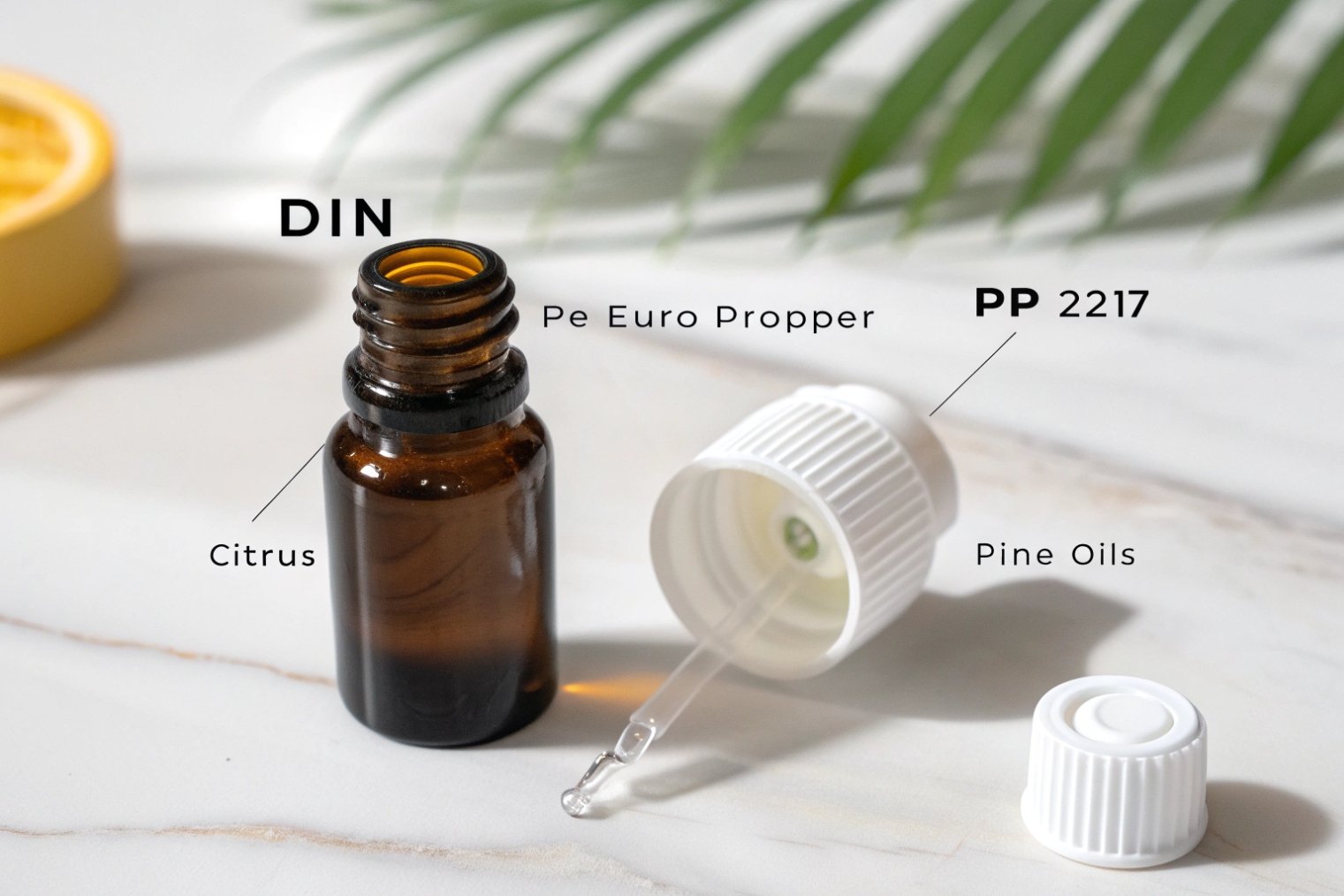
Even perfect glass cannot fix a weak cap. Terpenes, especially from citrus and pine oils, can attack some plastics, gaskets, and rubber bulbs over time.
Tight-sealing, EO-compatible closures with PE or F217 liners, orifice reducers, and minimal reactive rubber protect both oil quality and packaging from terpene damage.
How essential oils stress closures
Many essential oils are “solvent-like”. Components such as limonene, pinene, and other terpenes can:
- Soften or swell certain plastics and elastomers.
- Extract additives or odors from weak liners.
- Attack natural rubber over time, causing stickiness or cracking.
Closures must do two jobs at once:
- Seal tightly to limit oxygen and evaporation.
- Resist chemical attack from the oil, inside and on the threads.
Better closure systems for essential oils
Common and robust choices include:
-
Dropper caps with orifice reducers (“euro droppers”)
- Glass bottle + PE orifice reducer + tamper-evident cap.
- Oil only touches glass, PE, and the inside of the cap.
- Very standard in aromatherapy and professional supply.
- Example closure format: Euro dropper insert assemblies 5
-
Screw caps with EO-resistant liners
- Caps in PP or aluminum shell with PE or F-217 (foam+PE) liners.
- Good for bulk and refill sizes where droppers are not needed.
- Liner reference: F-217 foam liners 6
-
Glass pipette droppers for user convenience
- Best for facial oils and blends, but less ideal for long-term storage of strong citrus if the bulb is natural rubber.
- Silicone bulbs or special EO-rated elastomers are safer.
A simple compatibility view:
| Component | Better choices for EOs | Watchouts |
|---|---|---|
| Cap body | PP, aluminum shell | Low-grade PVC, styrenics |
| Liner | PE, F217, PTFE where needed | Cork, paper only, unknown foams |
| Dropper bulb | Silicone, EO-rated elastomer | Natural rubber for long storage |
| Insert / reducer | HDPE / LDPE | Hard, brittle plastics that crack |
Strong seals also need good neck finishes (e.g., DIN/GL threads standard in EO trade) and correct torque at capping. A cap that is too loose lets oxygen in; too tight can deform the liner or crack the neck.
For very reactive oils, large B2B containers sometimes move to lacquered metal caps or special inner bags. In general, the less complicated the closure is, and the fewer materials the oil touches, the easier it is to keep the system stable over the full shelf life.
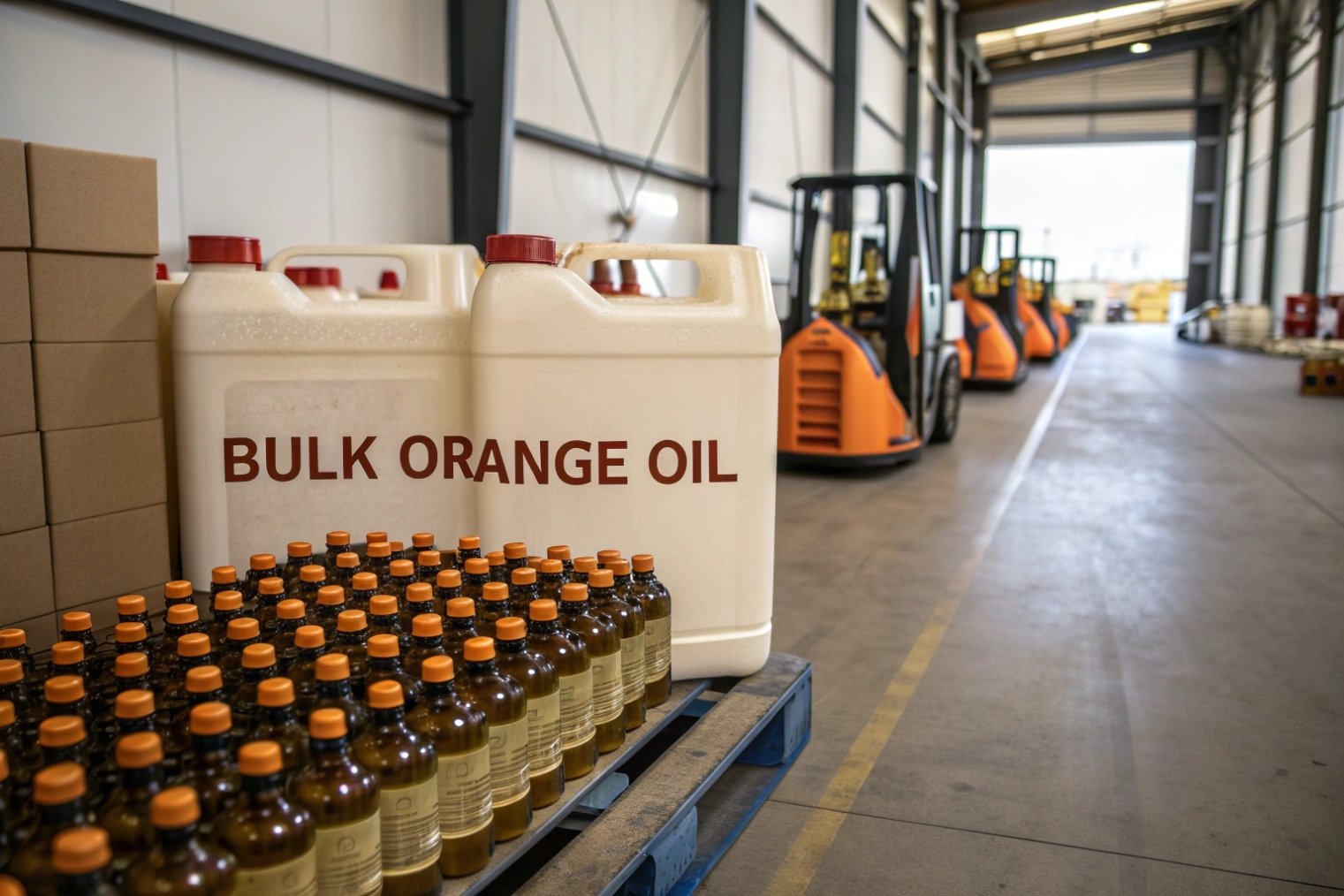
Are PET alternatives acceptable for essential oil storage in B2B logistics?
Glass is ideal at retail, but it is heavy and fragile for bulk moves. Many buyers ask whether PET or HDPE drums are “good enough” for essential oils in B2B shipments.
High-grade PET or HDPE can be acceptable for short-term B2B storage and transport of essential oils or blends, but glass or lined metal remains safer for long-term, pure, high-value oils.
When PET and other plastics make sense
In the supply chain, pure glass is not always practical for large volumes:
- Pallet loads of small glass bottles are heavy and fragile.
- Bulk buyers often decant quickly into their own storage.
- Freight cost per kilo of oil matters for commodity oils.
Here, PET or HDPE jerrycans and drums can work well if:
- The plastic grade is specified for essential oils or flavors.
- Contact time is limited (for example weeks or a few months, not years).
- The containers are stored cool and dark, away from sun-heated walls and roofs.
Many fragrance and flavor houses already use HDPE or lined metal drums safely for bulk material, then move into amber glass for final packing and retail.
Limits and trade-offs of PET for essential oils
Plastics bring some risks:
- Permeation: slow oxygen ingress and aroma loss over long periods.
- Scent scalping: measurable aroma scalping in plastic packaging 7 can reduce the intensity of volatile notes.
- Odor carryover: once a container holds a strong EO, it is hard to reuse for a different scent without trace notes.
A simple decision guide:
| Use case | Recommended container material |
|---|---|
| Long-term storage of pure, premium EO | Amber / dark glass or lacquered metal |
| Medium-term storage (3–6 months) in bulk | Food/EO-grade HDPE or PET, dark storage |
| Short-term transport before quick decant | PET / HDPE is usually acceptable |
| Retail and therapist bottles | Amber / dark glass with proper closures |
For B2B, the key is time and conditions. The longer and hotter the storage, the more glass or lined metal makes sense. When exposure time is short and supply chains are well controlled, PET and HDPE can safely move essential oils with less breakage and lower freight cost. At the point where the oil reaches the consumer, dark glass should take over again.
Conclusion
Amber or opaque glass with EO-compatible closures is the safest base for essential oils, while coatings, cartons, and limited PET use in logistics fine-tune protection and cost.
Footnotes
-
Evidence that bright light can rapidly drive terpene loss during storage. ↩ ↩
-
Explains why amber glass is widely used to block short-wavelength light for sensitive products. ↩ ↩
-
Shows how glass colorants are built into the melt to create durable, through-wall light filtering. ↩ ↩
-
Describes how violet glass filters visible light and its claimed transmission characteristics. ↩ ↩
-
Example of an EO-style euro dropper cap + orifice insert used for controlled, low-mess dispensing. ↩ ↩
-
Quick reference on what F-217 foam liners are and when they’re used in packaging. ↩ ↩
-
Study explaining aroma “scalping” where volatile compounds sorb into packaging and reduce perceived intensity. ↩ ↩






