
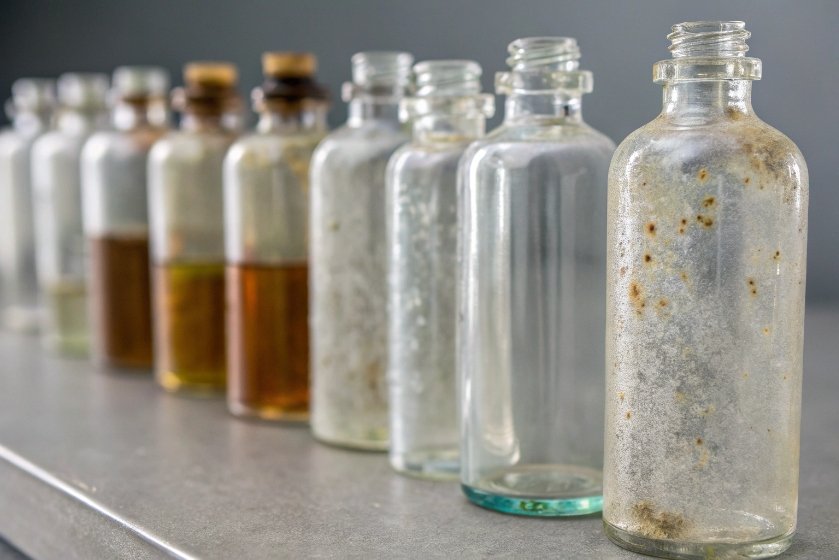
Stains and spots look “cosmetic,” but they destroy premium appearance, confuse customers, and hide deeper process problems in chemistry, coatings, or storage.
Stains and spots come from surface chemistry (sulfur, alkali leaching, mineral deposits), dirty contact points (oils, dust, release agents) and poor storage that encourages mold or carton transfer.
When we map each type of stain to its root cause, most “mystery marks” turn into very ordinary process issues: furnace atmosphere, coating balance, washer carryover, water quality, dust control, and warehouse climate. Fix those, and the glass starts to look premium again.
Are sulfur stains and surface iridescence tied to furnace chemistry?
Streaky browns, rainbows, or “pearlescent” patches on bottles rarely come from decoration. They come from the way the furnace and hot-end chemistry treat the surface.
Yes. Sulfur exposure, hot-end tin-oxide balance, and alkali leaching all interact with furnace chemistry and atmosphere to create brown stains, iridescent films, and cloudy weathering on glass.

Furnace atmosphere, sulfurization, and “sulfur stains”
Sulfur is a useful tool. It conditions the glass surface, helps with de-alkalization, and supports forming. But overdoing it or running with poor combustion control leaves visible stains.
In many plants, these effects are linked to SO₂ surface treatments used in container glass production 1 and the way furnace/hood atmospheres interact with the hot surface.
Typical patterns:
- Amber or brownish patches near the heel, shoulder, or one side of the bottle.
- Local “dirty” tone on flint glass that does not match bulk color.
- Bands that track specific sections or a forehearth zone.
Key drivers:
- Over-sulfurization at the blank mold or forehearth.
- Reducing furnace atmosphere, so sulfur and combustion by-products do not burn off cleanly.
- Soot and flame impingement that deposit carbon and sulfur compounds on hotter spots.
When furnace redox, sulfur dosing, and burner tuning are stable, that heavy brown cast disappears and glass tone becomes uniform.
Tin oxide, coatings, and surface iridescence
Hot-end coating builds a very thin tin-oxide layer that protects the surface and anchors the cold-end coating. When it is applied unevenly, or oxidation is not complete, it can look like a stain.
If you want a quick reference for the chemistry and application, see MBTC-based tin oxide hot-end coating 2.
Typical symptoms:
- Iridescent or rainbow-like patches on flint glass.
- Brownish or metallic sheen on one shoulder or panel.
- Clear difference between cavities or lehr lanes.
Root causes:
- Uneven MBTC feed or hood temperature.
- Poor exhaust or hood design, so fumes do not reach every bottle equally.
- Overbuild of tin oxide in some zones, under-build in others.
On top of that, long-term alkali leaching in damp storage can produce rainbow “weathering” stains. Moisture pulls sodium and potassium from the surface, leaving a thin altered layer that scatters light and looks oily or cloudy. This is very common on bottles parked too long in humid depots or near sea air.
Quick map: chemistry-based stains and how to respond
| Stain type | Typical root cause | Main fixes |
|---|---|---|
| Amber / brown sulfur stain | Over-sulfurization, reducing atmosphere | Adjust sulfur dosing; tune burners |
| Iridescent patches (hot-end) | Uneven tin-oxide thickness | Balance MBTC feed, hood, and exhaust |
| Rainbow weathering film | Alkali leaching in humid environments | Improve storage humidity and turnover |
| Black soot smudges | Flame impingement, incomplete combustion | Fix burner alignment and air–fuel ratio |
Once production teams see these patterns, they can trace stains back to very specific process zones instead of blaming “bad glass.”
Do oil, dust, or release-agent residues create specks on finishes?
Dark dots and greasy halos on the finish or shoulder often are not inside the glass at all. They sit on the surface, carried there by oils, dust, and wear particles.
Yes. Swab oils, shear lubricants, airborne dust, and refractory or metal wear all leave specks and halos on finishes, shoulders, and sidewalls when cleaning and lube control are weak.

Lubricants and release agents as “stain makers”
Hot-end and forming demand lubrication:
- Shear blades get sprays or oils.
- Blank and blow molds receive swab oils or graphite.
- Guides and mechanisms get greases.
When these products are:
- Over-applied,
- Degraded from heat, or
- Not compatible with the process,
they carbonize, smear, and transfer to the glass.
Typical signs:
- Dark brown or black spots with a faint halo.
- Smudgy streaks around the shoulder or in engraving.
- Local greasy appearance that resists normal washing.
On the finish, this is especially serious. Oils and carbon residues can interfere with closure sealing, coating adhesion, and ink or label performance.
Practical controls:
- Standardize lube types and application points.
- Use minimum effective swab frequency and volume.
- Introduce regular cleaning of molds, neck rings, transfer equipment.
- Audit finishes specifically for lube stains at cold-end inspection.
Dust, cullet, and refractory or metal pickup
Dry dust and solid particles can mimic “stains” when they embed or fuse into the surface:
- Loose cullet fragments on leaders or conveyors mark hot glass.
- Refractory and mold wear release gray or black specks.
- Rust or scale from steel parts can land on the finish or inside necks.
Some of these become true inclusions if they reach the gob. Others remain as stubborn surface specks that do not wash off.
The finish area is very sensitive:
- Any speck in the sealing surface can compromise closure performance.
- Visual quality expectations for cosmetics or spirits are extremely strict.
Simple checklist for specks and residues
| Defect look | Likely source | Quick actions |
|---|---|---|
| Black speck with halo | Swab oil or shear lube carbonizing | Cut lube volume; change lube; clean molds |
| Greasy patch or blotchy haze | Uneven cold-end coating plus lube | Rebalance hot/cold-end coatings; clean hoods |
| Gray metallic or rust-colored spot | Metal or conveyor debris | Inspect wear parts; add guards and cleaning |
| Fine light-colored speckles | Dust, cullet powder, cardboard | Improve dust control and housekeeping |
When we treat every contact point and every lubricant as a potential “ink,” the number of unexplained spots drops fast.
Can water quality and spray-nozzle patterning leave mineral spotting?
Washer, rinser, and coating sprays seem harmless, but the water and spray patterns themselves can paint the surface with spots and rings.
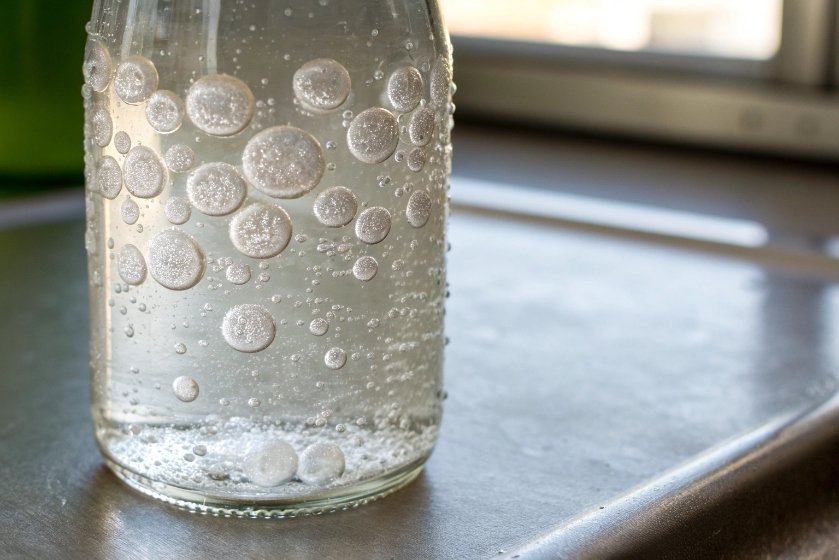
Yes. Hard water, caustic carryover, poor rinsing, and uneven spray patterns leave mineral spots, detergent films, and blotchy cold-end coatings that look like stains and haze.
Hard water, caustic carryover, and “water marks”
When water loaded with calcium and magnesium dries on glass, it leaves behind white, chalky mineral deposits. If your team needs a clean definition to align on, use water hardness caused by dissolved calcium and magnesium 3.
On bottles, this shows up as:
- Matte white spots or rings, often near the heel or shoulder.
- Cloudy hatching where droplets dried on sidewalls.
- Persistent “water marks” that do not vanish with light wiping.
In returnable systems, caustic washers add another layer:
- Residual caustic or detergent leaves streaky, whitish films.
- Caustic attack etches the surface over time, making future spotting worse.
If final rinses do not use softened or demineralized water, every cycle adds another thin layer.
Spray coverage, shadowing, and patchy cold-end coating
Spray-nozzle layout and condition matter:
- Plugged or misaligned nozzles create “dry” areas.
- Overlap errors cause regions with double or triple coverage.
- Poor atomization leaves big droplets that dry as spots or drips.
On cold-end coating systems, this turns into:
- Greasy, localized haze where coating is too heavy.
- Dry, scratch-prone stripes where coating is missing.
- Visible spotting when droplets dry before leveling.
If you need a practical primer for selection and performance, see polyethylene-based cold-end coatings 4.
If a downstream washer or rinser then dries unevenly, hard-water spots and coating blotches combine into very visible defects.
| Symptom | Main technical cause | Control levers |
|---|---|---|
| White mineral spots / rings | Hard water drying on glass | Use softened / DI water; optimize final rinse |
| Whitish films after washing | Caustic or detergent carryover | Adjust rinse steps; monitor conductivity / pH |
| Blotchy cold-end haze | Uneven spray pattern or nozzle plugging | Clean and balance nozzles; verify coverage maps |
| Drip marks / runs | Overspray, large droplets | Adjust pressure, nozzle type, and hood design |
Once water quality and sprays are under control, a lot of “mysterious” spotting simply disappears from customer complaints.
How do storage conditions trigger mold stains or carton transfer marks?
Even perfect bottles can pick up stains long after production. Storage, humidity, and packaging materials can all print their own marks onto the glass.
High humidity, damp cartons, and long storage promote mold growth, alkali weathering, and carton-ink transfer, leaving dark stains, fuzzy marks, or ghosted logos on bottle surfaces.

Mold, humidity, and “dirty” bottle surfaces
Mold spores are everywhere. They need only three things:
- Sustained high relative humidity (around or above ~70%).
- Organic material (dust, carton fibers, pallet wood).
- Time in dark or poorly ventilated storage.
Palletized glass stored in damp warehouses or in contact with wet cardboard can develop:
- Fuzzy, dark or pale stains where mold colonizes carton surfaces and then contacts glass.
- Musty odor and visible spotting on outer layers.
- Irregular, patchy marks that match carton fluting or printing.
At the same time, moist, slightly alkaline environments accelerate glass corrosion and weathering in humid storage 5, raising the chance of iridescent “weathering” stains on long-stored stock.
Carton ink, dust, and transfer marks
Cartons protect glass, but they also carry:
- Printing inks and coatings.
- Loose paper fibers and dust.
- Sizing and adhesives.
When pallets are:
- Wrapped while hot, causing condensation inside, or
- Stored where humidity swings a lot,
condensed moisture acts as a solvent. Carton inks and fibers soften and then print onto the bottle surface. In printing terms, this kind of transfer is related to set-off (ink transfer) during stacking and storage 6.
Common symptoms:
- Colored smudges or ghost logos on shoulders and panels.
- Parallel lines that follow carton flutes.
- Dusty, dull patches where fibers stuck to the coating.
These are often called “carton scuffs” or “carton transfer” and may only appear after weeks in the distribution chain.
Storage and packaging rules that keep glass clean
| Risk factor | Effect on stains and spots | Preventive guideline |
|---|---|---|
| High RH warehouse | Mold growth, weathering, carton softening | Keep RH below ~60%; ventilate and dehumidify |
| Damp or damaged cartons | Mold stains, ink bleeding | Reject wet cartons; store off the floor |
| Hot palletizing + tight wrap | Condensation and carton transfer | Allow cooling before wrapping; use vented patterns |
| Long storage near sea air | Alkali weathering, rainbow film | Rotate stock faster; use better climate control |
To align internal standards with common guidance, use recommendations like keeping indoor relative humidity below ~60% 7.
When storage and packaging are treated as part of the process, not an afterthought, a large share of stains and spots never reach the customer at all.
Conclusion
Most stains and spots on glass bottles are surface stories about chemistry, coatings, water, and storage. When we control those, the glass sells itself without needing excuses.
Footnotes
-
Overview of SO₂ and other surface treatments used on container glass. ↩ ↩
-
Explains MBTC hot-end coating chemistry and application basics for glass containers. ↩ ↩
-
Defines water hardness and why calcium/magnesium minerals leave deposits after drying. ↩ ↩
-
Practical notes on polyethylene cold-end coatings that reduce scuffing and improve line handling. ↩ ↩
-
Learn how humidity-driven corrosion creates rainbow films and cloudiness on glass surfaces. ↩ ↩
-
Defines set-off and why ink can transfer during stacking and storage. ↩ ↩
-
Guidance on controlling indoor moisture; recommends keeping relative humidity in a safer range to slow mold. ↩ ↩






