
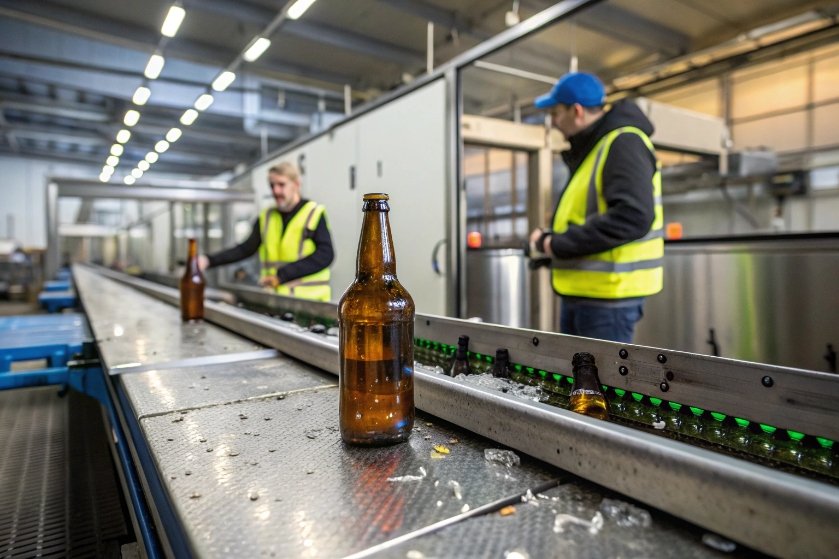
Cracked bottles destroy product, damage trust, and quietly drain profit. Many teams blame “bad glass,” but most fractures follow clear, preventable patterns in stress, impact, and handling.
Cracks in glass bottles and jars come from thermal shock, residual stress from poor annealing, mechanical impact, inclusions (stones, cords, bubbles), and rough handling or packaging that turns tiny flaws into full fractures.
So the real work is not guessing why a bottle broke, but tracing the crack back to its origin. When the team understands how thermal, mechanical, and chemical factors combine, it becomes much easier to prevent the next failure.
Do thermal checks really come from poor annealing curves in the lehr?
Thermal cracks often look “mysterious” because they can appear later at the filler, in a warehouse, or even in a customer’s kitchen.
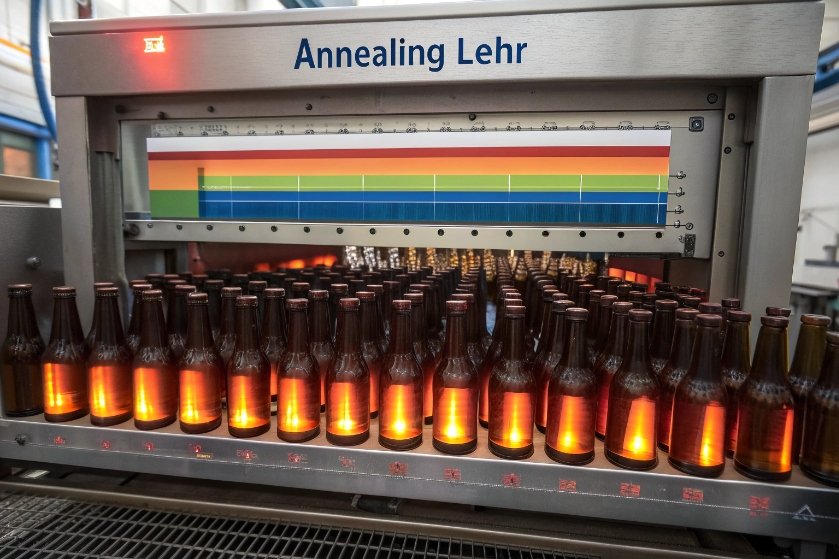
Thermal checks come from temperature differences between inner and outer glass surfaces, often made worse by poor annealing curves in the lehr and later thermal shock during use.
How thermal stress builds in a glass container
Right after forming, the outer surface of a bottle cools much faster than the inner glass. This creates a complicated pattern of tensile and compressive stress inside the wall. If the bottle moves through the lehr too fast, or the temperature profile is wrong, those stresses do not fully relax. Practical references on stress relief and the lehr curve (including annealing and strain ranges) are summarized well in Annealing and Tempering lecture notes for glass processing 1.
Residual tensile stress sits quietly until the bottle sees a new temperature change. Then even a modest hot-fill, pasteurization, or rapid temperature-change thermal shock 2 can push the combined stress over the glass strength and start a crack.
A typical sequence looks like this:
| Step | What Happens in the Glass |
|---|---|
| Rapid cooling after forming | Outer surface locks in compression, inner regions in tension |
| Poor annealing curve | Stress does not fully relax; pattern stays frozen |
| Hot fill / pasteurization | Inside heats faster than outside → new tensile stress outside |
| Combined stresses exceed limit | Crack begins at a weak point (scratch, inclusion, sharp corner) |
Thermal checks often appear as clean, simple fractures that circle the heel or run partway up the sidewall, sometimes with a nearly continuous ring around the base.
To reduce this risk, the lehr must:
- Reach the correct annealing temperature long enough for stress relaxation.
- Cool down slowly and evenly through the strain range.
- Avoid big temperature differences across belts or lanes.
Thermal shock in the field can still crack a well-annealed container if the temperature change is extreme (for example, boiling liquid in a fridge-cold jar). But with a good annealing curve, the safety margin is much higher, and real cracks become rare, not routine.
How do impact, rim-contact, and conveyor jams create mechanical checks?
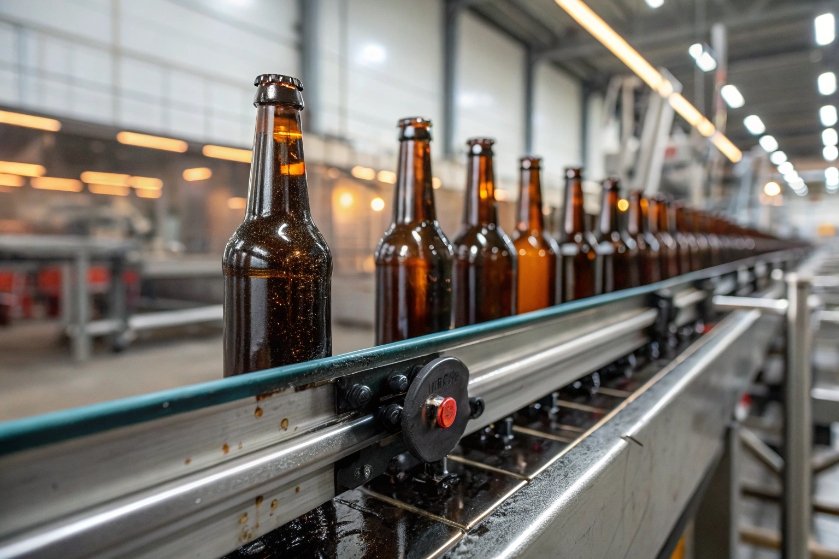
Many fractures do not start in the lehr; they start when bottles hit each other, metal guides, or machinery. Small “bruises” in the surface turn into crack origins later.
Mechanical checks form when impacts, rim contact, and conveyor jams put high local stress on the glass surface, creating microfractures that later grow under pressure, handling, or thermal load.
What impact really does to glass
Glass is strong in compression but weak in tension. A sharp impact from another bottle, a metal guide, or a starwheel produces very high local tensile stress at a small contact area. This creates:
- Bruises or percussion cones: circular ring cracks with crushed glass in the center; see the defect definition for percussion cone (bruise) fractures 3.
- Rim checks: small radial cracks around the mouth from hard crown or cap contact.
- Body checks: crescent or “comma” cracks where bottles hit along the sidewall.
These flaws might be microscopic at first, but they reduce local strength greatly. Later, when the bottle is filled, capped, pressurized, or thermally cycled, the crack grows from that weak point.
Conveyor jams and mis-synchronization make this worse. When bottles back up and collapse into each other, or when a pusher bar hits them off-center, impact speed and angle go up. For a practical field guide to how these fractures look and how they’re classified, many teams use Bottle Breakage—Causes and Types of Fractures 4.
Simple handling improvements give big gains:
| Cause | Example Symptom | Prevention Step |
|---|---|---|
| High infeed / outfeed speed | Bottles “ping” as they hit each other | Match speeds, use accumulation tables correctly |
| Hard metal guides | Circular bruises at shoulder or heel | Use plastic or coated guides and smooth curves |
| Rim-to-rim contact | Chips or cracks on finish ring | Control crowner height and capper settings |
| Conveyor jams | Multiple breaks in one area | Add sensors, line pressure control, jam logic |
In daily production, most “sudden” shatters on lines have a mechanical story, not a melting story. Once the line is tuned to minimize sharp hits, crack rates drop and bottles stop breaking “for no reason.”
Can devitrification, stones, or cords act as crack initiators?
Sometimes cracks start exactly where the glass itself is not uniform. A small stone, devitrified patch, or cord can turn into the first link in a fracture chain.
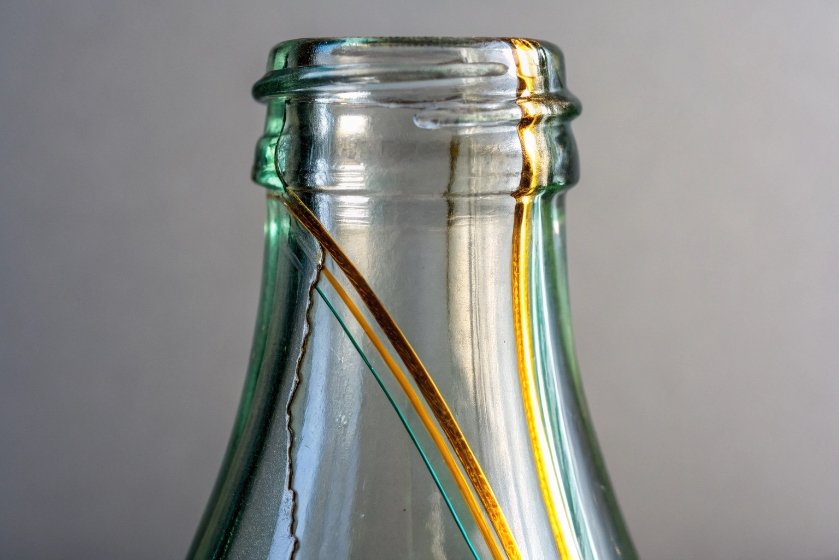
Yes. Devitrified zones, stones, cords, and even bubbles act as stress concentrators and crack initiators, especially when they sit in high-stress regions like the heel, shoulder, or finish.
Why inclusions and devitrification are so dangerous
Stones are small pieces of refractory or unmelted batch. Cords are streaks of glass with a slightly different composition or viscosity. Devitrification in glass 5 is a local region where glass has partially crystallized. All three change how the glass expands and carries stress.
At these spots, the stress field becomes uneven. Under load, tensile stress focuses at the interface between “normal” glass and the defect. Many fracture investigations trace the crack origin back to a single inclusion, and the visual logic of crack origins, hackle, and arrest lines is covered deeply in the NIST handbook on fractography of ceramics and glasses 6.
Gas inclusions can behave the same way. Larger blisters and clusters of bubbles weaken the wall and make the local region more brittle.
The risk grows when these defects sit in:
- Heel and base contact areas (high impact stress).
- Shoulder transitions and body corners (geometry-driven stress).
- Finish and bore (pressure and closure torque).
A simplified risk view looks like this:
| Defect Type | Typical Origin | Risk Level in High-Stress Zones |
|---|---|---|
| Stone | Batch / refractory | Very high |
| Cord | Melting / flow | High |
| Devitrification | Overheating / long exposure | High |
| Large bubble | Refining / forming | High |
| Small seeds | Refining / batch | Low–medium (location dependent) |
In practice, prevention starts upstream: cleaner raw materials, controlled furnace wear, better fining, and stable viscosity. But at the inspection stage, the rule is simple: if a stone, devitrified patch, or strong cord appears in a critical zone, that bottle should not reach a filling line.
Which handling and packaging steps most reduce crack propagation risk?
Even with good glass and careful forming, bottles still live a rough life: depalletizing, conveying, filling, capping, pasteurizing, packing, shipping, and retail handling.
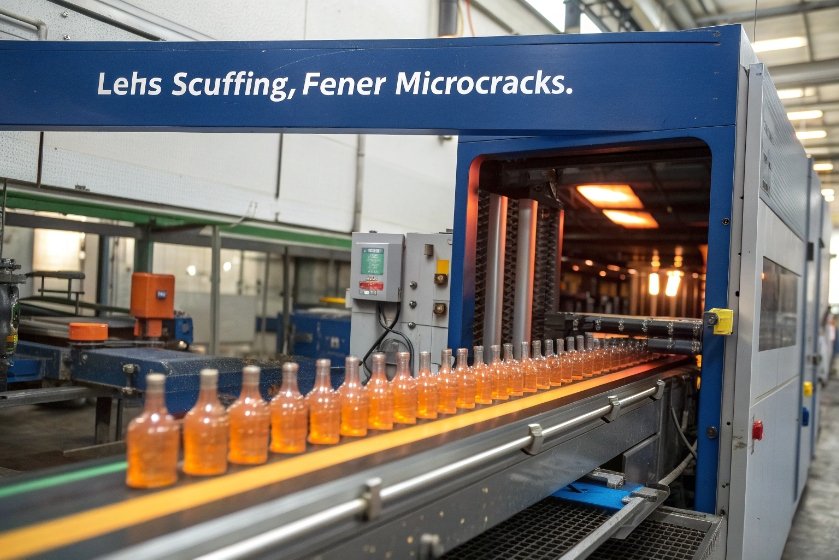
The biggest reductions in crack propagation come from soft handling on lines, protective coatings, smart secondary packaging, and stable pallets that prevent rubbing, tipping, and severe impact during transport and storage.
How to give glass a safer journey
Most cracks grow from something small: a fine scratch, a bruise, or a tiny inclusion. Good handling and packaging try to stop these flaws from starting or from seeing high stress later.
On the production and filling line, key steps include:
- Hot-end and cold-end coatings
- Hot-end (tin oxide) plus cold-end (polyethylene-type) coatings reduce friction between bottles and protect surfaces from scuffing; a technical overview is in Glass Surface Treatments: commercial hot-end/cold-end coating processes 7.
- Smooth container handling
- Use well-aligned, low-friction guides and starwheels.
- Control line pressure and avoid accumulation that causes clashing.
- Minimize hard metal-to-glass contact at transfers, diverters, and stops.
- Clean conveying environment
- Keep sand, glass chips, and hard debris off conveyors; these act like sandpaper on the heel and sidewall.
In secondary and transport packaging, other controls play a big role:
- Use dividers or molded pulp between bottles to stop glass-to-glass impact.
- Limit void space in boxes so bottles cannot gain speed before impact.
- Choose strong cartons and trays that resist crushing and shifting.
- Add tier sheets between pallet layers so upper layers do not load directly onto crowns or shoulders.
- Wrap pallets correctly: enough stretch film to hold tight, but not so much that tension cracks bottles at the edges.
A very simple way to think about crack control is:
| Stage | Main Risk | Key Protection |
|---|---|---|
| Cold end / lehr | Residual stress, fresh hot glass | Correct annealing and coatings |
| Filling line | Impact, abrasion, rim checks | Line pressure control, smooth guides, clean belts |
| Case packing | Bottle-to-bottle contact | Dividers, fit-to-size cartons, controlled drops |
| Palletizing | Tipping, over-compression | Flat pallets, tier sheets, correct wrap tension |
| Transport | Vibration and shocks | Tested packaging design, stable pallet patterns |
When the whole chain is designed around protecting the glass surface and avoiding high local loads, cracks become rare events instead of a constant headache.
Conclusion
Cracks in glass bottles and jars are not random. They usually start at a known weakness—residual stress, impact damage, or inclusions—and grow under thermal or mechanical load. If melting, annealing, handling, and packaging all aim at protecting the glass, cracks drop and confidence rises.
Footnotes
-
Shows how lehr temperature profiles relieve stress through annealing/strain ranges. ↩ ↩
-
Explains why rapid temperature change creates tensile stress that cracks glass. ↩ ↩
-
Defines percussion cone “bruise” damage patterns used in container glass breakage analysis. ↩ ↩
-
Visual reference of common bottle fracture types and their typical causes. ↩ ↩
-
Clear definition of devitrification and how glass becomes crystalline under certain conditions. ↩ ↩
-
Practical guide to reading fracture surfaces to find crack origins and failure modes. ↩ ↩
-
Summarizes industrial surface treatments and why coatings reduce scuffing-driven crack initiation. ↩ ↩






