
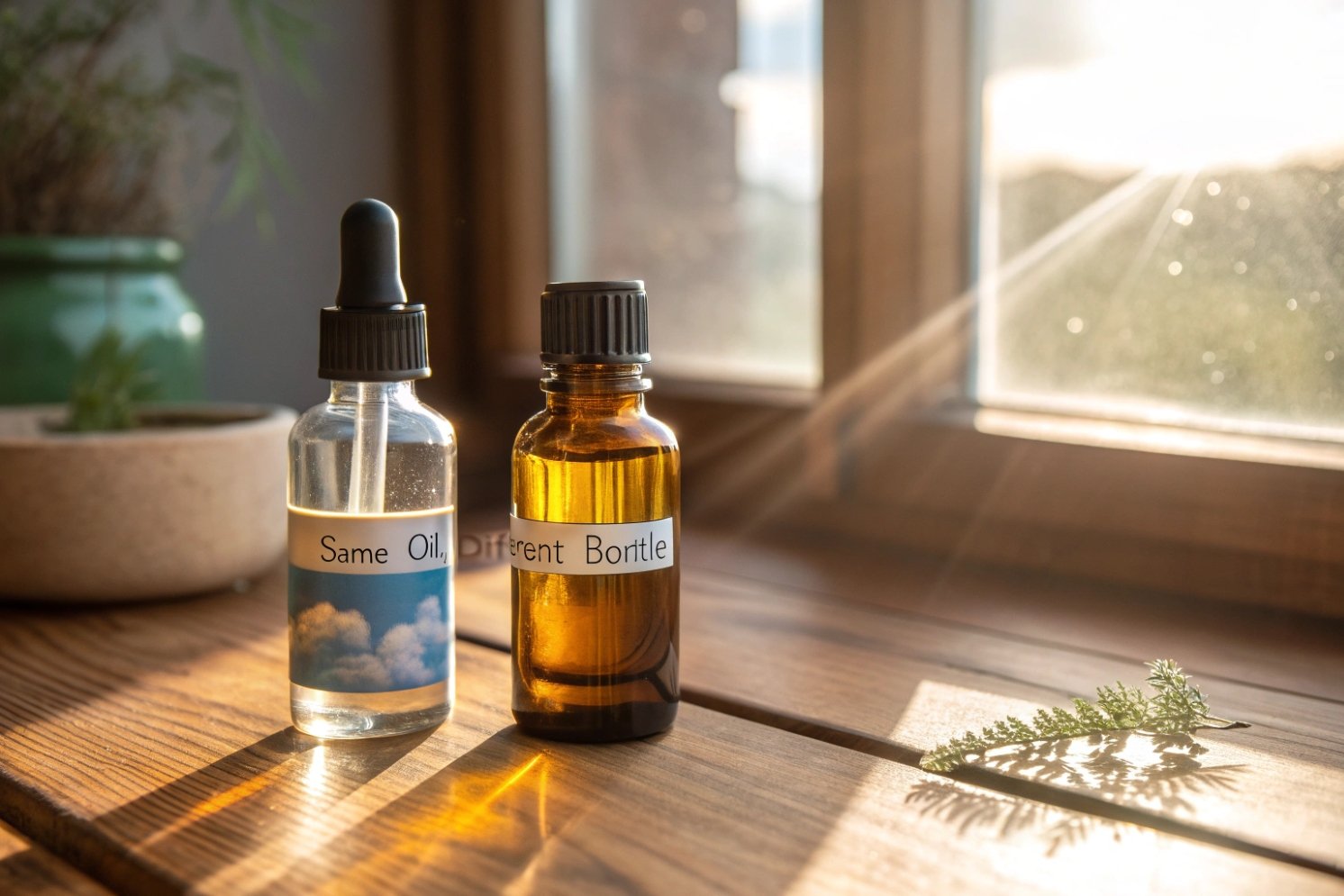
Essential oils can smell perfect today and harsh next month. Light and heat can quietly change the oil, and most people notice only after money is lost.
Essential oils should be stored in dark glass because UV and bright light speed up oxidation and breakdown. Amber or other dark tints slow aroma drift, while glass stays inert and avoids plastic contamination.
Dark glass is part of the formula’s protection, not a decoration
Light damage is real, even when the oil still “looks fine”
Essential oils are fragile mixtures. Many molecules inside them react to light, oxygen, and heat through photochemical reactions and auto-oxidation 1. A bottle can sit on a sunny counter and still look normal, but the aroma can shift. The oil can lose its bright top notes. The oil can also form oxidation by-products 2. Those changes can reduce perceived potency, and they can raise irritation risk for some oils when used on skin.
This is why packaging matters. A dark bottle is a simple barrier that reduces UV exposure and lowers the speed of photodegradation. Glass also helps because it stays inert for most essential oil use—aligned with USP ⟨660⟩ guidance on glass containers 3. It does not absorb aroma and it does not soften the way many plastics can when terpenes sit against them. In real customer feedback, the most common complaint is not “the bottle broke.” The more common complaint is “the oil smells different than last time.” Light and oxygen are often the hidden causes.
Dark glass also reduces “user mistakes”
Most users store oils where they can see them. That often means counters, shelves, and bathrooms. Dark glass forgives imperfect habits. Clear glass punishes them. Even when a brand includes good storage advice, not every customer follows it. A good package should assume real life.
| Packaging choice | UV protection | Chemical safety | Best use case | Typical failure |
|---|---|---|---|---|
| Clear glass | Low | High | Short-term use in a drawer | Fast aroma drift on counters |
| Amber glass | High | High | Most essential oils | Very few, if sealed well |
| Cobalt glass | Medium | High | Display-led sets with carton | Slower drift, but still drifts |
| Fully opaque | Very high | High | Very light-sensitive oils | Hard to see fill level |
What “dark glass” should mean in sourcing
A quality dark bottle uses integrally colored glass, not a surface paint. Surface coatings can scratch. They can also look uneven across lots. Integrally colored amber is more stable in production and more stable in daily use. When the oil is valuable, the bottle should act like a vault. Many amber containers are designed to keep light low—often targeting <10% spectral transmission between 290–450 nm 4.
A dark glass bottle is the first layer. The next layers are tint choice, closure materials, and storage habits. The sections below break each one down in practical terms.
If the goal is fewer returns and better repeat orders, light protection is the easiest win. The next step is understanding how UV damage actually happens.
How does UV exposure degrade potency and aroma?
A fresh oil can smell bright, then turn flat and sharp. People blame the supplier, but light exposure often did the damage after purchase.
UV exposure degrades oils by triggering photochemical reactions and speeding oxidation. This breaks down delicate aroma compounds, shifts the scent balance, and can reduce perceived potency over time.
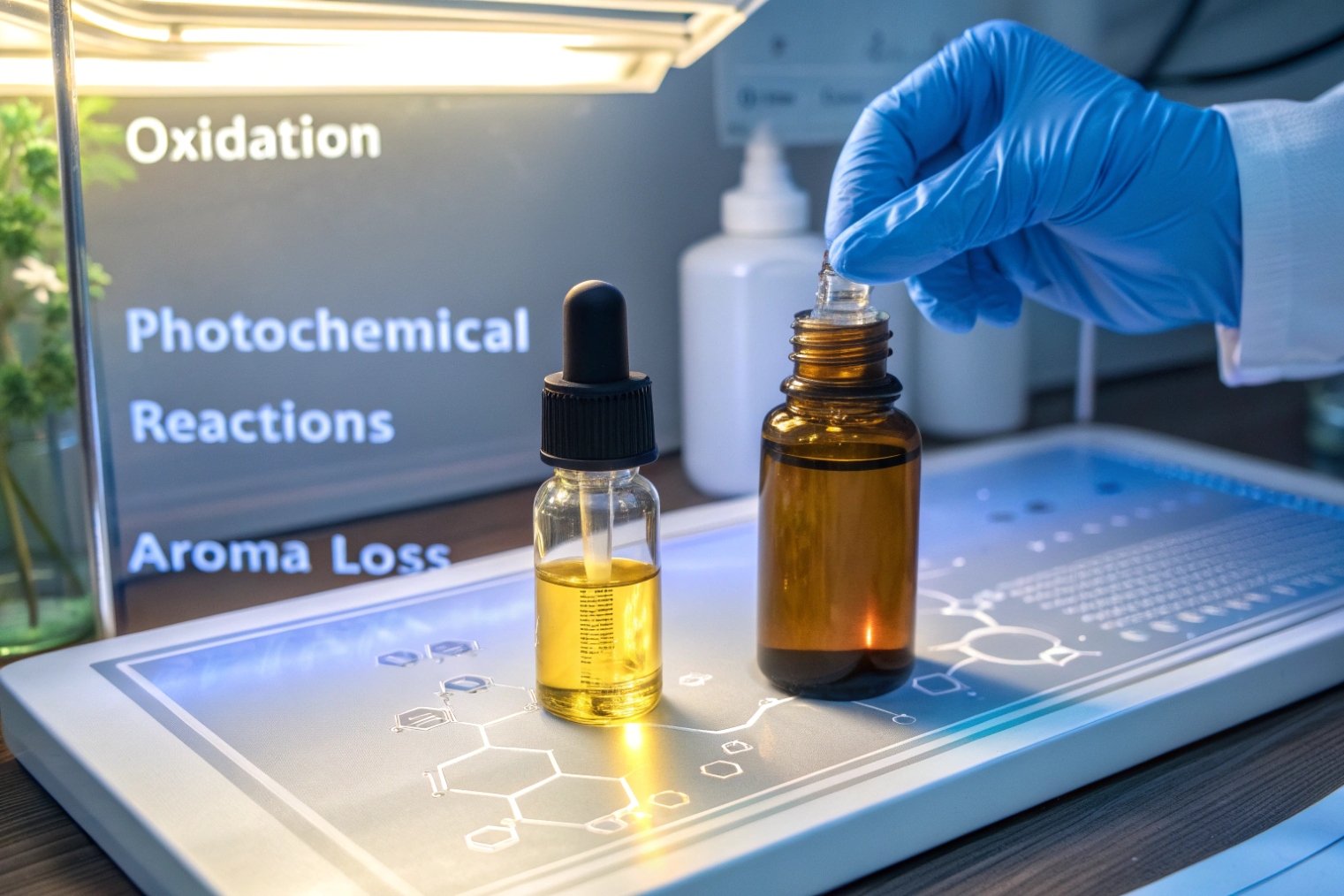
UV damage shows up as aroma drift, not as a clear warning sign
Top notes fade first
Many essential oils rely on small, volatile molecules for the first impression. These are often the notes customers love most. UV adds energy to molecules. Some molecules break. Some molecules react with oxygen faster. The result is a weaker opening and a shorter “lift” in the diffuser or on skin.
Oxidation becomes the second wave
Light and oxygen often work together. A bottle always has headspace, so oxygen is present. UV can speed up oxidation reactions. This is why oils can develop off-notes and a “stale” edge. Citrus oils are a common example because they are rich in reactive terpenes. Some blue oils also have light-sensitive constituents. A buyer may not know the chemistry, but the nose will notice the change.
Indoor light still matters
Sunlight is the strongest risk, but bright indoor lighting can also cause slow drift. Many oils sit near windows, under kitchen lights, or in bathrooms. Over months, even moderate light can shift the aroma.
Reduce UV risk with three simple controls
1) Use dark glass as the first barrier.
2) Reduce headspace and keep the cap tight to slow oxidation.
3) Store cool and dark, not near heat and humidity.
| UV exposure pattern | What changes first | What changes later | Practical fix |
|---|---|---|---|
| Direct sun daily | Top notes dull fast | Off-notes appear | Amber + cabinet storage |
| Bright indoor light | Slow loss of sparkle | Aroma imbalance | Keep in box or drawer |
| Light + heat | Fast degradation | Harsh notes, faster evaporation | Cool, dark storage |
| Light + big headspace | Quicker oxidation | Thinner aroma profile | Smaller bottles, fill higher |
In product development, the goal is not to eliminate all change. The goal is to slow change so the oil stays close to the intended profile across normal use. Dark glass gives that control at a low cost.
Once UV risk is clear, the next decision is tint. Many brands ask if cobalt is “as good” as amber. The answer depends on protection goals and customer behavior.
Are amber or cobalt tints better than clear glass?
Clear glass looks premium and transparent. Still, essential oils are not meant to be displayed like colored water.
Amber is usually better than cobalt and far better than clear for light protection. Cobalt can work when a carton blocks light and storage habits are strict, but amber is more forgiving for real-life use.
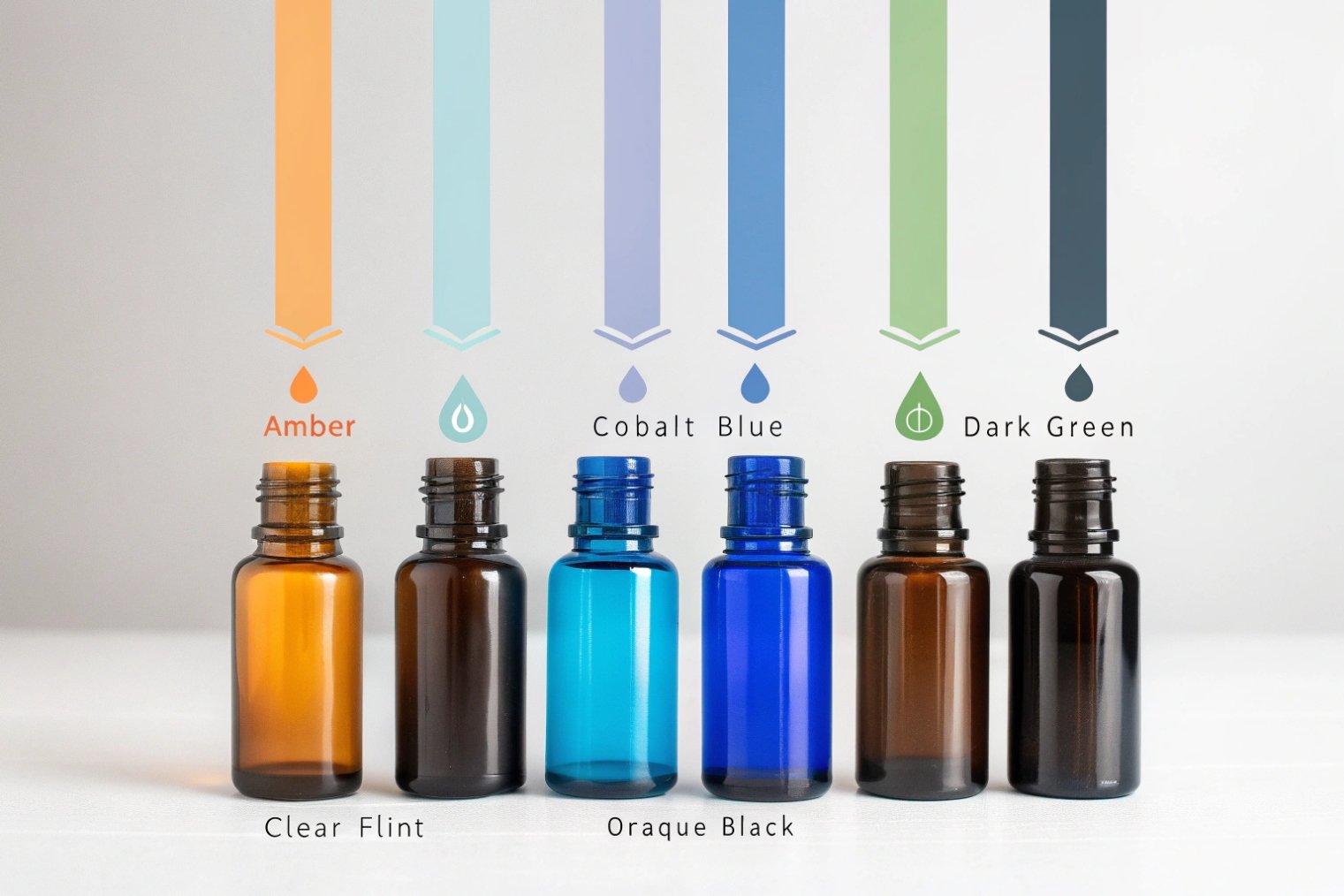
Amber wins for protection, cobalt wins for display, clear wins only with strict storage
Amber glass: the safest default
Amber blocks more UV wavelengths than clear glass, and it usually blocks more than blue or green tints. This matters for customers who store oils in visible places. Amber also fits the classic apothecary look, which many buyers link with “serious” and “effective.” A common reason is that amber packaging filters most light wavelengths under 450 nm 5.
Cobalt glass: strong shelf appeal with moderate protection
Cobalt can look clean and modern. It can also help a brand stand out. Still, the protection level often relies on good habits. When cobalt is used, a carton becomes important. The carton should block light, and the label should guide storage. Without that, cobalt bottles can still drift in bright environments.
Clear glass: only for controlled use
Clear glass is risky for long-term storage. It can be acceptable for fast-use blends, for professional settings where bottles stay in closed cabinets, or when the bottle remains inside an opaque box most of the time. Even then, the brand should expect more variance in customer experience.
Tint choice should follow the oil profile
Some oils oxidize faster. Terpene-rich citrus oils are common examples. These oils benefit more from amber or fully opaque packaging. A stable oil can tolerate more, but “tolerate more” still does not mean “no risk.”
| Tint option | Light protection | Brand look | Best fit | What to add |
|---|---|---|---|---|
| Amber | High | Classic, trusted | Most essential oils | Strong closure system |
| Cobalt | Medium | Premium, modern | Gift sets, display | Opaque carton + storage guidance |
| Clear | Low | Minimal, transparent | Quick-use products | Box + shorter shelf expectations |
| Opaque | Very high | Bold, protective | Most sensitive oils | Fill-level strategy |
A tint decision should be made early, not after label design. When tint and graphics are planned together, the pack looks intentional and performs well.
Tint protects the oil from light. The closure protects the oil from oxygen loss and terpene attack. Many brands lose quality at the cap, not at the glass.
Which cap and liner materials resist terpene migration?
A bottle can be amber and still fail. A weak liner can swell. A poor cap can leak. Terpenes can also pull odor from the wrong materials.
Caps and liners should resist terpenes and keep compression stable. Phenolic caps with polycone (PE) or PTFE-facing / F217-style liners are common choices. Avoid unlined metal caps and avoid natural rubber parts in contact with oil.
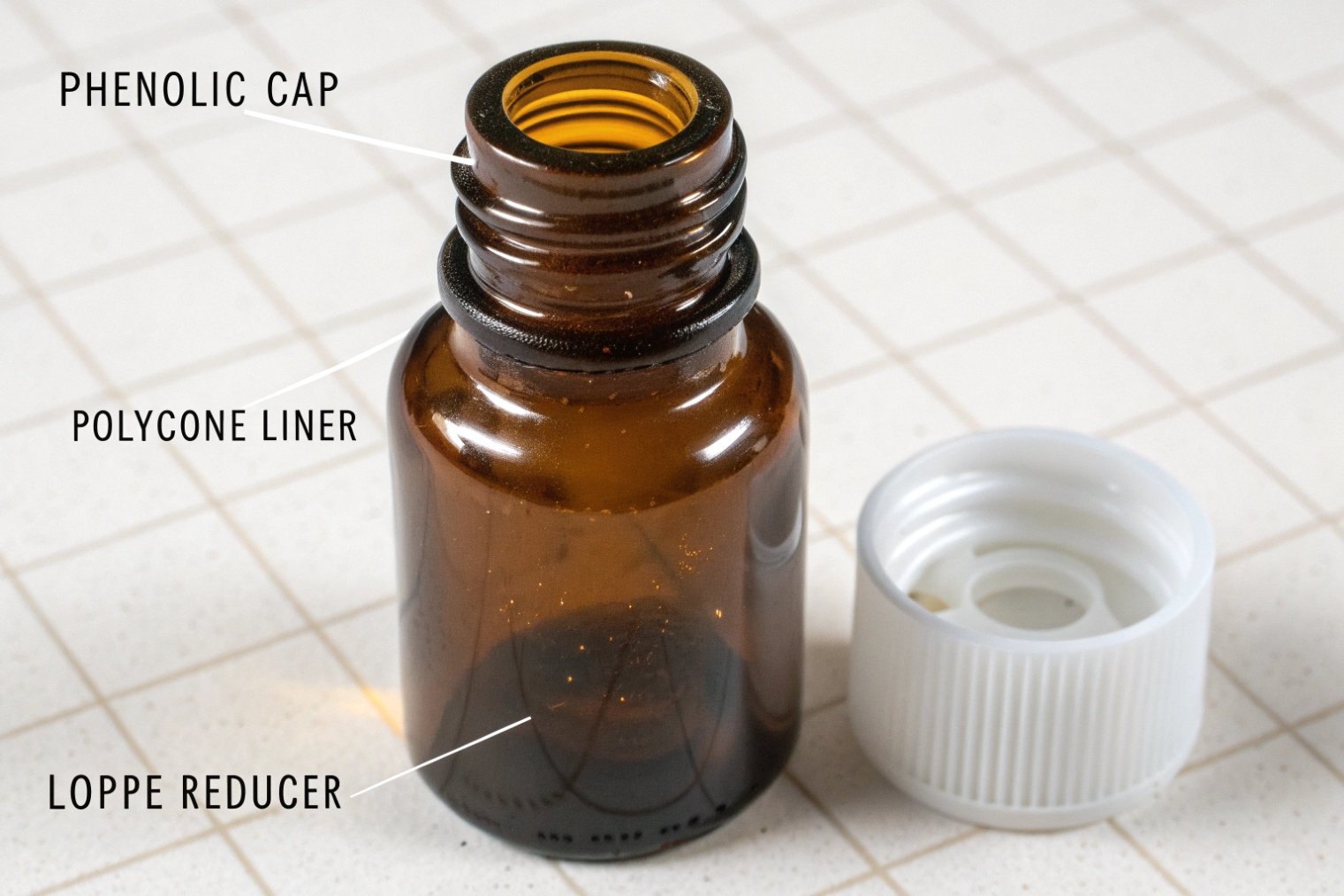
The closure is a chemical component, not an accessory
Why terpenes cause problems
Many essential oils contain terpenes that act like solvents. Some plastics can soften, and aroma compounds can also migrate into polymers—one example is d-limonene absorption into PET 6. Some liners can swell or take a compression set, which weakens the seal. Once the seal weakens, oxygen enters more easily and volatile compounds escape more easily. That accelerates aroma drift and reduces perceived potency.
Cap body: rigidity supports long-term sealing
Phenolic caps are widely used because they are rigid and they hold torque well. Rigid caps help keep liner compression stable over time. Soft caps can distort, especially after repeated opening. Distortion often shows up as slow leaks or as a cap that “feels loose” after a few weeks.
Liner type matters more than cap color
A polycone liner seals by wedging into the bottle opening. This creates strong leak resistance and reduces vapor loss. PTFE-facing liners offer better chemical resistance at the contact surface. F217-style foam liners can work well for many oils when matched correctly. The wrong liner can absorb aroma, deform, or shed particles.
Reduce oxygen exposure during dispensing
For drop bottles, an orifice reducer can help control flow and reduce time spent with the bottle open. Less open time means less oxygen exchange. It also reduces spills, which keeps threads clean and supports sealing.
| Closure system | Leak control | Terpene resistance | Best fit | Avoid when |
|---|---|---|---|---|
| Phenolic + polycone | High | Medium–High | Most oils, travel | Threads are mismatched |
| Phenolic + PTFE-facing liner | High | High | Citrus and aggressive oils | Budget is very tight |
| Plastic cap + flat liner | Medium | Medium | Short-term blends | Long shelf life is needed |
| Unlined metal cap | Low–Medium | Low | Not recommended | Any long storage use |
A good closure system can make a clear bottle perform slightly better, and it can make an amber bottle perform much better. Still, the best closure cannot fight high heat. That is why storage temperature and handling habits must also be part of the plan.
What storage temperatures and handling best preserve EOs?
Even premium packaging cannot save oils stored in a hot bathroom or left open during blending. Small habits decide shelf life.
Essential oils preserve best when stored cool, dark, and stable. Avoid heat spikes, avoid sun, store upright, minimize headspace, and close caps fast. Consistency matters more than extreme cold.
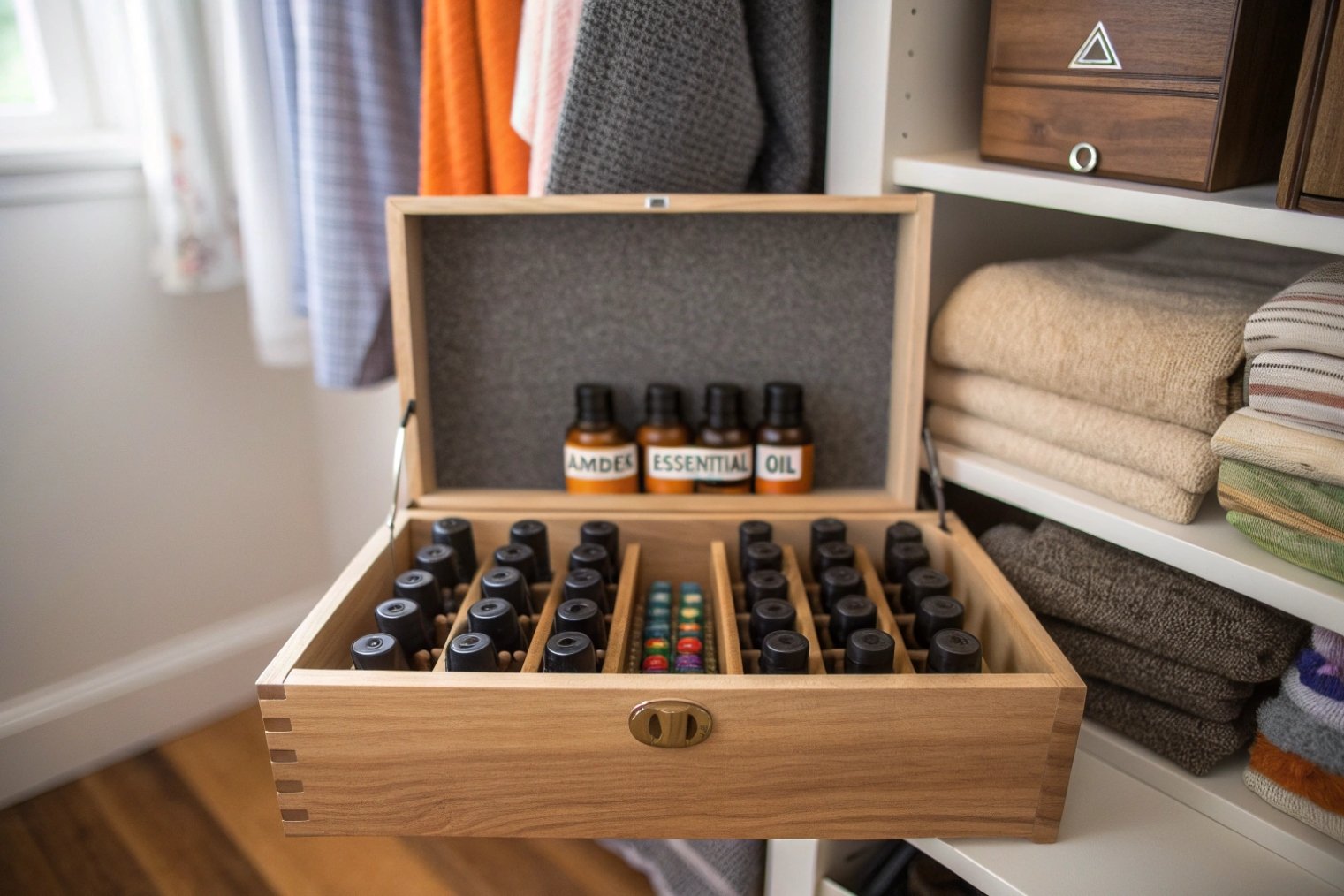
Temperature control is about stability, not perfection
Keep oils away from heat sources
Heat speeds oxidation and evaporation. A sunny windowsill, a car, and a shelf above appliances can degrade oils quickly. A cool cabinet is often enough. Many brands aim for normal room temperatures that stay stable, and they avoid repeated warm-cool cycling.
Refrigeration can help, but it adds risks
Cold storage can slow reactions, but it can also cause condensation when bottles warm up. Condensation can introduce moisture near the neck and threads. Some oils can also thicken or cloud when cold. For most daily users, stable cool storage beats refrigeration. For special oils or long-term reserves, refrigeration can be used carefully with tight sealing and slow warming before opening.
Handling habits that keep aroma true
Reduce oxygen exposure
Headspace matters. Smaller bottles (like 5–15 ml) reduce headspace and encourage faster use, which reduces oxidation risk. Filling closer to the shoulder helps too. Orifice reducers reduce open time and limit splashing.
Keep threads clean and caps tight
Oil residue on threads can prevent proper sealing and can soften some liners over time. A quick wipe after dispensing prevents sticky buildup. Caps should be closed firmly, not over-tightened. Over-tightening can deform liners and damage threads.
Store upright and protect from light even indoors
Upright storage reduces constant contact between oil and liner. A dark drawer or a carton keeps light low, and it also protects labels and finishes. If you want a conservative rule for fragile oils, note that citrus essential oils are particularly prone to oxidation 7, so “cool + dark” storage is not optional for long-term quality.
| Storage practice | Why it works | Simple rule | Common mistake |
|---|---|---|---|
| Cool, dark cabinet | Slows degradation | No window storage | Bathroom counter storage |
| Stable temperature | Reduces reaction speed | Avoid heat spikes | Leaving oils in a car |
| Cap tight and fast | Limits oxygen loss | Close right after use | Leaving caps loose |
| Minimal headspace | Slows oxidation | Use smaller bottles | Big bottle for small volume |
| Upright position | Protects liner | Store standing | Laying bottles sideways |
When packaging and handling work together, oils keep their intended aroma longer. That protects customer trust and reduces the “my oil changed” complaints that hurt repeat purchase.
Conclusion
Dark glass slows UV damage and supports longer shelf life. Pair amber or protected cobalt with terpene-resistant liners, tight seals, and cool, dark storage to keep oils potent and true.
Footnotes
-
Explains how light triggers oxidation pathways in essential oils. ↩ ↩
-
Shows how UV exposure creates measurable degradation products in essential-oil components. ↩ ↩
-
Reference on glass container behavior and light-protection concepts used in regulated packaging. ↩ ↩
-
Example of amber glass meeting low light transmission targets across UV-visible wavelengths. ↩ ↩
-
Compares amber vs cobalt protection and why amber is usually the safest default. ↩ ↩
-
Evidence that terpene-like aroma compounds can absorb into plastics and alter properties. ↩ ↩
-
Practical storage guidance noting oxidation risk (especially for citrus oils). ↩ ↩






