
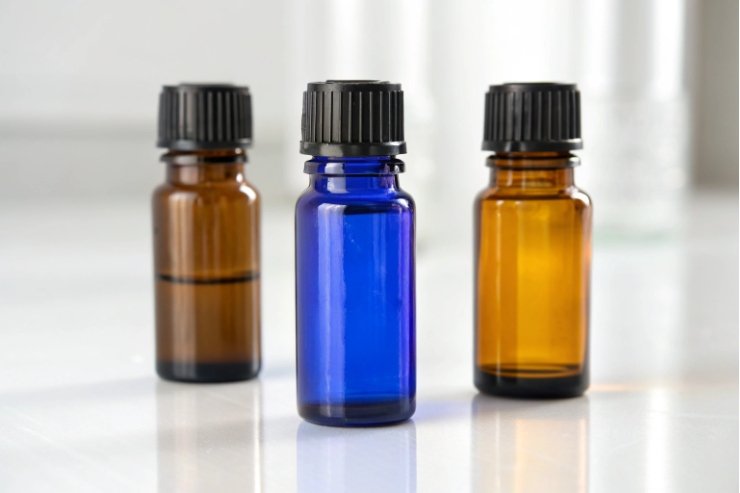
You can spend months on sourcing “therapeutic grade” oils, then lose power and aroma just because the wrong bottle lets light attack your formula.
Amber glass is better for essential oils because it blocks most UV and blue light, slows photo-oxidation, pairs with proven DIN-18 closures, and supports recyclable, apothecary-style branding customers already trust.
When you see amber glass as part of the formulation, not just “packaging,” your stability, complaints, and sustainability claims all improve at the same time. Let us unpack UV protection, oxidation, closure choices, and brand impact step by step.
Does amber glass block more UV than cobalt or flint for terpene stability?
Clear or pretty cobalt bottles look great on Instagram. Under shelf light and sunlight, they slowly cook your terpenes.
Amber glass filters most UV and short-wavelength visible light, so it protects terpene-rich oils much better than flint and usually better than standard cobalt, without going completely opaque.
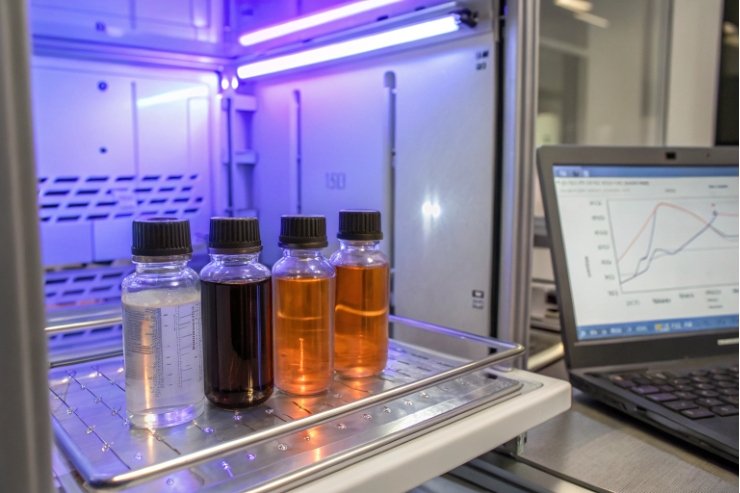
How different glass colors really behave with light
For essential oils, the “enemy” light sits mainly in:
- UV-A and UV-B 1
- Short-wave blue and violet visible light
These wavelengths trigger free-radical reactions in citrus, conifer, and many floral oils.
Roughly, you can think of typical protection like this:
| Glass color | UV blocking | Blue light blocking | Visibility of fill level | Typical use |
|---|---|---|---|---|
| Flint (clear) | Very low | Very low | Excellent | Display, very stable products |
| Cobalt / blue | Moderate for UV | Some blue; still passes | Good | Cosmetics, some lifestyle blends |
| Green | Moderate | Moderate | Good | Wine, some oils |
| Amber | High (most UV) | High for short-wave blue | Good (dark but visible) | Essential oils, pharma, beer |
| Black / violet UV glass* | Very high | Very high | Low/none | High-end niche, very sensitive |
*Specialty UV/violet glass is engineered; it often performs like or better than amber, but with extra cost.
Amber sits in a sweet spot:
- It filters most UV and a large part of blue light.
- It still lets you see the oil, the color, and the fill level.
- It is widely available in all the classic essential-oil sizes (5–100 ml).
Compared with cobalt or clear:
- Terpenes in amber face less light stress during storage and shipping.
- Color changes and clouding are slower and less dramatic, especially for citrus and pine oils.
So by default, if the oil has a meaningful terpene load and you do not have a very strong reason for a clear bottle, amber becomes the standard choice.
How does amber glass reduce photo-oxidation and extend essential oil shelf life?
Most “mystery” quality problems in essential oils are not bad distillation. They are slow oxidation helped by light, oxygen, and heat.
Amber glass cuts the light part of that equation, so oils form fewer radicals and oxidation products, keeping top notes, color, and perceived “strength” stable for longer.
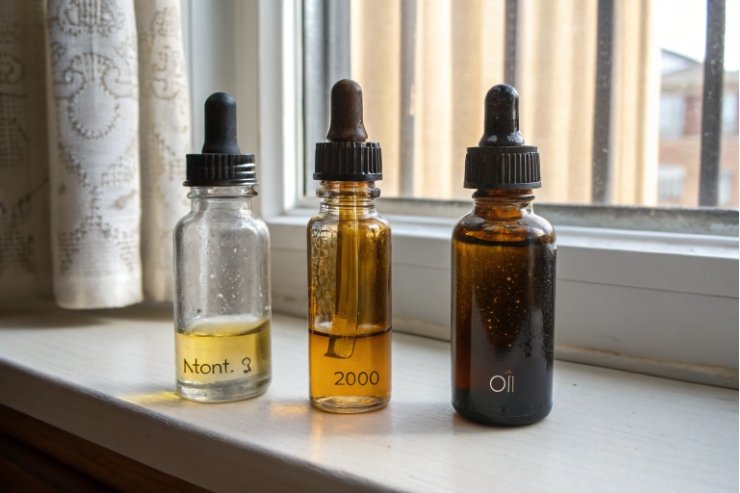
What actually happens when oils sit in the light
Essential oils are loaded with light-sensitive molecules:
- Monoterpenes (limonene, pinene, etc.)
- Some sesquiterpenes and oxygenated compounds
- Natural color bodies like carotenoids
When strong light hits them, especially UV and blue:
- Molecules absorb energy and move to an excited state.
- They form free radicals and reactive oxygen species.
- These radicals attack other molecules, breaking them or rearranging them.
This is the start of photo-oxidation 2 in essential oils.
Results:
- Citrus oils shift from bright and juicy to dull, “pithy” or solvent-like.
- Conifer oils lose their sharp pine note and smell flat or resinous.
- Color can darken or turn orange / brown.
Oxidized terpenes 3 can also increase the risk of sensitization on skin, which is a quiet safety and claims problem.
How amber glass slows that chain reaction
Amber glass works by simply not letting most of the problem wavelengths in.
When light intensity at the oil surface drops:
- Fewer molecules get excited at any time.
- Fewer radicals start the chain reactions.
- Oxygen still matters, but light is no longer “pushing” the process as hard.
So oxidation becomes dominated by:
- Headspace oxygen
- Oxygen introduced at each opening
- Storage temperature
This is good news. Headspace and opening frequency are things you can control with fill level, reducers, and consumer guidance.
In practice, brands see:
- Slower loss of “sparkle” in citrus and top-note blends.
- Less visible discoloration in clear or pale oils.
- Fewer “smells off” complaints from older batches.
Amber glass does not stop oxidation completely, but it takes one major accelerator off the table.
Shelf life and formulation freedom
With amber as a default, you often need:
- Less antioxidant designed purely to fight light.
- Fewer restrictions on where retail can place the product (not only in dark cabinets).
- More freedom to use light-sensitive naturals without ultra-short shelf lives.
You still need proper storage (cool, away from direct sun) and good closures. But amber buys you breathing room and a more forgiving stability profile.
What closures—DIN-18 orifice reducers or droppers—pair best with amber bottles?
Glass color protects the oil from light. Closures protect it from oxygen, leaks, and dosing mistakes.
DIN-18 amber bottles with well-matched orifice reducers, euro droppers, or pipette droppers give the best balance of light protection, sealing, and precise dosing for most essential oil formats.
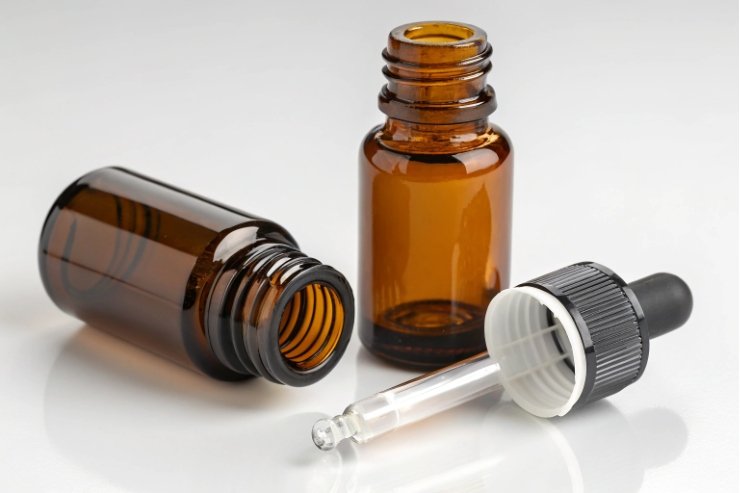
DIN-18: the quiet standard behind most EO bottles
DIN-18 comes from the DIN standards ecosystem managed by DIN (Deutsches Institut für Normung) 4. It is the workhorse neck finish for small amber bottles in 5–100 ml:
- Standard thread form many cap and reducer suppliers understand
- Good sealing area for both regular and child-resistant caps
- Strong, repeatable neck that survives multiple openings
Because it is so common, DIN-18 gives you:
- A wide choice of caps (standard, CRC, tamper-evident)
- Many orifice reducer and euro-dropper designs
- Easier sourcing from multiple suppliers as you scale
Orifice reducers and euro-droppers
Reducers and euro-droppers sit inside the DIN-18 neck and control how many drops the user gets per tilt.
Good pairing looks like this:
- Reducer hole size matches oil viscosity (thin citrus vs thick resins)
- Drop rate feels controlled, not frustratingly slow
- The piece grips the neck firmly and survives multiple openings
Hidden cost shows up when reducers are not matched:
- Too fast → overdosing, wasted product, complaints
- Too slow → users remove the insert, then bottles leak and oxidize
Amber bottles do not change this physics, but because the bottle is standard, you can combine stability data (light) with usability data (drop rate) and lock the best insert per SKU.
Pipette droppers and special caps
Pipette droppers are popular for skincare blends and “treatment” style oils.
Advantages:
- Very precise dosing by full or half pipette
- Strong “apothecary” feel when combined with amber
Watchpoints:
- Glass pipettes can break in transit; you need good interior packaging
- Some oils can migrate into bulbs and springs if materials are not selected well
For safety and regulatory needs, amber DIN-18 bottles also work with child-resistant (CR) and tamper-evident (TE) features 5.
For safety and regulatory needs, amber DIN-18 bottles also work with:
- Child-resistant caps (push-down-and-turn)
- Tamper-evident rings or shrink bands
These features add cost but protect brand trust, especially when oils are sold for home use around children.
Matching closure choice to product and channel
| Product type | Best closure style | Notes |
|---|---|---|
| Pure EO, aromatherapy | DIN-18 + orifice reducer + TE cap | Good control, low leak risk |
| EO blends for massage | DIN-18 + euro-dropper or pipette | Higher dose per application |
| Kids / home use | DIN-18 + reducer + child-resistant cap | Extra safety and regulatory support |
| Premium skincare serums | Amber pipette dropper | Strong apothecary + luxury signal |
In all cases, combine closure choice with proper torque control. Even the best amber bottle cannot save a poorly tightened cap from micro-leaks and evaporation.
Does amber packaging improve sustainability and apothecary brand cues?
Many essential oil brands sit at the crossroads of wellness, “natural,” and premium. Glass color can help tell that story, but it must also work in recycling systems.
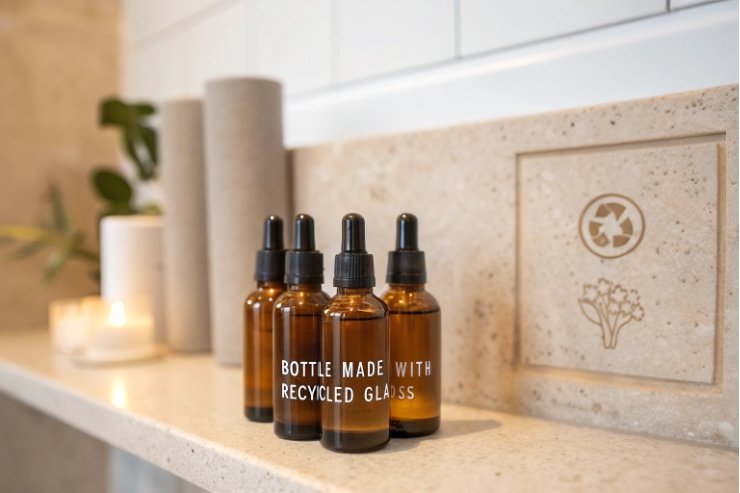
Amber glass supports mainstream recycling streams, works in refill and reuse models, and carries strong apothecary and “natural care” signals that customers already associate with trust and quality.
Sustainability: circular and practical
From a sustainability angle, amber offers a few key advantages:
- It is standard soda-lime glass 6, widely accepted in glass recycling.
- It is often made with a meaningful share of cullet (recycled glass) 7.
- It can run in refill or refill-at-home systems when the design allows.
Compared with specialty black or violet glass:
- Amber is usually more cost-effective.
- It does not confuse sorting systems as much as some opaque colors.
- It still offers strong protection without extra sleeves or boxes.
This means you can:
- Make honest “recyclable” claims without exotic waste streams.
- Add PCR targets at the glassmaker level to reduce footprint.
- Keep packaging specs simple for global logistics.
Visual codes: apothecary, natural, and trustworthy
On the shelf, amber glass speaks a clear visual language:
- It references pharmacies, laboratories, and herbalists.
- It feels serious, medicinal, and focused on function, not fashion.
- It fits both feminine and masculine lines without strong gender coding.
Combined with:
- Simple white or cream labels
- Serif or clean sans-serif typography
- Natural tones (green, beige, kraft cartons)
the result is a strong apothecary-meets-wellness look that matches essential oils very well. Customers often read amber as “pure, protected, natural,” even before they read any claims.
Balancing story, protection, and recycling
Amber helps you align three stories:
- Product safety: It clearly protects from light.
- Planet care: It recycles in normal glass streams and can include cullet.
- Brand story: It supports therapeutic, botanical, and heritage narratives.
If you need a more fashion-driven look (for example, pastel mists or body sprays), you can still keep amber for concentrates and use clear or tinted flint for diluted products. That way, the most valuable, sensitive oils get the most protection and the strongest apothecary cue.
Conclusion
Amber glass is better for essential oils because it blocks the right light, slows oxidation, works with proven DIN-18 closures, and supports recyclable, apothecary branding that protects both your product and your positioning.
Footnotes
-
Learn which UV bands matter most for degradation and why reducing UV exposure protects sensitive products. ↩ ↩
-
Understand the mechanism of photo-oxidation so you can connect light control to shelf-life stability. ↩ ↩
-
See evidence on how oxidized fragrance terpenes can contribute to skin sensitization risk. ↩ ↩
-
Reference the DIN standards body behind many packaging norms and technical specifications. ↩ ↩
-
Review U.S. guidance on child-resistant packaging expectations and when CR features may be required. ↩ ↩
-
Learn what soda-lime glass is and why it’s the common base material for recyclable container glass. ↩ ↩
-
Understand cullet basics and why recycled glass feedstock supports circular packaging claims. ↩ ↩






