
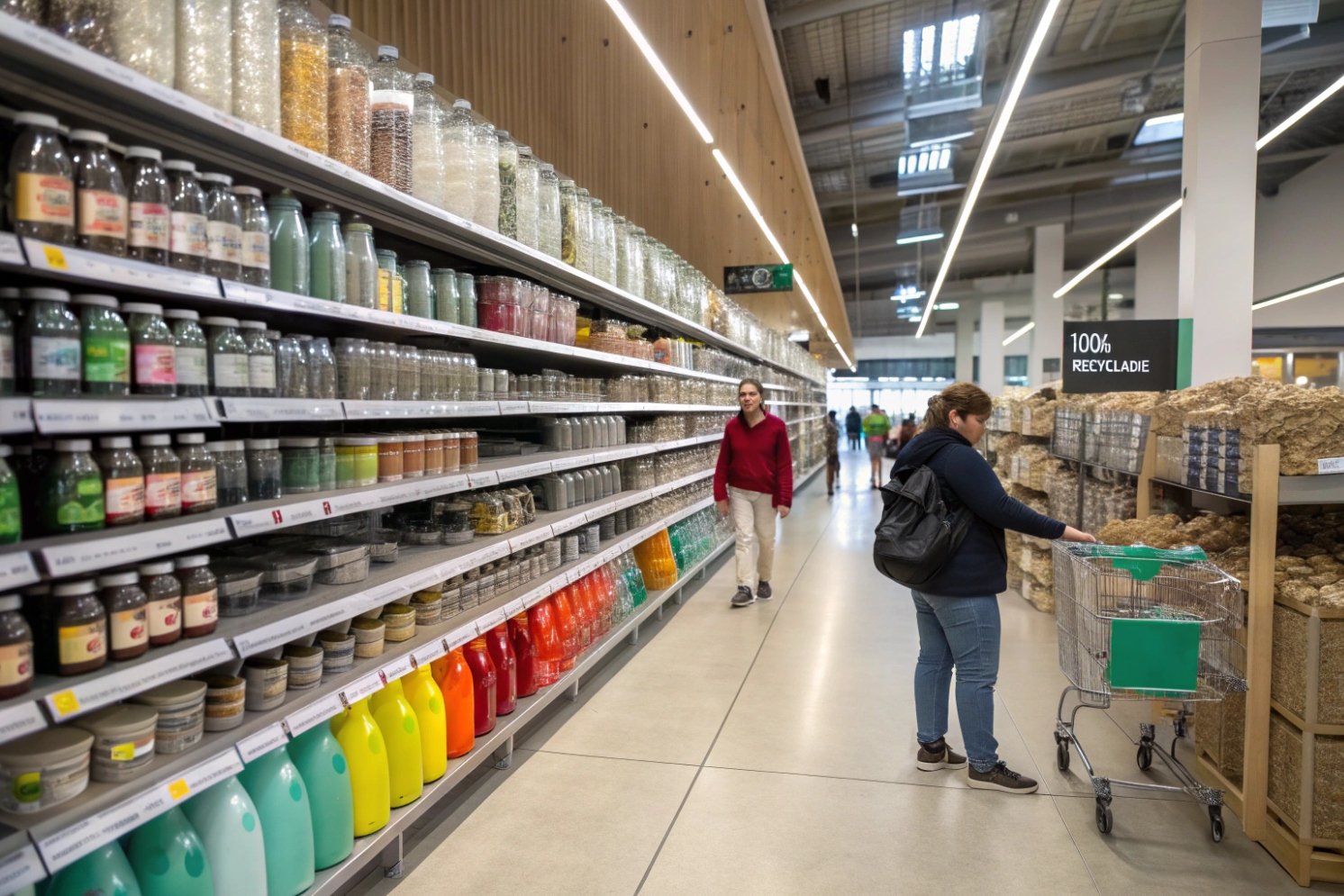
Consumers are tired of throwaway packaging and mixed messages. Retailers feel the same pressure from shoppers and regulators, but still need packaging that sells.
Sustainable borosilicate glass fits today’s trends because it is infinitely recyclable, durable enough for refill models, non-toxic and transparent, while still delivering premium shelf impact and credible, auditable sustainability claims.
When we design borosilicate glass bottles with retailers, they rarely start with technical specs. They start with three questions: Will shoppers see this as greener? Will it survive a refill or reuse system? And can we prove any of that under audit? The good news is that borosilicate glass lines up well with all three.
Which eco claims about borosilicate glass really matter to retailers?
Retail buyers now scan a spec sheet the same way consumers scan a QR code. They look for simple, defensible sustainability messages that fit their category and policy targets.
The eco claims that matter most to retailers are clear recyclability, real durability for reuse, non-toxic product contact, and alignment with EPR and deposit-return systems, all backed by data rather than vague “eco-friendly” language.
Recyclability as the headline claim
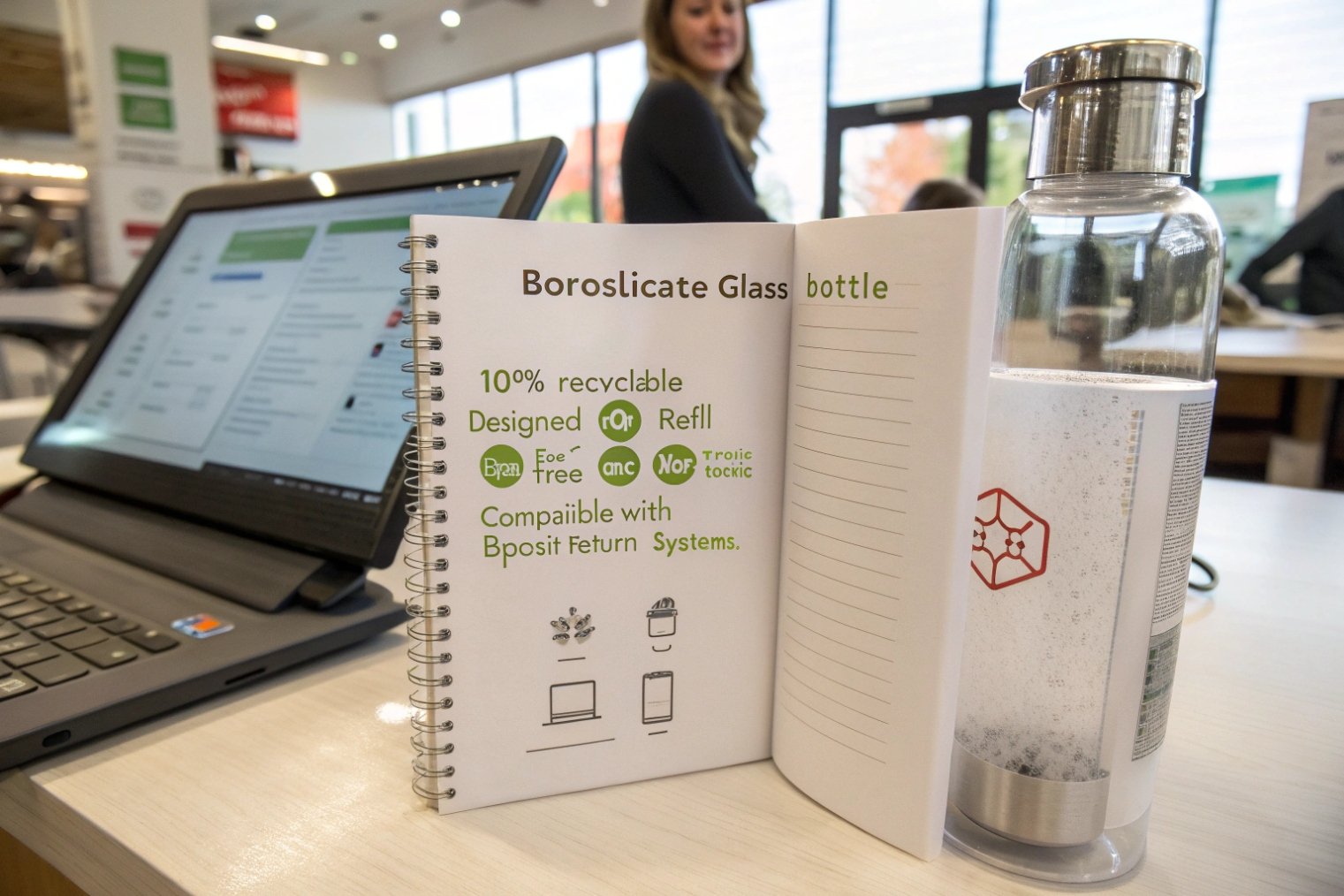
Recent global surveys show that recyclability is the top packaging sustainability attribute for consumers across many markets.:contentReference[oaicite:0]{index=0} This supports a very simple claim on shelf: “100% recyclable glass bottle,” often combined with a How2Recycle-style recyclability label 1 in North America or local symbols in Europe.:contentReference[oaicite:3]{index=3}
With borosilicate glass, we keep the same story, but add a performance layer: even after many heat cycles, the material can go back into the glass stream as cullet. This aligns well with policy shifts like extended producer responsibility (EPR) 2 and upcoming deposit-return schemes 3, which are pushing brands to favor materials that can stay in a closed loop.:contentReference[oaicite:4]{index=4}
Durability, reusability, and “buy fewer, buy better”
Shoppers are moving from “just recyclable” to “reusable and long-lasting.” European surveys show reusability now sits alongside recyclability as a top sustainability preference.:contentReference[oaicite:5]{index=5}
Borosilicate glass has a low coefficient of thermal expansion 4, which gives it strong resistance to thermal shock and repeated hot/cold cycles.:contentReference[oaicite:6]{index=6} That means bottles and jars can:
- Handle boiling-water sterilization
- Move from fridge to hot fill
- Survive many wash cycles in refill or return systems
For retailers, this supports “refill at home” or “return to store” programs without constant breakage or shape distortion. Refill and reuse are highlighted as key growth areas in recent sustainable packaging trend reports, especially for beverages, home care, and personal care.:contentReference[oaicite:7]{index=7}
In simple words, durability lets us say, “This package is made to be used again and again, not just recycled once.” That matches the “buy better, buy fewer” mindset many premium consumers now follow.
Health, safety, and non-toxic product contact
Another big trend is “clean inside and out.” Consumers want clean ingredients and clean packaging.
Non-porous borosilicate glass is chemically inert, BPA-free, and does not leach substances into food or drink, even with hot or acidic products.:contentReference[oaicite:8]{index=8} This supports:
- “No micro-plastic, no BPA in contact with your product” messaging
- “Flavor-neutral” and “odor-neutral” claims, important for tea, coffee, spirits, skincare, and aromatherapy
In 2025, a French study linked higher microplastic counts in beverages in glass bottles to the paints and liners on metal caps, not the glass itself.:contentReference[oaicite:9]{index=9} So when we design borosilicate packaging, we now pair the glass body with low-shedding or plastic-free closures and make that part of the sustainability story.
Aligning with policy and retailer scorecards
Retailers now benchmark suppliers against internal scorecards and public goals. They want packaging that:
- Scores well under EPR fee modulation
- Fits coming deposit-return schemes where they exist
- Keeps claims in line with what regulators call “recyclable”
Deposit-return schemes in the UK and Wales, for example, are designed to sharply increase container collection and move closer to real circularity, with Wales explicitly including glass.:contentReference[oaicite:10]{index=10} When we show a buyer that our borosilicate packaging is compatible with their current recycling systems and future DRS rules, it removes friction in their internal review.
A simple way to frame it in meetings is:
| Retailer priority | What they want to see on paper | How borosilicate glass helps |
|---|---|---|
| Recyclability | Clear “widely recyclable” status, standard labels | Infinitely recyclable glass body in most curbside systems |
| Reuse potential | Compatible with refill or return system | High durability and thermal shock resistance |
| Health and safety | Non-toxic, no harmful migration | Chemically inert, BPA-free, flavor-neutral glass |
| Policy and EPR fit | Low eco-modulated fees, DRS compatibility | Favored material in many EPR/DRS frameworks |
| Simple consumer message | One or two strong, honest eco claims | “100% recyclable glass” plus “made to refill” where relevant |
How do lightweighting and recycled content actually reduce carbon footprint?
When buyers ask for a lower carbon footprint, they usually expect more than “glass is recyclable.” They want to see specific levers and numbers.
Lightweighting cuts CO₂ by using less glass and lowering transport emissions, while higher recycled content (cullet) reduces furnace energy use and raw material emissions, so both levers give measurable, reportable carbon reductions.
Where emissions sit in a glass bottle’s life
For glass packaging, most emissions come from melting raw materials in energy-intensive furnaces, plus fuel used in transport. Melting alone can account for around three-quarters of production energy.:contentReference[oaicite:11]{index=11}
So when we talk about “low-carbon glass,” we focus on:
- How much glass we melt per bottle (weight and design)
- What mix of virgin raw materials vs cullet we melt
- What energy powers the furnace (fuel mix, electrification)
- How much weight we ship per unit of product
Borosilicate has a different composition from soda-lime glass, but the same basic logic applies. Less mass and more cullet mean less energy and less CO₂ per unit.
Lightweighting: less material, less energy, less transport
Lightweight glass packaging is growing because it cuts both transport cost and environmental impact without sacrificing strength.:contentReference[oaicite:12]{index=12}
From a carbon point of view, lightweighting helps in three ways:
- Less mass to melt: Every gram we remove is one gram we do not have to melt, so furnace energy and process emissions drop.
- Less transport weight: Pallets carry the same number of units but with lower total mass, so upstream and downstream logistics emissions come down.
- Less glass to recycle: At end of life, there is less material to re-melt, so the recycling loop also becomes slightly less energy-intensive.
We design borosilicate bottles with careful control of wall thickness, shoulder geometry, and base structure to keep strength where it is needed and trim glass where it is not. That is key for categories like RTD drinks or functional beverages, where brands want the “feel” of glass without the old heavyweight penalty.
Recycled content: cullet as a decarbonization lever
The second big lever is recycled content. Glass recycling is a classic closed-loop system: bottles become new bottles again and again.:contentReference[oaicite:13]{index=13}
Several studies and industry groups give similar numbers: every 10% increase in cullet can cut melting energy by roughly 2–3% and CO₂ by around 5%.:contentReference[oaicite:14]{index=14} At high cullet rates, total lifecycle emissions can drop by 30–40% compared with virgin-only production.:contentReference[oaicite:15]{index=15}
For borosilicate, the cullet stream is more specialized, but the principle is the same:
- High-quality, color-sorted cullet reduces furnace temperature and fuel use
- Less limestone and soda ash means fewer process emissions from raw material decomposition
- Local cullet sourcing reduces transport emissions from long-distance raw materials
When we speak to retailers, we turn this into a simple claim they can reuse: “Bottle contains XX% post-consumer recycled glass, which helps cut CO₂ vs virgin glass.” Where LCAs exist, we can put a percentage reduction against a baseline.
Here is how we usually frame the decarbonization levers for a buyer:
| Lever | What we change in the bottle | Typical impact story |
|---|---|---|
| Lightweighting | Reduce average glass weight per unit | Fewer emissions from melting and transport per product |
| Recycled content (cullet) | Increase % of recycled glass in the melt | Lower furnace energy and process CO₂ |
| Energy mix | Move toward electric furnaces, batch pre-heating, etc. | Supports company-level net-zero roadmaps |
| Design for reuse | Make bottles strong enough for multiple cycles | Fewer new bottles needed per year of product sold |
Retailers do not need every technical detail. They need a simple line for the consumer and good enough data for their own ESG report.
Sustainability alone rarely justifies higher shelf prices. Buyers want packaging that feels worth paying more for, visually and physically.
Premium borosilicate glass justifies higher price points through extreme clarity, clean minimalist shapes, precise detailing, and a reassuring hand-feel that signal “quality” and “clean ingredients,” all layered on top of strong sustainability cues.

Clarity and “show-the-product” minimalism
Consumers link glass clarity with purity and product quality. Surveys show many shoppers see glass as a premium material that makes food and drinks taste better and feel more authentic.:contentReference[oaicite:16]{index=16}
High-quality borosilicate glass has:
- Very high transparency and color neutrality
- Good resistance to staining and clouding
- Smooth surfaces that keep labels crisp and sharp
Brands use this to support “clean label” and “short ingredient list” messaging. The bottle becomes a transparent frame. Tea and specialty beverage companies highlight how borosilicate glass lets consumers see infusion color and clarity, which amplifies the ritual of use.:contentReference[oaicite:17]{index=17}
For skincare, serums, and functional drinks, this clarity gives a visual proof point: “Nothing to hide.”
Shape, weight, and tactile experience
The second aesthetic layer is shape and touch. Premium packaging research shows that consumers read weight, detailing, and shape complexity as proxies for quality, especially in spirits, wine, and beauty.:contentReference[oaicite:18]{index=18}
With borosilicate, we can:
- Use refined, thin walls without feeling fragile, thanks to durability
- Design distinctive shoulders, bevels, or faceting that catch light
- Keep bases visually solid while still relatively light in real weight
That gives retailers a bottle that:
- Looks more “designed” than a standard commodity soda-lime bottle
- Stands out on shelf with little or no secondary packaging
- Still meets weight and transport targets because of lightweighting
For refill systems, a good tactile profile also matters. Consumers are more likely to keep and reuse a bottle that simply feels nice in the hand and on the counter.
Linking aesthetics, sustainability, and price
Market studies show that a significant share of consumers, especially Gen Z and millennials, are willing to pay more for products in sustainable packaging.:contentReference[oaicite:19]{index=19} Glass benefits twice: it is seen as both sustainable and premium.:contentReference[oaicite:20]{index=20}
So the most effective price-justification story blends these points:
- “You are paying for a bottle that you can keep, reuse, or refill”
- “The material is fully recyclable and made with recycled content”
- “The clarity and design match the quality of what is inside”
Retailers like this because it supports both margin and ESG narratives. They can move a product into a higher price tier while telling a credible story about reduced waste and better materials.
A simple way to think about the premium mix:
| Aesthetic feature | Consumer signal | Price justification story |
|---|---|---|
| High clarity, no tint | Purity, clean ingredients | “Clean inside and outside” |
| Distinctive shape / faceting | Design, uniqueness | “Designed object, not a commodity bottle” |
| Reassuring hand-feel | Quality, durability | “Built to last and refill” |
| Minimal print, direct on glass | Honesty, transparency | “No wasteful outer packaging needed” |
| Elegant closure (wood, metal, etc.) | Craftsmanship, attention to detail | “Premium touch, supported by low-impact choices” |
Which certifications and audits substantiate sustainability messaging for glass packaging?
Retailers now ask a harder question: “How do we know this is real?” They look for third-party proof that goes beyond marketing copy.
Retailers look for product-level certifications (like Cradle to Cradle, recycled-content claims), corporate sustainability ratings (like EcoVadis), ethical audits (like SMETA), and clear on-pack recyclability and QR-based data to substantiate sustainability messaging.
Material and product-level certifications
For glass packaging, relevant certifications and tools include:
- Cradle to Cradle Certified® 5 product scores, which evaluate material health, circularity, water, energy, and social performance.
- Recycled content verification (through independent bodies), which gives audited percentages of post-consumer recycled glass in each bottle.
- Environmental Product Declarations (EPDs) or LCAs, which show cradle-to-grave CO₂, often required by big retailers and brand owners.
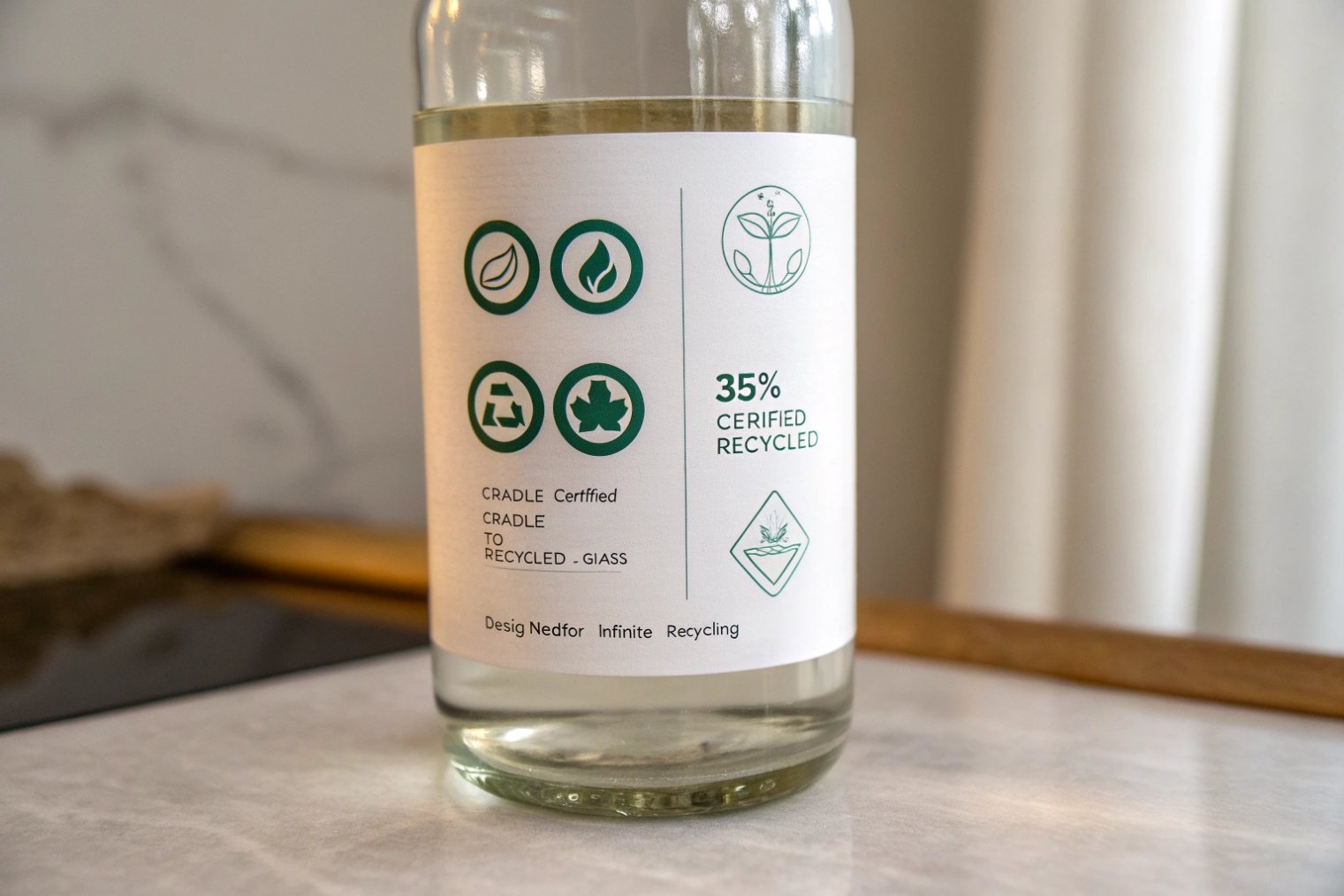
These allow us to state, for example, “This bottle contains 35% certified recycled glass and is part of a Cradle to Cradle Certified product system,” which is more robust than a generic “eco” logo.
Corporate and supply-chain ratings
Retailers also look at the supplier behind the bottle. Here, common tools are:
- EcoVadis sustainability ratings 6, which score companies on environment, labor and human rights, ethics, and sustainable procurement.
- SMETA (Sedex Members Ethical Trade Audit) 7, a widely used social audit covering labor, health and safety, environment, and ethics.
- ISO 9001 and ISO 14001 management systems, which many large customers still treat as basic hygiene for quality and environmental management.
For us as a borosilicate glass supplier, these ratings are not just badges. They make it easier for a retailer’s compliance and ESG teams to approve us without extra custom audits.
On-pack guidance, QR codes, and digital transparency
The last layer is what consumers see and scan.
- Programs like How2Recycle in the US give standardized recyclability labels and disposal guidance, now evolving to include real-time, localized instructions.
- Brands are adding QR codes and digital product passports that reveal verified data on material, recycled content, carbon footprint, and reuse/refill instructions.
This pairs perfectly with transparent borosilicate: consumers can both see the product and scan deeper information. For retailers, this reduces customer-service friction and supports their own digital-traceability requirements.
We usually map the “proof toolbox” like this for buyers:
| Type of proof | Examples | What it proves for the retailer |
|---|---|---|
| Product-level | Cradle to Cradle, EPD, LCA | Material health, circularity, carbon footprint |
| Recycled-content checks | Third-party recycled-content cert | Real recycled content, not just marketing claims |
| Corporate rating | EcoVadis score, CDP, etc. | Supplier’s overall ESG performance |
| Ethical/social audits | SMETA, other social audit schemes | Labor, health and safety, ethics in the supply chain |
| On-pack labels and QR | How2Recycle, DPP-style QR codes | Clear recyclability, usage and refill guidance for users |
Conclusion
Borosilicate glass lets us combine real circularity, durability, and health safety with premium aesthetics and credible proof, so retailers can trade up on design and still move closer to their sustainability targets.
Footnotes
-
Details what the label means and how brands should communicate disposal instructions consistently. ↩ ↩
-
Explains EPR principles retailers use to assess packaging responsibility and circularity alignment. ↩ ↩
-
Official overview of a deposit-return scheme and why glass can be included in scope. ↩ ↩
-
Datasheet evidence for low thermal expansion supporting wash, refill, and hot/cold cycle durability claims. ↩ ↩
-
Shows the certification standard behind multi-attribute circularity and material health claims. ↩ ↩
-
Explains how retailer-facing supplier ESG ratings are structured and used in procurement. ↩ ↩
-
Defines SMETA audit coverage for labor, safety, environment, and ethics across supply chains. ↩ ↩






