
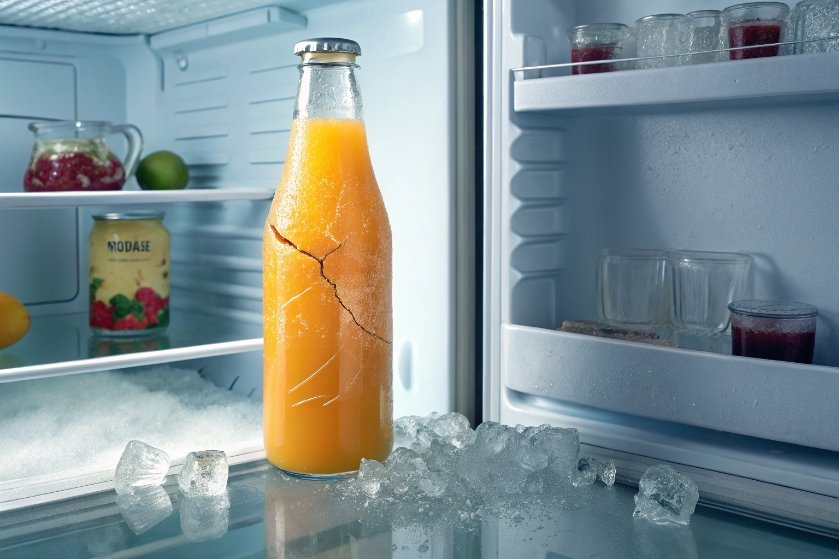
When a customer tells me “the whole freezer smells like fruit juice and glass,” I know exactly what happened: the bottle lost the battle against ice, pressure, and temperature.
Glass bottles crack during freezing because water-based liquids expand as they turn to ice, build up internal pressure, and combine with thermal stress in the glass until microscopic flaws grow into visible cracks.
In glass packaging, freezing is not a simple “cold vs hot” story. It is a slow mechanical fight between expanding ice, trapped liquid pockets, and a rigid glass shell that cannot stretch. When this pressure meets small defects in the glass, the result is a crack, a leak, or a complete shatter. The good news is that with the right bottle type, headspace, and freezing routine, the risk drops a lot.
What causes thermal stress and expansion when water turns to ice?
When a full bottle goes into the freezer, the liquid inside does not just “get hard.” It expands, moves, and wedges itself against the glass walls in all directions while the glass contracts.
Water expands about 9% as it freezes, so it presses on the glass from the inside. At the same time, rapid cooling creates temperature differences in the glass wall, which add extra tensile stress and trigger cracks at weak points.
How freezing water loads a glass bottle
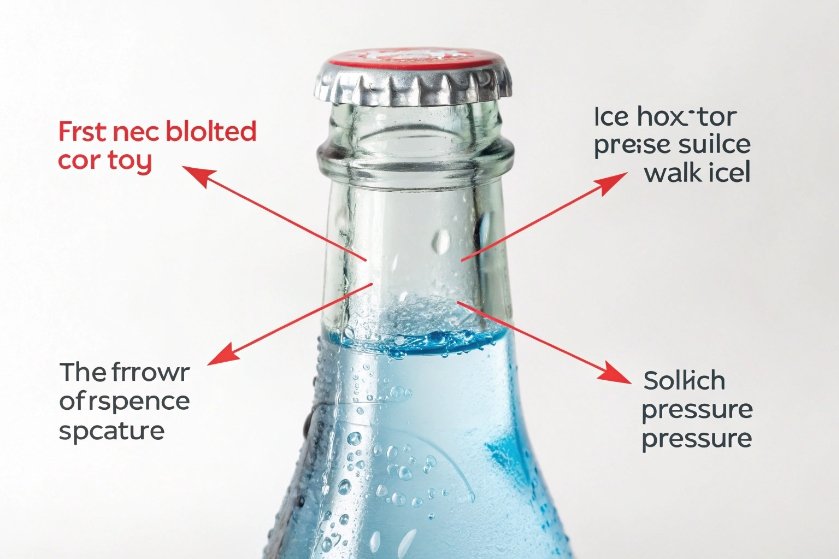
When water-based liquids freeze in glass, two processes happen at the same time: volume expansion and thermal shock 1. The liquid tries to grow; the glass wants to shrink.
1. Volume expansion and “ice wedge” formation
When water expands roughly 9% on freezing 2, in a flexible container, the walls stretch. In glass, they cannot. Ice does not form everywhere at once. It nucleates first near the coldest surfaces, often at the neck and shoulders. As ice grows, it forms an “ice plug” that blocks the neck and traps still-liquid pockets underneath.
These trapped liquid pockets sit between rigid ice and rigid glass. As freezing continues, the remaining liquid tries to expand but has nowhere to go. Pressure rises locally. This pressure pushes laterally on the side walls and vertically into the shoulder and finish. The shoulder area is often where the wall geometry changes, so stress concentrates there. That is why many freeze cracks start as a ring fracture around the shoulder.
2. Thermal gradients in the glass wall
Glass is a poor conductor of heat. When a warm bottle is put straight into a very cold freezer, the outer surface cools and contracts first. The inner surface near the liquid stays warmer and slightly larger. So one side tries to shrink while the other side resists. This difference creates a tensile stress regime on one side of the wall. Glass has low tensile strength. Small defects now carry high stress and can turn into cracks.
3. Lower fracture toughness at low temperatures
At lower temperatures, glass becomes slightly stiffer and less tolerant of flaws. Microcracks and scratches that were harmless at room temperature become active crack starters. Each freeze cycle pushes these flaws a bit deeper, so repeated freeze–thaw cycles act like fatigue, often accelerated by water-assisted crack growth in glass 3. A bottle that survives once may fail on the third or fifth cycle.
4. Key stress factors at a glance
| Factor | What happens during freezing | Effect on the bottle |
|---|---|---|
| Water expansion (~9%) | Ice pushes outward and upward | Internal pressure rises |
| Ice plug in neck/shoulder | Traps liquid pockets | Local stress concentration |
| Fast temperature drop | Cold outer wall, warm inner wall | Thermal tensile stress in glass |
| Low-temperature glass behavior | Slightly higher stiffness, lower toughness | Microcracks propagate more easily |
| Freeze–thaw cycles | Repeated stress on same flaws | Gradual damage and delayed breakage |
When these effects add together, the stress at a tiny flaw can easily exceed the strength of the glass, and the bottle fails.
Which glass types (soda-lime vs borosilicate) tolerate freezing better?
Not all glass behaves the same in the freezer. The chemical make-up of the glass controls how much it expands and how it reacts to sudden temperature changes.
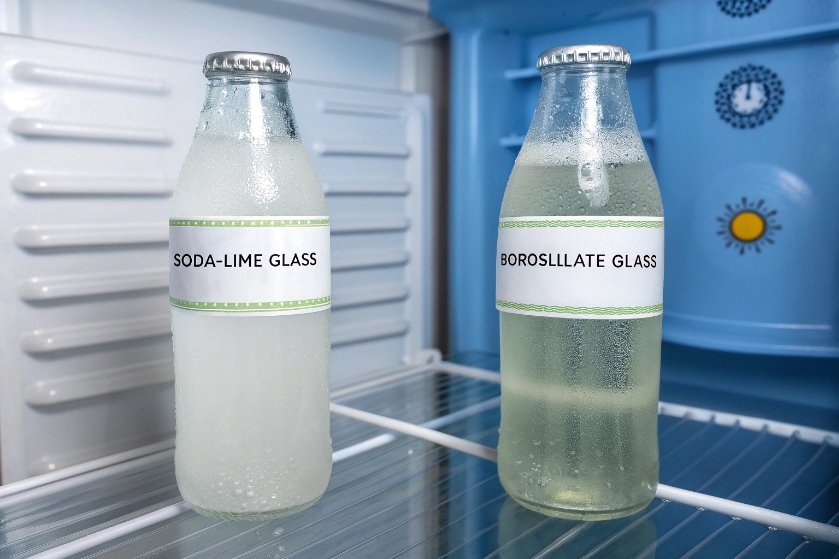
Borosilicate glass usually tolerates freezing and rapid temperature changes better than standard soda-lime glass, because its thermal expansion is lower and it handles thermal shock more gracefully. However, it is not immune to ice pressure if the bottle is overfilled.
Comparing soda-lime and borosilicate in real freezing conditions
In packaging, soda-lime glass 4 is the most common. Borosilicate glass 5 is used more in labware, high-end cookware, and some premium containers that need heat and cold resistance.
1. Thermal expansion and thermal shock resistance
The key property here is the coefficient of thermal expansion (CTE) 6. Soda-lime glass has a higher CTE. It expands and contracts more for the same temperature change. Borosilicate has a lower CTE, so it moves less.
When a hot or room-temperature bottle meets a very cold environment, soda-lime glass builds higher thermal stress for the same temperature gradient. Borosilicate can handle larger temperature jumps with less stress. This is why many lab beakers and oven-safe dishes use borosilicate.
2. Pressure from freezing liquid
However, the internal pressure from freezing water does not care much about CTE. The liquid expansion is the same. Both glass types are still brittle. If you fill a borosilicate bottle completely with water, seal it, and freeze it fast, it can also crack. The improved thermal shock resistance does not erase the pressure problem.
3. Defects, wall design, and surface damage
Real bottles are not perfect. There are seams, embossing, thickness changes, and surface scuffs from filling and transport. All of these act as stress concentrators. Soda-lime bottles for beverages often have thicker walls near the base and shoulder. Some borosilicate containers are thinner to save weight. So sometimes a thick, well-designed soda-lime bottle performs better than a very thin borosilicate container abused in use.
4. Practical comparison
| Property / Aspect | Soda-lime glass bottle | Borosilicate glass bottle |
|---|---|---|
| Typical use | Food, beverage, cosmetics, pharma | Labware, cookware, some premium bottles |
| Thermal expansion | Higher | Lower |
| Thermal shock resistance | Moderate | Better |
| Freeze pressure tolerance | Limited, depends on design | Also limited, still brittle |
| Cost | Lower | Higher |
| Best practice for freezing | Needs generous headspace, slow cycles | Still needs headspace and careful handling |
So borosilicate gives more safety margin against thermal shock, especially when cooling or heating is fast. For freezing applications, it is a good choice, but it still needs the same respect for liquid expansion and headspace.
How much headspace should I leave to prevent pressure buildup?
Many problems start with one simple habit: filling the bottle too high. A few extra millimeters of air above the liquid can mean the difference between a safe freeze and a cracked shoulder.
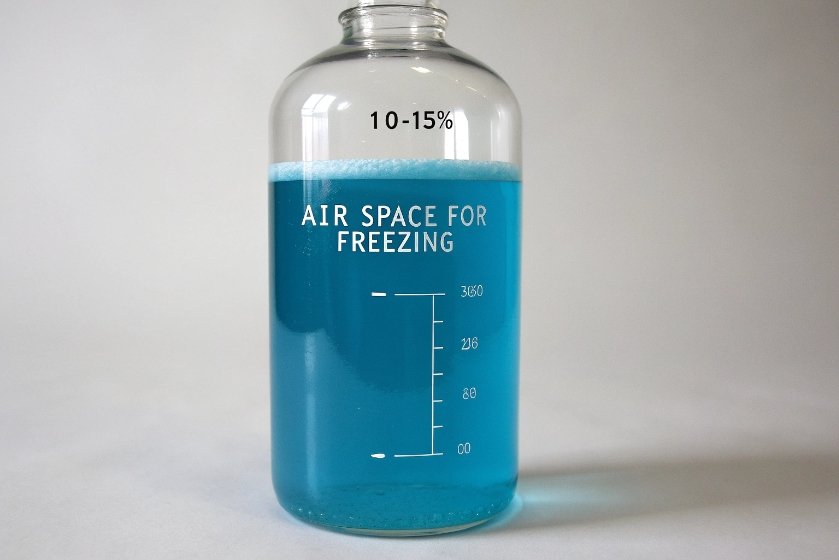
As a rule of thumb, leave at least 10–15% of the bottle volume as headspace when freezing water-based liquids in glass, and avoid tightening the closure fully until the liquid is frozen.
Why headspace is the cheapest insurance for freezing
Headspace gives the expanding liquid somewhere to go. Without this space, the pressure rises rapidly as ice forms and traps liquid.
1. Matching expansion with free volume
Water expands about 9% on freezing. If the bottle has less than this amount of free volume, the only way to “make room” is to stretch the container or raise pressure. Glass cannot stretch much, so pressure climbs. A compressible headspace, especially if it contains air rather than CO₂, lets the system absorb some of that expansion without reaching dangerous pressures.
2. Effect of closure type
A rigid, fully tightened closure turns the bottle into a closed pressure vessel. If the closure has a soft liner or a venting feature, the seal may lift slightly and relieve pressure. Many normal beverage closures are not designed for extreme freeze pressure. With a screw cap, leaving it slightly loose at first can reduce risk. Once the liquid is fully frozen, the closure can be tightened if needed.
3. Carbonated liquids are special
Carbonated drinks are more critical. As ice forms, CO₂ is rejected from the ice and concentrates in the remaining liquid and headspace. That increases gas pressure even more, consistent with Henry’s law 7. For highly carbonated products, freezing in glass is generally not recommended, even with headspace. The combined effect of ice expansion and CO₂ pressure makes breakage much more likely.
4. Simple guidelines for headspace
| Container Size | Recommended Headspace for Freezing | Notes |
|---|---|---|
| ≤ 250 ml | 15–20% of nominal volume | Small bottles heat and cool faster |
| 250–750 ml | 10–15% of nominal volume | Typical juice, sauce, and beverage bottles |
| ≥ 1 L | At least 15% if possible | Large volume means more total expansion energy |
| Carbonated | Avoid freezing in glass | Even with headspace, risk stays high |
These values are conservative and meant for water-based products. High sugar or alcohol content changes the freezing behavior, but the safer habit remains: do not freeze a full, sealed glass bottle.
What cooling and thawing practices reduce breakage risk?
Even with the right glass type and headspace, poor handling can undo everything. The way the bottle enters and leaves the freezer matters as much as what is inside it.
To reduce breakage, cool bottles gradually before freezing, avoid sudden temperature shocks, keep headspace generous, loosen closures while freezing, and thaw slowly in the refrigerator or at room temperature instead of hot water.
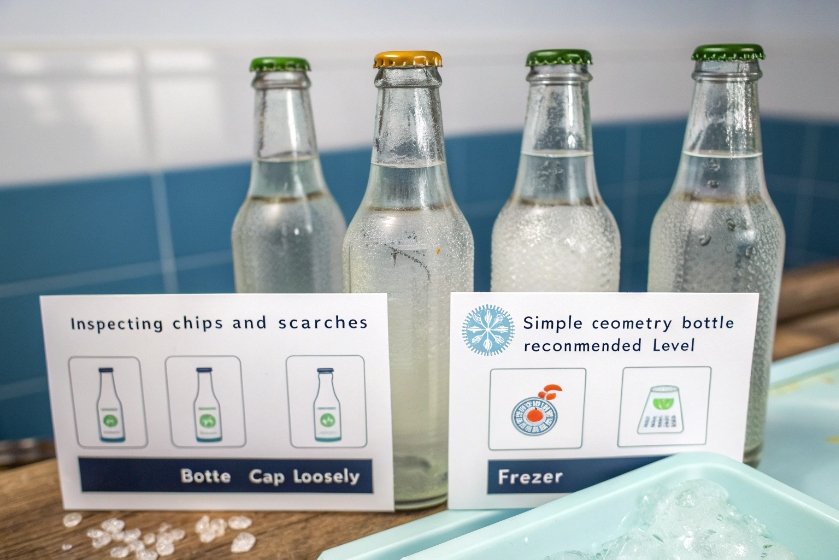
Building a freezer-safe routine for glass bottles
In production and in daily use, consistent habits protect both the glass and the product.
1. Before freezing: prepare the bottle
First, choose a bottle with a simple geometry and uniform wall thickness. Avoid bottles with sharp shoulders, heavy embossing, or deep cuts when you plan regular freezing. Check for chips, deep scratches, or scuff rings. These defects are classic crack starters under thermal stress.
Fill only to the recommended level, leaving the planned headspace. For water-rich liquids, stay on the generous side. If you use a screw cap, place it on loosely so it sits but does not fully compress the liner. This way, the closure can lift slightly if pressure rises.
2. Cooling down to freezing
If the liquid or bottle is warm, let it cool to refrigerator temperature first. Moving directly from hot filling to a deep freezer is the most dangerous scenario for thermal shock. A step from room temperature to the freezer is much safer, and a step from refrigerator to freezer is better again.
Try to avoid placing the bottle right next to the coldest spot or the freezer fan outlet. Very fast cooling creates steep temperature gradients in the glass wall and in the product, which amplifies both thermal stress and uneven ice formation.
3. During freezing: let the system move
While the liquid is freezing, do not handle or knock the bottle. Vibration can disturb the freezing front and increase local stress. For repeated freeze–thaw cycles, track how many cycles you apply to the same container. After several cycles, even a “strong” bottle may accumulate enough damage that it becomes a risk.
4. Thawing: avoid sudden heating
For thawing, place the frozen bottle in a refrigerator or at room temperature on a tray to catch any leakage. Do not run a frozen glass bottle under hot water or place it in a warm oven or microwave. The outer glass surface will expand fast while the inner side is still held by cold ice. This is a direct recipe for thermal shock and radial cracking.
5. Checklist of good practices
| Step | Good Practice | Risky Practice |
|---|---|---|
| Before freezing | Inspect glass, leave 10–15% headspace | Freezing a full, sealed, chipped bottle |
| Cooling | Cool in fridge first, then move to freezer | Hot fill directly into deep freezer |
| Closure | Cap loosely during freezing | Fully tighten a rigid closure |
| Freezer layout | Place away from strongest cold air stream | Put bottle against evaporator/fan outlet |
| Thawing | Thaw in fridge or at room temperature | Use hot water, stove, or microwave |
| Reuse / cycles | Limit freeze–thaw cycles on same bottle | Repeat cycles indefinitely |
When these simple rules become a habit, glass bottles survive freezing more often, and both safety and product quality improve.
Conclusion
Glass bottles crack in the freezer when expanding ice, trapped pressure, and thermal stress meet small flaws. With the right glass, headspace, and freezing routine, most breakage is avoidable.
Footnotes
-
Clear explanation of thermal shock and why rapid temperature shifts crack glass. ↩ ↩
-
USGS explains why ice is ~9% less dense than liquid water—driving expansion. ↩ ↩
-
NIST note on water-assisted crack growth that can weaken glass over time. ↩ ↩
-
Britannica summary of soda-lime glass composition and why it dominates bottles. ↩ ↩
-
Britannica overview of borosilicate glass and its thermal-shock advantages. ↩ ↩
-
Defines CTE and how expansion per degree creates stress during fast cooling. ↩ ↩
-
Henry’s law explains gas solubility behavior that affects CO₂ pressure during freezing. ↩ ↩






