
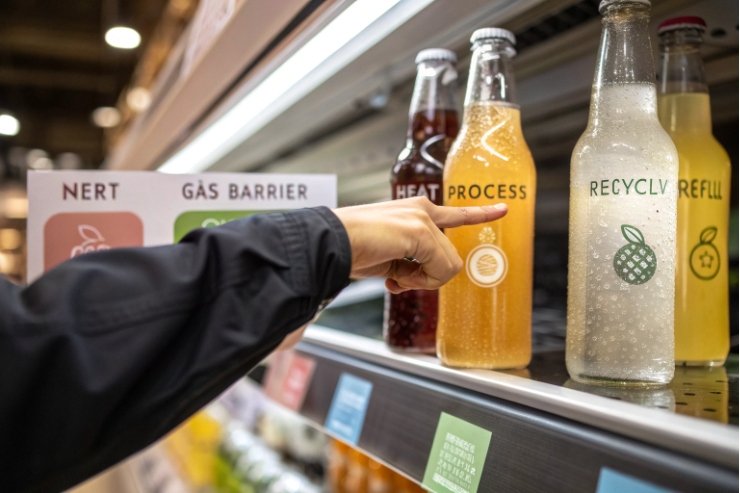
Beverage packaging is not just a container choice. It decides flavor, safety, shelf life, and how customers feel when they pick the bottle up.
Glass is chosen for beverages because it is chemically inert, blocks oxygen and CO₂ loss, survives heat and sterilization, supports refill and recycling loops, and creates a premium, trustworthy look that keeps flavor and aroma closer to what left the filling line.
Behind every glass bottle there is a chain of decisions about chemistry, processing, logistics, and brand story. Glass performs well in each area at the same time, which is why so many high-value drinks stay in glass even when lighter options exist. Now I will break this down into flavor and aroma purity, heat and sterilization, recyclability and refill, and the formats and closures that work across drink types.
Is glass’s chemical inertness really better for flavor and aroma purity?
When a drink tastes “off” months after filling, the first suspect is usually the recipe. In reality, the packaging often changed more than the formulation.
Glass offers superior flavor and aroma purity because it is inert, non-porous, and a strong barrier, so beverages avoid chemical migration, odor pickup, and carbonation loss over long storage.
How glass protects flavor at the surface
The inside surface of a package is where the real interaction happens. Glass has a big advantage here:
- It is chemically inert for almost all beverage pH levels.
- It does not need plasticizers or organic stabilizers.
- It has very low sorption, so it does not “steal” aroma molecules.
Glass is also nonporous and impermeable 1, so it does not absorb or release smells and it keeps flavor profiles cleaner over time. {#ref-1}
Acidic drinks, like sodas, kombucha, juice, and many alcoholic beverages, can slowly attack some plastics or linings. This may cause tiny migration of additives into the drink or changes in the contact layer—exactly the kind of risk regulators describe when discussing chemicals in food contact materials 2. Glass resists these effects very well. The result is a more stable flavor curve from day one to the end of shelf life. {#ref-2}
Glass is also non-porous. It does not absorb smells from the outside world. A pallet of glass bottles stored near strong spices or cleaning products will be fine. The same is not always true for some polymer materials over long periods.
For carbonated drinks, the story includes gas tightness. Glass gives an excellent barrier to CO₂ and oxygen. With a good closure, carbonation stays high and oxidation stays low. This matters a lot for beer, sparkling wine, RTD cocktails, and sodas that need to keep their “bite” for many months.
Glass vs plastic and cans at a glance
Each material has its own strengths. For flavor and aroma stability, glass often sits at the top:
| Property / Risk | Glass bottle | Plastic bottle (PET etc.) | Metal can (with lining) |
|---|---|---|---|
| Chemical migration | Very low | Low to moderate, process-dependent | Very low when lining is intact |
| Aroma scalping | Very low | Higher, can absorb volatiles | Very low |
| Oxygen barrier | Excellent | Good but not perfect | Excellent |
| CO₂ barrier | Excellent | Good, sensitive to wall thickness | Excellent |
| Odor pickup from outside | Very low | Possible over long storage | Very low |
If your portfolio includes PET, it helps to measure and manage oxygen permeation in PET bottles 3 so shelf-life targets match real barrier performance. {#ref-3}
Cans also protect well, but they rely on organic can coatings and linings 4 that must stay compatible with the beverage’s chemistry over time. Glass needs no such internal coating for most beverages. For brands that sell on “clean contact” and minimal packaging chemistry, that is a strong argument for glass. {#ref-4}
How do heat resistance and sterilization options expand beverage processing?
Many beverage lines need more than a simple cold fill. They run hot-fill, pasteurization, tunnel cooling, and sometimes retort. Package choice decides how flexible the process can be.
Glass opens more processing options because it tolerates hot-fill, pasteurization, and sterilization without warping, letting brands run shelf-stable juices, teas, and functional drinks while keeping closures tight and dimensions stable.
Heat, pressure, and glass stability
Glass can handle high temperatures as long as the design and thermal shock limits are respected. This gives you room for:
- Hot-fill for juices, teas, and isotonic drinks.
- Tunnel or flash pasteurization for beer and RTD products.
- Sterilization cycles for returnable bottle pools.
While plastics can handle some of these processes, they often deform, shrink, or panel if conditions are not perfect. Glass keeps its shape. Neck finish dimensions stay stable, so closures give reliable seals after heating and cooling.
Thermal shock is one point to watch. Glass bottles must be designed and produced to survive a set temperature difference (ΔT), which is commonly evaluated using the ASTM C149 thermal shock test method 5. With a suitable bottle spec and tested process, hot product and cold rinse water are no problem. {#ref-5}
Sterilization and refill loops
Returnable glass systems depend on strong washing and sterilization. Bottles travel many cycles through:
- Caustic wash baths to remove labels and residues.
- Hot rinses and sometimes disinfection steps.
- Mechanical handling inside washers.
Glass is well suited for this. It tolerates caustic and heat better than most plastics. It also resists swelling, softening, or stress cracking in common wash chemicals.
Here is a simple overview of process options:
| Process step | Glass bottles | PET / other plastics | Metal cans |
|---|---|---|---|
| Hot-fill | Very suitable | Limited by heat resistance | Not common (usually filled cold) |
| Tunnel pasteurization | Common for beer and RTD | Possible but more sensitive | Common for some products |
| Retort / high temp | Possible with correct design | Rare | More typical than glass |
| Caustic bottle washing | Very suitable for refill | Generally unsuitable | Not typical (cans are not refilled) |
Because of this flexibility, glass works well for many “challenging” products: low pH, high sugar, added botanicals, or live probiotics. It lets process engineers tune time, temperature, and pressure without worrying that the bottle will sag or pull away from the closure.
Are glass recyclability and refill cycles stronger than plastic or cans?
More buyers now ask not only “what is in this drink?” but also “what happens to the package after I use it?”. Here glass has some clear strengths.
Glass outperforms most plastics and cans in circularity because it is endlessly recyclable, keeps quality through many loops, and fits refill systems with caustic washing and multiple return cycles.
Recycling: how glass fits the loop
Glass is 100% recyclable and can be reused endlessly 6 with minimal loss in quality or purity, which makes it a strong material for long-term circular packaging claims. {#ref-6}
Recycled glass (cullet) can replace a large share of virgin raw materials. This saves energy and reduces CO₂ emissions from melting.
Colored glass also supports high cullet rates. Dark green and amber bottles can absorb more color variation in cullet streams. Flint (clear) glass needs more controlled cullet, but it still recycles very well.
Glass has another benefit. It is inert in the environment. It does not form microplastics. Although nobody wants litter of any kind, glass shards do not behave like plastic fragments in ecosystems.
Reuse and refill: when the same bottle lives many lives
In many markets, returnable glass systems are still strong for beer, soft drinks, and water. The same bottle may see 20, 30, or more trips. Glass supports this because:
- It resists repeated caustic washing.
- It survives many filling and handling cycles if the design is robust.
- It can be inspected and sorted automatically.
Systems like deposit refund schemes (DRS) 7 make reuse and high-return collection easy for consumers to understand and participate in. {#ref-7}
When a bottle finally leaves the refill pool due to wear or damage, it goes back into recycling. So the material stays in the loop longer.
Here is a simple comparison of end-of-life routes:
| Packaging type | Recyclability | Reuse / refill potential | Notes |
|---|---|---|---|
| Glass bottle | Very high, no quality loss | High, strong in deposit systems | Good fit for circular economy |
| PET bottle | High but with quality limits | Limited, washing and heat sensitive | Often downcycled over time |
| Aluminum can | Very high, strong markets | No refill, recycle only | Excellent recycling, single-use only |
Real performance still depends on collection and sorting systems. When those systems exist, glass can move through cycles of refill and recycle in a very stable way.
For brands that want to show real progress on circularity, not just lightweighting, it often makes sense to keep or move key SKUs into glass and optimize the bottle for both strength and weight.
Which glass formats and closures fit carbonated, alcoholic, and functional drinks?
Choosing glass is not the end of the story. The next step is to match bottle format and closure to the drink’s pressure, shelf life, and user experience.
For carbonated, alcoholic, and functional drinks, glass formats paired with suitable closures—crowns, ROPP screws, swing-tops, and lug caps—deliver strong seals, controlled opening, and the right pouring or drinking experience.
Matching drinks to bottle families
Different beverages ask for different glass features:
- Carbonated soft drinks and many beers need strong, pressure-rated bottles with good crown or closure support.
- Still wines and spirits need shapes that fit category cues and closures like corks, bar-tops, or ROPP.
- Functional drinks and cold-brew coffees may need wide mouths or ergonomic shapes for on-the-go use.
One smart way to design a portfolio is to use a small set of “families” that share neck finishes and base designs, while changing height, shoulder slope, or surface decoration for each product.
Closure options and their roles
Closures influence both freshness and consumer experience. Common combinations include:
| Beverage segment | Typical bottle format | Common closures | Key priorities |
|---|---|---|---|
| Beer and CSD | Pressure-rated longneck or stubby | Crown cap, sometimes ROPP | CO₂ retention, tamper evidence |
| Sparkling wine / cider | Heavy sparkling bottle | Cork + wire hood, sometimes crown | High pressure, celebratory opening |
| Still wine | Bordeaux / Burgundy / flute | Natural or technical cork, screw cap | Oxygen control, tradition vs ease |
| Spirits and liqueurs | Custom or standard spirits bottles | ROPP, bar-top cork, GPI screw | Premium look, reseal performance |
| Juices and functional | Round or square, often lighter | Lug cap, PP screw, sometimes crown | Hot-fill, reseal, convenience |
| Kombucha and fermented | Pressure-capable round bottle | Crown, swing-top, strong lug or ROPP | Variable pressure, safe venting |
For carbonated products, glass gives a strong base. With the right crown or ROPP, it holds pressure over long periods and tolerates pasteurization or warm logistics. For wines, the same inertness and barrier give winemakers more control over how much oxygen enters after bottling, through closure choice rather than bottle wall behavior.
From a branding angle, glass shapes and closures also send clear signals. A heavy flint spirits bottle with a natural bar-top cork feels very different from a slim green beer bottle with a crown. Both rely on glass, but they tell very different stories. With custom molds, embossing, and colored glass, the design space is large while keeping technical performance strong.
Conclusion
Glass gives beverages clean contact, heat and process flexibility, strong circular potential, and flexible formats and closures that support both product protection and brand storytelling across many drink categories.
Footnotes
-
Explains how glass’s nonporous, impermeable surface preserves taste and aroma with minimal interaction. ↩ ↩
-
Background on migration risks from packaging materials into food and beverages, and how safety is assessed. ↩ ↩
-
Practical explanation of oxygen ingress and CO₂ loss measurement in PET bottles for shelf-life planning. ↩ ↩
-
Overview of common metal can coating types and why lining choice matters for beverage compatibility. ↩ ↩
-
Defines a standard method to test glass containers against sudden temperature changes in hot-fill and pasteurization. ↩ ↩
-
Clarifies glass recyclability and why closed-loop reuse/recycling claims are credible when collection systems exist. ↩ ↩
-
Explains how deposit systems boost return rates and support refill/reuse loops for beverage containers. ↩ ↩






