
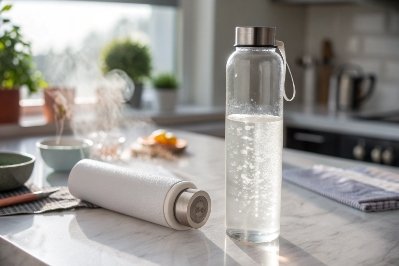
Plastic bottles can hold smells, warp with heat, and look tired fast. That creates doubts about cleanliness, even when the water is fine.
Borosilicate glass bottles are chosen because they handle hot-to-cold use better, stay clear and odor-free, clean easily, and support a premium, reusable story that customers trust.
What borosilicate changes in real daily use
Borosilicate glass 1 is not “just glass.” The material is engineered to expand less when temperatures change. That one behavior shapes most of the practical benefits: fewer cracks from temperature swings, better tolerance for repeated washing, and more stable performance with hot tea, cold water, citrus infusions, or electrolyte mixes.
In packaging work, borosilicate often becomes the “confidence material.” It feels clean. It looks clean. It also stays that way longer because the surface is smooth and non-porous and impermeable 2. That matters more than people admit. When a bottle stays crystal clear after months of dishwashing, the product feels premium without extra marketing. Customers do the advertising every time they carry it.
Still, the best choice depends on the use case. A borosilicate bottle with a weak lid can leak like any other bottle. A thin borosilicate bottle without a sleeve can chip if it hits tile. So the material should be treated as one part of a system: glass + sleeve + closure + user behavior.
Where borosilicate fits best
- Hot-to-cold routines: tea in the morning, ice water later
- Infused drinks: lemon, herbs, electrolytes
- Customers who hate plastic smell and taste carryover
- Premium gifting and lifestyle brands that need a “clean” look
Where standard soda-lime glass can still be fine
- Room-temperature water only
- Low drop risk, mostly desk use
- Lower price tiers where the brand prefers thicker, heavier walls instead of material upgrades
| Decision factor | Borosilicate glass | Soda-lime glass 3 | What it means for your brand |
|---|---|---|---|
| Thermal shock tolerance | Higher | Lower | safer for hot/cold switching |
| Required wall thickness for strength | Often lower | Often higher | can reduce weight for carry |
| Long-term clarity | Very stable | stable but can show wear sooner | cleaner look over time |
| Cost | Higher | Lower | supports premium pricing |
| Best pairing | silicone sleeve + quality gasket | thicker walls + protective sleeve | reduces break and leak risk |
A borosilicate bottle is usually picked when the brand wants a durable daily product that still looks premium after months of use. The next sections answer the common questions that decide whether it is the right upgrade.
If the goal is a bottle that keeps looking “new” longer, borosilicate often pays back faster than expected.
Does low CTE improve thermal-shock resistance for hot/cold use?
Hot water and cold glass do not get along. Many bottles fail during small moments, not extreme ones. A user pours warm tea into a bottle that was just rinsed in cold water. The bottle looks fine, then a crack appears later.
Yes. Low thermal expansion helps borosilicate resist thermal shock, so it is more forgiving when users switch between hot and cold drinks in normal life.
Why low CTE matters in simple terms
CTE means coefficient of thermal expansion 4. A low CTE means the glass expands and contracts less when temperature changes. When glass expands unevenly, stress builds. If stress exceeds the strength of the glass, a crack forms. Borosilicate reduces that expansion, so the stress is lower for the same temperature swing.
This matters most at the areas that heat unevenly:
- the base, where liquid pools first
- the shoulder, where thickness changes
- the neck, where hot liquid meets cooler air
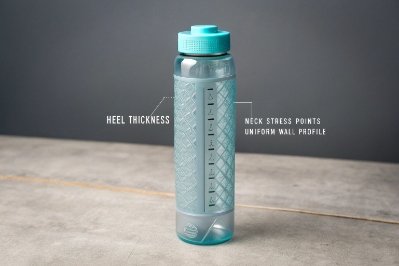
Thermal shock 5 is also affected by design. A smooth wall thickness, soft radii, and a stable base reduce stress points. A sudden thickness jump can create a “stress hinge.” That is why many premium bottles avoid sharp corners and sudden steps in the glass.
What brands should communicate to avoid misuse
Even borosilicate is not indestructible. It tolerates temperature changes better, but it should not be treated like a metal thermos. For example, taking a bottle from a freezer and adding boiling water is still risky. The best consumer guidance stays simple:
- avoid extreme temperature jumps
- warm or cool the bottle with a quick rinse first
- use sleeves to reduce cold-to-hot shock at contact points
A practical positioning angle
Low CTE supports a real lifestyle claim: “hot and cold safe for everyday routines.” That is stronger than vague “premium glass” language. It also reduces returns. Many breakage complaints happen from heat shock, not from drops.
| Scenario | Soda-lime risk | Borosilicate risk | Brand-safe guidance |
|---|---|---|---|
| Warm tea after room-temp rinse | Medium | Low | ok for most users |
| Ice water after warm wash | Medium | Low | let bottle cool briefly |
| Boiling water into very cold bottle | High | Medium | avoid extreme jumps |
| Dishwasher hot cycle | Medium | Low | confirm lid compatibility too |
Low CTE is not a marketing detail. It is a daily-use feature that reduces accidental failures and supports the “hot/cold” promise with less customer frustration.
Are borosilicate bottles lighter yet durable vs soda-lime?
A bottle can feel premium and still be annoying to carry. Weight is a quiet deal breaker, especially for commuters and gym users. Many brands try to solve this by using thinner soda-lime glass, then breakage rises.
Often, yes. Borosilicate can achieve good durability at thinner walls than soda-lime, so bottles can feel lighter while staying strong, especially when paired with a sleeve.
Weight is not only glass weight
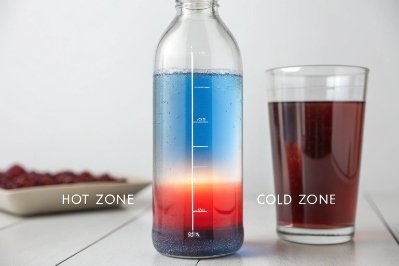
Total carry weight includes:
- glass weight
- lid weight (stainless caps can add more than expected)
- sleeve weight
- water weight, which is always the heaviest part
Still, empty-bottle weight influences first impression. A bottle that feels too heavy can read as “quality,” but it can also read as “inconvenient.” The goal is balanced weight, not maximum weight.
Where borosilicate helps durability
Borosilicate’s strength advantage is often felt in two places:
- resistance to small surface damage from repeated washing and handling
- resistance to crack propagation under typical temperature stresses
Drop impact is different. Any glass can break when it hits tile. That is why sleeves matter. A sleeve spreads impact, reduces scuffs, and improves grip when hands are wet. For many brands, the sleeve is not an accessory. It is part of the product safety plan.
Design choices that make “light yet durable” real
- Use a slightly thicker base, but keep walls balanced
- Avoid sharp corners and thin edges at the rim
- Use a protective sleeve with a stable bottom ring
- Design the cap so it does not create side-load on the neck when twisted
A brand positioning note that works
Customers often associate heavy glass with spirits bottles and luxury packaging. Water bottles are different. In water, “premium” can mean clean, safe, and durable, not heavy. A lighter borosilicate bottle supports that modern premium idea.
| Design variable | If optimized well | If optimized poorly | What to specify |
|---|---|---|---|
| Wall thickness | lighter carry | chips and breakage | thickness window + QC checks |
| Base design | stable and safer | stress point at heel | smooth radii and even distribution |
| Sleeve coverage | fewer drop breaks | false sense of safety | full-height sleeve for active users |
| Cap torque | easy open/close | neck stress and leaks | torque target + gasket compression |
Borosilicate supports a “carry every day” product without forcing a thick, heavy build. The durability story becomes much stronger when the bottle is designed as a system with a sleeve and a reliable gasket.
Do dishwashing and stain resistance improve longevity?
A reusable bottle fails in a boring way. It starts to look cloudy. It holds a faint smell. It becomes the bottle that stays in the cabinet.
Yes. Borosilicate’s smooth, non-porous surface helps it resist stains and odor retention, and it generally tolerates repeated dishwashing better, so the bottle stays clear and “clean-looking” longer.
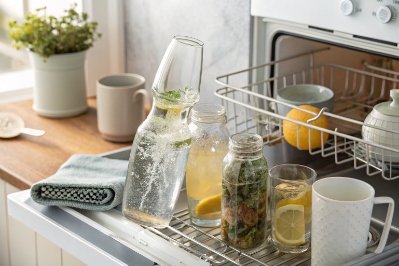
Many customers judge hygiene by appearance. A bottle that stays clear signals trust. A bottle that shows haze or stains looks risky even when it is safe. Borosilicate helps here because it does not absorb flavors and it resists many common stains from:
- tea and coffee
- citrus and herbs
- flavored powders and electrolytes
The main stains that still appear are usually from hard water mineral deposits 6, not from the drink. That is not a glass failure. It is a cleaning mismatch. A simple vinegar rinse removes mineral haze in most cases.
Dishwasher reality: the glass is not the only part
The weak link is often:
- silicone gasket swelling or tearing
- bamboo lids absorbing moisture and cracking
- printed coatings or decals fading
- metal caps corroding if low-grade
So a dishwasher-safe claim should cover the whole product, not only the glass—especially if you rely on a dishwasher sanitization standard like NSF/ANSI 184 7. Many premium brands solve this by offering:
- removable silicone seals
- stainless steel caps with food-safe liners
- optional bamboo caps for hand-wash customers
Cleaning habits that extend life
- rinse after sweet drinks
- remove gasket weekly for a deeper clean
- air dry with lid off to prevent trapped moisture odor
- use a soft brush to avoid scratches on decorative prints
What this means for brand economics
Longevity reduces replacement purchases, but it increases trust and referral. For premium positioning, that trade is good. Customers pay more upfront when the product stays beautiful and easy to clean.
| Issue users complain about | How borosilicate helps | What still needs design attention | Simple care guidance |
|---|---|---|---|
| Odor retention | low absorption | gasket and lid materials | dry fully, store open |
| Stains | resists many stains | mineral scale from hard water | vinegar rinse when hazy |
| Clouding | stays clear | abrasive cleaners and scratches | avoid harsh scouring pads |
| Mold smell | glass resists | trapped moisture under seals | remove gasket, air dry |
Dishwashing and stain resistance are not small perks. They decide whether a bottle becomes a long-term daily habit or a short-term experiment.
Higher material cost is real. Buyers will ask why the bottle is priced above basic glass or plastic. The answer cannot be vague. It must connect to daily benefits and brand value.
Often, yes. The higher cost can be offset by longer usable life, fewer replacements, stronger gifting appeal, and a credible premium story built around purity, durability, and reuse.
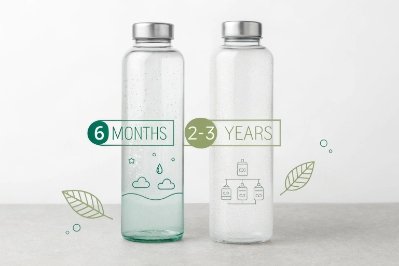
Cost is not only the material price
A borosilicate bottle can cost more to produce, but the brand also gains pricing power because the product signals:
- better hot/cold safety
- cleaner taste experience
- longer life with dishwashing
- better appearance retention
Those points are easy for customers to understand. They feel them quickly. That makes premium pricing more defensible than abstract claims.
Where reuse creates real value
Reuse offsets cost in two ways:
1) The buyer replaces fewer bottles over time.
2) The product becomes part of identity and routine, which increases brand attachment.
For many lifestyle brands, that attachment is the real margin driver. A bottle that becomes a daily carry item creates organic marketing. It is photographed. It is seen in offices and gyms. That is exposure without ad spend.
Premium positioning that does not rely on “luxury weight”
Some brands try to look premium with heavy glass alone. That works in spirits, but in water bottles it can backfire. Borosilicate lets the brand claim premium through:
- performance (thermal shock resistance)
- cleanliness (no odor transfer)
- durability (stays clear)
- sustainability story (reuse)
A simple profitability lens for brands
If a borosilicate bottle reduces returns from cracks and improves reviews because it stays clear, the premium can pay for itself quickly. The key is to avoid false promises. Premium claims should be backed by:
- closure leak testing
- dishwasher validation for lids and gaskets
- drop testing with the final sleeve
- clear consumer care instructions
| Value lever | How borosilicate supports it | What to do to capture it | What to avoid |
|---|---|---|---|
| Higher price point | performance and clarity | show benefits on packaging | vague “premium glass” only |
| Lower returns | thermal shock tolerance | include safe-use guidance | extreme hot/cold claims |
| Better reviews | stays clean and odor-free | design easy-clean lid and gasket | hard-to-clean caps |
| Gift appeal | clean, modern look | add sleeve and premium cap options | cheap-looking closure |
| Sustainability story | long reuse cycle | offer spare gaskets | pushing “eco” without durability |
A borosilicate bottle earns its price when it is built as a complete system and marketed with simple, true benefits. The premium story becomes credible because the user experiences it every day.
Conclusion
Borosilicate bottles win when hot/cold safety, long-term clarity, and easy cleaning matter. With a strong sleeve and gasket, the higher cost turns into durable premium value.
Footnotes
-
Definition and key properties of borosilicate glass, including heat and chemical resistance. ↩ ↩
-
Why glass is nonporous and acts as a strong barrier against odor and contamination. ↩ ↩
-
Background on soda-lime glass, the common lower-cost glass used in many bottles. ↩ ↩
-
Explains CTE and why low expansion reduces stress during temperature swings. ↩ ↩
-
Explains thermal shock and how rapid temperature gradients crack brittle materials like glass. ↩ ↩
-
Quick guide to water hardness and mineral scale that can cause haze on glass. ↩ ↩
-
What dishwasher sanitizing means in NSF/ANSI 184 and why heat/time matter for hygiene claims. ↩ ↩






