
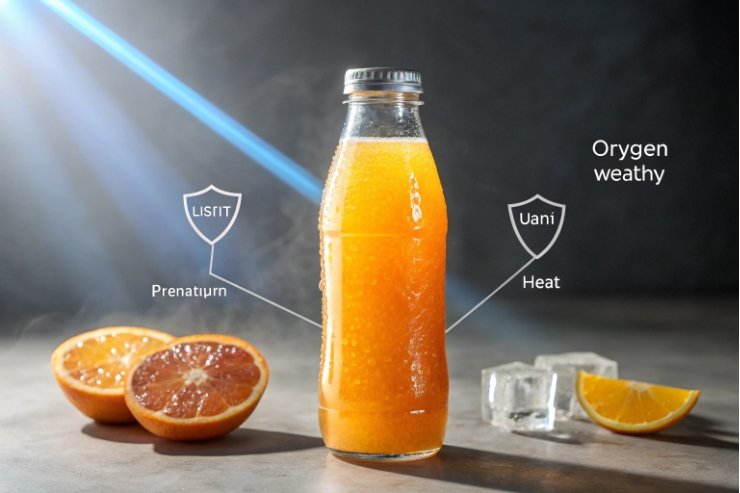
Juice is fragile. Light, oxygen, and heat slowly destroy color, vitamins, and aroma, and the wrong bottle can speed that up every day it sits on a shelf.
Glass bottles are preferred for juice because they are chemically inert, block oxygen and odor transfer better than most plastics, survive hot-fill and pasteurization without deforming, and support a clear, premium look while keeping vitamins, flavor, and color stable longer.
When juice goes into glass, the recipe, process, and packaging start to work together. The acid and aroma stay inside. Oxygen, smells, and heat damage stay outside as much as possible. Next, I break this down into barrier performance, heat treatment and ΔT, branding, and closure choice, so each decision becomes clear and practical.
Does glass reduce oxygen ingress and aroma scalping vs plastics?
Oxygen and aroma loss are silent problems. They do not make noise on the line, but they slowly flatten juice into something dull and brown.
Glass reduces oxygen ingress and aroma scalping because it is non-porous and inert, with almost zero gas permeability and very low sorption, while typical PET or HDPE always allow some oxygen in and some aroma out over time.
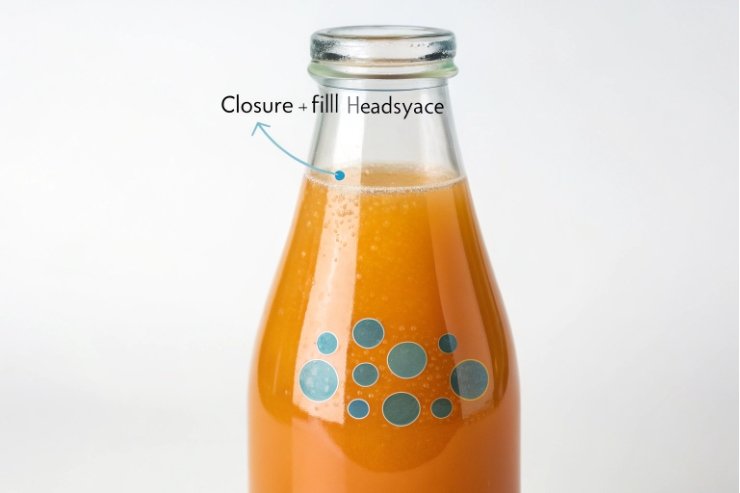
Oxygen ingress: glass vs PET and other options
Oxygen is the main driver of vitamin C loss and browning in juice. Even a small trickle of oxygen into the headspace feeds oxidation every day. Glass has a big advantage here:
- The glass wall itself is essentially an oxygen block.
- Any oxygen that enters the bottle usually comes from the headspace at fill or through the closure.
- So once you manage filling conditions and cap quality, the package becomes very stable.
Plastics work differently:
- PET and HDPE have finite oxygen transmission rates (OTR) 1.
- Barrier grades and multi-layers can reduce this, but not to zero.
- Thinner walls and higher temperatures increase oxygen ingress.
A simple way to view it conceptually:
| Package type | Wall oxygen barrier | Main oxygen risk sources |
|---|---|---|
| Glass bottle | Excellent | Headspace, closure, poor vacuum |
| Standard PET | Moderate | Wall permeation + closure + headspace |
| Barrier PET / multilayer | Better | Improved wall, but not like glass |
| Cartons (foil layer) | Good to excellent | Joints, seals, and closures |
With glass, you mostly tune closure and filling. With plastic, you must also watch wall thickness, resin choice, and age.
Aroma scalping and odor pickup
Many juices rely on delicate top notes: citrus peel, tropical esters, fresh apple, or herbs. If the package wall absorbs some of these compounds, the juice loses impact even when chemistry is still safe.
Glass is almost ideal here:
- Very low absorption of small aroma molecules.
- Very low interaction with acids and natural oils.
- No plasticizers or flavor-active additives in direct contact.
Plastics can absorb or “scalp” aroma over time (often called flavor scalping 2), especially at higher storage temperatures. They can also pick up smells from outside, for example from pallets, films, or nearby products. That matters when juice travels far or sits long.
What this means for vitamin C and color
Vitamin C is one of the fastest-changing nutrients in juice, and its loss correlates with the oxygen-barrier properties of the package 3. Oxygen and light both attack it. Glass helps by:
- Limiting oxygen ingress to the closure and fill headspace.
- Allowing the use of amber or green glass to cut harmful light.
As vitamin C oxidizes, color also shifts. Clear apple juice turns darker. Orange juice loses its bright tone. When you slow oxygen and protect from light, you keep both nutrition and appearance closer to “just filled” for much longer.
How do hot-fill, flash-pasteurization, and ΔT tolerance support juice shelf life?
Many juices cannot rely on cold chain alone. They need heat to make them safe and stable. The bottle must survive that heat and the cooling that follows.
Glass bottles support hot-fill and flash-pasteurization because they tolerate high temperatures and controlled thermal shock, allowing proper pasteurization, strong vacuum seals, and long shelf life without warping or paneling.
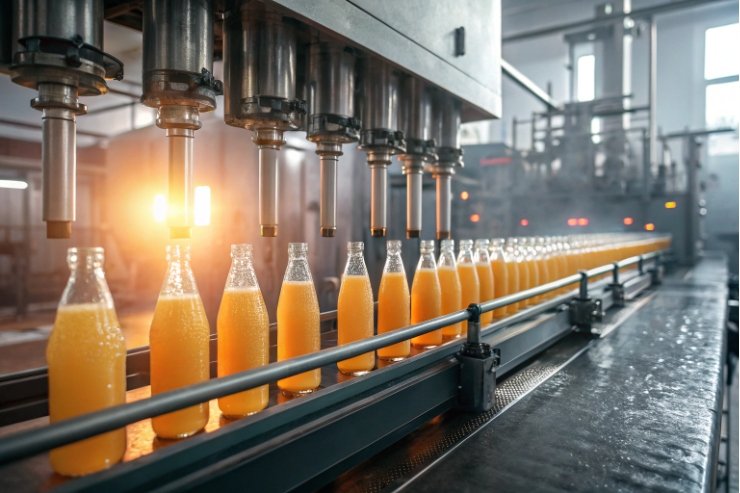
Why many juices need heat treatment
Juices carry natural sugar, acids, and sometimes pulp. Microorganisms love this mix. To keep shelf-stable juice safe at room temperature, producers often use:
- The hot fill process 4 at high temperature, then immediate capping and inversion.
- Flash pasteurization followed by filling into a clean, warm bottle.
- Tunnel pasteurization after bottling.
These steps kill spoilage organisms and many enzymes that would otherwise break down flavor and color.
For these methods to work, the container must:
- Stay dimensionally stable during heating.
- Hold a good seal as it cools and develops internal vacuum.
- Resist thermal stress between hot product and cooler environment.
Glass under thermal stress (ΔT)
ΔT is the temperature difference the glass sees between inside and outside during thermal shock events in glass containers 5. If this jump is too fast or too large, the glass surface can crack.
Good juice bottles are designed with ΔT limits in mind:
- Smooth transitions at heel and shoulder to spread stress.
- Adequate wall thickness in critical zones.
- Proper annealing during production to relieve internal stress.
In practice, glass handles typical hot-fill and pasteurization schedules very well when the process is matched to the bottle spec. Plastics often need special grades or panel designs to avoid collapse or warping after hot-fill.
How this supports shelf life
When the bottle survives the heat cycle comfortably, you get several benefits:
- Full pasteurization without having to compromise temperature or time.
- Stable vacuum on cooling, which improves oxygen barrier at the closure.
- No permanent deformation, so cap torque and seal geometry remain correct.
This tight seal and low oxygen entry slow down vitamin C loss, color change, and flavor fade. Glass also has higher thermal mass than thin plastic, so it buffers short temperature spikes in distribution. This does not replace proper storage, but it helps smooth out small abuses that happen in real life.
Shelf life is not only a lab measure. It is also about how fresh the juice looks and feels to a shopper standing in front of a crowded fridge or ambient shelf.
Transparent glass often boosts perceived freshness and value because it shows real color and pulp, feels solid in the hand, and signals “natural” and “premium,” especially when combined with clean labels and minimal decoration.
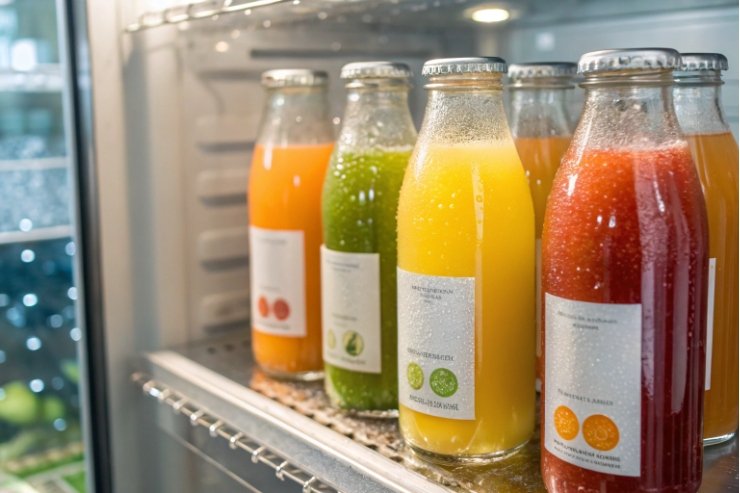
Freshness cues that shoppers read
Consumers cannot see microbiological safety, but they can read many small visual signals:
- Bright, stable color without browning.
- Visible pulp or natural particles.
- No floating flakes or haze in clear juices.
- Clean shoulders and base, no heavy sediment.
Glass makes these cues easy to see. Clear flint glass, in particular, lets the product do the talking. This supports higher price points for cold-pressed juices, NFC (not-from-concentrate) products, and short-run craft batches.
The weight and feel of glass also matter:
- It feels cooler and more solid than a thin plastic bottle.
- The sound of glass on glass or on the counter reinforces a “real product” image.
These subtle details help brands justify a premium over carton or PET, especially in channels where shoppers trade up.
Balancing visibility with light protection
The downside of clear glass is light exposure. UV and blue light damage natural colors and vitamin C. To manage this, you can combine clear or light-tinted glass with:
- Full or partial sleeves that block UV while leaving windows.
- Large labels that shade key areas.
- Secondary packaging like closed cartons or display boxes.
Colored glass gives more built-in protection—especially with amber glass for UV protection 6:
| Glass type | Visibility of juice | Light protection | Typical use case |
|---|---|---|---|
| Flint (clear) | Maximum | Low | Chilled premium juice, fast turnover |
| Light green | High | Medium | Ambient juices, some branding needs |
| Amber / brown | Lower | High | Sensitive or long-life juice products |
For chilled, fast-moving juices, clear glass plus good cold-chain control is often enough. For ambient or long distribution routes, amber or at least light tinting makes more sense.
Premium stories that glass enables
Glass also supports a full design story:
- Embossed logos on the shoulder or base.
- Custom shapes that echo fruit or origin.
- Heavy bases for “slow, indulgent” juice blends.
These features are hard or expensive in other materials. In glass, they become natural tools. They help buyers link what they see in the bottle with ideas like “freshly squeezed,” “cold pressed,” or “single orchard,” even before they read a word on the label.
Which caps and liners prevent leakage and vitamin C loss?
A perfect bottle does not work without a good closure. Many oxygen and leakage problems start at the neck finish, not in the glass wall.
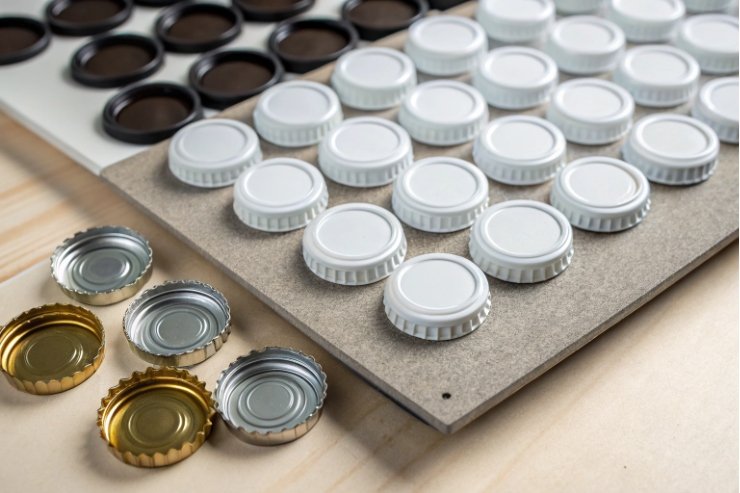
For juice in glass, metal lug or ROPP caps with quality liners, or PP screw caps with barrier liners, give the best combination of tight vacuum seal, low oxygen ingress, and low leakage, especially after hot-fill or pasteurization.
Matching closures to process and product
Juice lines use a few main closure families:
- Metal lug caps on twist-off finishes.
- Continuous thread (CT) metal caps.
- ROPP aluminum screw caps 7 on threaded ring finishes.
- PP plastic screw caps on glass finishes.
For hot-fill, lug caps and ROPP are very common:
- Their metal shells deform slightly to match the glass thread and land.
- The liner softens under heat, then sets as the package cools.
- The cooling juice creates vacuum, pulling the cap down and improving seal.
For chilled, short shelf-life juices, PP screw caps with suitable liners can work well. They give easy opening and re-closing, with lower cost and flexible colors.
Liners and oxygen control
Liners are the real sealing surface. They also control oxygen ingress more than many people think. Common options include:
- Plastisol liners in lug and some CT caps.
- PVC-free alternatives for markets that restrict PVC.
- Foamed or solid PE liners in plastic closures.
- High-barrier or oxygen-scavenging liners for vitamin-sensitive products.
For vitamin C retention, you want:
- A liner that conforms well to the glass finish and covers small defects.
- Low oxygen transmission through the liner itself.
- Good performance after thermal cycles.
Some brands also combine:
- Low-oxygen filling systems.
- Headspace flushing with nitrogen.
- Slight vacuum finish or hot-fill vacuum to pull the closure tight.
Together, these steps cut the oxygen available to attack vitamin C, flavor, and color during storage.
Practical line tips to avoid leaks and microleaks
Even the best closure and liner fail if the line is not set up well. Three simple checks help a lot:
-
Torque control
- Use cappers with monitored torque, not just “tight enough by feel.”
- Avoid both under-tight (leaks and oxygen) and over-tight (liner damage, cap deformation).
-
Finish and thread inspection
- Check neck finishes for chips, checks, or heavy mold seams.
- Keep glass suppliers’ finish specs and sampling plans active.
-
Clean, dry finish at capping
- Juice or syrup on the sealing land? That becomes a leak path.
- Use air knives or drip control at filling and pre-capping.
When closure design, liner choice, and line control work together, most complaints about “mysterious” slow leaks and vitamin C drop vanish. The bottle stays tight, and the chemistry inside stays closer to what left the pasteurizer.
Conclusion
Glass juice bottles combine strong flavor and vitamin protection, flexible heat processing, and a clear premium look, as long as bottle design, closures, and packaging are tuned to the real process and route.
Footnotes
-
Definition of oxygen transmission rate (OTR) used to compare package oxygen barriers.
https://www.sciencedirect.com/topics/agricultural-and-biological-sciences/oxygen-transmission-rate↩︎ ↩ -
Packaging definition of flavor scalping and how volatile aromas are absorbed by materials.
https://en.wikipedia.org/wiki/Flavor_scalping↩︎ ↩ -
Tetra Pak reference on oxygen barriers in juice packaging and vitamin C-related browning.
https://orangebook.tetrapak.com/chapter/packaging-and-storage-orange-juice↩︎ ↩ -
Explains the hot fill process, temperatures, and when it’s used for acidic beverages.
https://www.oberk.com/packaging-crash-course/hot-fill-cold-fill-aseptic-fill↩︎ ↩ -
Research paper describing stress generation and ΔT considerations during thermal shock in glass containers.
https://www.americanglassresearch.com/sites/default/files/2023-04/gw80_nov-dec_2018_thermal_shock.pdf↩︎ ↩ -
Shows why amber glass blocks UV and helps slow light-driven quality losses.
https://www.containerandpackaging.com/resources/The-Science-Behind-Amber-Glass-and-UV-Protection↩︎ ↩ -
Explains Roll-On Pilfer Proof caps and how rolling threads creates a tight, tamper-evident seal.
https://www.packagingdigest.com/machinery/how-roll-on-pilfer-proof-cappers-work↩︎ ↩






