
When a product tastes “off” or smells weird, customers blame the brand. Packaging is often the hidden cause, and fixing it later costs more than getting it right upfront.
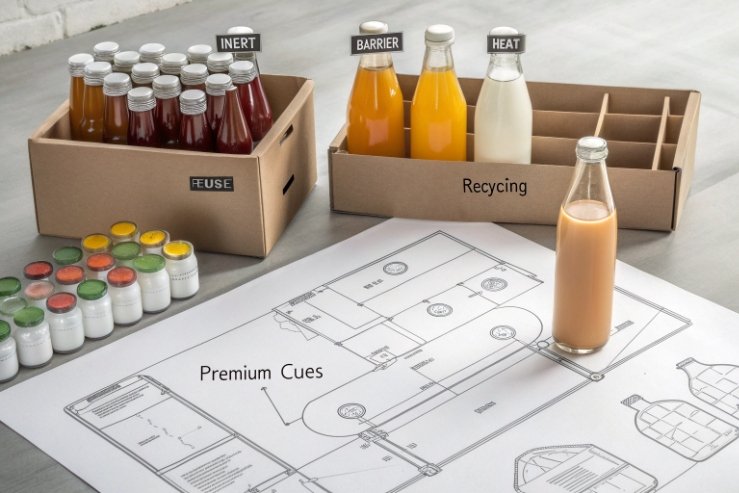
Glass stays the top choice because it is inert, nonporous, and a strong barrier for aroma and oxygen. It also supports heat processing, reuse, and premium brand cues, while offering credible recycling and PCR pathways when supply chains are managed well.
Most packaging decisions are trade-offs. Glass wins when the brand needs clean taste, stable scent, safe contact materials, and shelf presence that supports repeat purchase. The best results come when the bottle, closure, decoration, and logistics are designed as one system.
Is glass truly more inert with better flavor and odor protection?
A formula can be perfect in the lab, then change on shelf. That shift can ruin reviews, even if the ingredients never changed.
Glass is highly inert and nonporous, so it protects flavor and odor by blocking migration, taint, and aroma loss. In many products, this stability matters more than lightweight packaging convenience.
What “inert” means in real products
Glass is a stable silica network. It does not contain plasticizers, and it does not absorb oils and aromas the way many polymers can—this kind of aroma absorption (often called flavor scalping in packaging 1) can quietly change a product over time. That helps in three common situations:
- High-acid foods (vinegar sauces, pickles, tomato-based blends) where packaging contact must stay neutral.
- High-ethanol beverages (spirits, liqueurs) where alcohol can stress or extract compounds from some plastics.
- Fragrance-heavy cosmetics (essential oils, perfumes, actives) where small scent shifts are obvious.
That does not mean every non-glass package is unsafe. It means glass creates fewer unknowns. This is why it is often the “default safe” container for sensitive formulas and premium SKUs, especially when brands align to food-contact evaluation requirements 2.
Barrier performance that protects taste and scent
For many brands, the biggest win is that glass is a strong barrier to gases and vapors. It does not “breathe” like some plastics do. That helps reduce:
- aroma loss over time,
- oxygen-driven staling,
- and flavor cross-contamination from the outside environment.
If a customer wants the product to taste the same across long distribution routes, this barrier effect is a big reason to choose glass.
Where glass still needs help
Glass blocks gases well, but it does not block light unless color is added. That is why amber, green, or coated options exist. Also, the closure still matters. A perfect bottle with a weak liner will still leak aroma.
| Need | Why glass helps | Where the risk still lives | Practical fix |
|---|---|---|---|
| Clean taste | No odor absorption, low interaction | Closure liner and headspace | Match liner to product chemistry |
| Aroma retention | Strong barrier | Light exposure for sensitive products | Use amber/green or secondary pack |
| Formula stability | Neutral contact | Poor cleaning or contamination | Strong incoming inspection + hygiene |
Do heat-process options and reuse lower total cost of ownership?
A cheap container can become expensive after breakage, recalls, or short shelf life. Total cost is not only the unit price.
Glass supports hot-fill, pasteurization-style workflows, and repeated washing in many reuse models. When reuse loops are real and controlled, glass can lower total cost of ownership, even if freight weight is higher.
Heat tolerance in real production
Container glass can handle many food and beverage processes because it does not warp the way plastics can. Hot-fill, warm-fill, and pasteurization-like steps can work well when:
- temperature changes are controlled (avoid extreme thermal shock test methods for glass containers 3),
- the bottle design has stable thickness distribution,
- and the annealing quality is consistent.
For sauces, juices, coffee concentrates, and some ready-to-drink products, glass provides a stable container that stays dimensionally reliable through heat exposure.
Reuse and refill: where glass becomes a cost tool
Reuse is not just a sustainability story. It can be a cost strategy when the system is set up:
- returnable glass programs with deposits,
- in-store refill models,
- and foodservice loops where bottles are collected and washed.
In practice, brands often quantify this with a life cycle assessment of reusable glass bottle systems 4 to understand when reuse wins (and when it doesn’t). Glass resists staining and odor hold. It also handles detergents and hot wash cycles better than many plastics. Over multiple trips, the cost per fill can drop, even if the first bottle cost is higher.
The honest trade-offs
Glass is heavier, so freight can cost more. Also, breakage risk is real if secondary packaging is weak. For TCO, the question is simple: does the product’s margin and brand value justify stronger protection and reuse potential?
| Business case | Why glass can win | Cost driver to watch | What to validate early |
|---|---|---|---|
| Hot-filled sauce | No warping, strong barrier | Thermal shock + closure | Thermal cycling + leak tests |
| Premium spirits | Inert, premium cues | Freight weight | Drop + vibration in final carton |
| Refill program | Washable, low odor carryover | Reverse logistics | Loss rate, wash damage rate |
| Mass-market drink | Shelf stability | Logistics cost | Lightweighting + pallet efficiency |
Are recyclability and PCR content advantages real in practice?
Sustainability claims can boost trust, but only if the supply chain can support them. Otherwise, PCR claims turn into risk.
Glass recyclability is real because it can be recycled repeatedly without the same quality loss typical of many polymers. PCR content can also be real, but it depends on local cullet supply, color streams, and contamination control.
Why glass recycling is strong on paper
Glass is one of the few packaging materials with a credible “closed loop” story. Recycled glass (cullet) can go back into new container glass. Using cullet also tends to reduce melting energy needs and can support lower emissions per bottle.
If you need baseline numbers for claims and dashboards, start with the EPA’s glass material-specific data 5.
The practical limits brands should know
PCR content is not unlimited. It depends on:
- whether local recycling streams separate by color,
- how clean the cullet is (ceramics, stones, and metals create defects),
- and what color the brand needs.
In practice, darker colors often hide cullet variation better than flint. That can make higher PCR easier for amber or darker green bottles. Clear flint often needs cleaner, more consistent cullet to keep color stable.
For consumer-facing explanations, the EPA’s overview of glass recycling 6 is a practical reference.
What to ask suppliers before making a claim
A brand should request proof, not a promise:
- a PCR methodology statement,
- batch-level COA notes for cullet ratio where possible,
- and a plan for color consistency (ΔE limits 7) across lots.
Also, closures, labels, and coatings matter. A glass bottle can be recyclable, but a full-body shrink sleeve or heavy coating can reduce real recycling yield if it is not designed for removal.
| Sustainability goal | What glass can deliver | Common reality gap | Supplier questions to ask |
|---|---|---|---|
| “Infinitely recyclable” story | Strong recyclability potential | Local collection rates vary | Where will this bottle be sold? |
| High PCR content | Often feasible with good cullet | Color drift and defects risk | What PCR range is stable for this color? |
| Lower footprint | Cullet helps energy use | Freight weight adds impact | Can the bottle be lightweighted safely? |
| Reuse messaging | Washable container | Loss and breakage reduce benefit | What is the expected trip rate? |
Many customers cannot explain why a product feels premium. They just feel it and buy again.
Yes. Glass often increases perceived quality through weight, clarity, sound, and decoration options. These cues can lift conversion and loyalty when the product experience matches the promise, and when the packaging stays clean and intact through logistics.
Why glass signals “trust”
Glass looks and feels like a “serious” package. It communicates:
- purity (you can see the product, or you can hide it with confident color),
- stability (it does not flex),
- and craftsmanship (embossing, engraving, deep punts, thick bases).
In spirits and cosmetics, this matters because purchase decisions are emotional. A bottle that feels substantial supports a higher price point and reduces buyer doubt.
Shelf performance and repeat purchase
Premium cues only work when the bottle stays premium after shipping:
- scuffs reduce perceived value,
- crooked labels reduce trust,
- and leaky closures destroy loyalty.
So the premium strategy must include: strong coatings, controlled scuff prevention, and packaging that stops bottle-to-bottle contact.
Premium does not need waste. Some of the strongest premium programs use:
- smart weight distribution (strong heel and shoulder, not just “extra grams”),
- signature decoration (emboss zones and clean label panels),
- and color choices that protect product while supporting brand identity.
| Premium cue | Why it converts | How it can fail | Best practice |
|---|---|---|---|
| Heft and balance | Feels valuable and stable | Overweight freight cost | Focus weight where strength is needed |
| Clarity or rich color | Signals purity or protection | Light damage in flint | Use amber/green or secondary pack |
| Decoration options | Strong shelf recognition | Scuffing and rub marks | Hot/cold-end coatings + divider cartons |
| Refill-ready look | Loyalty through ritual | Closure wear or leakage | Validate torque + leak performance |
Conclusion
Glass remains preferred because it protects taste and scent, supports heat and reuse models, offers real recycling and PCR pathways, and delivers premium cues that strengthen conversion and loyalty.
Footnotes
-
Flavor scalping in packaging — Explains how packaging can absorb aromas and change flavor. ↩ ↩
-
EU food-contact regulation 1935/2004 — Official baseline rules for materials touching food. ↩ ↩
-
ASTM glass-container standards — Reference hub for container-glass test methods (e.g., thermal shock). ↩ ↩
-
Reusable glass bottles LCA — Example LCA showing when returnable glass performs best. ↩ ↩
-
EPA glass material-specific data — Official recycling-rate and tonnage data for glass in the U.S. ↩ ↩
-
EPA glass recycling overview — Practical guide to how glass recycling works and common constraints. ↩ ↩
-
ΔE color difference — Quick explanation of ΔE and how to quantify visible color drift. ↩ ↩






