
When the wrong bottle meets a delicate fragrance, oxidation, leaching, and fading start quietly in the background. By the time customers notice, the damage is done and trust is gone.
Glass is best for perfume because it is inert, low-permeability, light-protective, and precise, so it preserves scent integrity, supports luxury branding, and enables reuse in ways most plastics cannot match.
A good perfume bottle is not just decoration. It is a silent part of the formula. When the material, color, coatings, and safety choices all work together, the fragrance customers smell is the one the perfumer created.
Does glass prevent scent oxidation and leaching better than plastics?
Perfume is a cocktail of volatile aromatics sitting in high-proof alcohol. Any reactive surface turns that into a slow chemistry experiment you do not want.
Glass prevents scent oxidation and leaching better than plastics because it is non-reactive, non-porous, and almost gas-tight, while many plastics absorb aromatics and let oxygen slowly creep through.
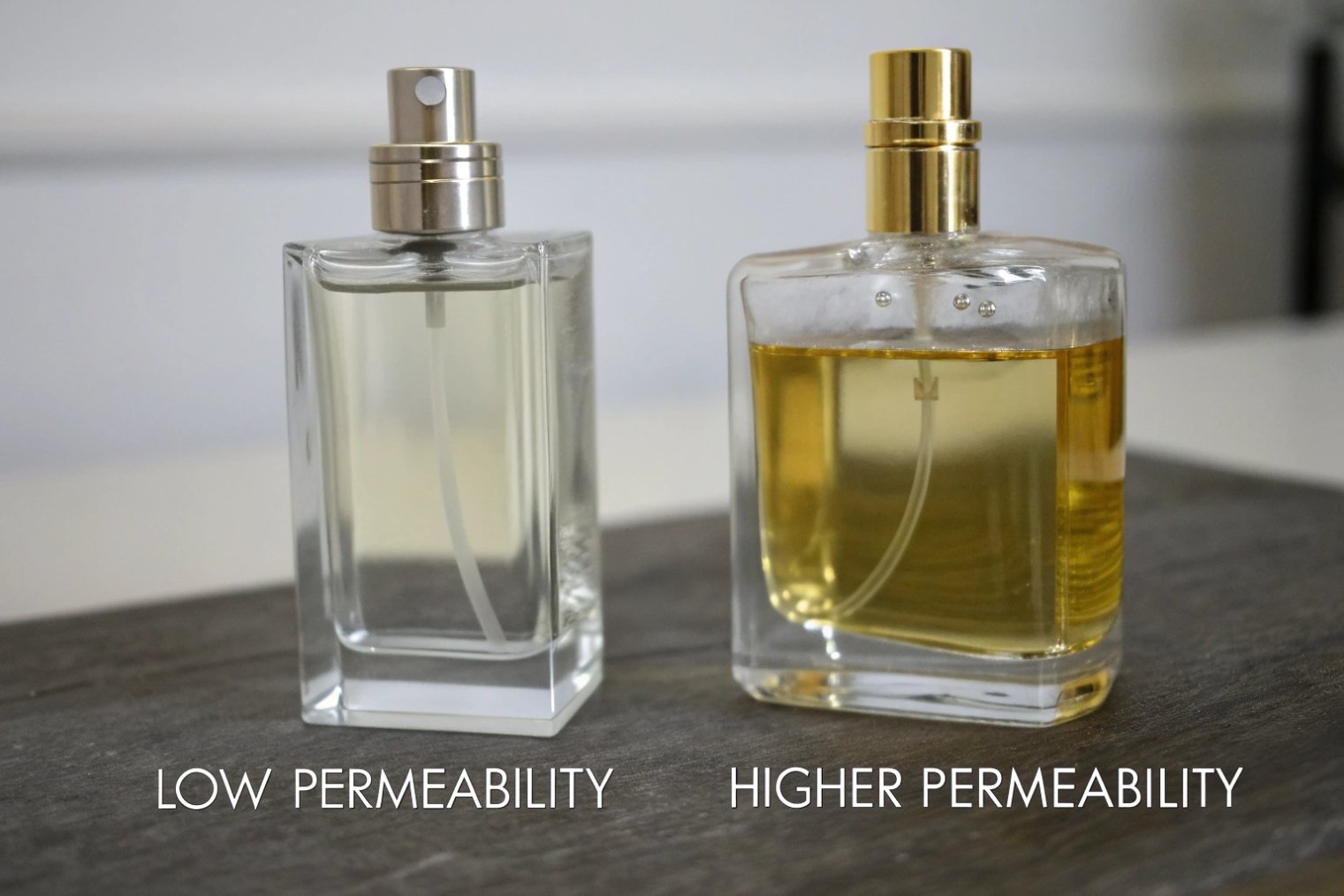
How glass protects against oxidation
Glass is a rigid, silica-based network. It does not swell in ethanol. It does not dissolve in fragrance oils. The surface is smooth and chemically neutral.
This brings two key benefits:
- Oxygen struggles to pass through the wall. Most oxidation happens only at the tiny headspace above the juice.
- Solvent and aroma do not soak into the bottle body. What you fill is what stays inside.
Thick glass also buffers temperature swings. When room temperature jumps, the liquid warms more slowly. That moderates volatility and slows down some oxidation pathways, especially in formulas rich in natural top notes.
Why plastics struggle with perfume
Many plastics behave differently under fragrance stress:
- Some grades absorb terpenes and small aromatics. This scent scalping 1 steals brightness from citrus, herbal, and green notes.
- Oxygen permeability 2 is higher, so fresh air can drift through the wall over months and years.
- Strong citrus and aldehydic accords can soften or crack weaker plastics, or extract additives from them.
The result is not always a “bad” perfume, but it can be a different perfume from the one that left the filling line. For a premium brand, that drift is expensive.
Practical comparison and design tips
| Feature | Glass bottle | Typical plastic bottle |
|---|---|---|
| Chemical reactivity | Extremely low | Low–medium |
| Aroma absorption (“scalping”) | Negligible | Possible with many formulas |
| Oxygen permeability | Very low | Higher |
| Solvent attack resistance | Excellent, even with citrus notes | Depends strongly on resin |
To keep oxidation under control:
- Use glass for the main retail bottle, especially for EDP, extrait, and natural-heavy formulas.
- Reserve plastics for short-term travel atomizers or discovery samples with faster turnover.
- Specify closures and gaskets that also resist alcohol and terpenes, so the full system matches glass performance.
Which glass colors provide the most UV protection for fragrances?
Even if a formula is perfectly stable in the dark, light can rewrite it. UV and blue light break down delicate molecules long before the bottle is empty.
Amber, black, and other opaque glasses give the strongest UV protection for perfume; cobalt and green offer medium protection, while clear flint needs strong secondary packaging to keep light damage under control.
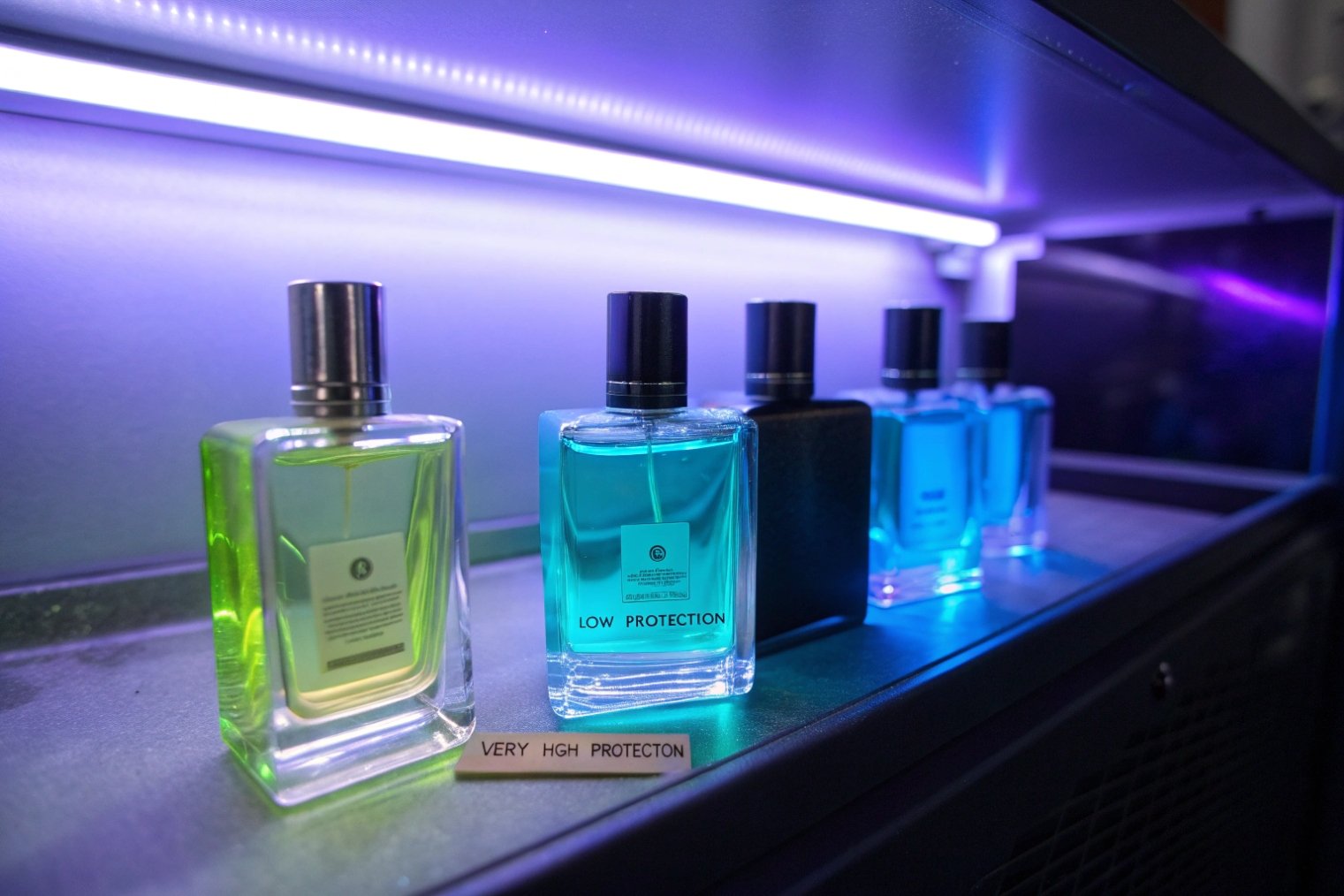
How light damages perfume
Light-sensitive notes include many naturals: citrus oils, some florals, resins, and colorants. Under UV and high-energy visible light, these molecules:
- Oxidize and fragment, dulling the top and heart notes.
- Create new by-products that can smell sour, dusty, or “off”.
- Darken the juice, which customers see as aging or poor quality.
The more light that reaches the liquid, the faster this happens. Bottle color is the first filter between ambient light and the formula.
Color options and their protection levels
Different glass colors block different parts of the spectrum:
| Glass color / finish | Relative UV / light protection | Typical use in fragrance |
|---|---|---|
| Clear flint | Very low | Display-focused, must use cartons |
| Light green | Low | Fashion bottles, faster-moving scents |
| Cobalt blue | Medium | Iconic branding with partial shielding |
| Amber glass 3 | High | Workhorse for light-sensitive formulas |
| Black / fully opaque | Very high | Maximum protection, long storage |
| Specialty violet / UV | Very high (select bands) | Niche, high-protection concepts |
Amber is the practical standard. It cuts a wide range of UV and blue wavelengths and is easy to source. Black or fully opaque coatings go further and are ideal when a brand expects long shelf life, high natural content, or hot, bright retail environments.
Cobalt blue and deep green look striking, but they sit in the middle. They are fine if the formula is fairly robust or if the bottle always lives in a box. For delicate compositions, they should be backed up with strong cartons and careful display lighting.
Layering protection beyond the bottle
Color alone is not the whole strategy. In practice, stable packaging stacks several layers:
- Dark or tinted glass bottle.
- Carton or rigid sleeve that stays on during storage and shipping.
- Display standards that keep bottles away from direct sunlight and strong spotlights.
If you want a structured way to validate light exposure risk, ICH Q1B photostability testing 4 is a useful reference point for how industries stress-test products under light.
The more fragile the juice, the more layers you combine. With smart design, this can still look premium. For example, a clear window cut into an opaque carton shows the bottle only partly, while glass color does much of the protective work from inside.
Do interior coatings affect alcohol-based formulas or stability?
Internal color effects and special barriers sound attractive. But for the perfume inside, the coated interior is no longer just “glass”. It is a new surface in contact with the formula.
Interior coatings can affect alcohol-based perfumes if they are not fully compatible with ethanol and fragrance oils; safe systems stay inert, but poorly chosen lacquers can leach, soften, or flake into the juice.
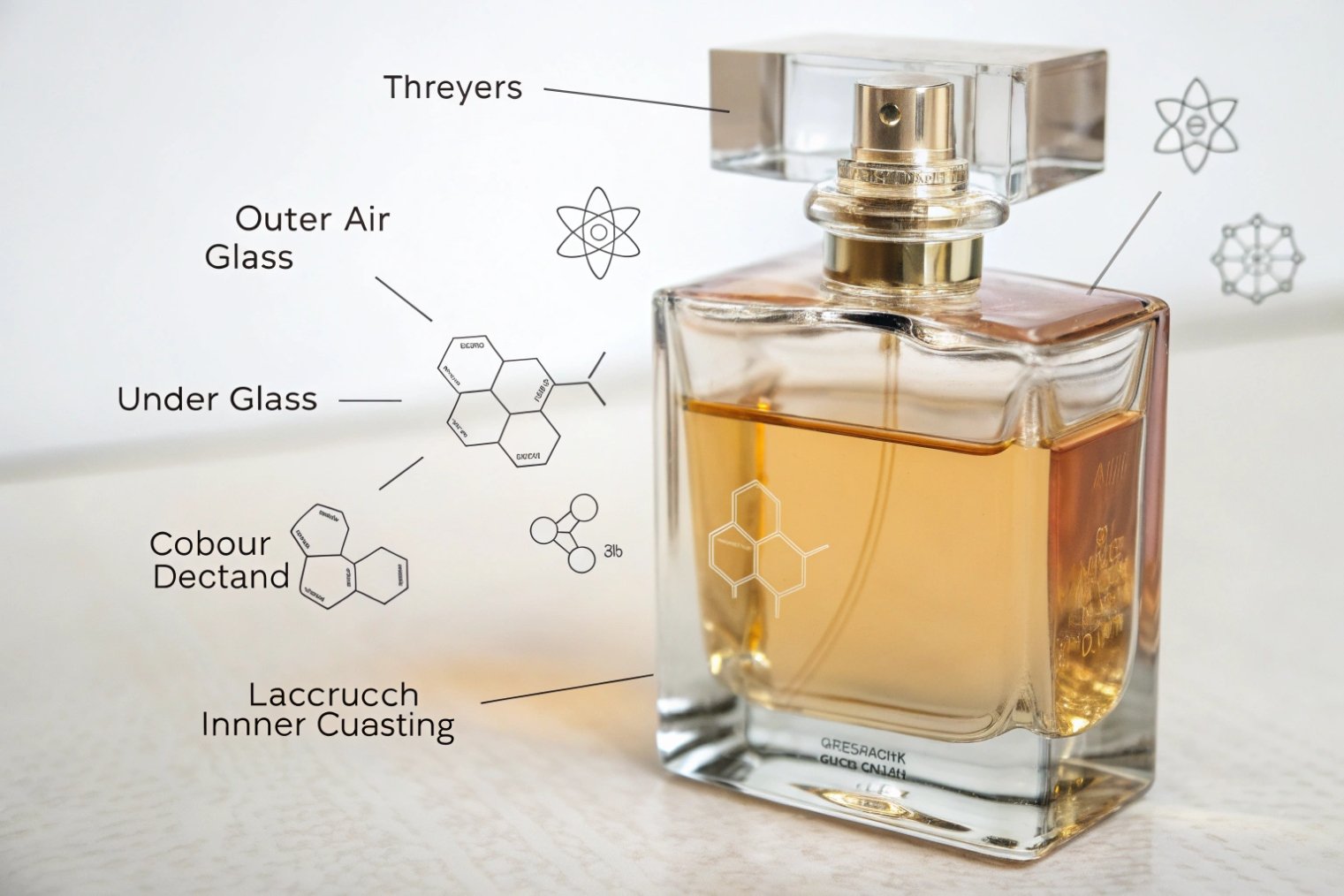
What interior coatings are trying to do
Brands choose interior coatings for a few reasons:
- To get a bold color effect while keeping the outside crystal-clear.
- To hide color variation in natural-heavy juices.
- To add an extra perceived “depth” to the liquid.
From a decoration perspective, this works. The problem is that most perfumes are high-proof alcohol plus concentrated aromatics, which are good solvents. Any interior film must behave like glass, not like a fragile paint.
Risks when coatings meet perfume
If the coating chemistry is not tuned for alcohol and oils, several failures can appear:
- Softening and swelling: the film absorbs ethanol, becomes rubbery, and may release micro-particles.
- Leaching: plasticizers, residual monomer, or colorants migrate into the perfume. This can create haze, off-odors, or unexpected discoloration.
- Poor adhesion: the film lifts from the glass and forms blisters or visible streaks inside the bottle.
Once this happens, the brand does not only lose visual quality. The formula itself may now be “contaminated” by low-level migrants that were never part of the original safety assessment. This is why extractables and leachables 5 thinking is useful even outside pharma when coatings touch high-ethanol fragrances.
Safer decoration strategies
Because of these risks, many perfume projects keep the inside of the bottle as naked glass and move all decoration outward:
- External spray coatings and gradients.
- Frosting, acid etch, or partial masking.
- Screen printing and hot stamping on the outer surface only.
These options still allow strong shelf impact while the juice only touches neutral glass.
If an interior coating is truly needed, it should be treated as an ingredient:
- Test the exact fragrance base in contact with coated glass for months at elevated temperature.
- Run stability checks on color, odor, clarity, and pump function.
- Confirm that coating suppliers can support cosmetic and contact safety claims.
When the test plan is serious, some specialized interior coatings can work without harming stability. Without that level of testing, plain glass inside is simply safer.
Are there safety or labeling rules that favor glass for perfume?
Perfume is flammable, often sprayed on skin, and shipped worldwide. Even when not written directly into law, these realities push packaging choices in a certain direction.
Glass fits safety and labeling expectations for perfume because it handles flammable alcohol well, does not leach into skin-contact products, and supports recycling and refill claims that regulators and consumers both watch closely.
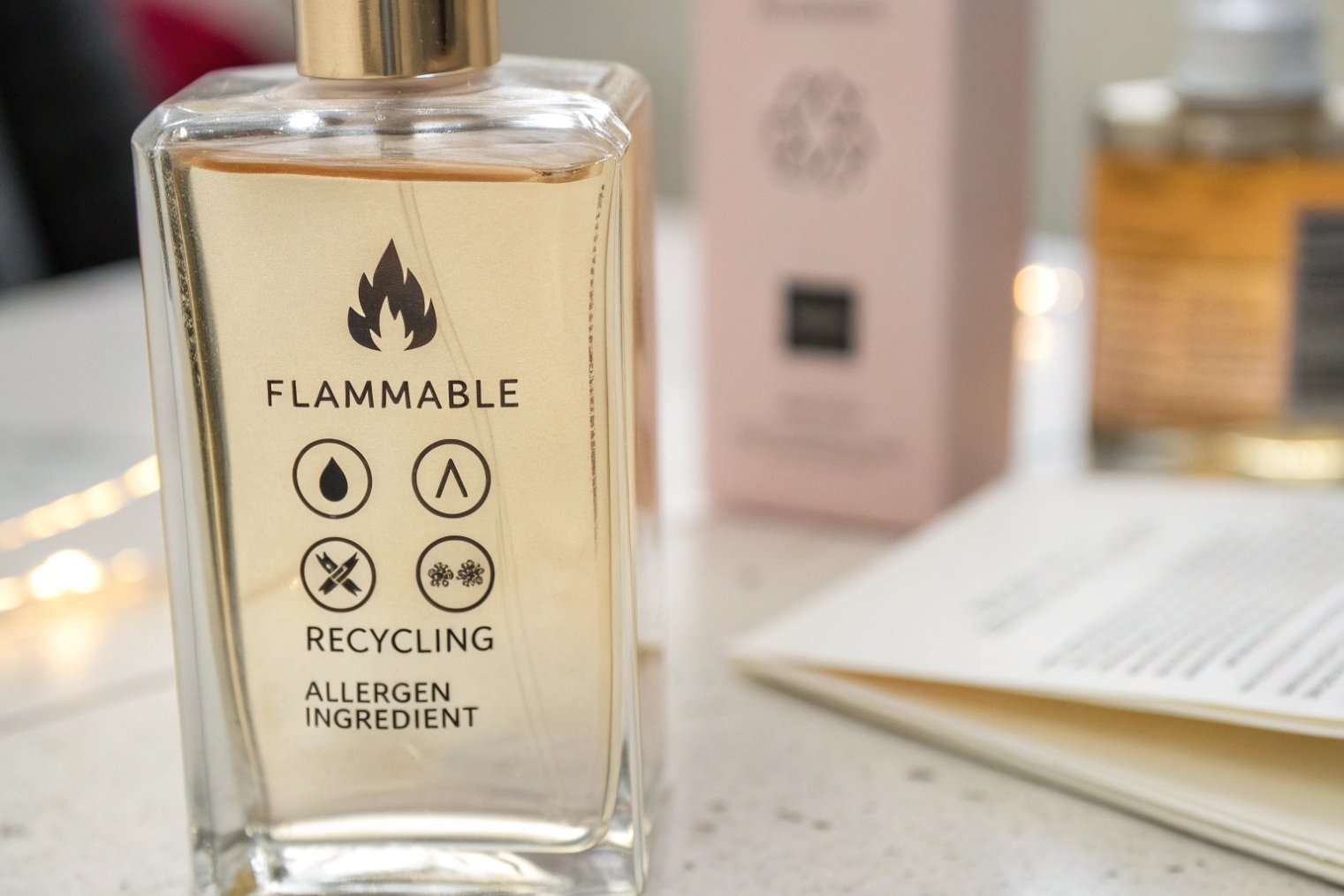
Flammability and transport
Alcohol-based fragrances are commonly treated as a Class 3 flammable liquid under UN dangerous goods transport rules 6. Packaging must:
- Resist high-proof ethanol.
- Maintain seal integrity under pressure and temperature swings.
- Withstand drop and vibration tests without leaking.
Glass has a long record in these conditions. Heavy-walled bottles, precise neck finishes, and tested crimp or screw pumps form robust primary packs. For aerosols and splashes, metal containers share part of this space, but for most EDT and EDP formats, regulators and logistics providers are very comfortable with glass.
Skin contact, purity, and “clean” positioning
Perfume is applied directly to skin, hair, and textiles. Many markets push brands toward:
- Low migration of any packaging substances into the product.
- Clear ingredient and allergen labeling.
- Honest “clean” or “natural” claims.
Glass helps. It does not leach plasticizers, residual monomers, or stabilizers into an ethanol base. When a brand claims “no harmful plastics close to the formula”, using glass as the primary container matches that story much better than complex plastics do.
This also matters for long-term storage. Some collectors keep bottles for many years. A glass container gives much more predictable behavior over that time than an experimental plastic wall.
Waste, recycling, and refill expectations
New regulations and voluntary schemes push producers to take more responsibility for packaging waste. Here glass has three advantages:
- It is widely collected and recycled.
- It does not retain odor, so cullet can return to high-quality glass.
- It handles cleaning and re-filling without structural fatigue.
This supports:
- Refillable flagship bottles with lighter refill cartridges.
- Take-back programs where brands reclaim empty glass and pumps.
- Strong on-pack claims about recyclability and reuse.
For fragrance safety governance, many brands also align formulas and labeling with IFRA Standards 7 to keep allergen and ingredient constraints consistent across markets.
A simple overview:
| Requirement area | How glass helps |
|---|---|
| Flammable liquid handling | Strong, rigid, solvent-resistant |
| Skin-contact safety | Minimal migration, inert in ethanol |
| Eco labeling / EPR rules | High recyclability, supports refills |
So while most regulations do not literally say “perfume must use glass”, once we map safety, transport, purity, and sustainability requirements onto real materials, glass naturally becomes the default answer.
Conclusion
Glass wins in perfume because it protects the formula, supports safety and sustainability, and lets brands build iconic, refillable objects that keep both scent and story intact over time.
Footnotes
-
Explains how packaging can absorb aroma compounds, reducing perceived fragrance intensity over time. ↩ ↩
-
Provides comparative data on barrier performance (including oxygen) for glass versus common plastics. ↩ ↩
-
Practical overview of why amber generally blocks more harmful short-wavelength light than cobalt. ↩ ↩
-
Reference framework for designing controlled light-exposure tests to understand photodegradation risk. ↩ ↩
-
Defines extractables/leachables concepts to evaluate whether coatings can migrate into high-ethanol products. ↩ ↩
-
Official overview of UN transport model regulations, including hazard classes like flammable liquids. ↩ ↩
-
Official IFRA standards reference used by fragrance brands for safe-use and compliance alignment. ↩ ↩






