
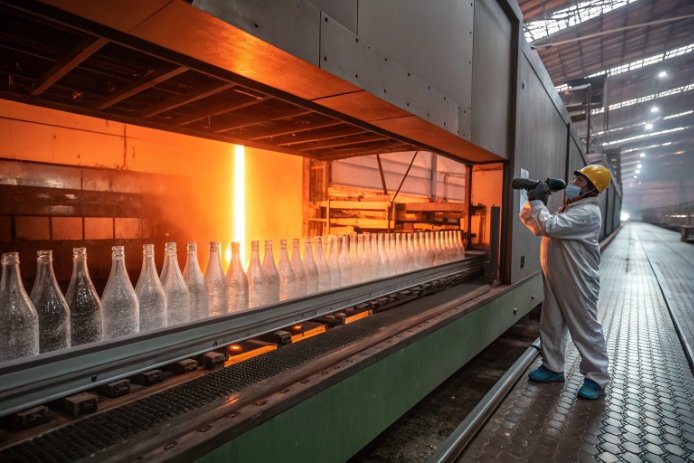
Devit is a silent profit killer. It starts as a faint line, then turns into stones, rejects, and a slow drop in forming stability.
To improve devitrification resistance, the base glass must keep a safe temperature margin above liquidus, while selected oxides slow crystal nucleation and growth without hurting melt rate, fining, or bottle strength.
A practical way to choose “anti-devit” oxides in container glass
Devitrification in soda-lime container glass is rarely caused by one oxide. It is a system problem. The system includes composition, furnace temperature profile, fining chemistry, cullet stream, and the cold surfaces the melt touches (refractories, forehearth blocks, spout, and feeder). A good formulation does not chase “the lowest liquidus” alone. It aims to keep the melt above the liquidus with a comfortable margin in every slow and cold zone of the line.
The most common devit phases in container glass tend to be calcium silicates 1 and calcium–magnesium silicates. Those crystals like time, cool spots, and local chemistry changes. Local chemistry changes often come from batch carryover, sulfate salt behavior, refractory corrosion, or cullet contamination. That is why the right oxide choice must also protect homogeneity and keep the liquidus from jumping in small pockets of melt.
What “devit resistance” means in daily production
A formula is devit-resistant when it does four things at the same time:
1) It keeps the liquidus low enough for the chosen operating temperatures.
2) It keeps the liquidus phase less aggressive, so growth is slow.
3) It keeps viscosity and surface tension in a stable forming window.
4) It stays stable against drift from cullet, SO₃, and redox 2 swings.
Where devit lines usually begin
Devit lines often appear when the melt lingers in a “danger range” near the liquidus, especially near cooler walls and metal contact points. The worst places are usually:
-
forehearth corners and dead zones
-
spout bowls and feeder areas
-
shear zones and gob formation points
-
areas with unstable burner control or pull changes
A quick decision table for oxide selection
| Goal | Oxides that usually help | Oxides that need caution | Why the result changes |
|---|---|---|---|
| Lower liquidus and widen margin | B₂O₃, small Al₂O₃ tuning, MgO/CaO balancing | Too much B₂O₃, too much Al₂O₃ | Volatility, viscosity shift, new crystal phases |
| Reduce surface crystallization | MgO adjustment, small ZnO or SrO | Excess CaO, TiO₂ contamination | Surface cold spots amplify nucleation |
| Keep forming stable while fighting devit | Al₂O₃ (modest), MgO tuning | Big Na₂O swings | Viscosity and working range must stay stable |
A useful mindset is to treat anti-devit oxides as “small steering moves,” not as a full rebuild. Most container plants get the best results by keeping the classic soda-lime base stable, then using a small set of controlled additions that are easy to hold in continuous production.
Next, the most common question is about Al₂O₃ and B₂O₃, because they are often the first tools people reach for.
Will boosting Al₂O₃ (≈1–2 wt%) and adding B₂O₃ (≈0.5–2 wt%) lower the liquidus and suppress devit?
Devit fixes that only work on paper usually fail on the floor. A plant adds an oxide, then the melt runs different, fining changes, and the line starts fighting a new problem.
Yes, modest Al₂O₃ (around 1–2 wt%) often improves devit resistance by slowing crystal growth and stabilizing the melt, and B₂O₃ (around 0.5–2 wt%) can lower liquidus and improve margin, but both must be tuned to avoid new devit phases, volatility, and working-range drift.
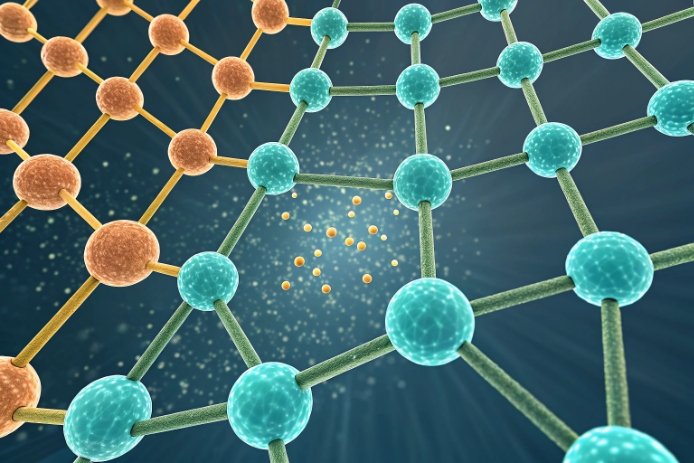
Why Al₂O₃ helps even when it does not “magically” lower liquidus
Alumina 3 acts as an intermediate oxide in soda-lime glass. It strengthens the network and often improves chemical durability. For devit control, the practical benefit is that Al₂O₃ can make the melt less friendly to fast crystal growth. It can also make the viscosity curve 4 more stable across normal process drift. That stability matters in the forehearth where small temperature drops can trigger surface crystals.
Still, Al₂O₃ is not a free win. If Al₂O₃ is pushed too high in a soda-rich system, aluminosilicate devit risks can rise in some compositions. The safe move is to raise Al₂O₃ in small steps and check the liquidus phase and the forming viscosity each time.
Why B₂O₃ can lower liquidus but needs discipline
Boron oxide 5 is a strong tool for lowering liquidus and improving melt fluidity at a given temperature. That can reduce devit risk in the cold zones because the melt has more margin. It can also reduce the time spent near the liquidus in the forehearth and spout.
The trade-offs are real:
-
B₂O₃ can be more volatile at high temperature.
-
B₂O₃ can change fining and foam behavior.
-
Too much B₂O₃ can change thermal expansion and bottle performance targets.
This is why B₂O₃ is often used as a small addition, not as a large redesign, unless the plant is already set up for borosilicate-style control.
How to decide the “right” level without guessing
The clean method is to look at three numbers together: liquidus temperature, viscosity at forming temperature, and the difference between operating temperature and liquidus (the margin).
| Control item | What a “good” change looks like | What a “bad” change looks like |
|---|---|---|
| Liquidus temperature | Drops or stays stable | Rises or changes phase to a faster-growing crystal |
| Viscosity at forming | Stays in the same working window | Shifts enough to change gob weight control and forming |
| Forehearth margin | Increases in the coldest zones | Only improves in hot zones while cold spots still devit |
When Al₂O₃ and B₂O₃ are used with small, controlled moves, they can suppress devit without turning the melt into a new glass that the furnace and IS machines do not recognize.
How do MgO/CaO balance and small ZnO or SrO additions cut surface crystallization in soda-lime glass?
Surface devit is the most frustrating type because the bulk glass can look perfect, but crystals start growing on the wall and peel into the melt.
Balancing MgO and CaO can reduce the tendency to form fast calcium-silicate crystals, and small ZnO or SrO additions can disrupt crystal growth at surfaces, but the benefits depend on the dominant liquidus phase and the cold-zone temperature profile.
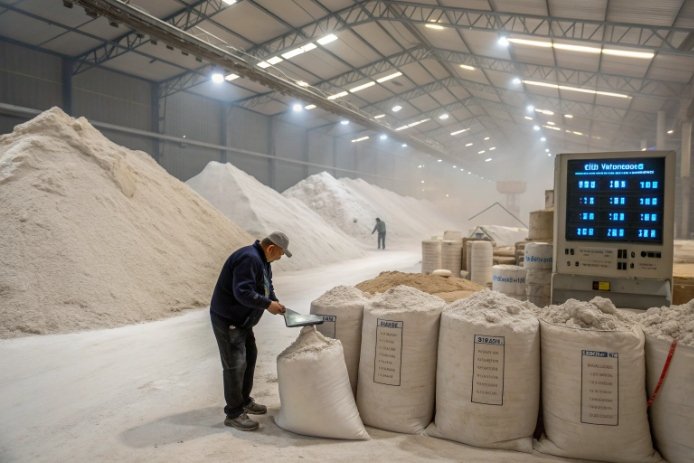
MgO/CaO balance: changing which crystals “want” to form
Calcium oxide 6 is essential for durability and stability, but excess CaO can raise the liquidus and favor calcium-silicate devit. MgO can play two roles: it can replace part of CaO while keeping stability, and it can shift the liquidus behavior so the melt is less prone to fast surface crystallization.
The practical move is usually not “add lots of MgO.” It is “adjust the ratio.” Many plants find that a slightly higher MgO share, with CaO held inside a stable range, reduces devit lines near forehearth walls. Still, too much MgO can bring other silicate phases into play in some compositions. That is why the ratio must be tested with the plant’s real temperature profile.
ZnO: a small modifier that can slow growth
Zinc oxide 7 is often used in small levels as a modifier that can disturb crystal growth kinetics. In simple terms, it can make it harder for a crystal lattice to build quickly, especially at surfaces where the melt is colder and more structured. The benefit is usually seen as fewer surface skins and fewer “snowflakes” peeling off into the stream.
The downside is cost and the need for stable dosing. ZnO also changes melt behavior slightly, so the plant must watch viscosity and fining response.
SrO: similar idea, different economics and side effects
Strontium oxide 8 can act as a heavier alkaline earth modifier. Small SrO can sometimes reduce surface devit tendency by changing the local structure and the preferred crystal chemistry. Like ZnO, it is normally used as a small trim. It is not a main ingredient in most container bases because of cost and supply planning.
A practical selection guide
| Option | When it helps most | What to watch closely | Typical mindset |
|---|---|---|---|
| Increase MgO (or shift MgO/CaO) | Calcium-silicate devit dominates | New liquidus phase, viscosity drift | Ratio tuning, not a rebuild |
| Small ZnO | Surface devit in cold zones | Cost, dosing stability, fining behavior | “Anti-growth” trim |
| Small SrO | Persistent surface devit with limited other levers | Cost, supply, subtle tone changes | Specialty trim |
The best results usually come from combining a sensible MgO/CaO balance with physical fixes in the forehearth, like removing dead zones and stabilizing temperatures. The composition change reduces the tendency. The process change removes the trigger.
Which oxides should be limited or avoided—like excess CaO, TiO₂, or high ZrO₂—to prevent nucleation?
Some oxides do not “cause devit” alone. They act like seeds. They raise the chance that crystals will start, especially at cold surfaces or in stagnant pockets.
Excess CaO can raise liquidus and favor calcium-silicate devit, TiO₂ is a strong nucleating oxide that can trigger crystals and haze, and high ZrO₂ can act as a nucleation source or create undissolved stones if not fully dissolved, so all should be controlled tightly in bottle glass.
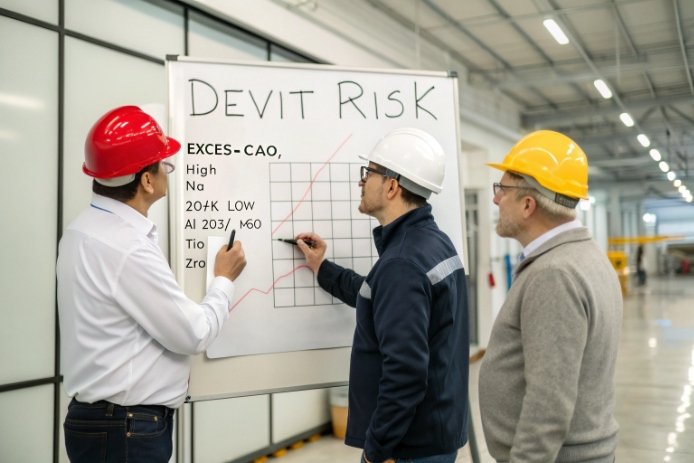
Excess CaO: stability vs devit risk
CaO is needed, but a high CaO level can raise liquidus temperature and make the melt more likely to crystallize when it meets cold zones. In container practice, the problem is not only the average CaO in the recipe. The problem is local CaO-rich pockets caused by incomplete melting, dusting, or segregation in the batch. Those pockets can devit even when the global composition is “fine.”
So the control action is twofold: keep CaO in a safe range, and keep batch mixing and melting stable so local spikes do not happen.
TiO₂: strong nucleation behavior and haze risk
Titanium dioxide 9 is well known as a nucleating agent in many glass-ceramic systems. In container glass, the goal is usually the opposite. TiO₂ is normally controlled as an impurity in sand and cullet. If it rises, the risk of haze, surface crystals, and devit lines can rise, especially if the melt spends time in the wrong temperature band.
TiO₂ also interacts with iron and other trace elements in ways that can change color tone and UV behavior. That can create a second problem when the plant is also trying to hold “high-white” flint.
ZrO₂: good refractory material, but risky as a melt additive
Zirconia is excellent in refractories, so it often appears as a corrosion product or a carryover contaminant. In bottle melts, high ZrO₂ can lead to:
-
undissolved zircon or zirconia particles (stones)
-
extra nucleation sites that start devit
-
viscosity shifts if used at higher levels
Small background ZrO₂ is normal in many plants. The key is to avoid any situation where zircon-rich particles enter the melt stream in a way that does not dissolve.
Other “quiet” nucleation and devit boosters
It is also smart to control:
-
Cr₂O₃ and NiO (color + potential nucleation behavior in some cases)
-
High Al₂O₃ with high Na₂O (can shift devit risk to aluminosilicates in some compositions)
-
P₂O₅ (can influence phase separation and nucleation in some glass families)
| Oxide / source | Why it increases devit risk | Practical control method |
|---|---|---|
| Excess CaO | Raises liquidus and supports Ca-silicate phases | Tight carbonate spec + good batch mixing |
| TiO₂ | Strong nucleation and haze potential | Low-Ti sand spec + cullet sorting |
| High ZrO₂ / zircon carryover | Stones and nucleation sites | Refractory wear control + filtration discipline |
| Cr/Ni contamination | Tint + possible crystallization effects | Cullet governance + raw material QC |
Limiting these oxides is often cheaper than fighting devit after it appears, because the cost of rejects and downtime is always higher than the cost of a tighter raw material spec.
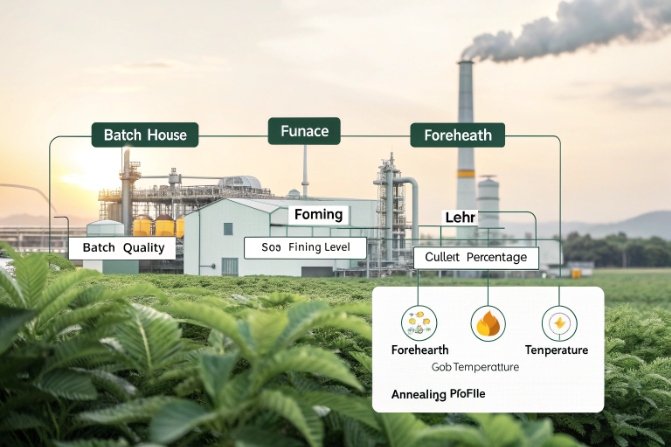
Do oxide choices work with batch/furnace controls (SO₃ level, cullet %, cooling rate) to stop devit lines?
A formula that looks perfect in a lab melt can still devit in production if the furnace feeds, SO₃, and cooling profile are not stable.
Yes, oxide choices only succeed when SO₃ and fining behavior stay stable, cullet is consistent, and cooling rates avoid long residence near liquidus; composition reduces the tendency to crystallize, and process control removes the triggers that form devit lines.
SO₃ and fining: devit control starts with a calm melt
SO₃ level and sulfate fining 10 behavior affect:
-
foam height and heat transfer
-
bubble removal speed
-
local chemistry near the batch blanket
-
redox stability, which can change melt structure slightly
When sulfate behavior swings, the melt can develop composition bands. Those bands can push local liquidus up and create devit streaks. In practice, the best approach is to keep SO₃ and fining agent feed steady and avoid frequent “big corrections.” A calm fining stage helps homogenization. Homogenization reduces devit lines.
Cullet percentage: energy helper, chemistry risk
Cullet usually improves melting and can reduce unmelted batch carryover, which is good for devit. Still, cullet also brings unknowns:
-
extra CaO or MgO drift
-
TiO₂ and Cr pickup from mixed cullet
-
ceramics and stones that act like seeds
-
organics that change redox near the doghouse
For devit control, the key is not only the cullet percentage. It is the variation of the cullet chemistry. A stable 50% can be safer than an unstable 30%.
Cooling rate and “time in the danger band”
Devit likes slow cooling near the liquidus. This is why cold forehearth corners, slow flow zones, and feeder bowl surfaces are common devit sources. Composition can lower the liquidus and slow growth, but process must still avoid long residence near that temperature.
Practical actions that pair well with oxide choices:
-
keep forehearth and spout temperatures steady
-
remove dead zones and improve flow pattern
-
avoid sudden pull changes that change residence time
-
keep gob temperature uniform across sections
A combined control checklist
| Control area | What to hold steady | Why it stops devit lines |
|---|---|---|
| Composition | Liquidus margin, MgO/CaO ratio, modest Al₂O₃/B₂O₃, low Ti/Zr carryover | Reduces nucleation and slows growth |
| SO₃ / fining | Stable sulfate feed, stable fining temperature | Avoids bands and improves homogenization |
| Cullet | Stable flint/amber stream, low ceramics, low Ti/Cr | Prevents seeds and chemistry spikes |
| Cooling profile | No cold corners, stable forehearth profile | Reduces time near liquidus |
| Operations | Stable pull, stable burner settings | Prevents redox and temperature waves |
The most reliable devit fix is usually a small composition tune plus a strong process discipline plan. When both are in place, devit lines stop being a “mystery defect,” and they become a controlled risk.
Conclusion
Al₂O₃ and B₂O₃ can help, MgO/CaO balance often matters more than people expect, and limiting nucleators like TiO₂ and high ZrO₂ is critical—but the biggest wins come when composition and furnace stability work together.
Footnotes
-
Calcium silicate crystals like wollastonite are common devitrification products that compromise glass strength and clarity. ↩
-
Redox fluctuations can destabilize local melt chemistry, creating conditions favorable for crystal nucleation. ↩
-
Aluminum oxide strengthens the glass network and retards crystal growth, improving stability in the forming range. ↩
-
A stable viscosity curve ensures consistent glass flow, reducing residence time in temperature zones prone to devitrification. ↩
-
Boron oxide lowers the liquidus temperature, providing a wider safety margin against crystallization during cooling. ↩
-
Calcium oxide acts as a stabilizer but excess amounts can increase the liquidus temperature and devitrification risk. ↩
-
Zinc oxide modifies crystallization kinetics, helping to suppress surface crystal growth in cooler melt zones. ↩
-
Strontium oxide serves as a specialized modifier that can alter crystal structure preference and reduce surface defects. ↩
-
Titanium dioxide is a potent nucleating agent that must be minimized to prevent haze and crystal formation in clear glass. ↩
-
Consistent fining removes bubbles and homogenizes the melt, eliminating local variations that can trigger devitrification. ↩






