
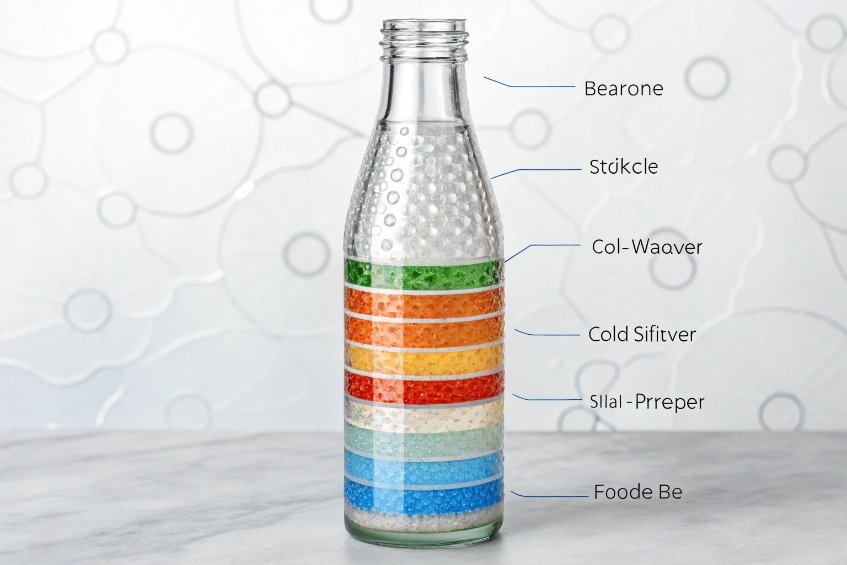
A glass bottle is only as strong and beautiful as its outer few microns. If the coating material is wrong, lines slow down, labels fail, and colors fade.
For glass bottles, hot-end oxides (SnO₂/TiO₂), cold-end PE/siloxane layers, organosilanes, sol–gel SiOx, and acrylic/urethane topcoats work together to deliver slip, protection, and decoration without risking food safety.
So the question is not “Which coating is best?”. The better question is “Which material belongs at which layer—hot-end, cold-end, or decor—to hit lubricity, sterilization, branding, and regulatory goals at the same time?”. A good starting point is understanding how hot-end tin oxide (SnO₂) surface treatments 1 interact with whatever you apply later at the cold end and in decoration.
Are PE, EVA, and acrylics standard for cold-end lubricity layers?
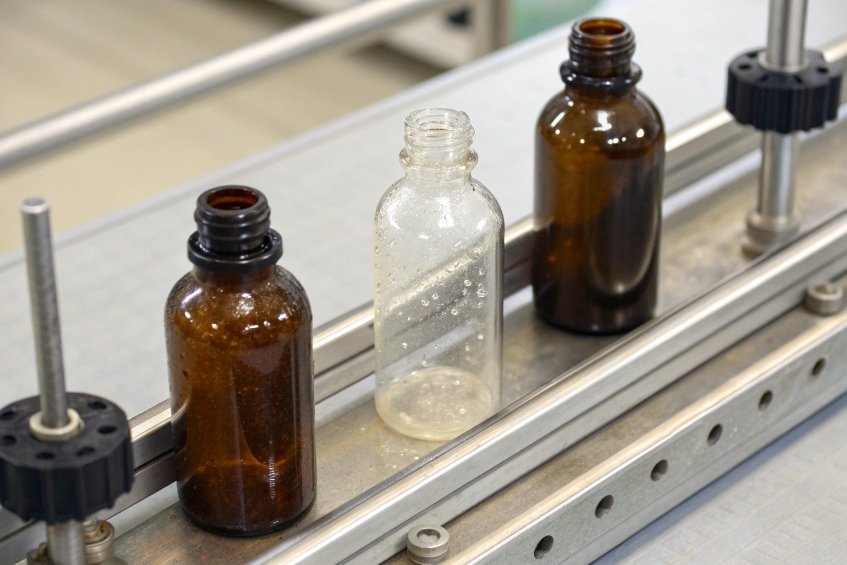
Scuffing, line jams, and carton rub all start at the cold end. If the lubricity layer is wrong, bottles squeak, stall, and turn cloudy in a few minutes of conveying.
For cold-end lubricity, waterborne PE emulsions and oxidized PE waxes are the real workhorses. EVA and acrylics are used more where extra flexibility, clarity, or decorative durability are needed, not as pure slip coats.
What actually runs at the cold end?
Cold-end coatings must do three things at once:
- Lower COF enough for smooth conveying.
- Protect the hot-end oxide and glass from abrasion.
- Stay compatible with labels, inks, and downstream decoration.
For that job, three material families show up most:
1. PE and oxidized PE waxes
These are the standard:
- Supplied as water-based polyethylene emulsion cold-end coatings 2.
- Easy to spray at lehr exit while the ware is warm.
- Form very thin, near-invisible films with stable slip.
They give:
- Good scuff resistance.
- Predictable COF windows for high-speed lines.
- Simple wash-off in returnable systems and recyclability streams.
2. Fatty acid salts and esters
For example:
- Calcium or zinc stearate emulsions.
- Stearic/oleic acid derivatives.
These bring:
- Extra lubricity in certain regions on the bottle.
- Adjusted feel and water-resistance.
They often blend with PE to fine-tune slip, especially on difficult shapes or where lines are particularly abrasive.
3. EVA and acrylic systems
EVA dispersions and acrylic emulsions are less common as pure cold-end slip, but they appear when:
- The same layer must also carry color tint or clear gloss.
- Coating needs better flexibility over embossed zones.
- Coating must pass tougher block resistance or detergent exposure tests.
They tend to create more “film-like” layers, so coverage and thickness control matter more.
A simple comparison:
| Layer type | Typical materials | Main purpose | Where it fits best |
|---|---|---|---|
| Pure lubricity / anti-scuff | PE emulsions, oxidized PE waxes, stearates | COF control, scuff resistance | Standard beverage / food cold-end |
| Lubricity + flexibility | EVA blends, modified wax systems | Slip + flexible clear film | Complex shapes, embossed cosmetic bottles |
| Lubricity + decor base | Acrylic emulsions, hybrid acrylic–PU | Slip + base for color/topcoats | Cosmetic / spirit bottles with outer decor |
So when the goal is simple slip and abrasion resistance, PE systems lead. EVA and acrylics step in when you want the cold-end layer to also support more visible decoration or higher flexibility.
When should organosilanes or UV-curable urethanes be specified?
Some bottles need more than a basic slip film. They need a hard, clear, chemical-resistant surface that also bonds well to inks, labels, or hydrophobic finishes.
Organosilanes are chosen when we need strong bonding and tailored surface energy; UV-curable urethanes are chosen when we need fast, thick, scratch-resistant clear-coats at high line speed.
Where organosilanes shine
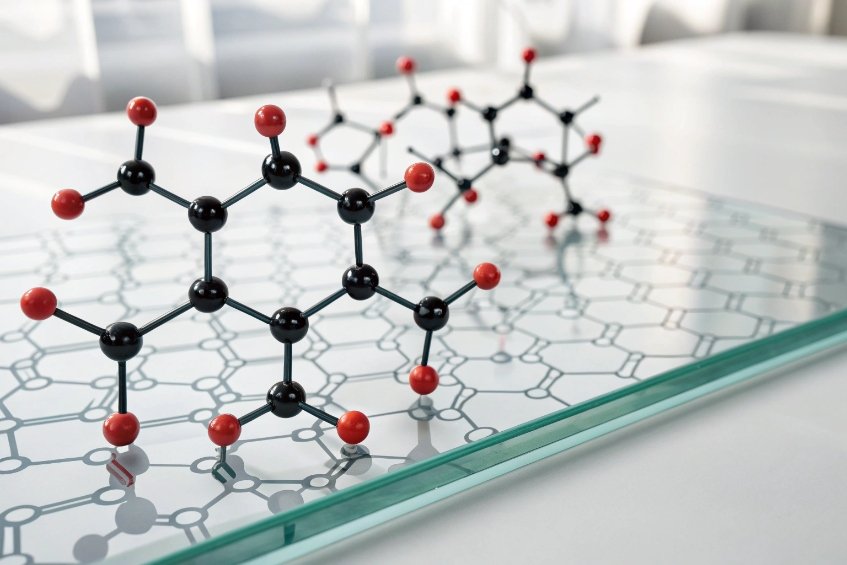
Organosilanes bridge inorganic and organic worlds. They bond to glass or oxide surfaces on one side and present functional organic groups on the other—this is the core idea behind silane coupling agents used in coatings 3.
Common types:
- Amino silanes
- Epoxy silanes
- Alkyl / fluoroalkyl silanes
- Polysiloxane-based slip coats
Use them when:
-
You need an adhesion primer or tie-coat
- Between hot-end SnO₂ and a decorative paint.
- Between sol–gel barrier layers and organic inks.
- Between glass and labels on very smooth, low-energy surfaces.
-
You need controlled surface energy
- Hydrophobic or oleophobic top layers for anti-fingerprint and easy-clean.
- Tuned wetting for better printability and uniform frost-look coatings.
-
You want low build but high function
- Very thin layers with big changes in wettability and adhesion.
- Minimal impact on color, gloss, or optical clarity.
Where UV-curable urethanes make sense
UV-cure urethane acrylates and hybrid urethanes are strong candidates for decorative clear-coats and hard top layers. For property tradeoffs and curing behavior, it helps to reference UV/EB urethane acrylate performance ranges 4.
They provide:
- High scratch and mar resistance.
- Fast cure at low bottle temperatures.
- Adjustable gloss from high-gloss to matte.
- Good chemical resistance when the cure dose is right.
Specify them when:
- The line needs high throughput and cannot add long bake ovens.
- The design requires a thick, robust clear skin over metallic, ceramic, or pigmented inks.
- The bottles will face strong solvents, oils, or repeated handling (like cosmetics, bar spirits, or premium sauces).
Position in the stack:
| Layer role | Best candidates | Typical bottle segments |
|---|---|---|
| Adhesion promoter / primer | Organosilanes, silane-based tie-coats | Food, cosmetics, spirits with decor |
| Slip + surface tuning | Polysiloxane / silane slip coats | High-end cosmetics, tableware |
| Fast hard clear-coat | UV-curable urethane / acrylic–urethane | Perfume, skincare, spirits, color bottles |
So if the problem is adhesion and wetting, think organosilane first. If the problem is clear hardness at speed, think UV-curable urethane.
Do sol–gel SiOx or ceramic inks meet high-heat sterilization needs?
Some bottles must survive pasteurization, retort, returnable washers, or lab sterilization. Soft organic films will not last there. We need coatings that tolerate high heat and strong chemistry.
Sol–gel SiOx and hybrid organosilicate layers can handle elevated temperatures and caustic better than standard organics, but ceramic frit inks and enamels are the real champions for extreme, repeatable high-heat cycles.
What high-heat actually means on bottles
Typical conditions:
- Pasteurization: 60–80 °C water bath.
- Hot-fill: product at 80–95 °C for a short time.
- Returnable caustic wash: 1–3% NaOH, 60–80 °C, multiple cycles.
- Lab or pharma sterilization: 121 °C steam (autoclave) or dry heat.
For each step, you need to check:
- Will the coating soften or yellow?
- Will it crack, craze, or delaminate?
- Will it leach or contaminate product or wash liquor?
Where sol–gel and SiOx systems fit
Sol–gel silica and organosilicate coatings:
- Form crosslinked, inorganic-rich networks.
- Provide hardness and improved chemical resistance.
- Can survive many wash cycles and moderate high temperatures when properly baked.
For fundamentals and process variables, a good reference is a review of hybrid sol–gel coating chemistry 5.
They are a good choice when:
- You need extra hardness and caustic resistance beyond cold-end PE.
- You want a transparent, thin protective layer over decorated bottles.
- High heat is present but not extreme (for example, pasteurization or moderate hot-fill, plus reasonable dishwashing).
Inorganic SiOx / AlOx barrier layers (often from vacuum/plasma processes):
- Are very thin and strongly bonded.
- Handle heat well due to their oxide nature.
- Need a compatible stack so that under-layers or topcoats do not fail first.
A practical overview of “glass-like” barrier layers is PECVD SiOx barrier coating for packaging 6.
Where ceramic frit inks win
Ceramic inks / enamels:
- Are glass-based frits fused to the bottle surface in a lehr.
- Become part of the glass, not just a coating on top.
- Withstand harsh caustic washing, repeated sterilization, and long life in returnable systems.
For the basics of frit-containing systems and firing behavior, see enamel frits used for glass decorating 7.
A simple heat-resistance ranking:
| Coating type | Heat and caustic resistance | Typical use |
|---|---|---|
| Standard cold-end PE / wax | Moderate, for one-way bottles | Beer, soft drinks, light food |
| UV acrylic / urethane topcoat | Good, finite cycles at mid temps | Cosmetics, spirits, premium food |
| Sol–gel SiOx / hybrid | High, good caustic and thermal | High-value decor, some returnable systems |
| Ceramic frit inks / enamels | Very high, fused into glass | Returnable beer, milk, lab ware, pharma |
So yes, sol–gel SiOx can meet many “high-heat” needs, especially where branding and transparency matter. But for the toughest sterilization and long-life returnable use, ceramic inks remain the most robust option.
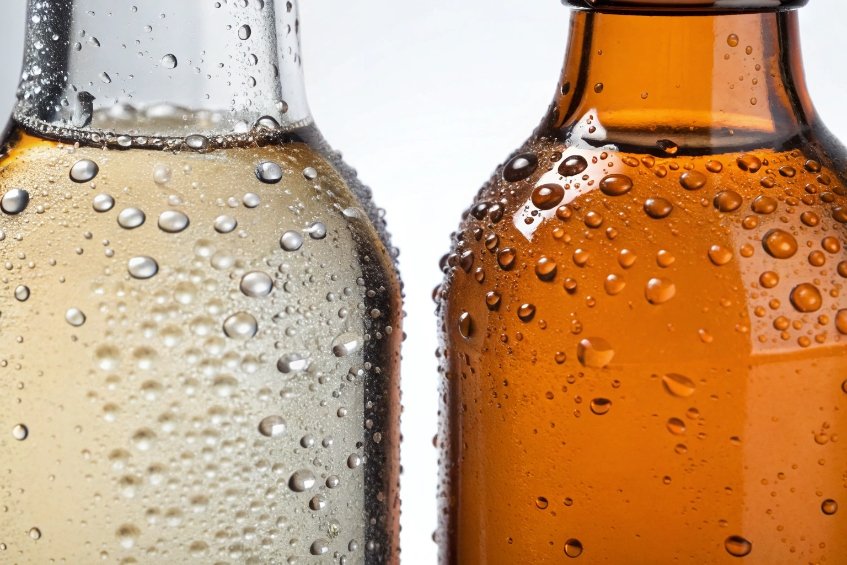
What primers and tie-coats improve adhesion on flint and amber glass?
Flint and amber glass look similar on drawings, but their surfaces behave differently in real coating lines. Some inks love one and hate the other. Primers and tie-coats bridge this gap.
Adhesion on flint and amber improves when you combine surface activation (hot-end oxide, cleaning, plasma/corona) with silane-based primers, acrylic/epoxy tie-coats, or matched underprints that are tuned for each glass chemistry.
Why glass type matters for adhesion
Flint and amber differ in:
- Composition (oxides used for color and UV control).
- Surface chemistry and micro-roughness.
- Interaction with hot-end oxides and cold-end lubricants.
This changes:
- Surface energy and wetting.
- Chemical bonding ability for primers.
- How quickly contaminants stick or migrate.
So a one-size-fits-all primer formula often gives uneven results across colors and factories.
Primer and tie-coat options
Useful primer families:
-
Silane-based primers
- Amino, epoxy, and methacrylate silanes.
- Bond to glass or hot-end oxides via siloxane bonds.
- Present organic groups that react with inks or topcoats.
Good for:
- Direct-on-glass UV inks.
- Sol–gel layers that need strong anchoring.
- Bridging cold-end PE / siloxane films and decorative coatings.
-
Acrylic and polyester primers
- Waterborne or solvent-borne.
- Create a flexible, clear or slightly tinted intermediate film.
- Designed to accept a wide variety of topcoats and inks.
Good for:
- Color coats on cosmetic and spirit bottles.
- Lines that run many colors but want one primer system.
-
Epoxy and polyurethane tie-coats
- Higher chemical and mechanical resistance.
- Strong crosslinking with compatible topcoats.
- Used when high chemical or abrasion resistance is needed.
Good for:
- Aggressive cleaners, high oil or solvent contact.
- Metallic finishes that need sealed edges and strong bonding.
Adapting primers to flint vs amber
In practice, we test each primer on both glass types:
- Measure contact angle and wetting on flint and amber.
- Run cross-hatch and tape adhesion after full cure.
- Run thermal cycling and, if needed, caustic or detergent tests.
Based on the result, small adjustments can help:
- Slightly different silane blend for amber vs flint.
- Different oven curve to match glass heat absorption.
- Localized surface activation (plasma/corona or flame) before priming.
A simple design table:
| Target problem | Primer / tie-coat choice | Extra steps |
|---|---|---|
| Poor ink adhesion on flint | Amino/epoxy silane + UV ink | Dyne check, light plasma if needed |
| Weak color coat on amber | Acrylic or polyester primer + color coat | Confirm cure schedule, adjust PE level |
| High-chemical cosmetic formula | Epoxy or PU tie-coat under clear topcoat | MEK rub + product-compatibility testing |
| Mixed flint/amber production | Silane-based universal primer | Tune surface prep by color if necessary |
The goal is simple: create a stable, well-bonded interface between glass (or hot-end oxides) and the decorative or functional layers. The right primer or tie-coat turns flint and amber from difficult substrates into reliable, repeatable surfaces.
Conclusion
Glass bottle coating materials are not interchangeable. Hot-end oxides, cold-end PE/siloxane layers, silane primers, sol–gels, UV urethanes, and ceramic inks each have a clear job—slip, protection, decoration, or barrier. Matching them to line conditions, heat loads, and food-safety needs is what makes the bottle work in the real world.
Footnotes
-
Explains why SnO₂ hot-end layers improve abrasion resistance and help cold-end coatings anchor. (↩) ↩
-
Example of water-based PE emulsion cold-end coating used to reduce scratches and improve handling. (↩) ↩
-
Clear primer on how silane coupling agents bond to glass and improve adhesion to organic coatings. (↩) ↩
-
Overview of UV/EB urethane acrylates and how they balance toughness, hardness, and cure speed. (↩) ↩
-
Practical sol–gel review explaining what controls durability, adhesion, and chemical resistance in hybrid layers. (↩) ↩
-
Explains “glass-like” SiOx barriers made by PECVD and why they improve gas barrier performance. (↩) ↩
-
Explains glass-decorating enamels/frits and how firing behavior drives durability in harsh wash/heat cycles. (↩) ↩






