
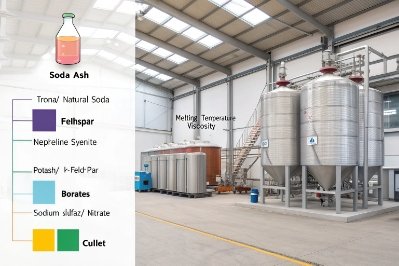
High fuel bills and unstable quality often start in the batch room. The wrong flux choice can raise melting load, add defects, and trigger color disputes.
Bottle-glass fluxes include carbonates, feldspathic minerals, borates, and a few specialty oxides. The right mix lowers melting temperature while keeping color, durability, and forming speed stable.
A practical flux map for container furnaces
What “flux” means in bottle production
A flux is any raw material that helps the batch melt and flow sooner. …It does this by breaking up the silica network and lowering melt viscosity at a given temperature. In container glass, flux is not a single ingredient. It is a controlled package that supports melting, refining, and forming.
The main flux families buyers will see
Most bottle plants use a blend of:
-
Carbonate alkalis: soda ash 1 (Na₂CO₃), and sometimes potash (K₂CO₃).
-
Feldspathic fluxes: feldspar and nepheline syenite 2 (alkali + alumina + silica).
-
Borate fluxes: borax, boric acid 3, and natural borates (more common in specialty or thermal-performance targets).
-
Specialty modifiers: small ZnO, Li₂O sources, or other intermediates in niche bottles.
What procurement should ask for
A good flux spec is not “use soda ash.” It is a set of controls tied to outcomes.
| Flux group | Typical purpose in bottles | Main risk if misused | Best control item |
|---|---|---|---|
| Na₂O sources | lower melt temp, lower viscosity | higher CTE, lower durability, volatilization | Na₂O window + redox stability |
| K₂O sources | adjust working range and appearance | cost, higher volatility in some melts | K₂O cap + consistency checks |
| Feldspathic fluxes | reduce CO₂ from carbonates, add Al₂O₃ | slower dissolution if coarse, dusting | PSD + melting completeness KPI |
| Boron sources | lower viscosity, thermal benefits | boron volatility, refractories attack | B₂O₃ limit + emissions discipline |
| Specialty oxides (ZnO/Li₂O) | niche performance tuning | cost, color interactions | restricted use + validation trial |
A flux strategy works when it lowers energy without creating new defects. The next sections answer the selection questions in a buyer-friendly way.
One clean rule helps: choose fluxes for the furnace you run, not the lab glass you wish you had.
What are fluxes and their melting roles?
Slow melting looks like a furnace problem. It is often a flux package problem that keeps sand and cullet from dissolving fast enough.
Fluxes lower melting temperature and viscosity so the batch reacts faster, bubbles leave easier, and the melt becomes uniform before it reaches the forming zone.

Flux roles explained with simple furnace logic
Fluxes reduce “network stiffness”
Silica builds a strong network. …That is good for durability. It is bad for melting speed. Alkali fluxes (Na₂O and K₂O) create a more open structure in the melt. This reduces viscosity at the same temperature. When viscosity drops, two things improve:
-
solid particles dissolve faster
-
bubbles rise faster and escape sooner
Fluxes help fining and homogenization
Even if a batch is melted, it can still be “dirty” inside. Cords and striae come from incomplete mixing and local chemistry pockets. Fluxes support mixing by keeping the melt fluid enough for convection and diffusion to do their job.
Fluxes also shape the working range
Bottle forming needs a narrow viscosity window at the feeder. A flux package shifts the viscosity curve 4. If the curve sits too high, the feeder struggles and defects rise. If the curve sits too low, gobs become unstable and thickness spreads.
| Flux role | What improves when it is right | What fails when it is wrong | What to monitor |
|---|---|---|---|
| Faster melting | higher pull stability | stones, cords | stone/cord trend by shift |
| Better fining | fewer seeds/blisters | sparkle defects | bubble counts + foam events |
| Stable gob flow | tighter thickness control | thin spots, checks | thickness map by zone |
| Consistent chemistry | fewer disputes | drift in ΔE and T(λ) | chemistry trend + optical trend |
Typical flux materials used in bottle plants
-
Soda ash (Na₂CO₃): the core Na₂O source in soda-lime glass.
-
Potash (K₂CO₃): used in smaller amounts when K₂O is needed.
-
…Feldspar / nepheline syenite: supplies alkali without carbonate CO₂, and brings Al₂O₃ support.
-
Borates (borax, boric acid, natural borates): more common when viscosity and thermal behavior need special tuning.
-
Cullet is not a flux, but it behaves like a melting aid because it is already glass and melts early.
Fluxes are the start of everything downstream. When flux is tuned, the furnace becomes calmer, and the forming line becomes faster.
Why flux choice affects energy and emissions?
Every batch decision has a carbon shadow. Flux can lower firing energy, but some flux sources also release CO₂ during decomposition.
Flux choice affects energy because it changes melting temperature and viscosity. It affects emissions because carbonate fluxes release CO₂, and some flux chemistries change SOx, NOx, and dust behavior.
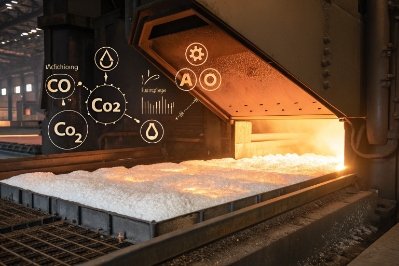
Energy and emissions are a trade, not a slogan
Energy: lower melt temperature usually wins
A stronger flux package can reduce the temperature needed to reach a workable viscosity. That can reduce fuel use per ton and improve pull stability. It can also reduce the need for emergency temperature corrections that cause volatility and deposits.
Process CO₂: carbonates are a direct source
Soda ash and potash are carbonates. They release CO₂ when they decompose in the melt. That CO₂ is “process CO₂,” not fuel CO₂. Even if the furnace is electrified, carbonates still release that CO₂ inside the melt. This is why high-carbonate batches can have a higher baseline CO₂ footprint.
Other emissions: sulfur and volatility management
Flux packages also influence:
-
SOx: if sulfate chemistry is used for fining, and sulfur balance is not stable.
-
NOx: mainly a burner and temperature issue, but flux that lowers melt temperature can support lower NOx strategies.
-
Dust and carryover: fine feldspathic fluxes and borates can increase dusting if handling is weak.
-
Volatilization: high alkali and boron can increase vapor species that create deposits.
| Goal | Flux direction that helps | Risk that must be managed | Practical mitigation |
|---|---|---|---|
| Lower energy per ton | stronger meltability (more effective flux + clean cullet) | foam, deposits | stable blanket + PSD control |
| Lower process CO₂ | reduce carbonate share, use feldspathic sources | slower melt if coarse | finer PSD + residence time |
| Stable color | stable redox and alkali | drift from corrections | fewer corrections + better sensors |
| Lower emissions pain | reduce peak temperatures | quality loss if under-melted | prove with seed/stone KPIs |
The clean path is not “maximum flux.” The clean path is “right flux plus stable operation.”
How to select Na₂O, K₂O, ZnO, or boron sources?
Buyers often ask for “more Na₂O” or “add boron,” then the plant fights viscosity and color drift. Selection must be based on the full oxide budget.
Selection means choosing sources that deliver the needed oxides while staying compatible with your furnace redox, volatility limits, and product requirements. Na₂O and K₂O drive meltability, ZnO is a niche modifier, and boron can lower viscosity but needs tight control.

…Selection rules that keep both cost and quality stable
Na₂O sources: cost-effective, but watch durability and CTE
Common Na₂O sources:
-
Soda ash (Na₂CO₃): most common, consistent, and easy to dose.
-
Feldspathic sources (nepheline syenite / sodium feldspar): lower carbonate CO₂, adds Al₂O₃ support.
-
Sodium silicate / NaOH (special cases): can reduce carbonate CO₂ but changes handling and batch moisture.
How I select:
-
Use soda ash for most standard bottles.
-
Add feldspathic flux when CO₂ reduction or stability needs justify it.
-
Avoid exotic sodium sources unless the plant has strong batch handling discipline.
K₂O sources: small tool, big sensitivity
K₂O is often used in smaller amounts because potash is more expensive. It can help tune working range and sometimes optical feel, but it can also add volatility sensitivity.
Common K₂O sources:
-
Potash (K₂CO₃)
-
Potassium feldspar
Selection rule:
- Keep K₂O as a controlled minor component unless a special SKU needs it.
ZnO: niche use, not a default bottle flux
ZnO can act like an intermediate oxide. In some glasses, it can support chemical durability 5 and change refractive behavior. In bottles, ZnO is usually limited by cost and by the need to keep color and redox stable. It is more common in special cosmetic packs than in commodity bottles.
Boron sources: powerful, but manage volatility and compatibility
Boron (as B₂O₃) can lower viscosity and improve thermal behavior in borosilicate-like systems. Common sources:
Selection rule:
- Use boron when the product truly needs thermal or chemical performance, and when the furnace can manage boron loss and deposits.
| Oxide target | Common source choices | Why buyers choose it | Main “do not ignore” risk |
|---|---|---|---|
| Na₂O | soda ash, nepheline syenite | melt speed, cost | CTE rise, carbonate CO₂ |
| K₂O | potash, K-feldspar | fine tuning | cost, volatility sensitivity |
| ZnO | ZnO powder (special) | niche durability/feel | cost, color interactions |
| B₂O₃ | borax, boric acid, natural borates | lower viscosity, thermal gains | volatility, refractory impact |
A safe sourcing plan always includes change control. If a supplier swaps a feldspar mine or borate grade, the furnace can drift even if the oxide target looks the same on paper.
Are alternative fluxes enabling lower-carbon melts?
Many brands want lower-carbon bottles, but they still expect the same clarity and forming speed. The path is real, but it is not only a new chemical.
Yes. Lower-carbon melting is being enabled by higher cullet use, feldspathic fluxes that cut carbonate CO₂, better batch preheating, and more electrification. Alternative fluxes help, but they must be paired with stable process control.
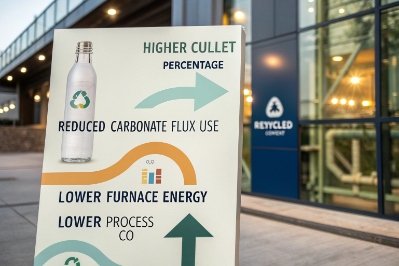
Lower-carbon melting is a package strategy
The three levers that matter most
1) More clean cullet
Cullet 6 melts earlier and reduces energy demand. It also reduces the need for virgin carbonates. Less carbonate input means less process CO₂ from decomposition. The risk is color drift and contamination, so closed-loop flint cullet becomes a big advantage for premium programs.
2) More non-carbonate alkali input
Feldspathic fluxes like nepheline syenite deliver Na₂O/K₂O without carbonate CO₂ and also add Al₂O₃ and SiO₂. This can reduce process CO₂ and support durability. The trade is dissolution speed and dusting, so PSD and mixing discipline matter.
3) Process upgrades
Batch preheating 7, improved blanket control, and electric boosting reduce fuel CO₂. These are not “fluxes,” but they change how much flux strength is needed. A furnace with better heat transfer can run with a more stable, lower-volatility flux package.
What “alternative flux” can realistically mean in bottles
-
Nepheline syenite / feldspar blends to reduce carbonate load.
-
Higher cullet + controlled sodium carbonate to keep melting stable at lower energy.
-
Liquid sodium silicate in special cases, when batch handling allows it.
-
Minor boron tuning for niche thermal programs, not for every SKU.
Premium feel and clarity can be preserved if the plan protects the basics:
-
stable Fe input and redox stability (for true flint)
-
low seeds and low cords (for optical clarity)
-
stable viscosity window (for forming speed)
-
stable thickness distribution (for strength)
| Low-carbon route | What it reduces | What it can break | What to lock before scaling |
|---|---|---|---|
| Higher cullet | fuel and process CO₂ | color drift, stones | cullet grade rules + reject SOP |
| Feldspathic flux share | carbonate process CO₂ | under-melt, cords | PSD + melt completeness KPIs |
| Batch preheating | fuel CO₂ | dust handling changes | batch handling discipline |
| Electric boosting | fuel CO₂ | new hot spots | temperature uniformity plan |
The honest answer for buyers
Alternative fluxes can support lower-carbon melts, but the big wins come from stable cullet streams and stable furnace operation. When those are in place, flux changes become safer and more predictable.
Conclusion
Flux choice controls meltability, energy, and quality. The best bottle programs use proven Na₂O sources, selective feldspathic and boron tools, and strong cullet discipline to cut carbon without adding defects.
-
Explains how soda ash reduces melting temperatures and acts as a key flux in glass manufacturing. ↩
-
Details how this alumina-rich flux lowers melting points and improves glass chemical resistance. ↩
-
Describes how borates lower viscosity and inhibit crystallization in specialized glass formulations. ↩
-
A guide to understanding how temperature changes affect glass flow and production control. ↩
-
Learn why glass resistance to weathering and corrosion is vital for product longevity. ↩
-
Highlights the energy-saving and emission-reducing benefits of using recycled glass in the melt. ↩
-
Overview of technologies that recover waste heat to preheat raw materials and save energy. ↩






