
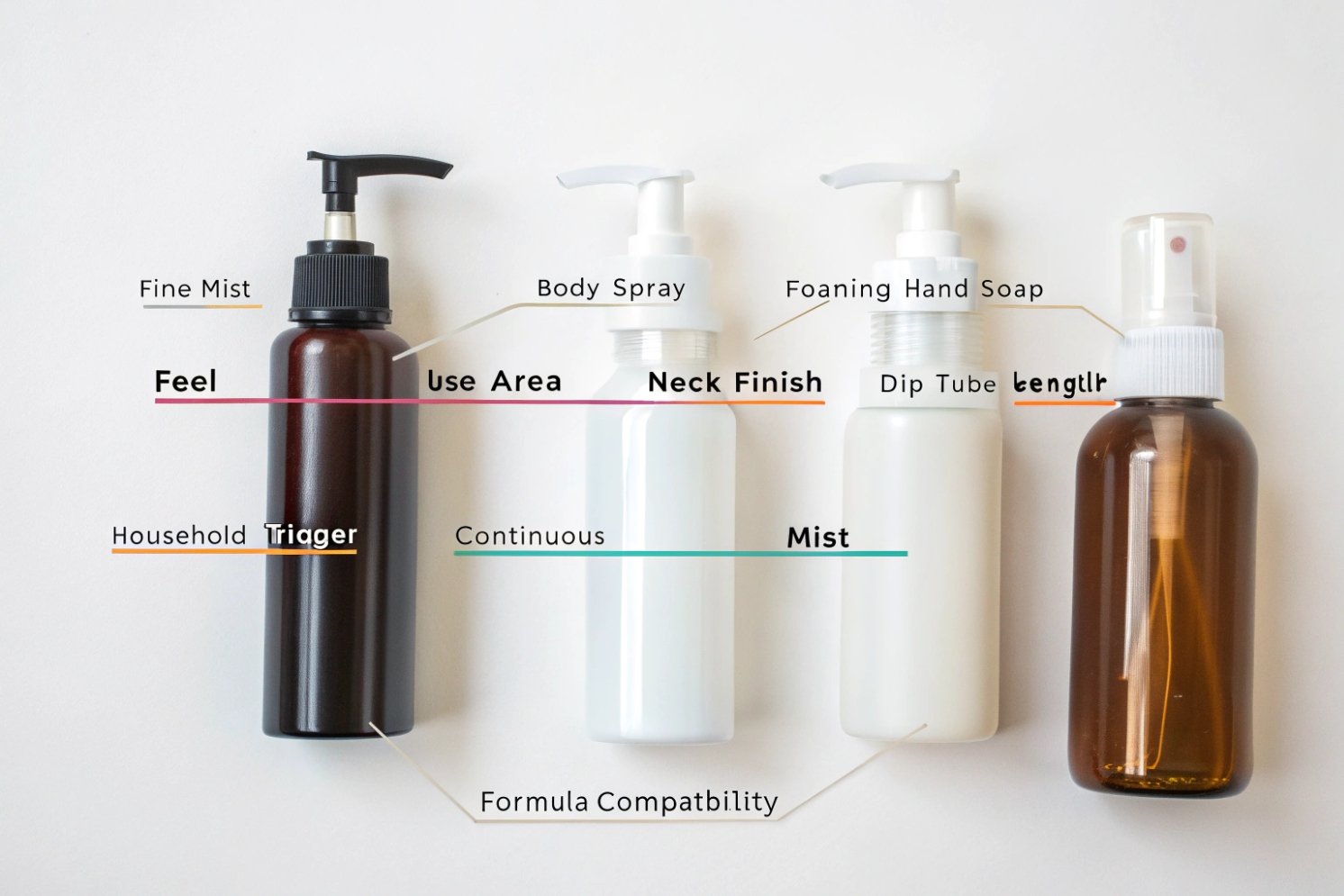
Spray bottles all look similar on the shelf, but a wrong choice can ruin a mist, leak in transit, or even attack the formula.
Fine-mist pumps suit perfumes and skincare, trigger sprayers suit cleaners, and foaming or continuous sprayers suit soaps and hair care. Neck finish, dip-tube length, output, and material compatibility decide whether the pack works or fails.
When I match a spray to a formula, I always look at four things together: how the mist should feel, where it will be used, what bottle it fits, and what the liquid can safely touch. Let’s walk through those step by step.
Mist, fine-mist, and trigger: which sprayer suits cosmetics vs. household?
It is easy to order “a sprayer” and only discover at filling that the spray is either a fire hose or a useless cloud.
Fine-mist atomizers are best for cosmetics and light fragrances, while trigger and foaming sprayers are better for household, garden, and heavy-duty cleaners that need higher output and coverage.
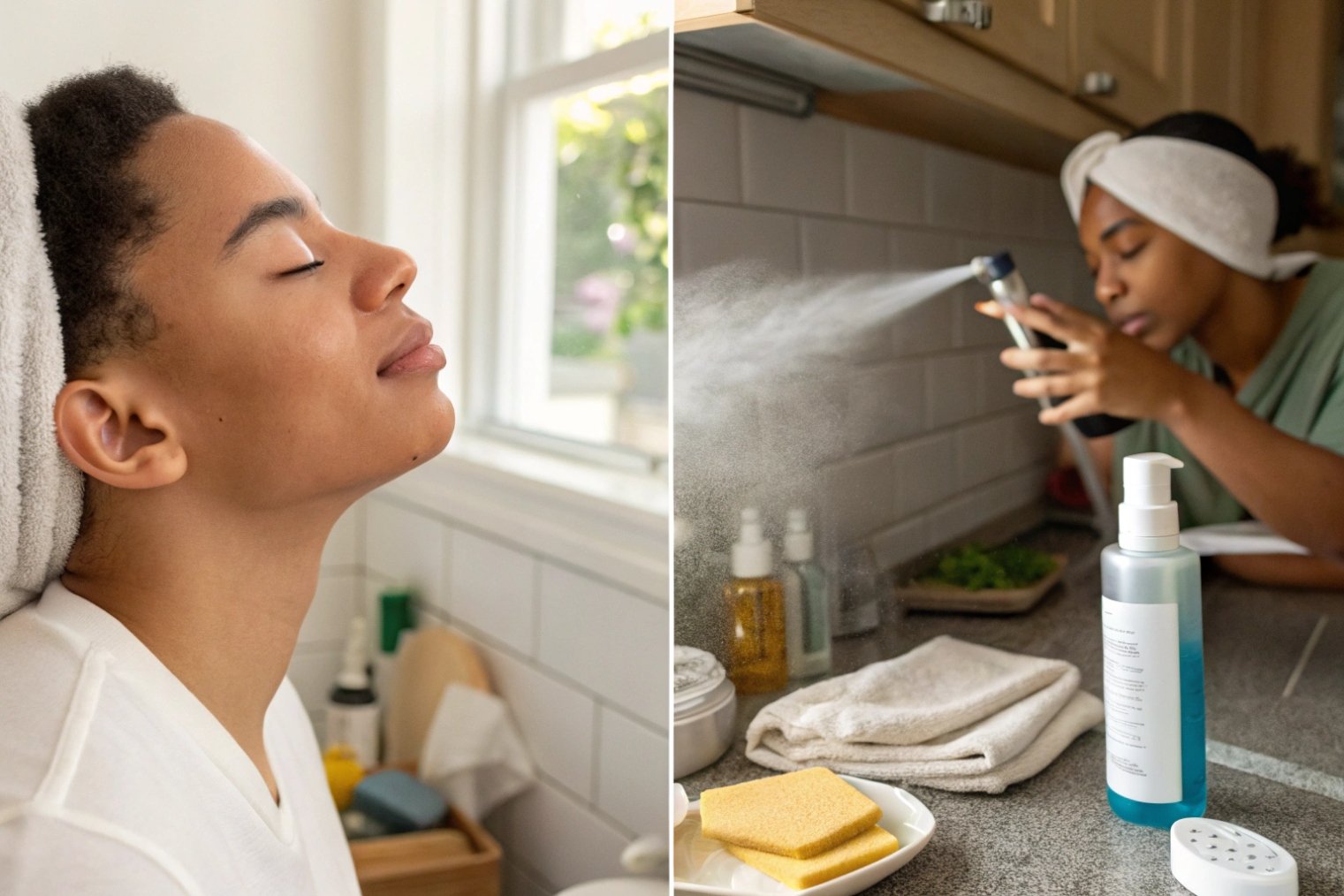
Key sprayer families at a glance
I like to start with a simple map of what exists. Most projects fall into one of these families:
| Sprayer type | Typical output / feel | Common uses |
|---|---|---|
| Fine-mist atomizer 1 | Very low, soft mist | Perfume, toners, facial mists, room sprays |
| Standard mist pump | Light but wetter mist | Body sprays, light hair products, sanitizers |
| Trigger sprayer | High output, mist or jet selectable | Household cleaners, gardening, surface care |
| Foaming pump / trigger | Rich foam, low run-off | Hand soap, face wash, degreasers |
| Continuous-spray bottle 2 | Long, aerosol-like mist | Hair styling, tanning, plant care, home care |
| Aerosol / bag-on-valve systems 3 | Ultra-fine, very even film | Deodorant, hairspray, sunscreen, medical sprays |
| Airless mister 4 | Fine mist with low air intake | Active-rich skincare, sensitive formulations |
| Pump-up pressure sprayer | Very high volume, adjustable pattern | Gardening, pest control, disinfection |
Fine-mist finger pumps atomize a small dose with each press and spread it in a soft cloud. Trigger sprayers are little pumps with a lever handle. They move much more liquid and often let users switch between mist and stream. Foaming heads mix air into the liquid to produce a clinging foam that does not run off quickly.
Continuous-spray bottles sit in between classic pumps and aerosols. A few fast strokes pressurize a chamber, and the bottle then releases a long, even mist. There is no propellant gas inside, so they are often easier to ship than classic aerosols, but the feel is very close.
Matching sprayers to cosmetics and personal care
For face and body, the skin feel of the mist matters as much as coverage.
- Perfumes and EDTs: need a fine, even mist that hangs in the air for a moment and lands lightly on skin or clothes. Here I use fine-mist atomizers with small outputs.
- Facial toners and mists: also need gentle coverage, with droplets small enough not to leave big wet spots or choke the user. Fine-mist or high-quality standard mist pumps work well.
- Makeup setting sprays, hair treatments, light oils: often like slightly higher output, still in a soft pattern, so the product coats evenly without dripping.
Continuous-spray bottles are popular for hair styling and tanning mists because they coat large areas quickly and give a similar feel to aerosol, without gas. For very active skincare that should not pull air back into the bottle, airless misters are a useful option. They protect oxygen-sensitive actives and keep the spray feel stable until the last dose.
Matching sprayers to household, garden, and pro use
Household and garden products usually need much more liquid per stroke and must hit surfaces at a distance.
- Kitchen and bathroom cleaners: typically use trigger sprayers with 0.7–1.2 ml per stroke. Users can switch between a fan-shaped mist for wide coverage and a narrow jet for stains.
- Glass cleaners: also use triggers, but the pattern is often tuned for fewer streaks.
- Degreasers and heavy formulations: often move to foaming triggers, so the product clings to vertical surfaces and has more dwell time.
- Gardening and pest control: may use trigger sprayers for small volumes, or pump-up pressure sprayers for large areas.
Electrostatic sprayers add a charge to droplets so they “wrap” around objects. These are more niche, used mainly for fast disinfection of large spaces.
So, for cosmetics, I lean toward fine-mist, continuous, or airless systems that feel gentle. For household and garden, I lean toward trigger, foaming, and pressure sprayers that move volume and withstand tough handling.
What dip-tube lengths and thread finishes fit standard bottles?
A perfect spray head still fails if the tube is too short or the thread does not match, so the line leaks or leaves a lot of product behind.
Most cosmetic fine-mist pumps use small neck finishes like 18/410 or 20/410, while household triggers often use 24/410 or 28/410; dip tubes are cut just off the bottle base to avoid kinking.
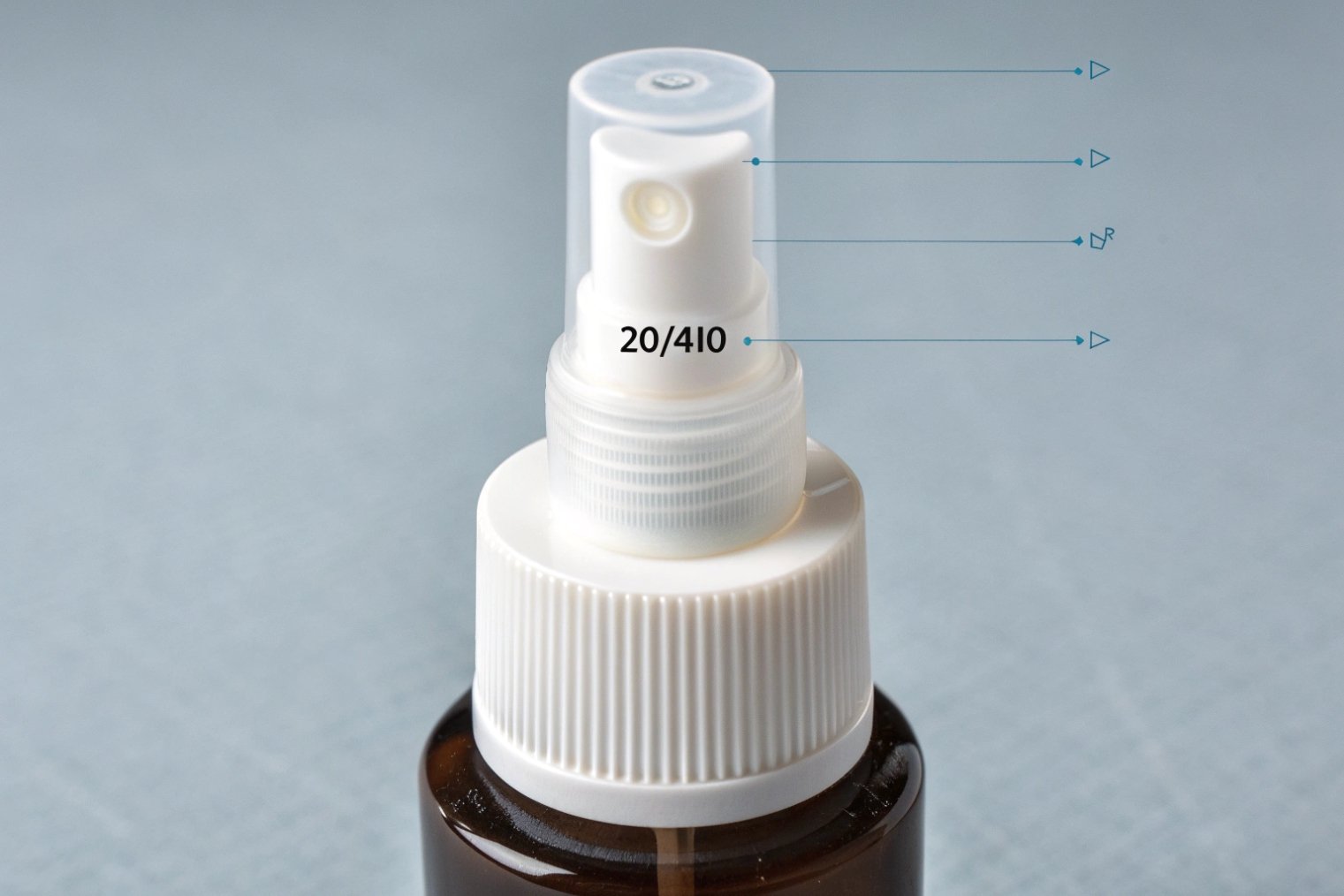
Common neck finishes and where they appear
Neck finish codes combine outer diameter and thread style. In many spray projects I see the same sizes again and again:
| Neck finish | Typical bottle volume | Common use |
|---|---|---|
| 13/410 | Small 5–10 ml vials | Travel perfumes, samples |
| 15/410 | 10–20 ml | Niche fragrances, face mists |
| 18/410, 18/415 | 15–50 ml | Serums, perfumes, light mists |
| 20/410 | 30–120 ml | Toners, hair mists, light body |
| 22/410 | 80–200 ml | Body sprays, some hair care |
| 24/410, 24/415 | 200–500 ml | Household spray, cosmetic refills |
| 28/400, 28/410 | 500 ml and above | Cleaners, garden, pro products |
The last part (410, 415, 400) describes thread style and height. Sprayers must match both the diameter and the thread style to seal correctly. Even a small mismatch can cause slow leaks or pumps that never fully tighten.
When I design around existing glass bottles, I always ask first: “What neck finish do we already have?” That number then drives which sprayer families are available from suppliers. If you need a clear primer on how these codes work, the GPI 20/410 neck finish standard 5 is a useful reference point.
Setting dip-tube length correctly
Dip tubes should reach close to the bottom without folding or pressing into the corner.
A simple rule of thumb:
- Measure the inside height from sealing surface to base.
- Subtract 2–3 mm so the tube sits just off the bottom.
- If the base is domed, cut the tube at a slight diagonal so it does not seal itself against the glass.
For sloping or unusual shapes, I sometimes accept a small “dead volume” at the base, especially for premium products where the very last drops are less important than a consistent spray pattern.
Dip tubes also change with viscosity. Thicker products may need a slightly wider tube or a shorter path to reduce suction effort. For thin, very fluid products, a standard tube works fine.
Matching standard components to your bottle
To keep tooling costs low, I try to choose:
- A bottle neck that matches standard 410 / 415 threads.
- A sprayer with a tube supplied extra-long, then cut at filling.
- A cap that matches the sprayer collar and looks coherent with the rest of the line.
This way, the same sprayer can work on several bottle heights simply by adjusting the tube. It also makes replacements and supplier changes easier if a later project needs higher output or a different mist without changing the whole bottle family.
How do output and particle size affect user experience?
Two pumps can look identical, but one gives a beautiful cloud and the other spits; the difference is output volume and droplet size.
Low-output, small-particle nozzles feel soft and luxurious for face and fragrance, while higher output and larger droplets suit cleaning, gardening, or body products where users want to see a wet surface.
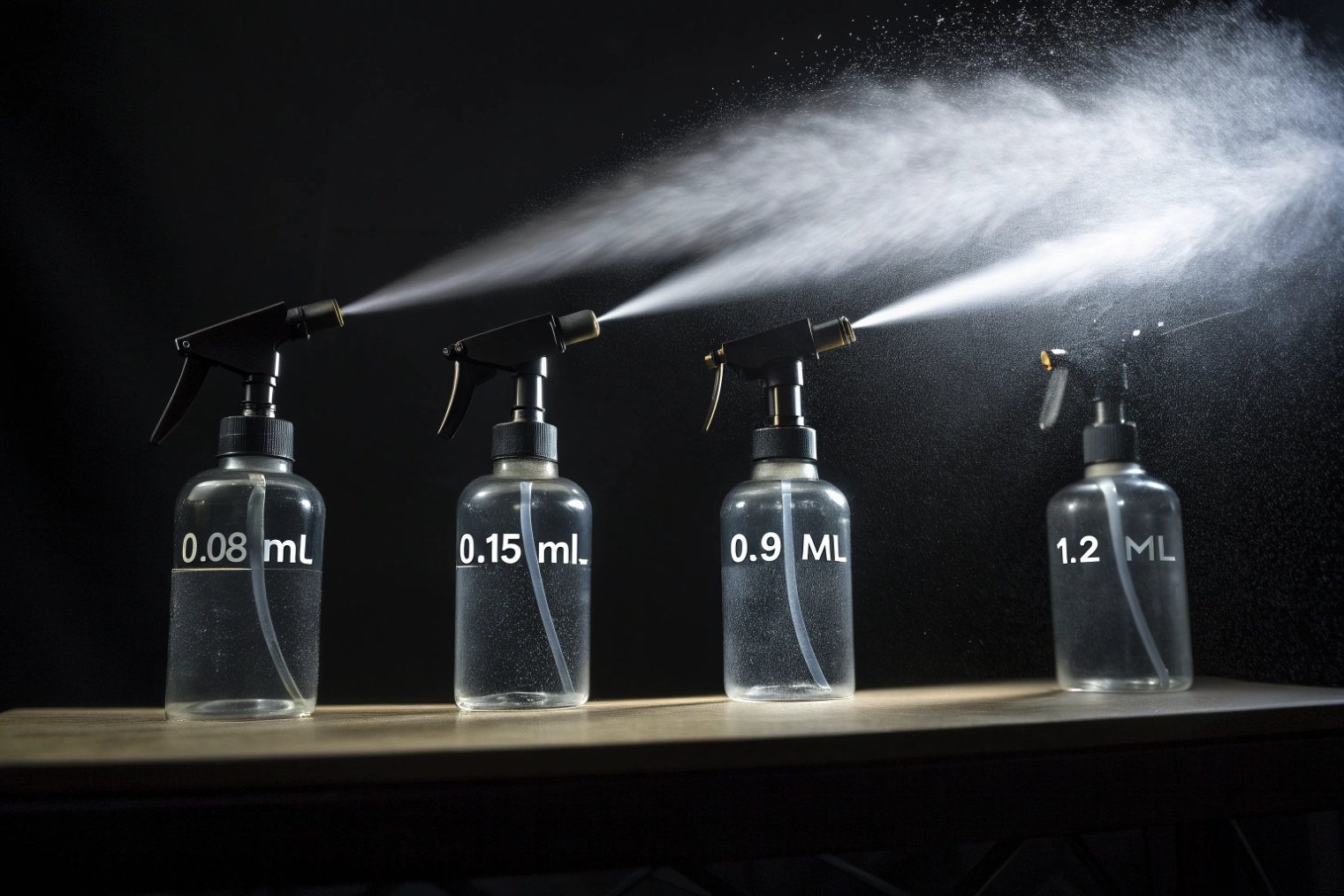
Output volume: how much comes out per spray
Output is usually given in ml per stroke. Typical ranges look like this:
| Sprayer type | Typical output per stroke |
|---|---|
| Fine-mist atomizer | ~0.05–0.16 ml |
| Standard mist pump | ~0.15–0.30 ml |
| Trigger sprayer | ~0.7–1.4 ml |
| Foaming pump | ~0.4–1.0 ml (foam volume larger) |
| Continuous mister | ~1.0 ml per second of spray |
For fragrance and face mists, I prefer 0.08–0.12 ml per spray. This gives a clear sensation without soaking skin or hair. For body sprays, 0.15–0.20 ml often feels better because users are covering larger areas.
For household cleaners, 0.9–1.2 ml is common. One or two pumps can wet a decent patch of countertop or glass. If output is too low, users overwork their fingers and feel the product is weak.
Droplet size: cloud, mist, or splatter
Droplet or particle size controls how the spray feels and how it behaves on surfaces. If you want a practical, measurement-oriented overview, this spray nozzle drop size bulletin 6 is a solid reference.
- Very fine droplets (tens of microns) give a soft, cloud-like mist. They are ideal for face and hair but can hang in the air and be inhaled more easily, so the formula must be safe for that use.
- Medium droplets work for body sprays and surface cleaners where we want a light wet film.
- Larger droplets make visible spots and reduce airborne mist. They suit trigger sprays and jet patterns where precise wetting is needed.
We can think of it simply:
| Droplet feel | Perceived effect | Best for |
|---|---|---|
| Cloudy, almost dry | Luxurious mist, light coverage | Face mists, perfumes, hair refreshers |
| Light, wet film | Noticeable moisture, no run-off | Body sprays, glass cleaners |
| Visible drops | Strong wetting, fast coverage | Degreasers, garden sprays, stain removers |
For cosmetics, too large droplet size feels cheap and can disturb makeup. For cleaners, too fine a mist risks inhalation and overspray onto nearby objects. So I always test nozzles with real product on skin, hair, glass, and counters, not only with water in the lab.
Balancing feel, safety, and product cost
Output and droplet size also control how much product gets used per application. A high-output, ultra-fine mist can feel great but may burn through perfume quickly. A simple “cost per spray” check helps keep both brand and user happy.
The sweet spot is where:
- The user feels in control, and the spray lands where they aim.
- The coverage matches the task.
- The bottle lasts a reasonable number of uses for its price.
When we tune output and particle size to that balance, complaints about “too wet”, “too weak”, or “leaks everywhere” drop sharply.
Which materials are compatible with alcohol, acids, or oil-based formulas?
Spray packs have many hidden parts: springs, gaskets, valves, tubes. If any of those materials dislike the formula, the pump can swell, crack, smell, or seize.
For alcohol-rich perfumes and sanitizers, PP/PE, stainless steel, and FKM/EPDM seals work well; for acids and strong cleaners, more resistant plastics and elastomers are needed; for oils, avoid plastics that swell or stress-crack.
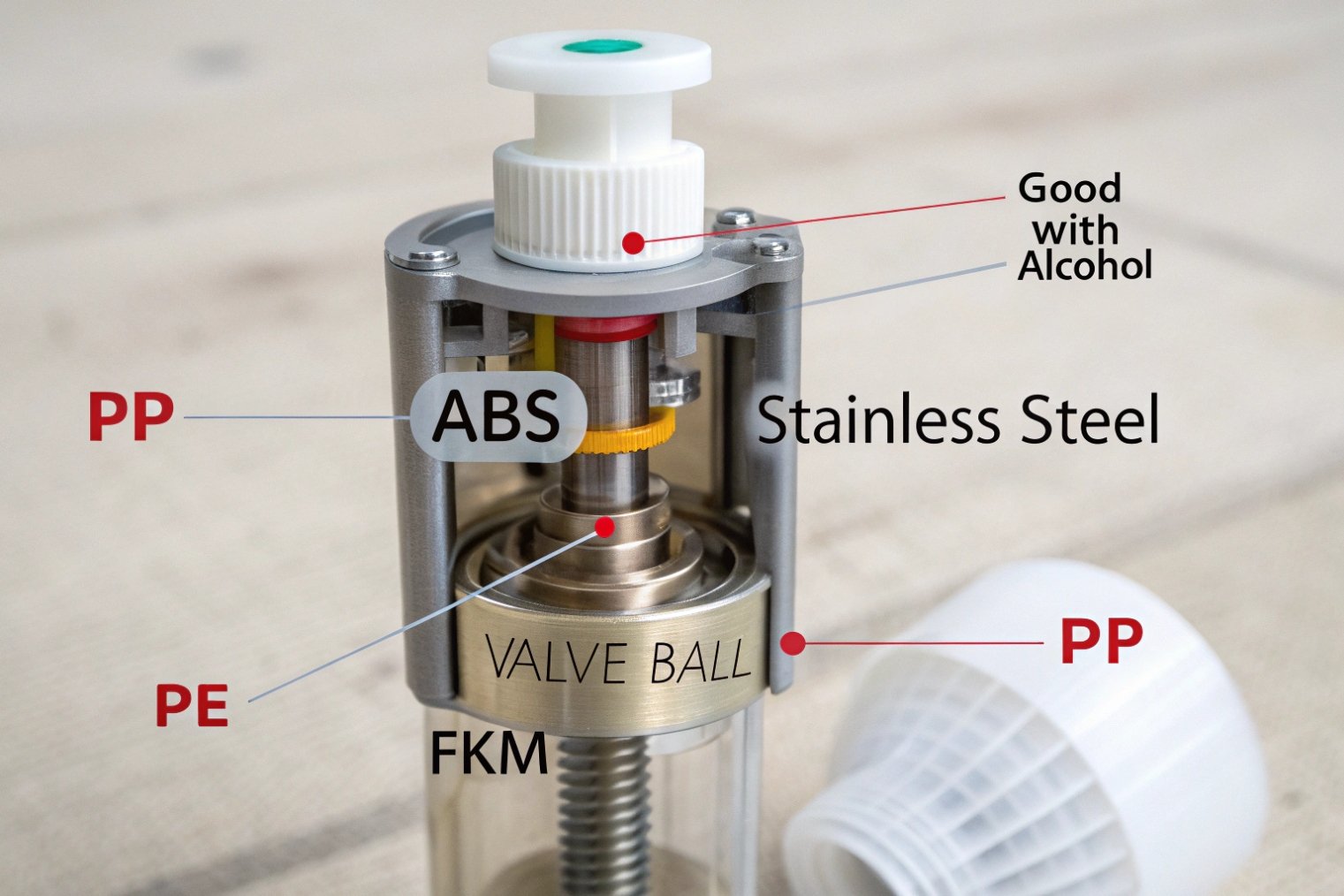
Materials inside a typical spray pump
Most sprayers combine:
- Housing and actuator: often PP or sometimes PET or ABS.
- Dip tube: LDPE, HDPE, or PP.
- Spring: stainless steel in many cosmetic and household pumps.
- Seals / gaskets / valves: various elastomers such as NBR, EPDM, or FKM.
Compatibility is always a pair problem: this formula vs. this material. But some patterns repeat often.
Alcohol-based fragrances and sanitizers
High-ethanol formulas can attack some plastics and rubbers. For perfume and many sprays I look for:
- PP or PE for housings and tubes. They tolerate ethanol well.
- Stainless-steel springs to avoid rust.
- FKM (Viton-type) or EPDM seals for long life with alcohols and many fragrance oils.
If you need a quick place to sanity-check seal choices, an EPDM and FKM chemical compatibility guide 7 can help you spot obvious red flags before you test.
PVC and low-grade rubbers can leach plasticizers or give a faint “plastic” or “rubbery” smell, so I avoid them near alcohol-heavy perfumes. PET bottles can hold ethanol too, but over the long term glass is still more stable for fine fragrance.
Acidic and alkaline cleaners
Strong bathroom or kitchen cleaners can be tough on both glass and pump parts.
For these, I focus on:
- PE and PP again for tubes and bodies, often with thicker walls.
- High grade stainless steel or plastic (no metal) springs depending on pH.
- EPDM or special elastomers that resist alkali or acid.
Some very aggressive products use trigger sprayers without metal springs, where a plastic spring or a no-spring “bellows” design handles the return. This removes one common corrosion point.
Oil-based and solvent-heavy formulas
Essential oils, citrus terpenes, and some solvents can swell or crack certain plastics.
For oil-heavy products, I like:
- HDPE or PP tubes and bodies.
- Caution with POM and PC, which some solvents can attack.
- Seals selected and tested with the real oil blend, not just with a surrogate.
Again, it is not enough to read a chart. I prefer soak tests where the finished pump sits in contact with the real formula for weeks at warm and room temperatures. I check for:
- Swelling or softening.
- Odor transfer from plastic to liquid.
- Sticky valves or changes in output over time.
When materials and formula are in harmony, the pump feels the same on day 300 as it did on day 1, and the only thing that changes is how much product is left.
Conclusion
When you choose a spray bottle, you are really choosing a full system: sprayer type, neck and tube, output and particle size, and all the materials in contact with your formula and your customer.
Footnotes
-
Explains how atomizers break liquid into fine droplets for a soft mist. ↩ ↩
-
Shows the pre-compression mechanism behind continuous, aerosol-like spray without propellant. ↩ ↩
-
Overview of aerosol dispensing and where bag-on-valve fits as a barrier alternative. ↩ ↩
-
Explains airless fine-mist pumps that limit air intake for sensitive cosmetic formulas. ↩ ↩
-
Helps decode 20/410-style neck finishes so closures seal correctly across suppliers. ↩ ↩
-
Practical guide to understanding and measuring spray droplet size from nozzles. ↩ ↩
-
Quick compatibility reference for EPDM and FKM when choosing seals for challenging formulas. ↩ ↩






