
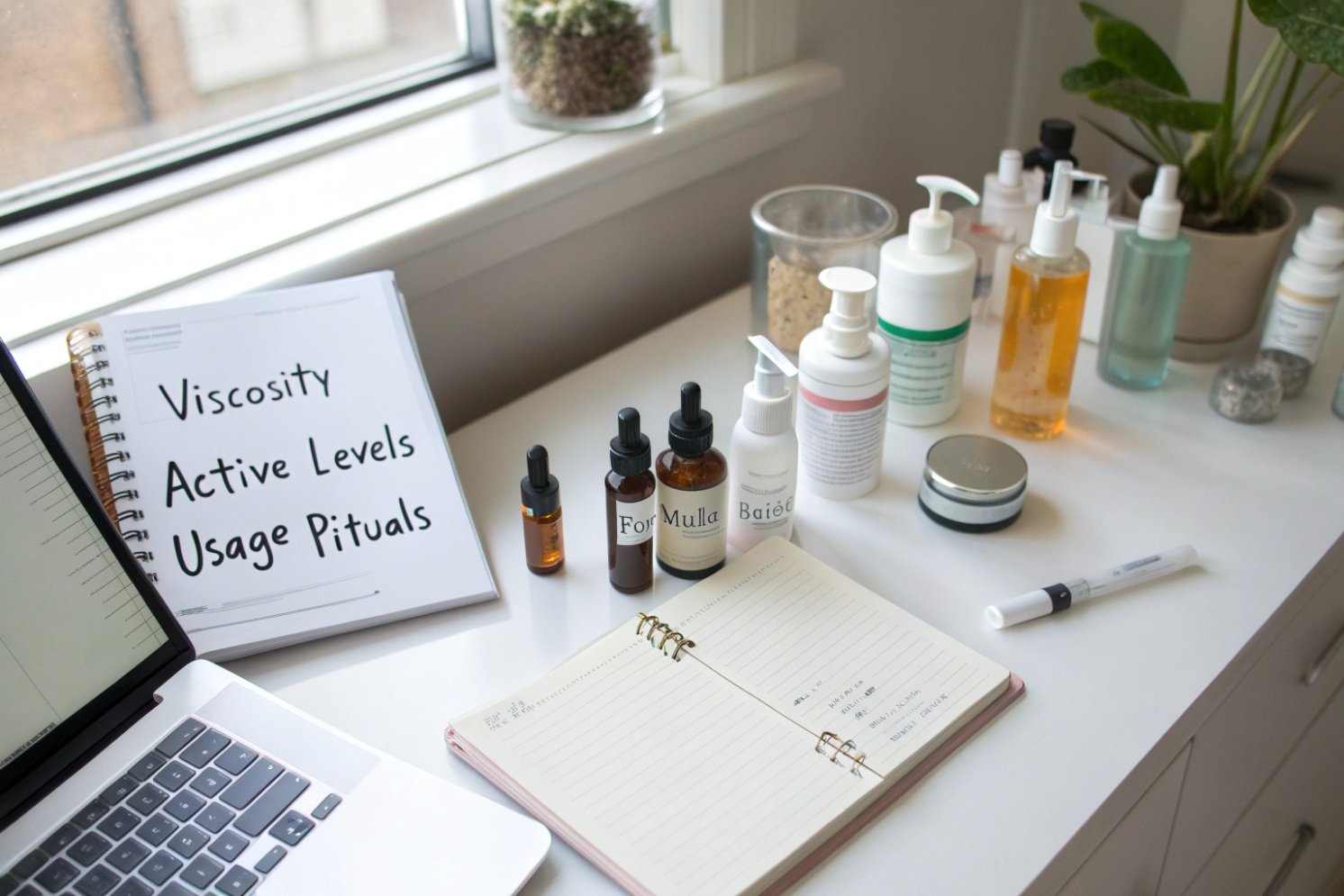
Most “bottle problems” start long before filling. They start when closure, capacity, and decoration do not match the formula or the brand story.
Cosmetic brands can choose from droppers, pumps, airless, mists, rollers, and squeeze bottles, but the right match depends on viscosity, sensitivity to air/light, usage ritual, and sourcing strategy.
A smart packaging plan does not start from shape; it starts from the formula and how the consumer will use it. Once we understand formula viscosity 1, active level, and application zones, the correct closure type, neck standard, and decoration path become much easier to define.
Dropper, pump, and mist bottles: which closure fits your formula?
Every formula wants to leave the bottle in its own way. Thin serum, rich cream, and watery toner should not share the same closure just because they share a line name.
Droppers suit low-viscosity serums and oils, pumps suit lotions and creams, and fine-mist sprayers suit toners and fragrances; formula texture and dosage control decide which closure actually works.
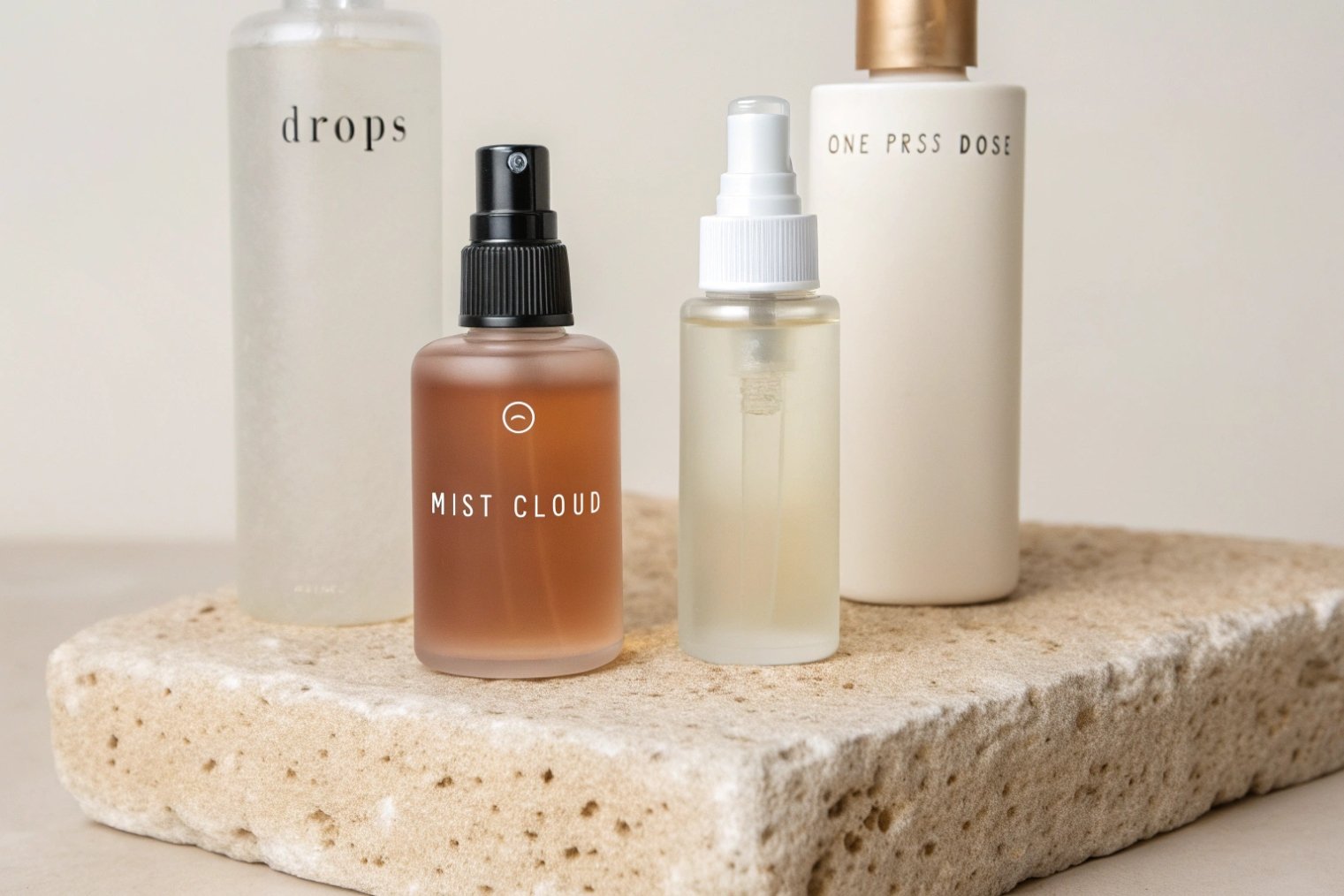
For modern skincare and cosmetics, three closures appear over and over: droppers, pumps, and misters. Each one works best in a certain viscosity window and usage ritual.
Dropper bottles (glass or PET/PETG) are ideal for:
- Low- to medium-viscosity serums and treatment essences
- Anhydrous or oil-based formulas like facial oils and booster concentrates
- Products where the user doses by drops (for example 2–3 drops into the palm)
The pipette gives precise control, and the glass body protects sensitive actives. Droppers also work well for multi-phase or “booster” products that customers mix with other creams in the hand. They look technical and “lab-like”, which fits many active or clinical ranges.
Lotion pump bottles are the workhorses for:
- Emulsions: lotions, light creams, body milks
- Cleansers, liquid soaps, and more viscous serums
- Foundations and tinted moisturizers in daily-use formats
Here the goal is one press = one use zone. Pumps keep fingers out of the bulk, improve hygiene, and feel effortless in the bathroom. Screw or crimp pumps on glass bodies give a premium look; PP or PET bottles with pumps keep weight and cost down for mass lines.
Fine-mist spray bottles or atomizers are best when:
- The formula is very low-viscosity, near water
- We want a cloud, not a dose blob: toners, facial mists, fixing sprays, light hair mists
- The spray experience itself is part of the pleasure (cooling, refreshing, setting)
In these cases, a dropper or pump would lay down too much product and disturb makeup or hair.
A quick mapping:
| Formula type | Typical viscosity | Best closure choice |
|---|---|---|
| Vitamin C / retinol serum | Thin–medium | Dropper or treatment pump |
| Facial oil / dry oil | Low–medium (oily) | Dropper or roller for targeted use |
| Day cream / body lotion | Medium–high | Lotion pump |
| Watery toner / essence mist | Very low | Fine-mist spray |
| Hair and body mist | Very low | Fine-mist or continuous spray |
When in doubt, think about three points together: viscosity, dose size, and target area. If the user needs drops into the hand, use a dropper. If they need one press for a face or arm, choose a pump. If they should feel a cloud on face or hair, use a mister.
When should brands choose airless bottles over standard pumps?
Airless packs are not just “more expensive pumps”. They solve specific problems, and for the wrong formula they simply add cost.
Airless bottles make sense for oxygen-sensitive or preservative-light formulas, high-value actives, and textures that must keep performance from first to last dose; standard pumps are enough for stable, everyday products.
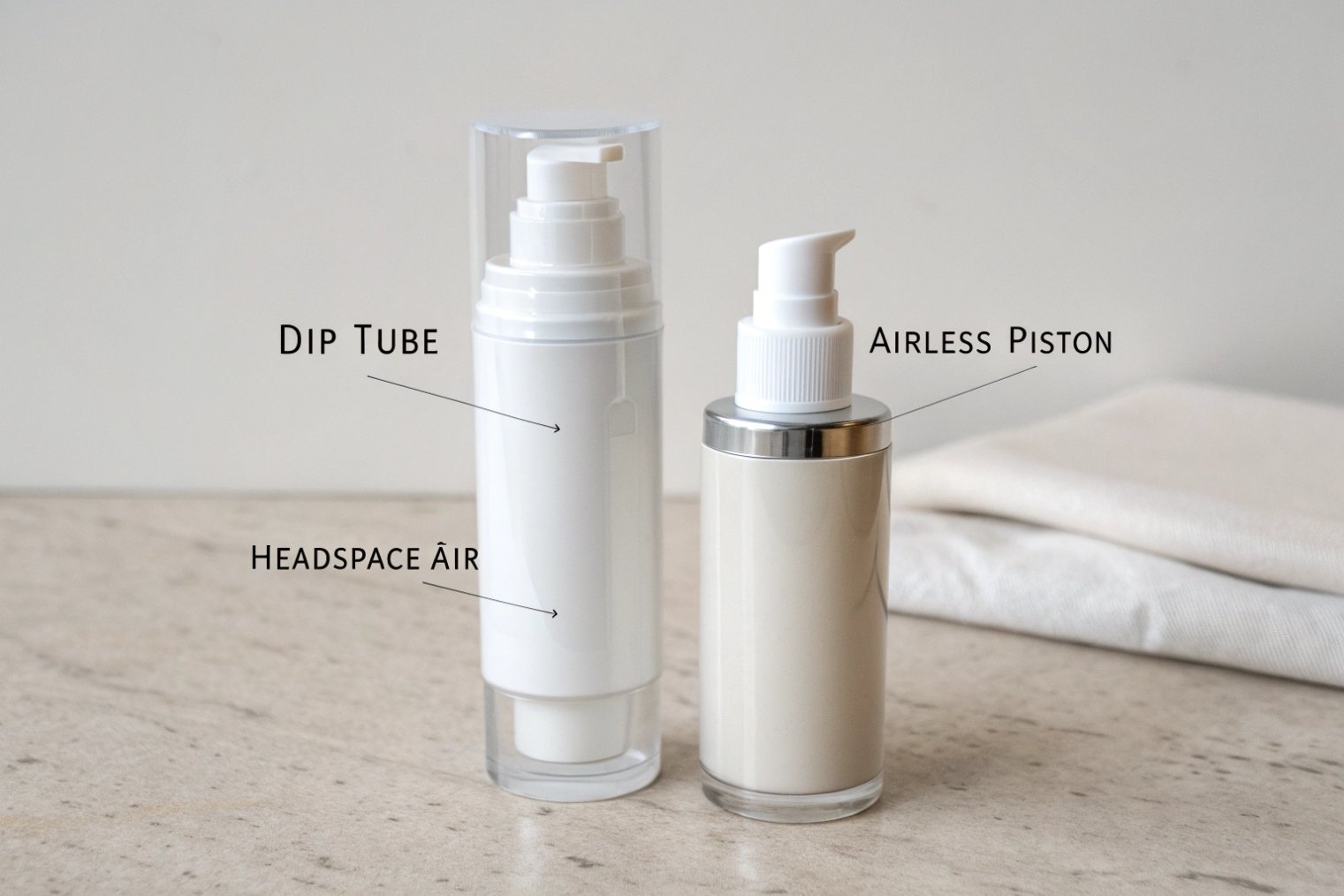
Standard pumps rely on a dip tube that pulls product up from the bottom while air enters the bottle to replace the volume. This is perfectly fine when formulas:
- Are reasonably stable in air
- Have enough preservative system
- Are not extremely expensive per milliliter
However, many modern skincare and derm-cosmetic formulas push in the opposite direction. They use:
- High levels of sensitive actives (vitamin C, retinoids, peptides, probiotics)
- Lower preservative loads to meet “clean” or “sensitive skin” claims
- Rich textures that oxidize or discolor when exposed to air
For these lines, airless systems 2 bring clear advantages:
-
Minimal air contact
The piston or collapsing bag moves up as product is dispensed, so almost no new air enters. This slows oxidation and color change, and keeps sensitive actives closer to their designed potency. -
Improved hygiene
There is no “pump-back” of air through the actuator, and the small orifice reduces the chance of contamination. This is helpful for eye-area creams, post-procedure care, and children’s products. -
High evacuation rate
Airless bottles can empty 95–99% of the content 3. This matters for expensive formulas or thick creams that often sit in the corners of a standard bottle. -
Stable dosing at any fill level
The first and last dose look and feel the same because pump performance does not depend on headspace.
When should a brand stay with standard pumps instead?
- For basic moisturizers, body lotions, and cleansers where the formula is robust.
- When price point does not support the extra packaging cost.
- When the communication is more about indulgence than “clinical precision”.
A useful rule: if the marketing and R&D teams talk often about “oxidation”, “freshness until last drop”, or “almost preservative-free”, airless is usually worth the investment. If the product is a general daily lotion with conventional system, a well-designed standard pump is enough.
How do capacity and neck finish standards simplify bulk sourcing?
It is tempting to invent custom everything: new molds, new necks, new caps. But each new dimension is a new risk and a new cost.
Using standard capacities (15–30–50–100 ml) and neck finishes (e.g., 18/410, 20/410, 24/410) lets brands reuse closures across SKUs, switch suppliers more easily, and keep MOQs and lead times under control.
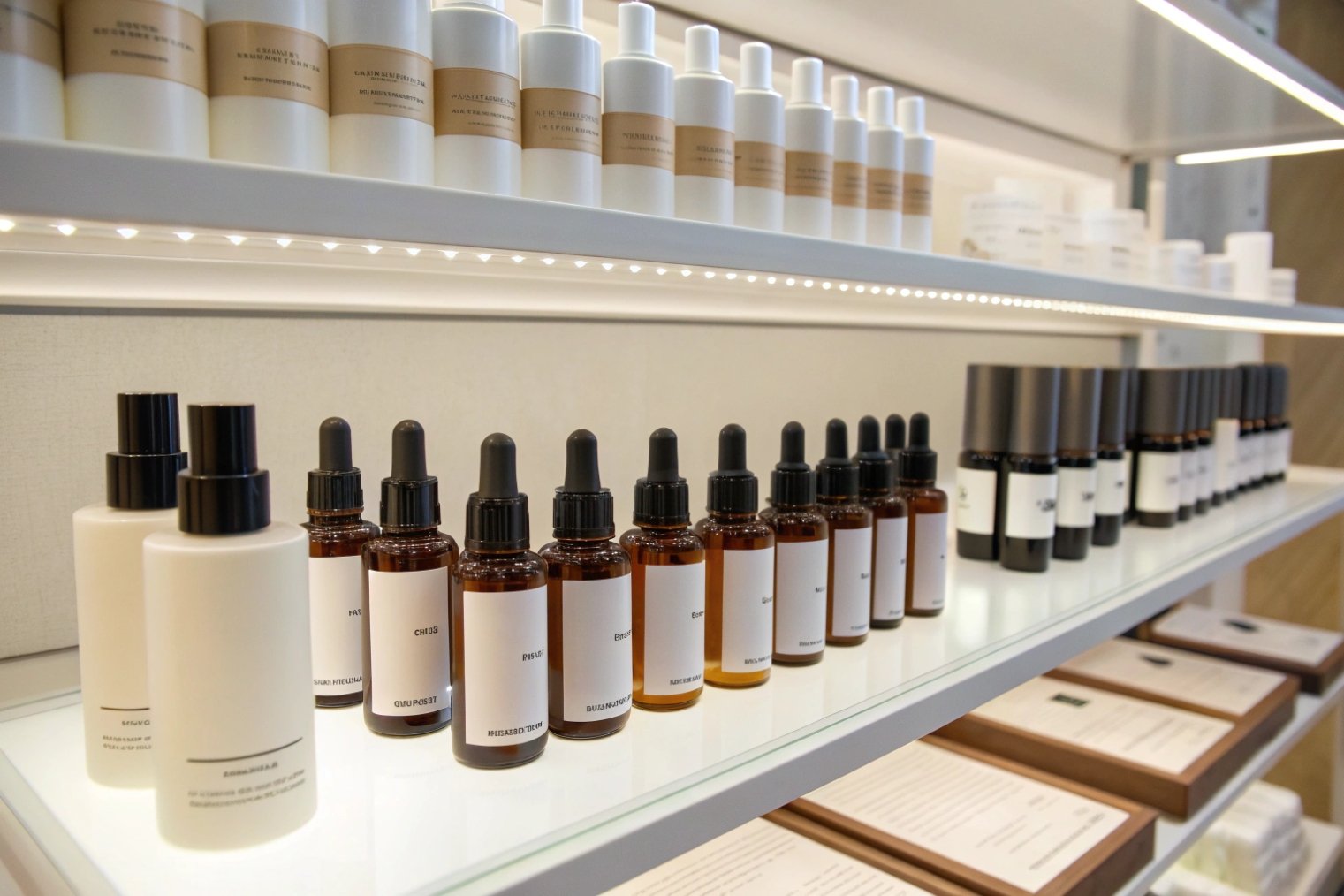
Capacity and neck standards are the quiet heroes of a smooth supply chain. When they are aligned, life gets easier for both the filler and the brand.
Standard capacities like:
- 10 / 15 / 20 / 30 / 50 ml for serums and droppers
- 100 / 150 / 200 / 250 / 300 ml for toners and hair care
- 200 / 300 / 400 / 500 ml for body care and cleansers
allow you to:
- Combine multiple formulas in a coherent visual ladder (for example 30 ml serum + 100 ml lotion + 200 ml body product).
- Use existing production lines and automated case-packing with proven tooling.
- Tap into a wide catalog of ready-made bottle shapes instead of starting with custom molds.
More important, neck finishes tie everything together. Codes like 18/410, 20/410, 24/410 4 describe outer diameter and thread style. If you keep these consistent across a family, you can:
- Use the same pump on several bottle heights and even different materials (glass, PET, PETG).
- Swap in droppers, mists, or disc-top caps on the same base bottle for different SKUs.
- Change decoration or label only, while keeping bottle and closure shared across regions.
Example:
- Serum in 30 ml glass dropper: 18/410
- Oil in 30 ml glass with treatment pump: 18/410
- Mist in 50 ml PET spray bottle: 18/410
One neck, three closures, one parts family to source and manage.
For volume sourcing, this also means:
- Lower MOQs on closures because you aggregate demand across SKUs.
- Faster second-sourcing if one supplier has delays; another vendor can step in with the same thread and gasket geometry.
- Easier forecasting: you buy pumps and droppers as a shared pool, not SKU by SKU.
A short guide for planning:
| Product family | Suggested capacities | Typical necks |
|---|---|---|
| Active serums / oils | 15 / 30 / 50 ml | 18/410 or 20/410 |
| Toners / hair mists | 100 / 150 / 200 ml | 20/410 or 24/410 |
| Body care / cleansers | 200 / 300 / 500 ml | 24/410 or 28/410 (pumps / triggers) |
Once capacities and neck finishes are standardized, you can focus creativity on glass shape and decoration, instead of rebuilding the entire mechanical system for every new SKU.
Many brands want a “luxury” bottle, but custom molds and complex decorations often demand huge minimums and long lead times.
Frosting, spray coloring, simple gradients, one- or two-color screen printing, and hot-stamped logos can create a premium appearance on standard bottles, keeping MOQs and tooling costs reasonable.
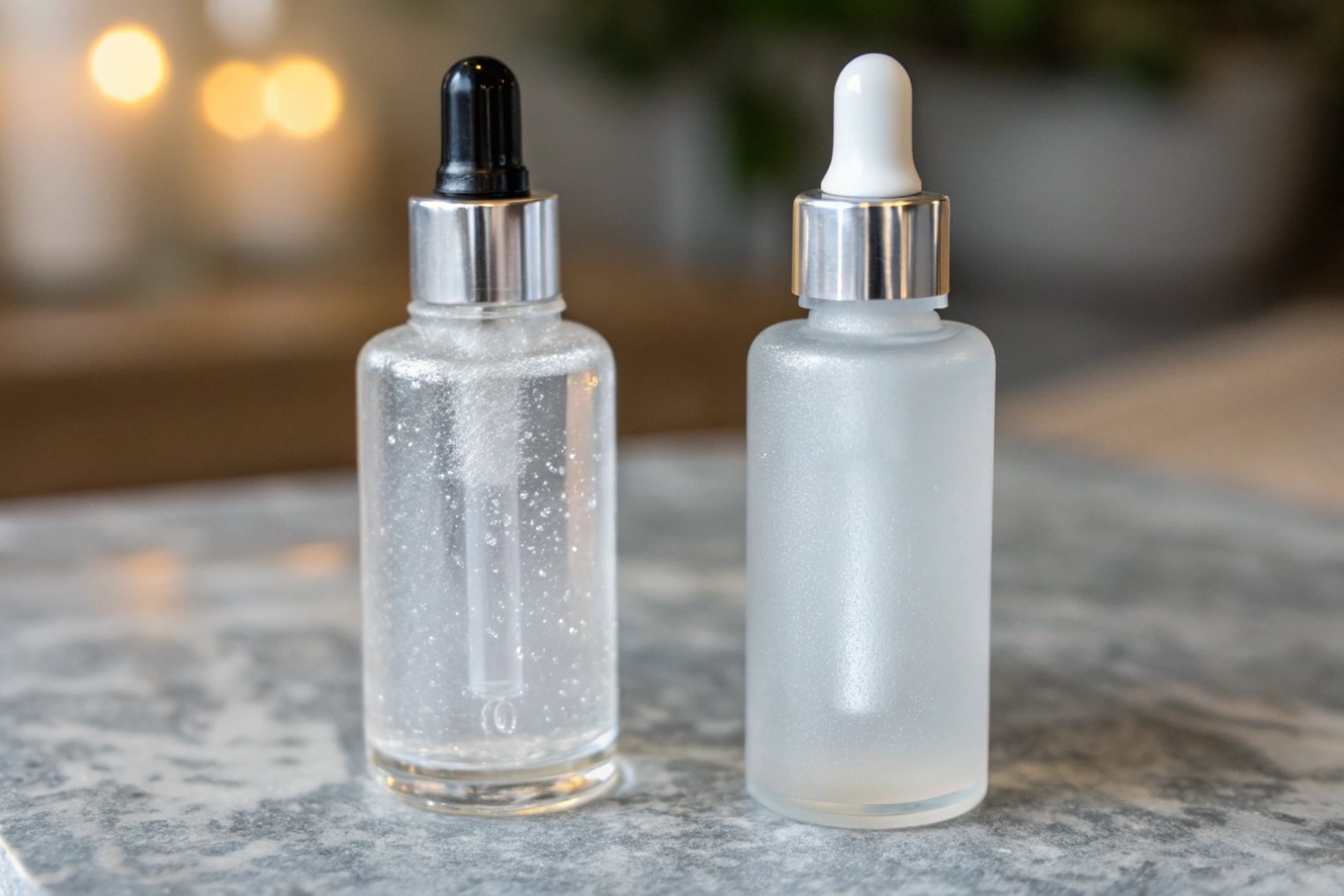
The good news is that a bottle does not need a custom shape to look high-end. Surface treatment can do much of the work while you stay on catalog molds.
Some effective, MOQ-friendly options:
-
Frosted / matt glass
- Achieved by an acid-etching process 5 or spray-matt finishes.
- Hides fingerprints and small scuffs, feels “soft touch”.
- Immediately lifts perceived value for skincare and fragrance.
- Works well with simple white or black pumps and droppers.
-
Spray coloring (solid or translucent)
- Single-color spray on standard flint bottles, inside or outside.
- Can be opaque for strong identity, or translucent to show fill level.
- One pass of color usually keeps MOQs lower than complex multi-pass designs.
- Easy to create line segmentation by changing only color across SKUs.
-
Simple gradient sprays
- Color fading from clear to dense, vertical or horizontal.
- Feels more custom than a plain spray, but still uses the same base bottle.
- Often achievable at moderate MOQs, especially with one color plus clear.
-
Silk-screen printing (1–2 colors)
- Direct silk-screen printing onto the glass 6 of logo, claims, and minimal graphics.
- No need for full wrap labels; keeps a clean, “apothecary” look.
- One or two spot colors keep set-up simple and MOQs reasonable.
-
Hot stamping / foil accents
- Small hot-stamped logos 7 or line marks on the front panel.
- Very strong premium signal with minimal extra ink or complexity.
- Combined with frost or matte spray, it looks much more expensive than it costs.
A quick decision view:
| Desired effect | Surface treatment combo |
|---|---|
| Minimal, clinical | Frosted glass + 1-color screen print |
| Soft luxury | Matte spray tint + gold hot-stamped logo |
| Fresh and young | Translucent color spray + white screen print |
| “Clean” natural brand | Clear or light frost + simple single-color print |
Because these treatments work on standard glass molds, you avoid the highest MOQs that come with private molds and heavy relief engraving. You can often start with a few thousand pieces per design instead of tens of thousands.
The trick is to design graphics and color strategy around processes that decorators run every day. Simple shapes, limited color count, and thoughtful placement of logos and text can create a very refined look without forcing you into risky inventory or tooling investments.
Conclusion
Cosmetic bottles are more than containers; they are delivery tools and brand signals. When closure type, airless vs. standard, capacity and neck geometry, and surface treatment all align with the formula and business plan, the packaging quietly helps the product succeed instead of getting in its way.
Footnotes
-
Practical guidance for matching closures to product thickness so dispensing stays consistent. ↩ ↩
-
Explains how airless packs limit air exposure and why brands choose them for sensitive formulas. ↩ ↩
-
Details airless pump benefits, including very high product evacuation and reduced waste. ↩ ↩
-
Helps decode neck finish standards so closures seal correctly and can be second-sourced. ↩ ↩
-
Shows how frosting is achieved through etching to create a durable matte, premium surface. ↩ ↩
-
Overview of screen printing on containers for clean branding with durable, direct-to-bottle graphics. ↩ ↩
-
Explains hot stamping on glass and why primers/process control matter for crisp metallic decoration. ↩ ↩






