

Picking the wrong bottle size can break a launch. Labels stop fitting. Cases do not palletize. A buyer asks one question: “Is this even legal here?”
Most wine stays anchored to 750 ml, while spirits split between 700 ml and 750 ml depending on region. The practical ladder includes 187/375 for trial, 500–1 L for versatility, and 1.5 L+ for celebration, gifting, or premium positioning.
A quick size map for wine and spirits?
Bottle sizes look like a simple list, but the list hides three forces that shape reality: standards, regulation, and logistics. Standards keep shelves consistent and keep lines running. Regulations keep net contents predictable for consumers (see Standards of Fill for Wine and Distilled Spirits 1). Logistics decides what survives shipping and what makes money after freight and breakage.
In day-to-day packaging work, the “best” size is the one that matches where the product sells. A DTC brand thinks about shipping weight and breakage first. A supermarket program thinks about shelf facings and case packs first. A duty-free program thinks about leakage, tamper evidence, and global SKU harmony first.
The good news is that most brands do not need twenty sizes. A tight size ladder covers most strategies.
The sizes people actually buy most
The core pattern is stable across categories:
- Small formats sell convenience, trial, and gifting.
- Standard formats sell familiarity and easy price comparison.
- Large formats sell value-per-ml or celebration prestige.
| Volume | Common name in trade | Typical use | Why it works |
|---|---|---|---|
| 50 ml | Mini / nip | sampling, hotels, airlines | low commitment, high margin per ml |
| 187 ml | Split (wine) / small spirit | single serve, gift bundles | controls portion, lowers waste |
| 375 ml | Half bottle | trial, premium “try me” | better perceived value than minis |
| 500 ml | Mid-size | DTC, premium kitchen bar | balances price and shipping weight |
| 700 ml | Standard spirits (many markets) | global spirits SKU | aligns with EU/UK norms |
| 750 ml | Standard wine + common spirits | core retail | most familiar shelf price point |
| 1 L | Liter | value + bar efficiency | popular for cocktails and on-trade |
| 1.5 L | Magnum | celebration, gifting | strong premium presence |
| 1.75 L | Handle | club/value retail | lowest price per ml for spirits |
That table is the “map.” The next sections answer the questions that decide which sizes belong in a real launch plan.
If a brand wants fewer headaches, it helps to treat size as a business tool, not a tradition. The size choice should protect compliance, margins, and brand story at the same time.
Which standards—187/375/500/700/750 ml, 1 L, 1.5 L—are common?
Shelf standards exist because they make shopping easy. A buyer can compare two bottles fast. A warehouse can stack cases without surprise. A filling line can change over with less waste.
Common sizes cluster into three ladders: mini and trial (50–375 ml), core retail (700–750 ml and 1 L), and statement formats (1.5 L+). Wine is dominated by 750 ml, while spirits often anchor to 700 ml globally and 750 ml in parts of North America.
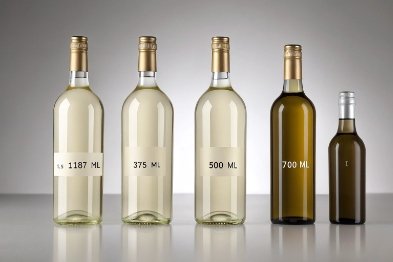
Core wine sizes
Wine stays loyal to 750 ml because it matches serving math and global habits (see the Wine Folly guide to wine bottle sizes 2). Smaller and larger sizes exist, but they play specific roles:
- 187 ml fits single-serve programs and airline use.
- 375 ml fits premium trial, dessert wines, and smaller households.
- 1.5 L supports celebration and premium gifting. It also performs well in restaurants by reducing table-side waste.
Large-format names (jeroboam, methuselah, and more) show up in marketing, especially for sparkling. Still wine and sparkling sometimes use the same name for different volumes (see large-format wine bottle name differences by region 3), so brands often print the liter volume clearly rather than relying on the name.
Core spirits sizes
Spirits operate like a toolkit:
- 700–750 ml is the “hero bottle” for retail shelves.
- 1 L supports cocktails and on-trade speed.
- 375 ml and 500 ml support trial, e-commerce bundles, and premium “small batch” positioning.
- 1.75 L is a value move for club retail.
| Segment | Best-fit size | Why buyers accept it | Common brand use |
|---|---|---|---|
| Trial / discovery | 187–375 ml | low risk, giftable | tasting sets, limited drops |
| Core retail | 700–750 ml | familiar price anchor | flagship SKU |
| Cocktail heavy users | 1 L | bar efficiency | on-trade + home bar |
| Celebration / gifting | 1.5 L | visual impact | premium packs |
| Value shoppers | 1.75 L | lowest unit cost | club channel |
The “common” sizes are common because they solve pricing and shelf behavior. A brand can still be unique without inventing a strange volume that breaks distribution.
Do regional rules dictate 700 ml vs 750 ml for spirits?
Size is not only preference. It is also permission. Many brands discover the 700 vs 750 issue only after a distributor asks for a different bottle for a different market.
Yes. Many European markets require spirits to be sold in specific nominal quantities, where 700 ml is the standard and 750 ml is often not an approved spirits size. The U.S. historically centered on 750 ml for spirits, but U.S. rules now allow 700 ml too, which helps global brands reduce SKU complexity.
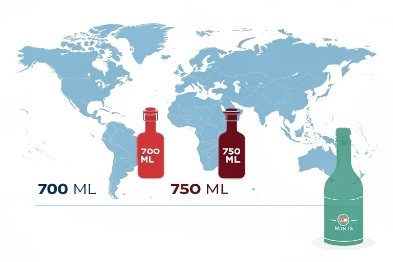
Why Europe leans hard to 700 ml
In much of Europe, spirits bottle sizes follow a set list of permitted quantities (see EU standards of fill under Directive 2007/45/EC 4). That framework pushes 700 ml as the standard retail spirits format. The goal is simple: consumers should not be tricked by a bottle that looks like a bigger size but holds less.
This is why global spirits brands often run:
- 700 ml for EU/UK and many international markets
- 750 ml for the U.S. and markets that follow that habit
Why the U.S. used to be “750 ml first”
The U.S. market built decades of pricing and shelf behavior around 750 ml. Retailers and consumers still think in that unit. Many POS systems and promotional price points are tuned for it.
The big change is that the U.S. now allows more flexibility in standards of fill (see 27 CFR § 5.203 standards of fill 5). That matters because it opens a clean path for international brands to keep one “global” bottle size, and it gives U.S. brands an option to choose 700 ml when export is a core strategy.
A practical global plan for brands
A brand can choose one of these strategies:
1) Two-SKU approach: 700 ml for EU and 750 ml for U.S.
2) Global 700 ml approach: use 700 ml everywhere it is allowed, keep 750 ml only where it is commercially necessary
3) Global silhouette approach: keep the bottle shape consistent, but adjust height or fill line for 700 vs 750
| Strategy | Pros | Cons | Best for |
|---|---|---|---|
| Two SKUs (700 + 750) | matches local expectation | more molds, more inventory | established brands |
| Single global 700 | simpler supply chain | some markets still expect 750 | export-first brands |
| Same look, two volumes | brand consistency | careful design and label control | premium brands with design focus |
Regional rules do not have to kill creativity. They just force discipline. The fastest way to reduce risk is to decide early which markets matter in Year 1 and which markets come later, then lock the size ladder around that plan.
How do size and weight influence shipping and pricing?
A bottle size decision changes more than liquid volume. It changes glass weight, case configuration, freight cost, breakage risk, and even how price feels on shelf.
Size and weight influence shipping and pricing through freight cost per unit, damage rates, and perceived value. Heavier glass can support premium pricing, but it raises landed cost and can reduce margin unless the channel supports the story.

Shipping reality: glass costs money to move
Freight is driven by:
- Actual weight (glass + liquid + carton)
- Dimensional weight (case size and pallet cube)
- Breakage risk (which adds replacement and labor costs)
A heavier bottle can make sense when the brand sells premium. It feels good in hand. It photographs well. It makes the shelf look “serious.” Still, freight does not care about feelings. Freight charges every kilogram.
For brands exporting or doing DTC, it helps to validate cartons and unit loads against recognized transit simulations like ISTA test procedures 6.
Bottle size affects how many units fit in a case:
- 750 ml spirits often run 6 or 12 per case depending on bottle footprint and weight.
- 1 L often shifts case count or increases carton size.
- 1.5 L often reduces case count and increases packaging cost per unit.
That matters because retailers negotiate in cases and pallets. A format that packs efficiently often wins distribution faster. It also helps to keep case and pallet IDs consistent with common trade practices (see the GS1 Logistic Label Guideline 7).
Price architecture: how size shapes value perception
- Smaller bottles can carry higher price per ml, but consumers accept it when the use case is clear (trial, travel, gifting).
- Standard bottles anchor price comparison. Promotions and shelf tags are optimized around them.
- Large bottles can win on price per ml in value channels, or win on “statement” in premium channels.
| Size move | Cost impact | Pricing impact | Operational note |
|---|---|---|---|
| 375 ml launch | higher packaging cost per ml | strong trial conversion | great for gift sets |
| 500 ml focus | balanced freight and price | premium “small batch” feel | strong for e-commerce bundles |
| 700/750 ml hero | best line efficiency | clean shelf comparison | easiest for distributors |
| 1 L extension | higher landed cost | bar value story | works for cocktail brands |
| 1.5 L magnum | high packing cost | celebration premium | protect well in transit |
A stable plan treats weight as a profit variable. The bottle should be heavy only when the market pays for it, and the case pack should be designed as carefully as the label.
When do minis or magnums make sense for branding?
Minis and magnums look opposite, but they solve the same problem: attention. Minis invite trial. Magnums invite celebration. Both can strengthen brand memory when used with a clear purpose.
Minis make sense for sampling, travel, hotels, and gift sets because they reduce commitment and create variety. Magnums make sense for celebrations, premium gifting, and limited editions because they create shelf theater and social proof.
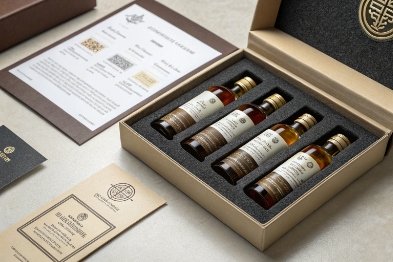
Minis: the fastest way to earn a first sip
Minis work when the brand wants a low-friction entry point:
- Tasting flights for new flavors
- Hotel minibars and airline programs
- Subscription boxes and influencer kits
- Multi-pack gift sets with variety
A mini also changes the label plan. The label must stay readable at small scale, and legal text may need a wrap label or a peel-back label. The closure choice matters too. A mini that leaks destroys trust immediately.
Magnums sell moments:
- weddings and events
- restaurant tables
- gifting and collector drops
- holiday editions
A magnum also supports storytelling. A brand can add neck tags, numbered labels, wax, or a gift box without looking “overdone,” because the format is already special.
When minis or magnums fail
They fail when the channel does not match the format:
- Minis fail when pricing looks “expensive” with no reason.
- Magnums fail when shipping and breakage cost eats margin.
- Both fail when the packaging system (closure, carton, label) is treated as an afterthought.
| Format | Best channel | Brand advantage | Key risk to manage |
|---|---|---|---|
| 50 ml mini | travel, sampling | trial at scale | leak control and label legibility |
| 187–200 ml | single serve | portion and convenience | unit economics |
| 375 ml | gifting + trial | premium entry | shelf placement |
| 1.5 L magnum | gifting + events | premium theater | carton strength and freight |
| 3 L+ | luxury events | viral presence | handling and storage logistics |
A brand does not need minis or magnums to succeed, but these formats can accelerate awareness when the story is clear. A good rule is simple: minis sell “try,” magnums sell “celebrate.”
Conclusion
Most brands win with a simple ladder: trial (187/375), hero (700/750), and one statement size (1 L or 1.5 L). Regional rules and shipping math should guide the final choice.
Footnotes
-
Official U.S. rule outlining authorized container sizes for wine and distilled spirits. ↩ ↩
-
Practical chart of common wine bottle sizes and equivalents used in real retail and service. ↩ ↩
-
Clarifies large-format naming and why some bottle names map to different volumes by region. ↩ ↩
-
Quick reference for EU permitted sizes (including 700 ml) tied to Directive 2007/45/EC. ↩ ↩
-
The legal U.S. standards-of-fill list used to confirm which spirits sizes are permitted. ↩ ↩
-
Transit-testing procedures for packaged products and unitized loads to reduce breakage in shipping. ↩ ↩
-
Logistics label guidance that helps standardize case/pallet identification across trading partners. ↩ ↩






