
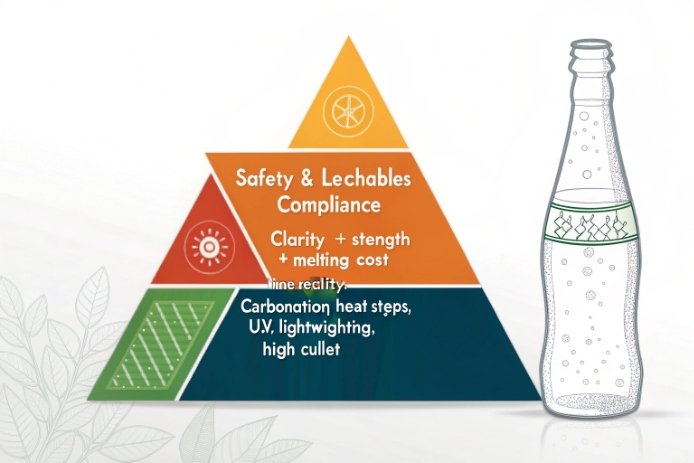
Beverage bottles fail in quiet ways. A tiny tint shift ruins shelf impact, a small strength drop raises breakage, and one redox swing makes the melt unstable.
The best beverage formulation priorities are: keep a stable soda-lime base for strength and melting cost, design color for real light risk, and lock cullet + fining + redox controls so every bottle matches spec at high speed.
Build the formulation around the production system, not a single oxide
A beverage bottle is a high-volume product. That means formulation decisions must survive continuous production, not only a lab melt. The main goal is to keep a predictable working range, consistent quality, and low cost per bottle. Clarity and color are important, but they must not create fining problems, devitrification risk, or mechanical weakness at the finish and heel.
In practice, three priorities decide whether a recipe becomes “easy to run” or “always adjusted.”
Prioritize stability before optimization
A stable composition window usually beats an aggressive recipe that looks good for one week. A beverage line needs the same viscosity 1, the same fining behavior, and the same color response even when cullet quality changes or pull rate shifts. That is why I prefer to define a tight “operating window” for the major oxides and then adjust only inside that window.
Prioritize strength through defect control, not only chemistry
Chemical durability and hardness help, but most breakage issues come from defects and residual stress. So formulation must also support strong refining and low devitrification 2 tendency. If the melt throws cords, seeds, or devit skins, the bottle loses real strength even if the oxide ratios look “right.”
Prioritize recyclability and compliance as part of the recipe
Modern beverage packaging is judged by recycled content, recyclability, and migration safety. That means cullet governance, impurity limits, and stable redox are not “process topics.” They are formulation topics, because they decide what ends up in the final glass.
| Priority | Why it matters for beverage | What must be controlled |
|---|---|---|
| Stable base glass window | Predictable melting and forming | SiO₂–Na₂O–CaO–MgO–Al₂O₃ drift limits |
| Controlled color system | Shelf protection and brand look | Fe/Cr systems, amberants, redox response |
| Strong refining behavior | Low defects and high line efficiency | SO₃ level, fining agents, temperature profile |
| Cullet governance | Cost, CO₂, and stability | Color purity, CSP, organics, trace metals |
| Lightweighting readiness | Material cost and sustainability | viscosity curve, devit margin, annealing control |
A recipe becomes successful when it supports the plant’s real constraints: furnace capacity, cullet availability, forming speed, and customer handling conditions.
If those priorities are clear, the detailed design choices become much easier.
Now the work becomes four focused decisions: base oxides, process adaptation, color/UV strategy, and the cullet + fining + lightweighting system.
Which oxide ratios (SiO₂–Na₂O–CaO–MgO–Al₂O₃) deliver clarity, strength, and cost-efficient melting for soda-lime beverage glass?
When a beverage plant chases “lowest cost melt,” the line often pays later in defects, weak bottles, and unstable color.
A cost-efficient soda-lime beverage glass usually sits in a tight oxide window that melts easily but keeps enough network strength for durability and strength, with Al₂O₃ used as a stability and durability booster.
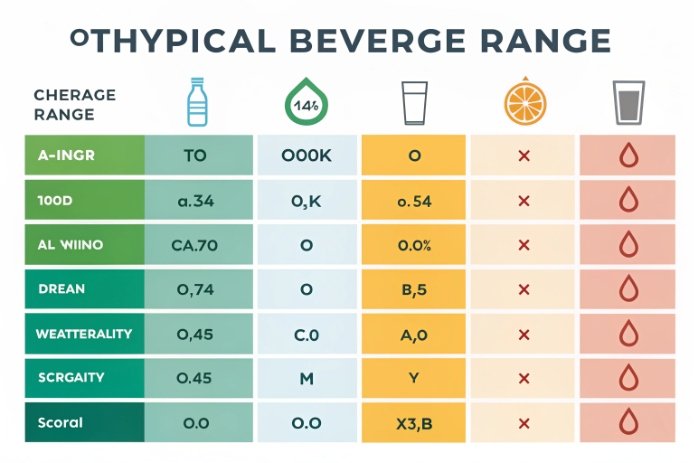
A practical base window that runs well in high-volume production
For most beverage bottles, a stable “base window” is the best starting point. Many successful container glasses land near:
- SiO₂: 71.5–74.0 wt%
- Na₂O: 12.5–14.5 wt%
- CaO: 8.8–10.8 wt%
- MgO: 2.0–4.0 wt%
- Al₂O₃: 1.0–2.5 wt%
This window supports:
- good clarity when raw materials are clean
- a workable viscosity range for IS machine 3 forming
- acceptable chemical durability for beverages
- stable fining 4 response when SO₃ is controlled
The most important rule is not the exact center. The rule is low drift.
How each oxide supports the three beverage targets
Clarity
- Clarity is driven more by defects and impurities than by major oxides.
- Still, too low SiO₂ or too high alkali can increase volatility and foaming, which can raise seeds and reduce brilliance.
Strength
- Strength depends on surface quality, residual stress, and defect population.
- A stable base with modest Al₂O₃ often helps by keeping the melt uniform and improving durability.
Cost-efficient melting
- Na₂O is the main melting cost lever, but it is also the main alkali leaching and surface hydration lever.
- A recipe that relies on very high Na₂O can melt cheaper, but it often creates a narrower stability margin and higher sensitivity to cullet variation.
What I prioritize when choosing the “best” ratio
A beverage bottle must survive filling, capping, case packing, and distribution. So the best oxide ratio is the one that holds a stable working range and keeps defects low. If one change improves melting but increases devit risk or cording, it is not a real improvement.
| Oxide | If increased (within reason) | Benefit | Risk |
|---|---|---|---|
| SiO₂ | Network strength rises | Better durability and hardness | Higher melting demand |
| Na₂O | Flux effect rises | Lower energy, easier melting | Higher alkali release, more volatility risk |
| CaO | Stabilization rises | Better durability and stiffness | Higher liquidus and devit tendency if high |
| MgO | Stabilization shifts | Can reduce devit if balanced | Working-range shifts if pushed too far |
| Al₂O₃ | Network rigidity rises | Better durability, more stable viscosity | Slower melting if too high |
A buyer-friendly way to lock the base recipe
For beverage projects, I like to write the specification as:
- a target and a tight allowed band for each major oxide
- an allowed drift limit per week (to control cullet and raw material swings)
- impurity maximums for Fe, Cr, Ti, Ni (even in flint lines)
That is how “clarity and strength” becomes repeatable instead of a daily adjustment.
How should the recipe adapt to process conditions—carbonation pressure, pasteurization, hot-fill/retort—to improve thermal-shock and mechanical performance?
A bottle that is strong in a lab drop test can still fail in real production if the thermal cycle and internal pressure are not respected.
The recipe should be tuned to keep a stable viscosity curve, low defect population, and strong annealing response, while design and forming targets handle most of the pressure and thermal-shock load for carbonation and hot-fill cycles.
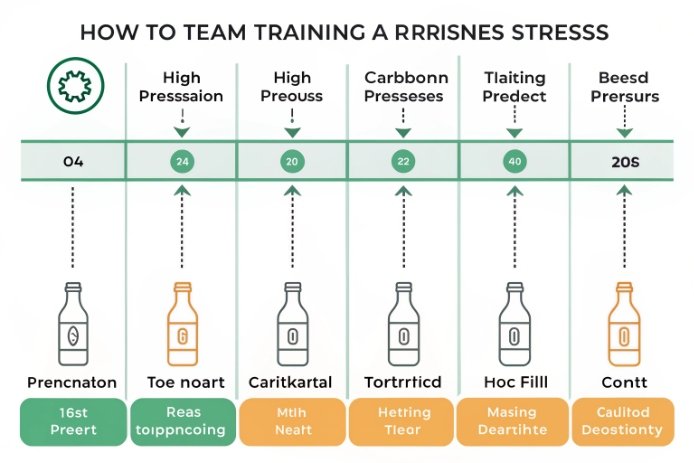
Carbonation pressure: strength comes from finish quality and surface defects
Carbonated beverages load the bottle through internal pressure. The formulation impact is indirect but important:
- A stable base glass supports consistent forming of the finish and shoulder.
- Good refining and low cords reduce strength scatter.
- Devit skins or stones raise local stress and reduce pressure performance.
For carbonation, the “recipe adaptation” is usually:
- keep the base window stable to reduce viscosity drift
- avoid composition moves that raise devit risk in the forehearth
- keep cullet clean to reduce inclusions that cause failure at high pressure
Pasteurization and hot-fill: thermal shock is a system of expansion + stress + defects
Thermal shock performance depends on:
- the thermal expansion 5 coefficient of the glass
- the temperature gradient through the wall
- residual stress from forming and annealing
- surface defect population
In soda-lime 6 glass, thermal expansion is not tuned freely like in borosilicate. So the main recipe goal is stability, while the main thermal-shock controls are:
- wall thickness consistency
- good annealing 7 and stress control
- smooth surfaces and low defects
- avoiding devit lines that act like crack starters
For hot-fill and retort, heavy-base designs often help, but they require better annealing. So the formulation must support stable viscosity in thick sections, or flow lines and cords become visible and strength drops.
What changes in composition actually help thermal performance?
Small composition shifts can support process robustness:
- modest Al₂O₃ can improve durability and reduce surface hydration sensitivity
- balanced MgO/CaO can reduce devit and keep surfaces smoother
- avoiding excessive alkali spikes can reduce long-term surface weakening
Still, the biggest gains often come from controlling defects and stress rather than changing oxides dramatically.
| Condition | Main failure risk | Best formulation priority | Best process priority |
|---|---|---|---|
| Carbonation | pressure burst at weak points | low defects, stable viscosity | finish accuracy, inspection, handling control |
| Pasteurization | stress + microcrack growth | stable base glass, low cords | controlled heating/cooling ramps, annealing |
| Hot-fill | thermal gradient + vacuum on cooling | devit resistance, smooth surface | stable wall thickness, annealing |
| Retort | repeated thermal cycles | low defect population, stable composition | tight stress control and QC |
The strongest beverage bottle programs treat formulation and forming as one plan. Composition supports stability. Process controls deliver the final mechanical performance.
Which colorants and UV blockers (Fe/Cr systems, amberants, green/emerald) best protect beer, juice, and functional drinks without hurting brand color?
A beverage color choice is not only design. It is a protection strategy that must work at real thickness and real shelf light.
Beer usually benefits from amber (iron–sulfur systems) because it blocks UVA and blue light, while juices and functional drinks often use green/emerald or clear-with-label protection; the best choice is the one that meets light-risk needs without forcing unstable redox control or brand color drift.
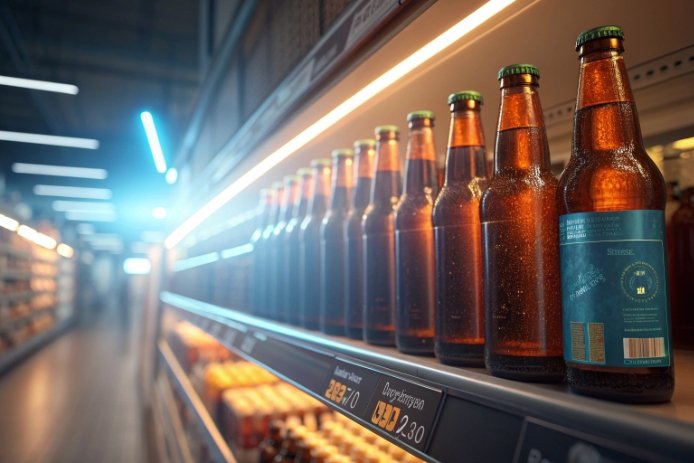
Beer: amber is the safest protection system
Beer is sensitive to light in the near-UV and blue range. Amber glass is effective because it reduces transmission in those bands. The typical amber approach uses:
- an iron pool (Fe₂O₃) plus sulfur chemistry
- a controlled redox environment to form the amber chromophore
- stable SO₃ and fining control to avoid cords and over-ambering
The main risk is not “wrong ingredients.” The main risk is unstable redox and sulfate behavior that creates color drift and cords.
Juice and functional drinks: match protection to the ingredient risk
Many juices and functional drinks are sensitive to light, but not always in the same band as beer. Some are more sensitive to UVA 8 (365 nm) and some to visible light. That means the color strategy should be product-specific.
Common strategies:
- Green/emerald for a premium natural look with moderate protection
- Amber when stronger protection is required
- Flint + sleeve/label when brand needs a clear look but the product still needs protection
- Clear with secondary packaging for high sensitivity, when glass color cannot change
Cr/Fe systems can create greens, but chromium must be controlled tightly for consistency and recyclability.
Control the color system like a process, not a pigment
Color in container glass is a redox product, especially for amber. The same nominal batch can produce a different UV–Vis curve if:
- Fe²⁺/Fe³⁺ shifts
- sulfate retention shifts
- cullet color mix changes
So the best color strategy is the one the plant can hold stable.
| Beverage type | Common bottle color | Main colorants system | Main risk to manage |
|---|---|---|---|
| Beer | Amber | Fe + sulfur + controlled redox | over-ambering, cords, shade drift |
| Cold-pressed juice | Green/emerald or amber | Fe/Cr for green, or amber system | chromium drift, cullet mix impact |
| Functional drinks | Flint + label or light tint | low-iron flint, optional UV blockers | insufficient UVA control, brand mismatch |
| Kombucha/ferments | Amber or green | depends on light risk and branding | color consistency across lots |
Keep recyclability in mind when selecting color
Color choices also affect recycling streams. A stable amber stream and a stable green stream recycle well when separated. Mixed colors create downgrades and more variability in recycled feed. For high recycled content beverage programs, choosing a standard color family that fits existing recycling infrastructure can be a smart move.
How do cullet %, fining and redox control, and lightweighting targets affect leachables compliance (FDA/EU), line efficiency, and bottle-to-bottle recyclability?
This is where beverage formulation becomes a business decision. Cullet and lightweighting reduce cost and emissions, but they can also increase variability if the control plan is weak.
Higher cullet and lightweighting can succeed only when fining and redox are stable and cullet quality is governed; that stability protects leachables compliance, keeps line efficiency high, and preserves recyclability by keeping color and impurity drift low.
Cullet %: the percentage matters less than the variability
Cullet usually improves melting efficiency and can reduce energy per ton. It can also reduce unmelted batch grains, which helps clarity and strength. Still, cullet can bring:
- colored glass contamination (changes color and UV performance)
- ceramics/stone/porcelain (CSP) that create inclusions and scratches
- metals that create stones or breakage
- organics that create odor events and redox swings
- trace elements that complicate migration risk narratives
For FDA/EU food-contact compliance, glass is generally considered inert, but compliance is still about ensuring no harmful transfer and no unacceptable taste/odor effects. A plant that wants high recycled content must prove control through documentation and testing, not only through a recipe claim.
Fining and redox: line efficiency depends on “quiet” melt behavior
Fining controls seeds and cords. Redox controls:
- iron valence and color response
- sulfate decomposition and foaming behavior
- stability of the melt blanket and heat transfer
When fining and redox are unstable, the plant sees:
- higher seed counts and rejects
- more cords (especially in colored glass)
- variable gob temperature and weight control
- more frequent quality adjustments
This is why SO₃ level, fining agent feed stability, and combustion stability belong in the formulation discussion.
Lightweighting: smaller safety margin demands better control
Lightweighting 9 increases sustainability and lowers cost per bottle, but it tightens the quality margin:
- thinner walls amplify defects and stress sensitivity
- finish accuracy becomes more critical
- thermal gradients become more severe in hot-fill cycles
- scuffing risk rises without good surface control
So lightweighting must be paired with:
- low defect populations (better refining and clean cullet)
- stable annealing and stress control
- stable viscosity curve (composition stability)
- surface protection strategy (handling control and coatings if needed)
Bottle-to-bottle recyclability: design for clean material streams
A recyclable beverage program needs:
- stable color families
- low heavy metal and trace element spikes
- low CSP contamination
- minimal mixed-material attachments (closures are separate, but label systems matter)
Glass formulation supports recyclability by keeping impurity levels low and stable. Operations support recyclability by protecting cullet streams and limiting cross-color mixing.
| Lever | Helps | Hurts when uncontrolled | Best KPI to track |
|---|---|---|---|
| Higher cullet % | lower energy, lower CO₂ | impurity spikes, odor events, color drift | CSP ppm, organics, color contamination rate |
| Stable fining (SO₃) | fewer seeds, higher yield | foam swings, cords, unstable gob | seed count, reject rate, forehearth stability |
| Stable redox | stable color and UV protection | over-ambering, green drift, cords | Fe²⁺/Fe_total trend, exhaust O₂ stability |
| Lightweighting | lower material cost, better sustainability | higher breakage and scuffing | breakage rate, stress birefringence, scuff score |
| Recyclability discipline | long-term cost advantage | downgrade of cullet 10 streams | cullet color purity, trace metal trend |
For beverage bottles, the best formulation strategy is the one that aligns with a control strategy. High cullet and lightweighting are achievable, but they demand tighter incoming QC, tighter furnace control, and clearer testing plans to support compliance and customer confidence.
Conclusion
Beverage bottle formulations succeed when the base oxides stay stable, color matches real light risk, and cullet + fining + redox controls protect efficiency, compliance, and recyclability—especially under lightweighting pressure.
Footnotes
-
A measure of a fluid’s resistance to flow, critical for forming. ↩
-
Unwanted crystallization of glass that causes weakness and defects. ↩
-
Industry-standard machinery used to form glass containers. ↩
-
Process of removing bubbles from the molten glass. ↩
-
How much the glass expands with heat, affecting thermal shock. ↩
-
The most common type of glass used for beverage containers. ↩
-
Controlled cooling process to remove internal stresses in the bottle. ↩
-
Ultraviolet light that can degrade light-sensitive ingredients. ↩
-
Reducing container weight to save materials and energy. ↩
-
Recycled broken or waste glass used to make new bottles. ↩






