
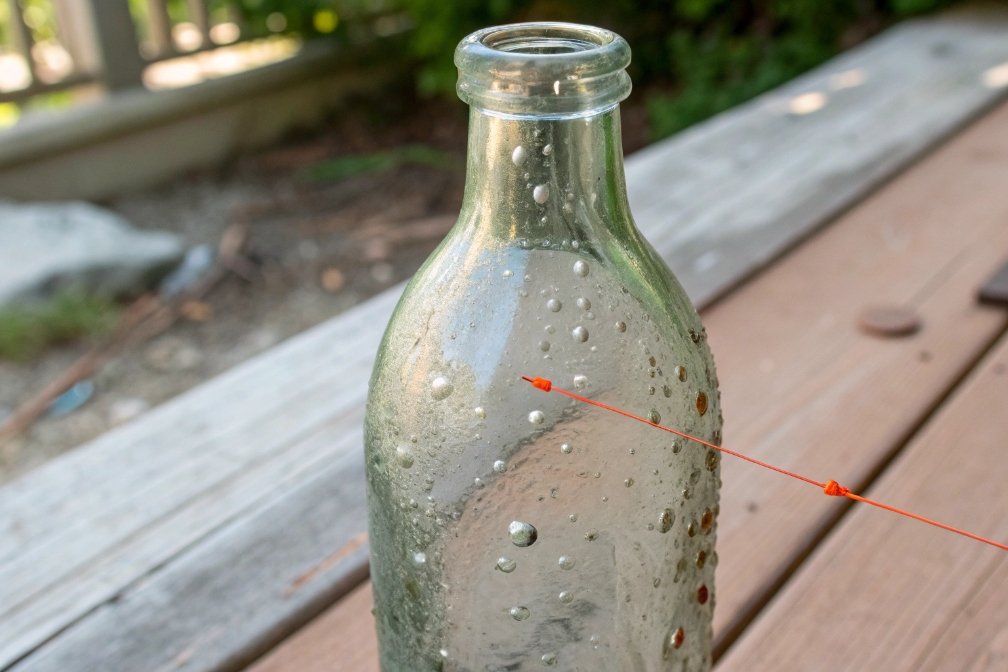
A glass bottle can look beautiful on the table and still be a quiet time bomb on the filling line or in the customer’s hand.
Common glass bottle quality issues include forming defects that leak or crack, cooling defects that lock in stress, contamination from cullet or refractory, and gaps in in-line inspection that let bad ware escape.
When we judge a bottle, we never look at one point only. Forming, annealing, raw materials, and inspection all leave their fingerprints. If any link is weak, trouble shows up later as leaks, breaks, or complaints. Let us break this down in a practical way.
Which forming defects in glass bottles cause leaks or weak points?
Some defects only hurt appearance. Others create direct leak paths or weak zones that will fail on the line or in the field.
Forming defects that most often cause leaks or weak points include finish and neck defects, checks and cracks, thin walls, large bubbles, stones, cords, and internal bird swings.
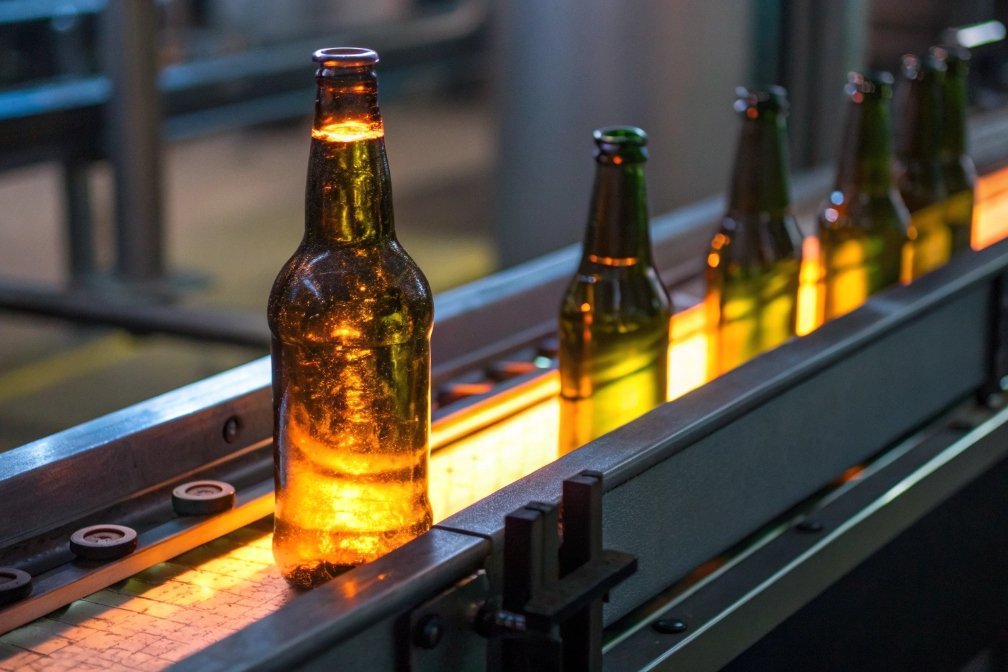
The forming defects that really matter
When we review production, the first focus is always forming. Typical high-risk defects include:
- Finish defects: chipped finish, split finish, overpress, underpress, offset or bent neck. These distort the sealing surface and threads or lugs.
- Checks and cracks: shoulder checks, heel checks, base cracks, fire cracks. Even tiny open checks can grow under pressure or impact.
- Thin wall sections: local thin spots at the shoulder, heel, or push-up. These become weak points for impact and thermal shock.
- Bubbles and blisters: large blisters near the surface or inside the sealing ring. They reduce local wall strength and can open to the surface.
- Stones and inclusions: hard particles of unmelted batch or refractory. They create internal stress and act like rigid “pebbles” inside the glass.
- Cords/striae: ribbons of glass with different composition. They distort appearance and can carry stress along the sidewall.
- Bird swing: a fine glass strand from wall to wall or wall to base. It may break into sharp fragments inside the container.
If you want a clear defect library to align operators, suppliers, and inspectors, Emhart’s container defect causes and remedies 1{#fnref1} is a strong reference.
| Defect type | Typical location | Main risk in service |
|---|---|---|
| Split / chipped finish | Finish and threads | Leaks, broken caps, glass splinters |
| Shoulder / heel check | Shoulder, heel | Crack growth in pasteurization or impact |
| Thin wall | Shoulder, panel, heel | Low impact and pressure strength |
| Large blister | Near surface, neck, base | Local weakness, visible bubble |
| Stone / inclusion | Any wall, base, heel | High stress, early breakage |
| Cord | Sidewall | Visual defect, possible stress band |
| Bird swing | Across interior | Internal glass fragment, safety risk |
Why some forming defects leak and others just look bad
Not every flaw is a reason to scrap a lot. So we classify defects as critical, major, or minor, and we apply an AQL (Acceptable Quality Level) sampling plan 2{#fnref2} to each batch.
- Defects at the finish and sealing surface are often critical. Even small chips at the lip can break the seal and create glass fragments.
- Defects in high stress zones like the heel and shoulder are usually major or critical, because they drive breakage under impact, pressure, or thermal shock.
- Minor surface marks, small seeds (tiny bubbles), or light scuffing may be minor, especially when they do not affect strength or sealing.
If the defect can cause injury, leakage, or product contamination, it belongs in the critical group and the acceptance level must be extremely low, often zero.
How we control forming defects at the source
The best quality control is prevention. In production we work on:
- Gob control: stable gob weight and temperature to avoid thin walls and blisters.
- Mold design and maintenance: clean blank and blow molds, correct cooling, proper venting.
- Forming settings: counter-blow pressure, contact time, and timing in press-blow or blow-blow sections.
- Cold-end selection: removing any pieces with visible forming defects before packing.
For high-value bottles, we combine process control with detailed defect libraries and training samples. This helps operators recognize early patterns, such as a bird swing trend or a specific heel check linked to a mold or section.
How do surface checks and stress rings form during cooling?
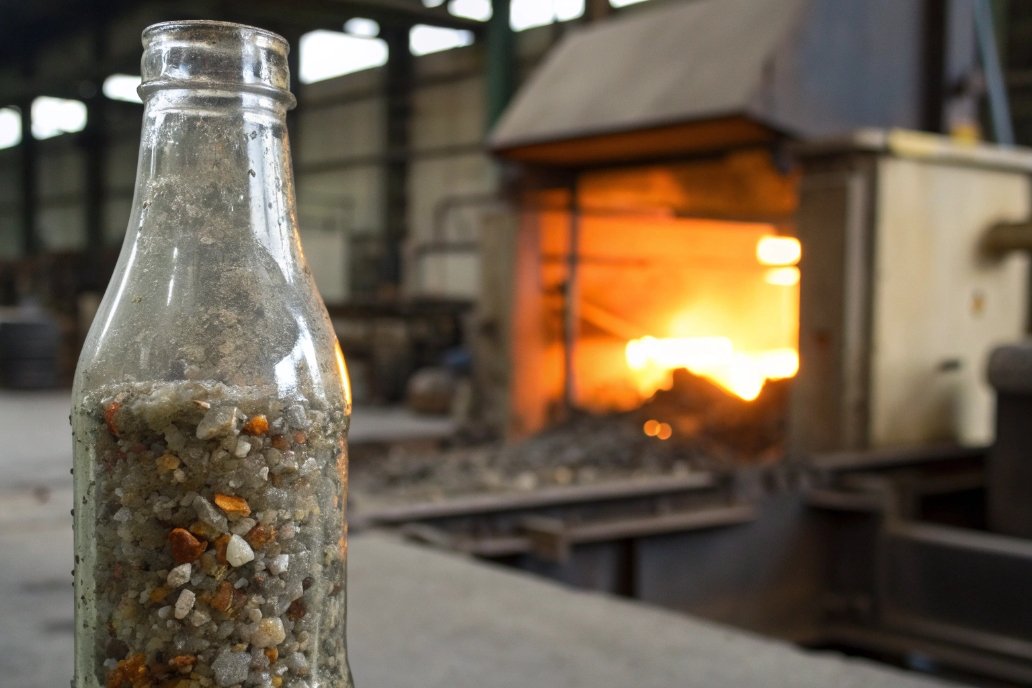
Most containers leave the mold while still glowing hot. What happens in the annealing lehr decides whether they keep hidden stress or not.
Surface checks and stress rings form when the bottle cools too fast or too unevenly, locking in residual stress that later shows up as cracks at the shoulder, heel, or base.
What are surface checks and stress rings?
Surface checks are fine cracks on or just below the surface. They may appear as:
- Fire checks from hot contact with mold, dead plates, or lehr rolls.
- Shoulder or heel checks where geometry changes and stress focuses.
- Base and push-up checks around the bottle’s central support area.
Stress rings are not always visible cracks. Many times we only see them under a polariscope as bright bands around the heel, shoulder, or finish. One practical way to standardize what “good” vs “high” stress looks like is to use a vendor guide like the Agr Polariscope overview 3{#fnref3}.
In both cases, the core issue is the same: some parts of the bottle cooled faster than others, so they “wanted” to shrink more, and the glass network froze in that mismatch.
Cooling, annealing, and how stress builds
Right after forming, the bottle is very hot and plastic. As it moves into the annealing lehr:
- It first reheats slightly to the annealing range, where the glass is still rigid but can relax stress over time.
- It then cools slowly and evenly down through the strain point, so new stress does not form.
If this process is too fast, or if one region sees more air or contact than another, several things can happen:
- The outer surface cools and contracts while the inside is still hot and expanded.
- Thick areas like the heel and base stay warm longer than thin sidewalls.
- Direct contact with cold metal, air jets, or lehr chain links creates local cold spots.
These gradients set up internal tension and compression. If the stress exceeds the local strength, visible checks appear. Even if it does not, the stress stays inside and reduces the bottle’s thermal-shock and impact performance.
| Area of bottle | Typical stress or check issue | Main cause |
|---|---|---|
| Finish / neck | Ring stress, finish checks | Uneven finish cooling, hot contact with metal |
| Shoulder | Shoulder checks, stress bands | Rapid cooling at shape change, lehr profile |
| Heel | Heel checks, bright stress ring | Thick glass cooling slower than sidewall |
| Base / push-up | Base checks, star cracks | Direct contact with cold conveyor or supports |
What contamination risks come from cullet, batch, and refractory?
Recycled glass and furnace linings are great for cost and sustainability, but they can also be the source of dangerous inclusions.
Contamination from cullet, batch, and refractory can create stones, cords, color streaks, and internal particles that weaken bottles, change color, or even flake into the product.
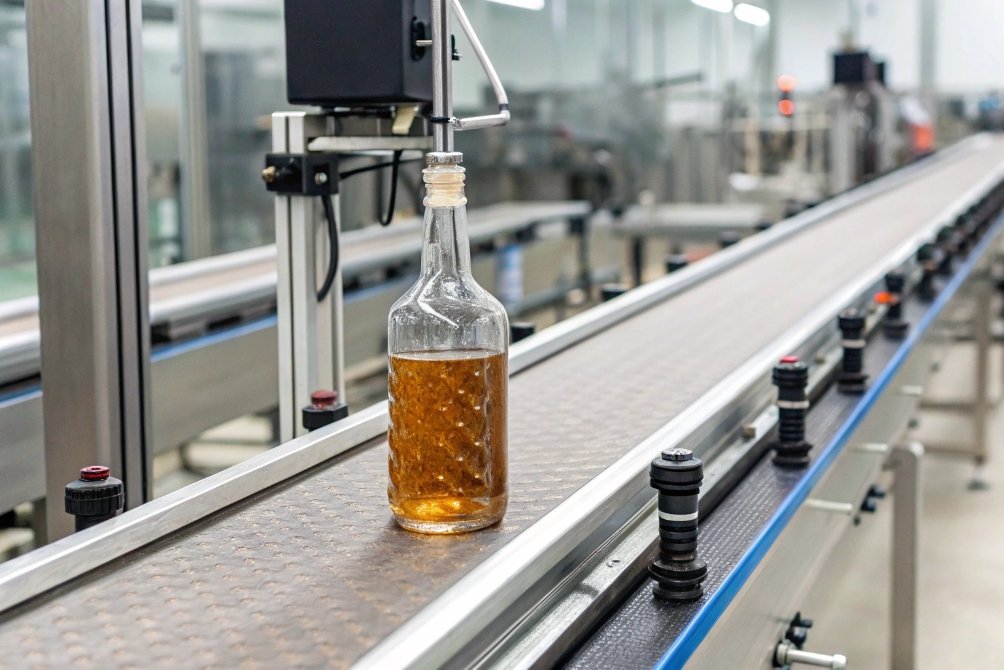
What can hide inside cullet?
Cullet is recycled glass that returns to the furnace. It saves energy and raw materials, but only when it is clean. Industry groups explicitly note that cullet must be free of contaminants such as metals and ceramics 4{#fnref4}.
Common cullet contaminants include:
- Ceramic and glass-ceramic pieces that do not melt fully.
- Different glass families like borosilicate or lead glass mixed into soda-lime cullet.
- Metals and wires that survive collection and sorting.
- Stones, sand, and non-glass particles from labels, caps, or dirt.
A major pain point is ceramics: older technical reports explain how ceramic contaminants enter the cullet stream 5{#fnref5} and why they are so disruptive in high-cullet container production.
These materials can turn into stones and knots in the melt. Many of them have different thermal expansion or melting behavior, so they sit in the wall as hard inclusions with high local stress.
They can cause:
- Spontaneous cracks as the bottle cools or later during thermal shock.
- Local weak points that break under impact or pressure.
- Visible defects that buyers reject on sight.
Apart from cullet, the furnace itself can be a source of contamination. The refractory lining and superstructure can erode, especially AZS (alumina-zirconia-silica) blocks and feeder channels. This erosion can drip small bits into the melt.
The batch (virgin raw materials) can also introduce risks if the sand, limestone, dolomite, or other components are impure or poorly mixed. Unmelted grains may survive as stones or create bubbles as trapped gas escapes.
For pharmaceutical or high-purity bottles, we also watch for:
- Delamination risk: inner surface flaking under aggressive pH, heat, and time.
- Excess alkali extractables: if the glass composition or surface treatment is not optimized, the product pH can drift.
| Contaminant source | Typical defect in bottle | Main risk |
|---|---|---|
| Dirty cullet | Stones, knots, bubbles | Strength loss, visual rejects |
| Foreign glass type | Color streaks, stones | Color shift, stress, regulatory risk |
| Metals and wires | Inclusions, furnace attack | Internal particles, furnace damage |
| Furnace refractory | AZS stones, cords | High stress zones, breakage |
| Batch impurities | Stones, cords, seeds | Weak points, cloudy appearance |
Which in-line inspections prevent defective glass bottle shipments?
Even with good forming and melting practice, some bad bottles will always appear. The real test is whether they reach the customer.
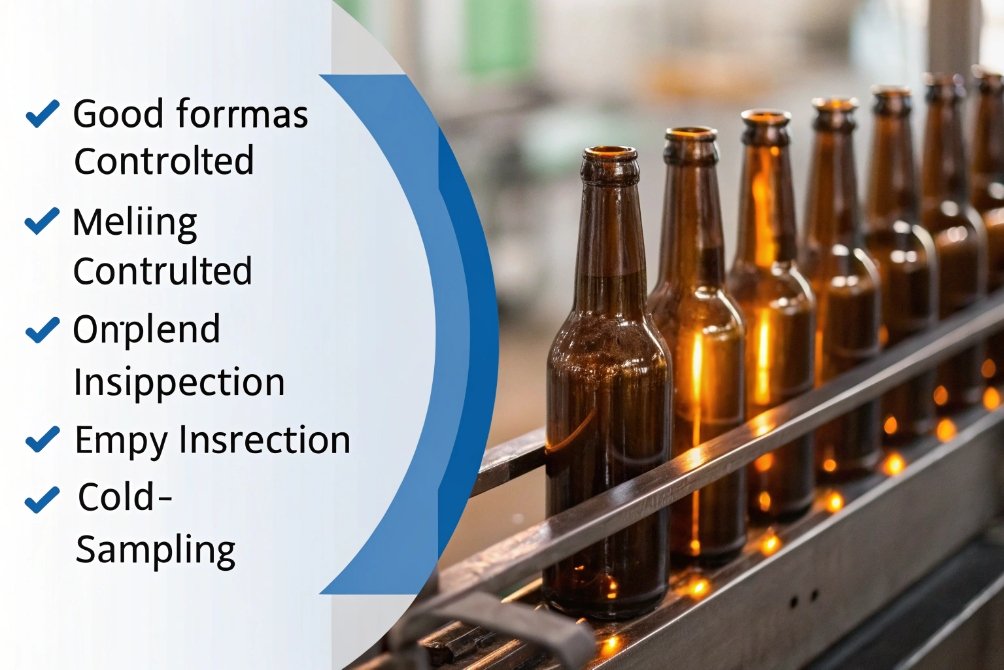
A mix of hot-end monitoring, 100% cold-end vision inspection, empty-bottle inspection at the filler, and smart sampling tests keeps critical defects out of shipped pallets.
From hot-end to cold-end: catching defects early
At the hot end, we focus on process stability:
- Gob monitoring (weight, length, temperature).
- Infrared or camera checks of parisons and newly formed bottles.
- Mold temperature and section-by-section trend data.
These systems help us see forming drift before it creates many rejects. But the heavy work of defect removal still happens at the cold end.
Typical cold-end inspection stations include:
- Finish inspection: cameras and gauges check thread height, ovality, chips, split finishes, and cocked necks.
- Sidewall inspection: rotating cameras look for stones, blisters, cords, bird swings, and cracks.
- Base inspection: under-bottle cameras look for base checks, inclusions, glass splinters, and foreign bodies.
- Dimensional checks: height, diameter, roundness, and sometimes push-up height.
- Coating and code checks: verifying surface treatment and legible markings.
If you need to explain “what 100% inspection actually covers” to a non-glass audience, a vendor overview of an in-line machine vision inspection system for sidewall, sealing surface, and base 6{#fnref6} makes the layer-cake concept easy to visualize.
| Inspection station | Main focus | Typical defects removed |
|---|---|---|
| Finish / neck | Sealing surface and threads | Chips, split finish, cocked neck, overpress |
| Sidewall | Body integrity and inclusions | Stones, blisters, bird swings, cracks, scuffs |
| Base | Stability and internal fragments | Base checks, heel cracks, internal glass chips |
| Dimensional | Fit and handling on the filler | Out-of-round, wrong height, tilt |
| Code / decoration | Traceability and branding | Missing codes, misprints |
Empty-bottle inspection and sampling at the filler
After bottles reach the customer, empty-bottle inspection systems give a second protection layer before filling. These systems can use:
- High-speed cameras to scan base, sidewall, and finish for cracks and dirt.
- Backlighting and mirrors to detect contamination inside the bottle.
- X-ray or other special tools to catch hidden inclusions or base defects that cameras might miss.
At the same time, the filler runs sampling plans:
- AQL-based visual checks on incoming pallets.
- Polariscope checks for residual stress.
- Mechanical tests: vertical load, internal pressure, and thermal shock on sample bottles.
For teams writing internal SOPs, the USDA’s visual aid for glass container defects 7{#fnref7} is also handy because it labels defect types consistently (including critical ones like bird swing and chips).
Conclusion
Most glass bottle problems start small—as a missed forming detail, a hidden stone, or a stress ring—and only strong inspection and process control stop them from reaching your customers.
Footnotes
-
A factory-focused defect handbook to identify root causes and fixes for common container-glass defects. ↩ ↩
-
Explains how to set acceptance sampling rules so “critical vs major vs minor” defects are enforceable. ↩ ↩
-
Shows how a polariscope reveals residual stress patterns that predict delayed cracking and failure. ↩ ↩
-
Defines cullet and lists typical contaminants (metals, ceramics) that must be controlled to avoid stones and stress. ↩ ↩
-
Details why ceramic contamination is a major barrier to clean cullet streams and quality container production. ↩ ↩
-
Demonstrates what modern 100% vision inspection checks (sidewall, sealing surface, base) in real production. ↩ ↩
-
Standardized defect naming/visuals useful for training inspectors and aligning defect severity categories. ↩ ↩






