
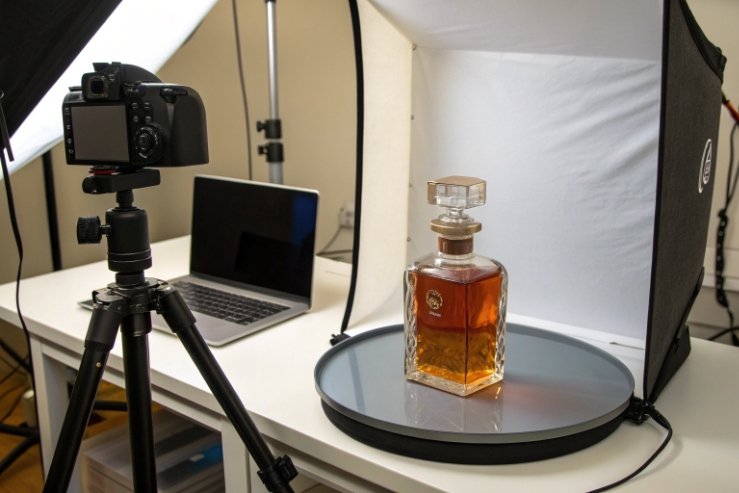
A premium baijiu bottle can fail for small reasons. A tiny check grows. A finish chip leaks. A weak wall breaks in transit.
Baijiu bottle inspection uses layered controls: 100% visual/finish screening, dimensional and stress checks, weight and wall uniformity mapping, optical color grading for flint glass, and AQL sampling plans that document pass/fail by lot.
Incoming inspection is not just “look and sort.” It is a system that connects risk to test method. The goal is simple: stop unsafe or unstable bottles before they enter filling, and keep records that make supplier correction fast. The best plants use the same structure every time: define defect classes, pick the right sample plan, then run checks that target sealing, breakage, and appearance.
Do polariscope stress checks reveal thermal checks early?
Thermal checks can hide in plain sight. A bottle can pass visual inspection and still crack later. This is why stress screening matters.
A polariscope can flag high residual stress and stress concentration patterns that often come before thermal-related failures, but it does not guarantee detection of every microcrack without a companion visual and thermal screening step.
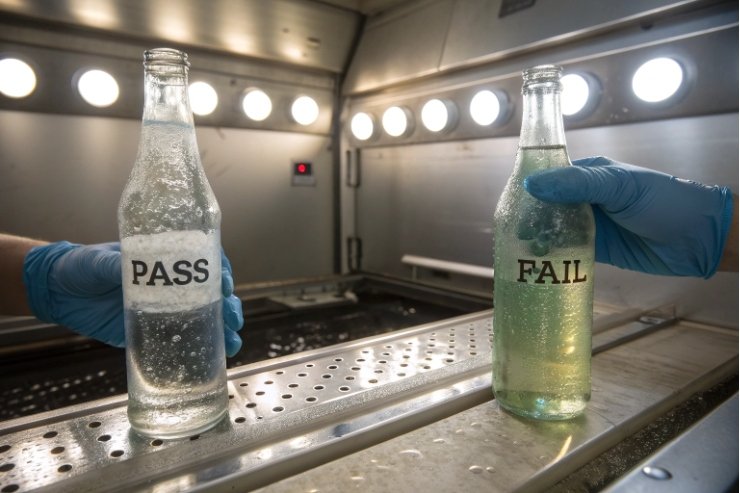
What a polariscope really tells the team
A polariscope uses polarized light to show stress birefringence patterns 1 in glass. When annealing is weak or cooling is uneven, the stress pattern becomes stronger and less uniform. That pattern is a warning sign. It means the bottle has less margin against impact and thermal shock 2. It also means a small defect can grow faster.
This helps in baijiu because the product is high alcohol and the bottle is often heavy. The bottle also faces temperature swings during washing, rinsing, and seasonal transport. Residual stress can turn those swings into cracks.
Can it reveal thermal checks “early”?
A thermal check is a crack or partial crack caused by fast temperature change or local stress. Some checks are visible. Some are not. A polariscope does not “see” the crack the way a microscope does. It sees the stress field around it. If a check creates a strong local stress concentration, the polariscope image can show a bright band, a sharp fringe change, or a localized pattern near the heel, shoulder, or finish.
So the honest answer is:
-
A polariscope is strong at risk screening for poor annealing and stress hot-spots.
-
It is weaker as a standalone crack detector for very small surface checks.
-
It works best when paired with finish inspection and thermal shock sampling for the same lot.
Where to focus polariscope checks on baijiu bottles
Stress issues that hurt spirits lines often sit in repeat zones:
-
Finish and neck ring: capping load and torque can trigger cracks.
-
Shoulder: shape transitions collect stress.
-
Heel and base edge: impact and case vibration hit here.
A simple stress grading system also helps incoming inspection stay consistent. It can be based on internal standards, but it must be written down and trained.
| Zone | Why it matters | Polariscope sign to watch | Typical decision |
|---|---|---|---|
| Finish/neck | seal and capping stress | strong bright fringes near lip | hold lot for deeper checks |
| Shoulder | stress transition | uneven, sharp fringe bands | sample more, check weight/thickness |
| Heel/base edge | impact risk | concentrated pattern at heel | raise impact test frequency |
| Body panel | cosmetics and strength | patchy pattern | review annealing trend |
The best practice is simple: use polariscope to catch stress drift early, then confirm with mechanical and thermal sampling so the result is not guesswork.
Which weight maps and wall gauges confirm uniformity?
A bottle can meet total weight spec and still be weak. The glass can be thick in the wrong place and thin where it matters. Uniformity is the real strength driver.
Uniformity is confirmed by combining total weight control with wall-thickness mapping across critical zones using ultrasonic or optical gauges, then trending results by mold cavity and shift to spot forming drift early.
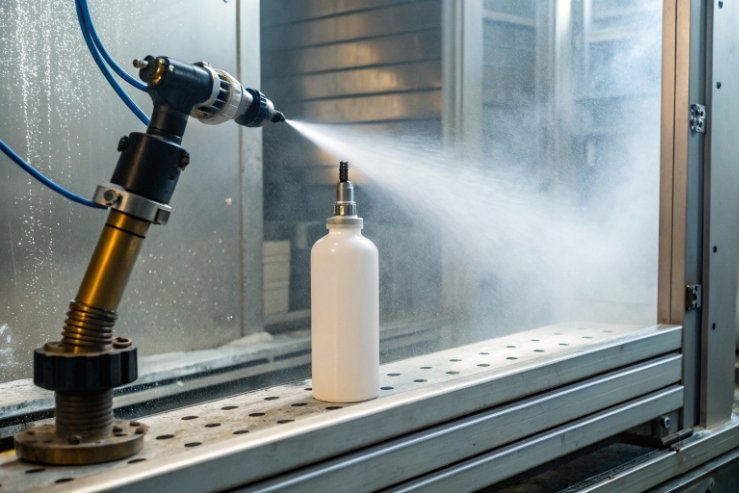
Weight maps: turn a simple number into a process tool
Total bottle weight is fast to measure, so it is often the first control used at receipt. But a single number only catches big problems. A weight map adds value by showing how weight varies:
-
Across the lot (mean and spread)
-
Across cavities (some molds drift first)
-
Across time (shift-to-shift stability)
A practical “weight map” approach:
-
Pull samples and record weight.
-
Sort by mold cavity code or traceability mark.
-
Build a simple heatmap or trend chart for each cavity.
-
Flag cavities that drift or show high scatter.
This is also a fast way to predict later failures. If one cavity trends light, thin zones are likely. Then impact and pressure strength drop.
Wall thickness gauges: confirm glass is where strength is needed
Wall thickness is the best direct indicator of strength margin. Incoming inspection does not need a lab-grade scan every time. It needs a repeatable, zone-based method.
Common tools and methods:
-
Ultrasonic thickness gauge 3: non-destructive, works well on glass when set up correctly.
-
Optical wall measurement 4 systems: faster for high volume, often used in automated inspection.
-
Section cut and microscope: destructive audit method for calibration and dispute resolution.
The key is to define measurement points that match real failure locations:
-
Finish area thickness (for stress cracking during capping)
-
Shoulder thickness (for impact and handling)
-
Body thickness (for general strength)
-
Heel/base thickness (for impact, vibration, and pallet load)
A simple zone plan keeps checks consistent:
| Measurement zone | Why it is critical for baijiu | Gauge method | What to record |
|---|---|---|---|
| Finish/neck ring | torque and capping load | ultrasonic / cut audit | thickness and variation |
| Shoulder | shape change stress | ultrasonic | minimum thickness |
| Mid-body | general strength | ultrasonic | average + ovality notes |
| Heel | impact hot spot | ultrasonic / cut audit | minimum thickness |
| Base center | stability and base strength | cut audit | punts and transitions |
How to use “uniformity” as a pass/fail control
Uniformity must be defined as a spec window, not a feeling. A practical incoming rule set often includes:
-
Total weight within tolerance
-
Thickness at each zone above minimum
-
Thickness variation within a limit across samples
-
Outliers traced back to cavity or shift
This is where traceability codes become a real quality tool. When the incoming report links failures to cavity marks, the supplier can correct forming and annealing fast, and the same defect does not return next month.
How do color and transmittance tests grade flint quality?
Flint glass is not only “clear.” It has a measurable color tone, and that tone changes with raw materials, furnace condition, and oxidation balance. Premium baijiu and spirits brands care a lot about this.
Flint quality is graded with objective optical tests such as visible-light transmittance, haze, and color coordinates (L*a*b*), using a light box and spectrophotometer to separate true clarity from green/yellow tint and to control lot-to-lot consistency.
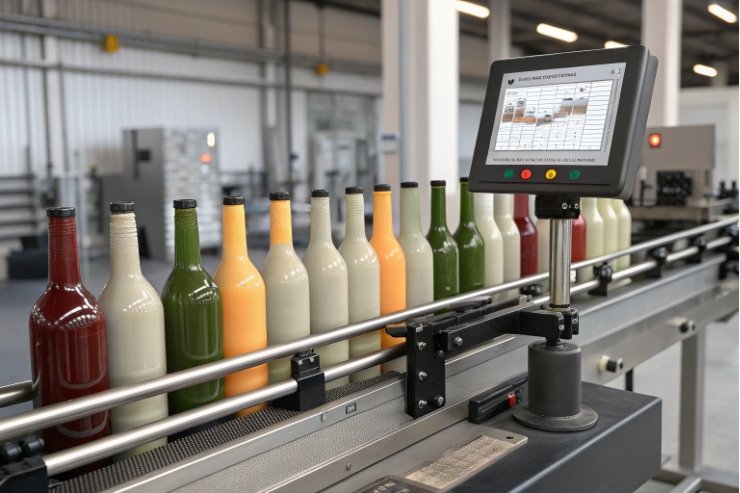
What “flint quality” means in daily QC terms
In production, flint quality is judged by:
-
How bright the bottle looks under standard light
-
How little green or yellow tint appears in thick sections
-
How consistent the color is across lots and cavities
-
How low the haze is after decoration or washing
Visual inspection is useful, but it can drift with lighting and human bias. So optical testing makes the decision stable.
The core instruments and what they measure
A practical incoming kit includes:
-
Standard light box (fixed color temperature) for visual grading and defect spotting.
-
Spectrophotometer 5 for L*a*b* color values and ΔE comparison to the master standard.
-
Transmittance measurement across visible wavelengths to confirm clarity.
-
Haze measurement if the brand is sensitive to “milky” appearance.
Many plants set a master “golden sample” bottle and compare each lot against it. This is a simple rule that avoids arguments. The lot either matches inside the agreed window or it does not.
Grading flint: make categories that match sales needs
Some buyers use terms like “super flint” or “high flint,” but those words only matter if linked to numbers. A better approach is to define grades by measured windows:
| Metric | What it controls | Why it matters for baijiu | How to use it |
|---|---|---|---|
| L* (lightness) | brightness | premium shelf look | set minimum L* |
| a and b | red/green and yellow/blue shift | green/yellow tint control | keep within a tight band |
| ΔE vs master | total color difference | lot consistency | accept/reject by threshold |
| Visible transmittance | clarity through glass | label and liquid presentation | set minimum transmittance |
| Haze | milkiness or scatter | “clean glass” appearance | set maximum haze |
Practical tips that prevent false failures
Optical results can be skewed if the setup is sloppy. These controls keep data clean:
-
Always test bottles that are clean and dry.
-
Use a fixed test location on the bottle body.
-
Keep the same light source and geometry each time.
-
Record bottle thickness context, because thicker glass shows more tint.
With these rules, flint grading becomes a real pass/fail control, not a debate in the warehouse.
What sampling plans document pass/fail at receipt?
Without a documented sampling plan, incoming inspection becomes random. One lot gets deep checks. Another lot gets waved through. That creates risk and supplier conflict.
Receipt inspection should use an AQL-based sampling plan with defect classes (critical/major/minor), defined inspection levels, and a standard report that records lot ID, sample size, accept/reject numbers, and measurement results for full traceability.
Build the sampling plan around defect risk
Baijiu bottles have three main risk buckets:
-
Safety and leakage risk (critical)
-
Line performance risk (major)
-
Appearance risk (minor/cosmetic)
So the sampling plan must separate them. A common structure is to set:
-
Very tight acceptance for critical defects (often near zero tolerance)
-
Tight acceptance for major defects
-
A higher allowance for minor defects if the brand agrees
This is the easiest way to keep standards fair and consistent.
Sampling plan framework used at receipt
A practical receipt flow:
-
Identify lot (supplier, PO, furnace date, mold codes).
-
Put the lot in quarantine until pass is signed.
-
Select samples using a written rule (random, across pallets, across layers).
-
Run checks in tiers: visual/finish first, then dimensions, then special tests by schedule.
-
Decide pass/fail using the accept/reject numbers from the plan.
-
Record results and release or block the lot.
AQL plans are often based on ISO/ANSI sampling tables. The exact accept/reject numbers depend on lot size and inspection level, so the incoming SOP must state which table and level the plant uses. The important part is that it is fixed and auditable.
What the incoming inspection report must include
A report that protects both the bottler and the supplier includes:
-
Lot number, quantity, date received, supplier batch
-
Sampling method and sample size
-
Defect counts by class and defect type
-
Dimensional results (finish OD/ID, height, ovality, tilt)
-
Stress grading summary (polariscope)
-
Weight and thickness summary (mean, range, outliers)
-
Optical color and transmittance summary (and master reference ID)
-
Photos of key defects
-
Final disposition: pass, conditional pass, rework, or reject
This table format keeps the result clear:
| Item | Result | Spec / Rule | Pass/Fail |
|---|---|---|---|
| Visual critical defects | count recorded | AQL critical | |
| Finish dimensions | mean + max/min | drawing tolerance | |
| Polariscope stress grade | grade distribution | limit grade | |
| Weight | mean + range | weight tolerance | |
| Wall thickness | zone mins | min thickness | |
| Color ΔE vs master | value | color coordinates (L*a*b*) 6 | |
| Transmittance / haze | values | min/max limits |
Add a smart rule for “high-risk” lots
Sampling is not the same as blind trust. When risk is high, tighten the plan:
-
New supplier or new mold set
-
Past failures on finish chips, stress cracks, or leaks
-
Heavy decoration that can hide checks
-
Winter shipments with bigger temperature swings
For these cases, it is normal to increase sample size and add one extra test like thermal shock sampling or a longer inverted leak hold with the real closure.
When receipt inspection is documented like this, quality control stops being personal. It becomes a stable system that protects the filling line and supports supplier improvement.
Conclusion
Baijiu bottle inspection works best when stress, uniformity, flint clarity, and AQL sampling plans 7 are all measured, recorded, and tied to lot traceability and defect risk.
Footnotes
-
Explanation of the optical phenomenon used to visualize residual stress distributions within transparent glass materials. ↩ ↩
-
Understanding how rapid temperature changes cause stress and potential failure in glass containers. ↩ ↩
-
Non-destructive testing method for measuring bottle wall thickness without cutting the glass. ↩ ↩
-
Automated non-contact inspection technology for verifying glass container dimensions and profile consistency. ↩ ↩
-
An instrument that measures light intensity as a function of wavelength to ensure precise color matching. ↩ ↩
-
A standardized color space definition used to quantify lightness and color channels for objective quality control. ↩ ↩
-
Statistical method for determining the number of samples to inspect and the acceptance criteria for a lot. ↩ ↩






