
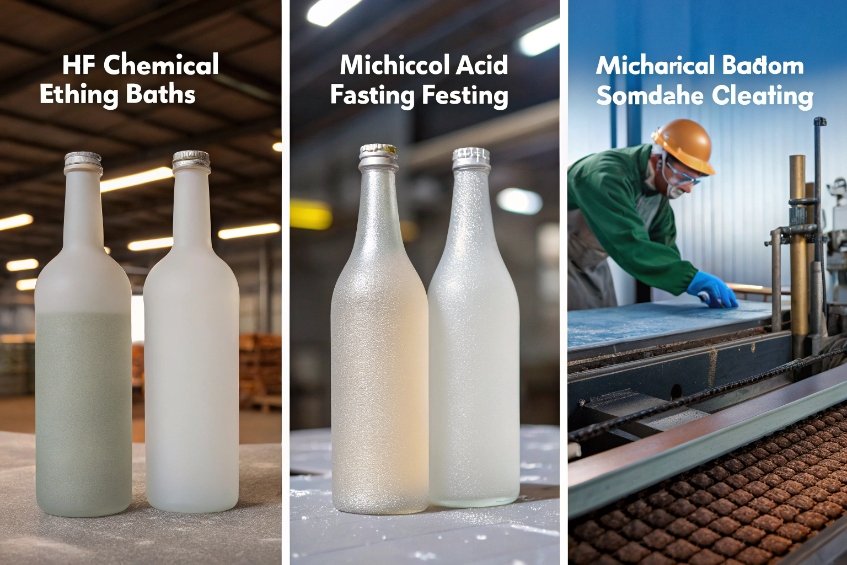
Frosting looks like a pure “design” choice, but it changes chemistry, roughness, and strength at the same time. If we pick the wrong system, we pay for it later in filling.
Industrial glass frosting uses three big toolboxes: fluoride-based chemical etching, abrasive blasting, and “etch-look” coatings or frits. The right choice depends on food-contact rules, required durability, and line speed.
When bottle designers say “frosted”, they often mean completely different technologies. A cosmetic brand may want deep acid-etch, a spirit brand may want fine bead-blast, and a personal-care brand may accept an etch-look lacquer. So I always start by sorting the request into: chemistry, abrasives, or coatings, then map that to food-contact and performance.
Which materials actually frost glass bottles for packaging?
Frosting recipes all attack the same thing: silica on the surface. They just do it with different levels of aggression, control, and risk.
Real production lines use a mix of HF-based chemistries, fluoride powders, abrasive media, and coating systems to hit different looks and price points.
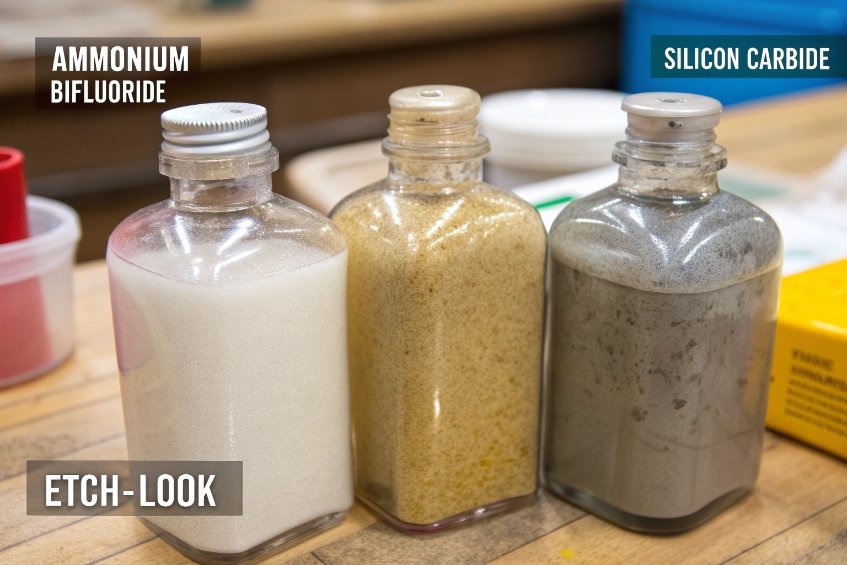
The three main frosting families
When someone asks “What do you use for frosting?”, I think in three families.
1. Chemical etching systems
These react with the glass surface and permanently change it:
-
Hydrofluoric acid (HF) baths and creams 1
Classic deep etch and satin finishes. Often combined with sulfuric or nitric acid to control reaction speed and sludge. Great coverage, very aggressive, high safety burden. -
Fluoride salt–based systems
Ammonium bifluoride 2, sodium or potassium bifluoride, and related salts, in liquids, powders, or pastes. They still generate active fluoride chemistry but with easier handling and more controlled attack. Good for uniform matte or “sugar” finishes. -
HF-free / low-HF sol-gel and hybrid coatings
Silica or organosilicate systems that build a micro-rough, frosted outer layer with much lower free fluoride. These often lean on the sol-gel process 3 to create a durable, washable surface.
These methods remove actual glass. The frost will not scratch off, and it survives standard washing, filling, and labeling.
2. Mechanical sandblasting media
Here we do not dissolve glass, we chip and cut it:
-
Aluminum oxide (corundum) 4
The workhorse media. Good control, long life, available in many grits for soft satin to heavy carve. -
Silicon carbide 5
Sharper and more aggressive. Used for fast cutting, deep matte, or carving heavy embossing. -
Glass bead blasting 6
Softer, more peening than cutting. They give a very even, fine satin that feels pleasant in hand.
These leave a “pitted” surface. Depth depends on pressure, grit, time, and stand-off distance.
3. Etch-look coatings and frits
These simulate frost without attacking the glass:
-
Waterborne acrylic or polyurethane etch-look lacquers
Sprayed and baked on. Easy color control, good for brand tints, but they are only as durable as the coating. -
Ceramic frit etch-look inks
Screen-printed and fired during decoration. Fuse into the glass surface, very durable, ideal for local frosted graphics. -
Sol-gel etch-look layers
Thin inorganic-organic hybrids applied as a coating, combining good chemical resistance with refined matte.
Add to this the masks and resists that create patterns: vinyl films, rubber masks, photoresists, UV inks, and laser-ablated resists. They do not frost by themselves, but they decide where the chemistry or blasting can touch the glass.
For a bottler, the choice is less about art, more about: food-contact, line speed, capital cost, and how the bottle should age in the market.
Are acid-etch and sandblasting media safe for food-contact bottles?
When we say “food-contact safe”, we really mean two things: nothing harmful can migrate into the product, and the surface can be cleaned and handled without leaving residues.
Both acid-etched and sandblasted glass can be safe for food packaging, if the chemistry is neutralized and the media is kept out of the final product.
How I think about food-contact safety for frosting
The good news is that pure glass is inert. Our risk comes from what we add:
1. Chemical etching on food-contact ware
With acid frost, the key risks are:
- Free HF or fluoride residue on the surface
- Drag-out of etchant into rinses and washers
- Contaminated sludge or rinse water finding its way back into production
To make acid-etched bottles food-contact safe, we need:
- A validated rinse and neutralization sequence (multiple counterflow rinses, pH and conductivity targets)
- Clear segregation of etching and bottle interior (most bottle frosting is external only)
- Supplier declarations that no heavy metals or non-approved additives remain on the surface
Used correctly and rinsed well, HF and fluoride salts do not sit untouched on the bottle. The final surface is still glass, just rougher. Many projects align their compliance approach to the EU food-contact framework (Regulation (EC) No 1935/2004) 7 when documenting suitability and migration controls.
2. Sandblasting media and dust
Abrasive blasting does not leave soluble chemicals, but we must control:
-
Dust and fine particles
Any loose abrasive must be cleaned from the bottle, especially from the inside. -
Media composition
Modern lines avoid free crystalline silica sand in favor of aluminum oxide, glass bead, or other engineered media, which are easier to control in a closed system.
As long as the sandblasting chamber is sealed and bottles are washed or blown clean afterwards, the final surface is again just glass, with a textured outer layer.
3. Coatings and etch-look paints
For food-contact packaging, the safest rule is:
- No organic coating on the product-contact side
Frosting should sit on the outside only, or on non-contact areas.
Any etch-look lacquers or inks must be based on resins and pigments that have suitable migration limits and are approved for use on the outside of food packaging. That is why many beverage brands choose real acid-etch or bead-blast: the surface is fully mineral.
In practice, we always back this up with:
| Item | What I want to see |
|---|---|
| MSDS / TDS | Clear chemistry, no hidden heavy metals |
| Migration test results | Simulants for wine, spirits, juice where relevant |
| Rinse / neutralization SOP | pH, conductivity, and contact time targets |
| Third-party certification | Declarations for EU/FDA food-contact suitability |
So the short answer: yes, acid-etched and sandblasted surfaces can be safe for food-contact packaging, but only if the process is engineered for complete rinse-off and no coating on the inside.
How do HF-free frosting systems compare with traditional acids?
Many brands want the look of acid frost without the full HF risk profile. That is where “HF-free” or “low-HF” systems come in.
HF-free etchants are usually safer to handle and easier on equipment, but they can be slower, more sensitive to process control, and may give a slightly different texture.
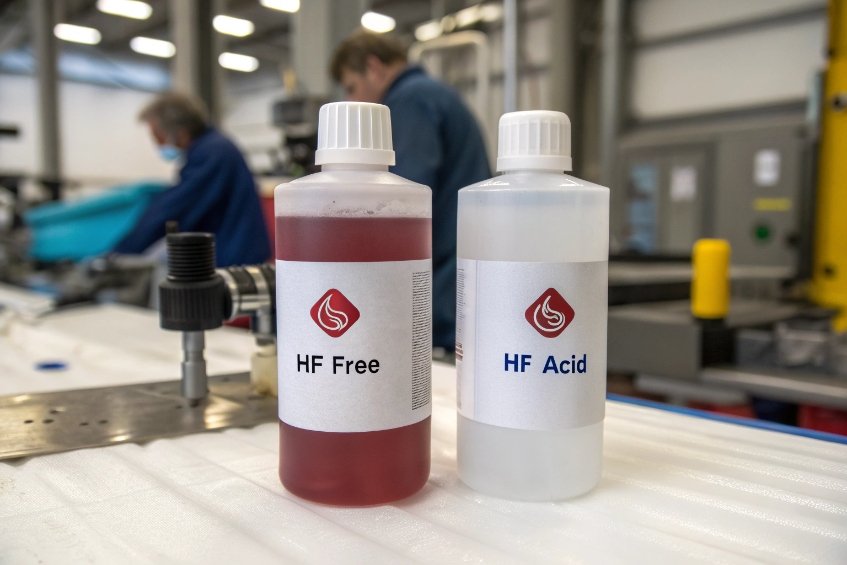
HF vs fluoride salts vs sol-gel: trade-offs in real production
When we compare systems in the plant, three things matter: safety, consistency, and appearance.
1. Traditional HF-based frosting
Pros:
- Very fast reaction, high productivity
- Deep, rich frost with wide adjustment range (from satin to heavy bite)
- Good coverage in complex shapes when bath circulation is right
Cons:
- Severe health and safety risk for workers and maintenance
- Strong attack on equipment, high corrosion cost
- Sensitive sludge handling and wastewater treatment
- Harder to sell to brand owners with strong EHS policies
These are the reason many decorators still love HF for tough jobs, but also why many corporate EHS teams push to phase it down.
2. Fluoride salt–based systems (ammonium bifluoride, etc.)
These are often sold as “HF-free”, but from a chemistry view they still create active fluoride species when dissolved. However, compared with neat HF they offer:
- Easier storage and dosing (solid or lower concentration liquids)
- Smoother, more controllable reaction rates
- Lower fume levels and less violent attack on equipment
- Slightly narrower frosting window but very good uniformity
The finish is usually a fine, even matte. For cosmetic and spirit bottles, this is often exactly what designers want: soft touch, good light diffusion, clean look on the shelf.
3. Sol-gel and hybrid organosilicate coatings
These do not dissolve the glass; they build a micro-rough layer on top of it.
Pros:
- No free fluoride needed
- Very good durability and chemical resistance when cured correctly
- Easy to combine with anti-fingerprint or hydrophobic tweaks
Cons:
- Need extra curing step (oven or UV)
- Adhesion must be tuned for each glass composition and pre-treatment
- Surface is technically a coating, not pure glass, which matters in some regulatory frameworks
When a project is “no fluoride, period”, sol-gel and frit-based solutions are our main tools.
For FuSenglass, the choice usually goes like this:
| Requirement | Likely choice |
|---|---|
| Deep permanent frost, classic look | HF or bifluoride bath + strong rinsing |
| Cosmetic satin, EHS-critical client | Bifluoride / low-HF powder system |
| Patterned logo frost only | Ceramic frit etch-look ink + firing |
| No fluoride allowed | Sol-gel / hybrid etch-look coating |
The more the world tightens HF rules, the more these alternative systems become standard instead of “special options”.
What grit sizes and masks give a uniform matte finish at scale?
Mechanical frosting looks simple in a lab. On a 30,000-bottle-per-hour line, grit size, nozzle layout, and masking quality decide if the finish is premium or patchy.
Uniform matte at scale needs the right abrasive size, stable pressure, and masks that can survive thousands of blasts without curling or lifting.
Building a repeatable blasted frost
I like to break blasting into three modules: media, motion, and masking.
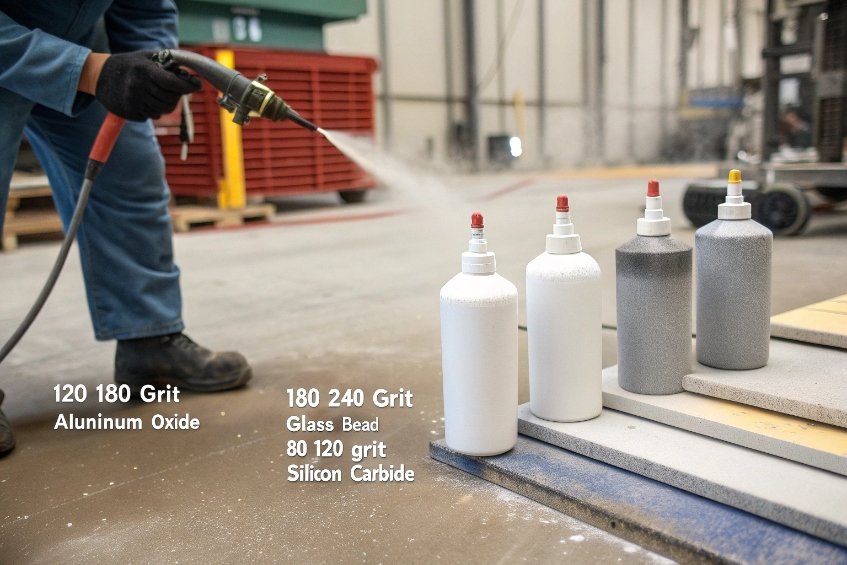
1. Media and grit size
For bottles, we rarely use the very coarse grits found in architectural work. Typical choices:
-
120–180 grit aluminum oxide
Good all-round satin frost for body and shoulder. Fine enough for labels and printing, still strong diffusion. -
180–240 grit glass bead
Very soft, touch-friendly finish. Ideal for high-end spirits or perfumes where hand-feel matters. -
80–120 grit silicon carbide or alumina
For deeper matte or carved logos. More aggressive on strength, needs careful stress checks.
Finer grit gives smoother texture and better cleanliness, but it also:
- Needs higher pressure or longer dwell to achieve the same opacity
- Creates more dust, so extraction and filtration must keep up
Coarser grit cuts faster but leaves a more “sparkly” texture and can trap more dirt.
2. Nozzle layout, motion, and process parameters
Uniformity depends on:
- Nozzle stand-off distance and angle
- Traverse pattern (how the spray sweeps the bottle)
- Bottle rotation speed
- Exposure time per area
- Consistent pressure at the nozzle, not just at the compressor
A simple way to tune this is to:
- Run a test bottle with a white or dark temporary coating
- Blast and then inspect the pattern bands by eye
- Adjust overlap until the banding disappears
For mass production, I always specify:
| Parameter | Typical starting point (bottles) |
|---|---|
| Grit size | 150–180 alumina for body frost |
| Nozzle pressure | 3.5–5.5 bar, depending on media |
| Stand-off distance | 150–250 mm |
| Bottle rotation | 60–120 rpm |
| Exposure time / zone | 1–3 seconds per band |
We then fine-tune these based on opacity and strength tests.
3. Masks and resists for pattern control
Masks decide where the glass stays clear:
-
Vinyl films
Cheap, easy to plot, good for simple logos and stripes. Not ideal for very long runs because edges can lift. -
Rubber masks
Thicker, more durable, better for deep carve or long campaigns. -
Photoresists and UV-curable inks
Great for fine detail and halftones. Coated, exposed, and developed like a photo plate.
Key to uniform matte is edge integrity. If edges lift, abrasive creeps under and creates fuzzy halos. If masks are too hard, they can bounce media and create bright bands near the edge.
So at scale, the best practice is:
- Match mask thickness to blasting depth
- Use clean, well-adhered surfaces (no dust, no oil) before masking
- Use consistent removal procedures to avoid pulling chips of glass at the edge
When media, motion, and masks work together, we get a smooth, repeatable matte with sharp patterns, even on complex bottle shapes.
Does frosting change strength, cleanliness, or label adhesion?
Designers usually only talk about look and feel. On the plant side, we must ask three more questions: Does this frost break more? Does it clean well? Will labels stick?
Frosting always changes surface roughness. That can either help us (better label grip, better scratch resistance) or hurt us (weaker bottles, harder cleaning) depending on how deep and sharp the texture is.
Performance impact of frosting in production
1. Mechanical strength
-
Shallow, uniform acid-etch
Often keeps strength close to or slightly better than clear glass, because it can soften existing surface flaws instead of adding new deep scratches. -
Deep sandblast or heavy carve
Cuts sharp pits and micro-cracks. These act as stress concentrators and can reduce impact and internal-pressure strength. For returnable or carbonated bottles, this is critical.
Because of this, whenever a customer wants a very deep blast, I like to:
- Run inner-pressure and pendulum impact tests
- Compare breakage rates on a pilot run vs standard glass
- Check long-term scuffing on lines with high conveyor contact
2. Cleanliness and stain resistance
Rougher surfaces trap more dirt:
- Fine acid frost with small pores is easier to clean and less prone to staining.
- Coarse sandblast can hold oils, inks, and dirt in deep valleys. Cleaning and drying must be stronger.
Inside the bottle we almost never frost because that would make cleaning and visual inspection harder. For the outside, we can keep hygiene high by:
- Targeting moderate roughness (soft satin, not deep carve)
- Choosing chemistries that build rounded, not needle-like, peaks
- Using good cold-end washing and air-blowing after decorating
3. Label adhesion and application
Frosted surfaces change how labels behave:
-
Better grip
Extra roughness gives more mechanical keying for pressure-sensitive and hot-melt labels. -
More air trapping
Very rough or highly porous frost can trap air pockets and give silvering under clear labels. -
Different surface energy
Acid-etched glass may have a slightly different surface chemistry compared to plain glass or coatings. This can change adhesive wetting.
To keep label performance stable, I like to:
- Test label systems on both clear and frosted samples
- Adjust adhesive tack and coat weight if needed
- Check label skew and flagging at full line speed, not only in the lab
A simple summary for the team:
| Aspect | Light acid frost | Deep blast frost |
|---|---|---|
| Strength | Close to clear, sometimes + | Often lower, needs tight control |
| Cleanability | Good, smoother microtexture | Harder, more dirt retention |
| Label adhesion | Usually good, easy to tune | Good grip but risk of silvering |
| Food-contact use | Common externally, safe with rinse | Needs careful media cleaning |
So yes, frosting is more than a visual effect. It is a surface-engineering decision that reaches all the way to breakage rates, washing, and labeling efficiency.
Conclusion
Glass frosting is not just chemistry or blasting. It is a full system choice that must balance look, safety, strength, cleaning, and label performance on the same bottle.
Footnotes
-
HF reference for hazards and controls—useful when assessing etch-system safety burden. ↩ ↩
-
Chemistry and identifiers for ammonium bifluoride, a common fluoride salt used in etching blends. ↩ ↩
-
Explains sol-gel coating formation, useful for understanding HF-free frosted layer options. ↩ ↩
-
Background on corundum/aluminum oxide as an abrasive media for controlled matte blasting. ↩ ↩
-
Overview of silicon carbide properties, helpful for choosing aggressive media for deep matte or carving. ↩ ↩
-
Shows how bead blasting creates a fine satin texture via peening rather than cutting. ↩ ↩
-
EU baseline regulation for materials intended to contact food; useful when documenting packaging compliance approach. ↩ ↩






