
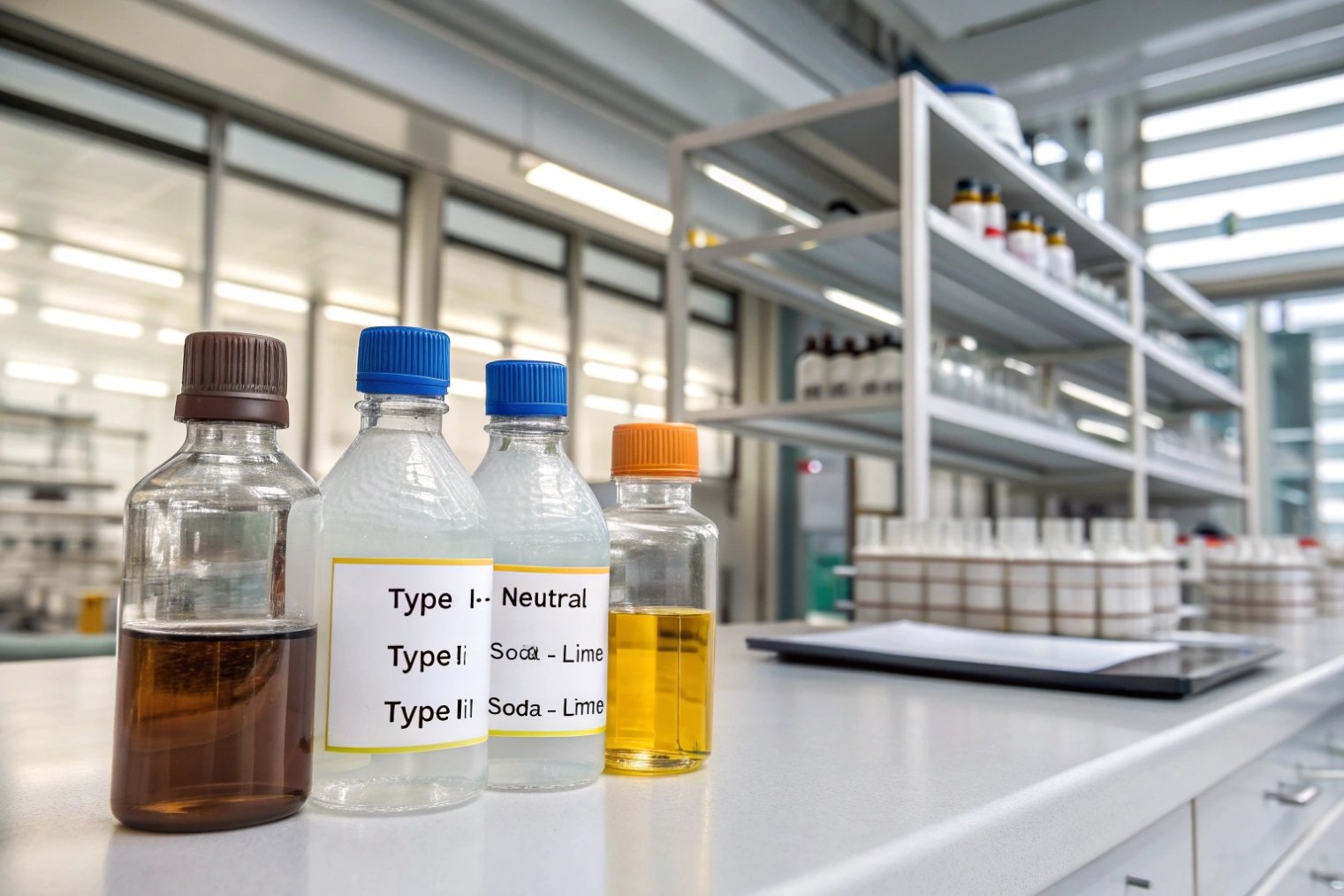
Choosing the wrong pharmaceutical bottle does not just risk cosmetic defects; it can shift pH, shed ions, and ruin stability data you spent months generating.
At a high level, pharma bottles use neutral borosilicate (Type I), treated soda-lime (Type II), or standard soda-lime (Type III), plus coatings, siliconization, and colors like amber or cobalt that tune extractables, light protection, and compatibility for each specific formulation.
Seeing these as a toolbox helps. Instead of asking “Which glass is best?”, it is better to ask “Which glass, surface, and color combination fits this exact drug, route, and shelf-life target?”
When should you choose neutral borosilicate vs. soda-lime glass for pharma bottles?
Many teams default to “Type I for everything” and then wonder why the packaging budget explodes or lead-times jump.
Neutral borosilicate (Type I) fits high-risk, injectable, or alkaline products, while soda-lime (Type II or III) works for less sensitive oral or topical drugs when hydrolytic performance and stability data support it.
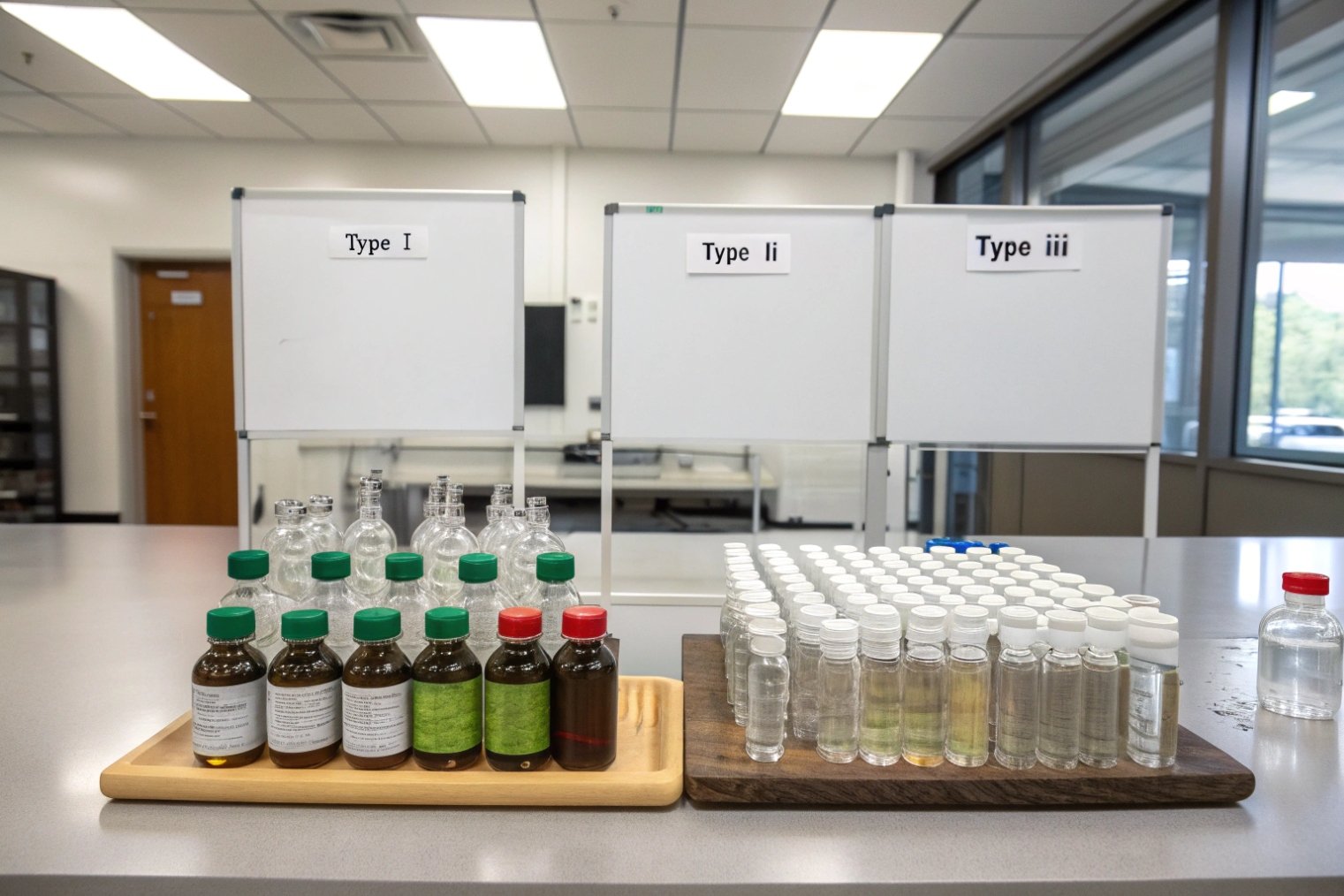
Understanding Type I, II, and III in practice
Pharmacopeias (for example, USP ⟨660⟩ Containers—Glass 1 and Ph. Eur. general chapter 3.2.1 2) group glass by hydrolytic performance, not only by recipe now:
- Type I: “neutral” high-resistance glass – usually borosilicate or aluminosilicate.
- Type II: soda-lime glass with internal surface treatment to improve hydrolytic resistance.
- Type III: untreated soda-lime glass with moderate hydrolytic resistance.
Neutral borosilicate (classic Type I) contains boron and alumina that tighten the glass network. This cuts sodium and calcium leaching and increases resistance to thermal shock. Newer aluminosilicate Type I families keep the same hydrolytic rating with even better mechanical behaviour and fewer delamination issues.
Type II starts life as Type III soda-lime. A controlled sulfur-based de-alkalization treatment on the inner surface converts surface alkalis into soluble salts that are washed away. The result is high hydrolytic resistance at the surface, even though the bulk glass is soda-lime.
Type III is standard soda-lime glass. It is cheaper, easier to mold, and widely used for syrups, oral suspensions, and many solid-oral bottles.
Simple selection logic that actually works
A practical decision pattern many pharma teams use:
-
Choose Type I when:
- Product is parenteral (especially IV, subcutaneous, intrathecal).
- Formulation is alkaline or prone to precipitation with trace ions.
- Drug is sensitive, biologic, or has a narrow therapeutic index.
- Autoclave or high heat sterilization is required.
-
Consider Type II when:
- Product is aqueous, neutral, or acidic.
- You need higher volume moulded bottles but still want high surface resistance.
- Cost and weight matter, but you cannot accept plain Type III.
-
Use Type III when:
- Product is non-parenteral (oral, topical) and stability data show no issue with moderate hydrolytic resistance.
- Tablets, capsules, dry powders, or oil-based products are packed.
- You want the most cost-effective glass that still meets stability specs.
If you are documenting this choice for development or filing, align the rationale with the FDA Container Closure Systems guidance 3.
In short, neutral borosilicate is the default for risk-heavy use cases. Soda-lime (Type II or III) is the workhorse for everything else, as long as hydrolytic tests and stability data confirm that extractables stay inside your limits.
How do hydrolytic classes and alkalinity impact stability?
A bottle can pass all dimensional checks and still silently damage a formulation by nudging pH or adding trace metals.
Hydrolytic resistance tells you how much glass surface leaches into water at high temperature; higher classes and lower alkalinity mean fewer ions, smaller pH shifts, and lower risk of precipitation or degradation.
What hydrolytic resistance really measures
Hydrolytic tests expose glass (either as crushed grains or whole containers) to purified water at defined temperature and time. Standardized approaches like the ISO 4802-1 hydrolytic resistance test method 4 use this same “released alkali ions” principle. After exposure, the test measures:
- How much alkali has leached into the water.
- Equivalent volume of acid needed to neutralize that extracted alkalinity.
Lower acid consumption means higher hydrolytic resistance. Type I is at the top of this scale; Type III is lower. Surface-treated Type II moves a soda-lime container up toward Type I performance at its inner surface.
Why this matters for stability:
- Extracted Na⁺ and Ca²⁺ can raise pH of weakly buffered injections or eye drops.
- Higher pH can speed oxidation or hydrolysis of sensitive APIs.
- Calcium or other ions can cause precipitation with phosphate or citrate buffered systems.
- In extreme cases, long contact can lead to flaking or delamination, adding visible or sub-visible glass particles.
FDA also maintains a running summary of recent findings related to glass delamination in injectable vials 5.
Hydrolytic class is therefore not a “nice to have” label. It is a proxy for how stable your formulation will be over years on a shelf or in a fridge.
Linking alkalinity and formulation risk
From a formulation point of view, you can think of risk bands like this:
| Product type / condition | Glass expectation |
|---|---|
| Small-volume parenterals, biologics | Type I hydrolytic performance always |
| Large-volume parenterals, irrigations | Type I or Type II with strong justification |
| Acidic or neutral orals (syrups, drops) | Type II or III, stability data driven |
| Alkaline aqueous products | Type I strongly preferred |
| Dry solids, tablets, powders | Type III usually fine, confirm humidity risk |
A couple of practical checks help:
- Run accelerated stability including pH, metal ions, and visible/sub-visible particle counts with the chosen container.
- Compare Type I vs Type II/III early if you hope to downgrade; sometimes savings vanish once extra controls and rejection costs are included.
One more nuance: hydrolytic resistance and light protection are separate. A Type I bottle can be clear or amber; hydrolytic tests do not care. Light risk is handled by colorants and spectral transmission tests, which sit on top of the base glass choice.
Which coatings and siliconization options improve drug compatibility?
Bare glass is already quite inert, but some drugs still adsorb, denature, or trigger surface reactions that cause particles or potency loss.
Internal siliconization, barrier coatings, and external safety or lubricity coatings extend compatibility by lowering surface reactivity, reducing adsorption, and protecting the glass from scratches and breakage.
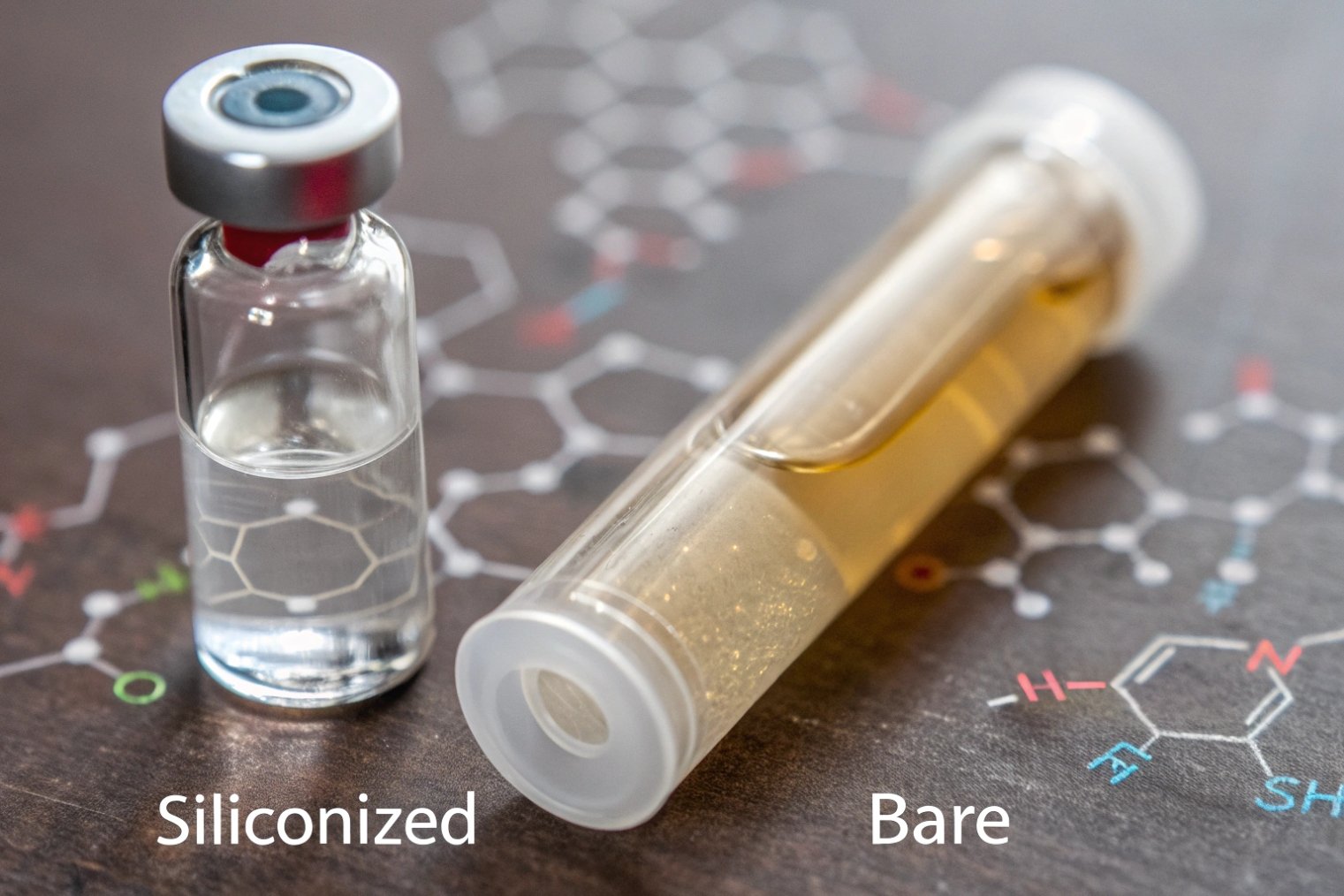
Inside the bottle: siliconization and barrier layers
The inner surface is where formulation and glass meet. Common strategies include:
-
Siliconization (silanization)
A thin silicone or siloxane layer is applied inside vials or bottles, then cured. This creates a smoother, low-energy surface that can:- Reduce protein adsorption in biologics.
- Help wetting and emptying for viscous solutions.
- Decrease the risk of mechanical sticking for lyophilized cakes.
However, siliconization must be controlled. Poorly cured layers can shed droplets or particles, and some regulatory teams worry about silicone-derived particulates in parenterals.
-
Inorganic barrier coatings
Very thin silica-like or other barrier coatings (often plasma-deposited) further reduce extractables and interaction. These can help with:- Aggressive or high-pH drugs.
- Minimizing alkali leaching and delamination.
- Keeping a more “inert” surface while still using a standard glass type behind it.
Any internal coating needs its own extractables and leachables assessment (see the USP ⟨1663⟩ extractables assessment framework 6). It should not introduce more risk than it removes.
Outside the bottle: strength and safety
On the outside, coatings focus on mechanical performance and safety:
-
Hot-end and cold-end coatings from container glass practice (metal oxide at the hot end, polymer at the cold end) can:
- Increase scratch resistance.
- Improve line handling and lower breakage.
- Reduce abrasion in packing and transport.
-
Polymer safety coatings (for example, PA-based shells around borosilicate):
- Improve impact resistance.
- Contain fragments if breakage occurs, which is useful in cleanrooms or hospital settings.
- Allow handling of large volumes or heavy bottles with reduced risk.
For high-value biologics, vaccines, or cytotoxics, this outer safety layer is often worth the cost because one broken bottle can mean not just glass and liquid, but full batch write-offs and cleanroom downtime.
In short, coatings and siliconization let you separate “mechanical and hydrolytic backbone” (the glass type) from “surface behaviour” (how the drug sees the container). Each new layer must earn its place by improving net compatibility and risk, not just by adding complexity.
What colorants (amber, cobalt) provide needed light protection?
A chemically stable bottle can still fail if light breaks down the API faster than your shelf-life allows.
Amber is the default for light-sensitive drugs because it strongly cuts UV and blue light; cobalt or green glass give moderate protection and branding options, while clear is only for photostable products or when extra secondary shielding is used.
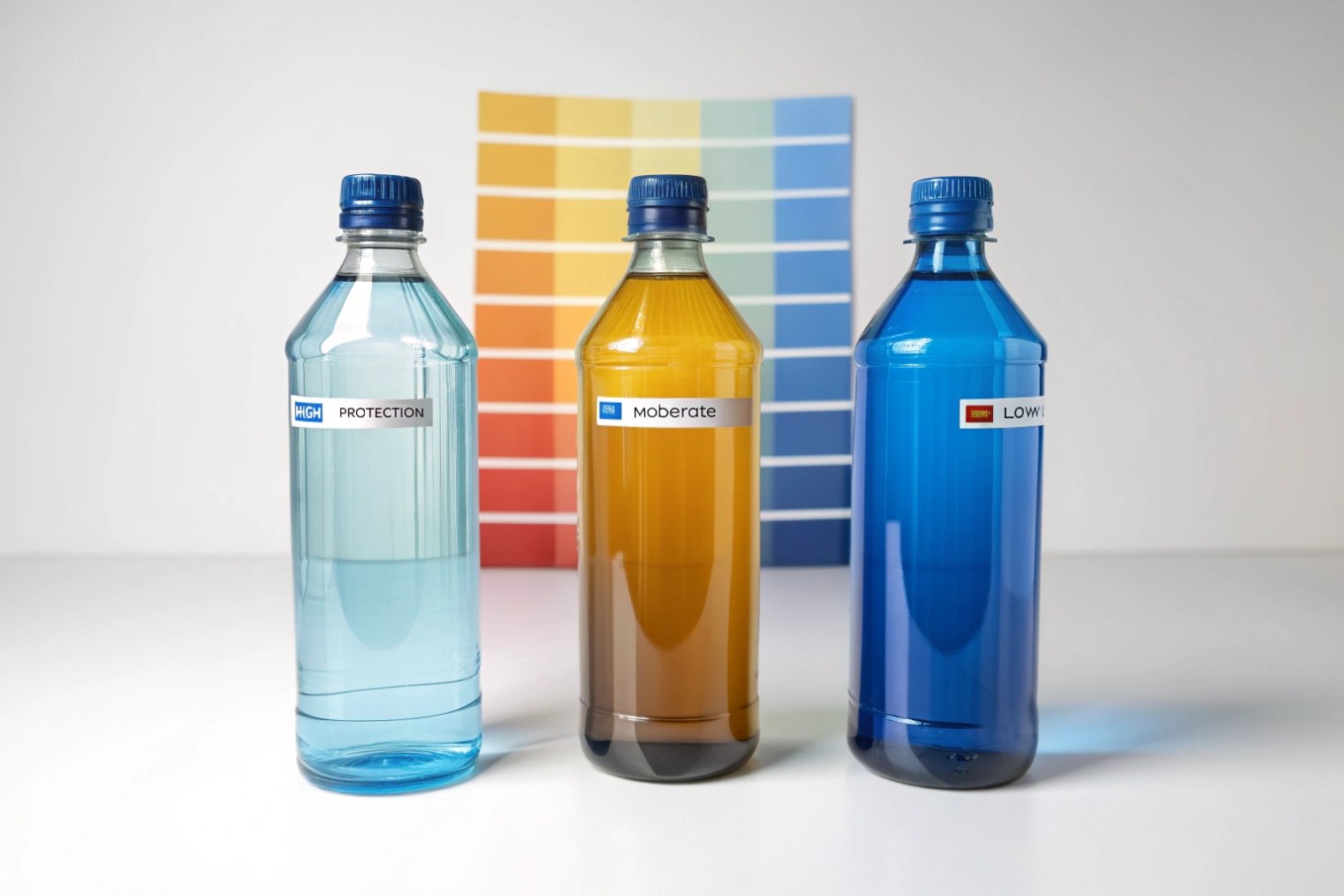
Linking bottle color to photostability studies
Pharmacopeias define “light-resistant containers” based on spectral transmission between about 290–450 nm. For many products, the rule of thumb is that the container must block at least a large share of this band.
In practice:
-
Amber glass uses iron, sulfur, and sometimes carbon species to absorb UV and much of the blue region. Typical pharma amber vials block a majority of light in the 290–450 nm range, which aligns well with many photodegradation pathways.
-
Cobalt blue and green glass offer moderate UV and visible protection. They can be enough for APIs that are only mildly light-sensitive but are often chosen more for branding than for maximum shielding.
-
Flint (clear) glass gives almost no intrinsic UV protection. It is only suitable for truly photostable products or when secondary packaging (cartons, overwraps, full-body sleeves) provides the real light barrier.
From a development point of view, the steps usually look like:
- Run photostability studies on the drug in representative containers per the ICH Q1B photostability testing guideline 7.
- Compare degradation profiles in clear vs amber (and sometimes other colors).
- Decide whether the product needs a light-resistant container or whether secondary packaging alone is enough.
- Confirm that the chosen bottle color meets spectral transmission requirements for the region and product type.
Balancing color, glass type, and market needs
Color does not change hydrolytic type; it rides on top of Type I, II, or III. The key is to match all three dimensions:
- Glass type: chemical and thermal resistance.
- Color: light protection vs visibility of contents.
- Coatings / surface: drug compatibility and mechanical performance.
Some common combinations:
| Use case | Typical choice |
|---|---|
| Light-sensitive parenteral | Type I amber vial or bottle |
| Photostable parenteral, focus on clarity | Type I clear, often with cartons |
| Oral liquids needing light protection | Type II or III amber |
| Topicals / dermatologics with branding | Type III cobalt or green, backed by data |
| High-value biologics | Type I (sometimes aluminosilicate) + amber + optional safety coating |
One last practical point: marketing often wants blue or clear; quality wants amber. The best compromise is to start from photostability data, not aesthetics. When the data show a clear risk, amber usually becomes the easiest way to meet shelf-life without adding complex secondary packaging or storage restrictions.
Conclusion
Choosing pharma glass is not just “Type I vs Type III.” It is a design exercise combining glass type, hydrolytic class, coatings, and color so the bottle quietly protects your drug from day one to expiry.
Footnotes
-
Official USP chapter defining glass container performance classifications and hydrolytic tests. ↩ ↩
-
EDQM update explaining revised Ph. Eur. 3.2.1 tests for defining glass types and hydrolytic resistance. ↩ ↩
-
FDA expectations for container closure system information in drug and biologics submissions. ↩ ↩
-
ISO method for classifying hydrolytic resistance of glass container interior surfaces. ↩ ↩
-
FDA overview of causes, risk factors, and recalls tied to glass delamination in injectable vials. ↩ ↩
-
USP framework for designing and justifying extractables studies for packaging and delivery systems. ↩ ↩
-
Official ICH guideline detailing photostability study design, light exposure conditions, and acceptance concepts. ↩ ↩






