
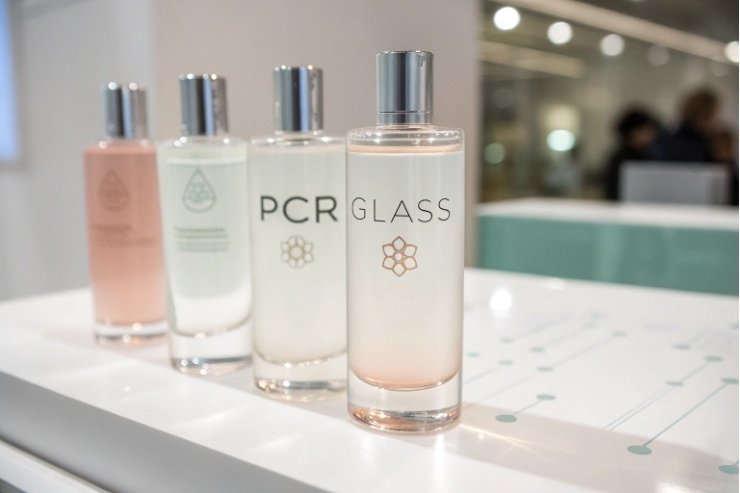
Clients keep asking for “more sustainable” glass, but nobody wants to gamble with clarity, strength, or brand image.
PCR glass is made with post-consumer recycled cullet from used bottles. It keeps the same performance as virgin glass, while cutting energy use, CO₂ emissions, and raw material demand.
Once you understand how cullet percentage affects color, process, and supply, PCR glass becomes a very practical tool. It helps you hit ESG and regulatory targets without redesigning your entire pack from scratch.
How does PCR (post-consumer recycled) cullet % affect clarity, tint, and strength?
Everyone loves the idea of “recycled”, until a batch comes in with a slight green cast or more visible seeds than expected.
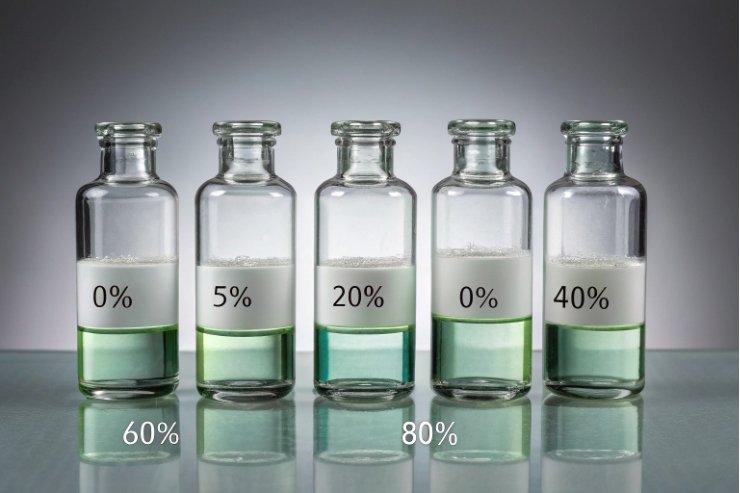
Higher PCR cullet percentages mainly influence optical properties—slight tint and occasional inclusions—while strength and chemical resistance stay equivalent, as long as the furnace and cullet streams are tightly controlled.
What actually changes when cullet % goes up
cullet (crushed recycled glass) 1 can come from many sources: beverage bottles, food jars, sometimes cosmetic containers. When you increase the share of this cullet in the batch, three things show up first:
-
Tint drift
Mixed cullet often carries a low green or “feint” tone, even after sorting and decolorizing. The higher the PCR %, the harder it is to keep a perfect water-white flint. -
Color variability between batches
If the incoming cullet mix changes (more green one month, more amber the next), the furnace color balance shifts slightly. Good plants manage this with strict cullet specs and color corrections, but very tight visual tolerances become harder. -
Defect sensitivity
Poorly cleaned cullet can add seeds (tiny bubbles), stones, or cords. Modern lines use metal detectors, optical sorters, and washing systems to reduce this, but cullet quality still matters.
You can think about cullet level like this:
| PCR cullet % (by weight) | Typical visual effect in flint* | Common use case |
|---|---|---|
| 10–25% | Almost identical to virgin flint | General food, beverage, standard cosmetics |
| 30–60% | Very slight green / feint tone possible | Premium but “eco” stories, tinted cosmetics |
| 60–90%+ | Noticeable tone, tighter QC needed | Dark tints, amber, greens, or opaque designs |
*Exact result depends on cullet sorting and furnace controls.
If your brand can accept a hint of character in the glass tone, you gain more freedom to push PCR levels up. If you need “crystal clear”, you may settle on lower PCR percentages or use tinted glass to hide small shifts.
What about mechanical strength and chemical durability?
Here is the good news: glass does not wear out. When you melt PCR cullet, you rebuild the same glass network as with virgin sand, soda ash, and limestone. The core properties come from:
- Overall composition (oxide mix)
- Furnace conditions
- Forming and annealing curve
PCR cullet does not, by itself, weaken the glass. What reduces strength is:
- Poor annealing → internal stress
- Inclusions or stones → crack starters
- Thin spots in design → impact sensitivity
If your supplier has stable forming and annealing, a 40–60% PCR bottle can meet the same internal pressure and impact tests as a virgin bottle.
Design tricks to manage tint and perceived quality
For premium cosmetics and fragrance, you can use design to turn PCR optics into a feature, not a bug:
- Embrace a slight green or feint tone as part of the eco story.
- Use tinted glass (amber, smoke, olive) where high PCR has almost no visible downside.
- Add coatings or partial sprays that leave a “recycling window” while masking most color variation.
- Keep decoration and coating light enough so recyclers can still sort glass (target some visible transmission, not full opacity).
This way, PCR content becomes part of the visual language of “natural”, “responsible”, and “authentic”, instead of “almost but not quite clear enough”.
Can PCR glass reduce CO₂ and energy use without compromising quality?
Sustainability teams want clear numbers. Operations teams want to know if those numbers cost them downtime or higher reject rates.
Raising PCR cullet content cuts furnace energy demand and CO₂ emissions—roughly a few percent per +10% cullet—while delivering the same functional quality when cullet is clean and process controls are strong.
Why cullet melts “easier” than virgin batch
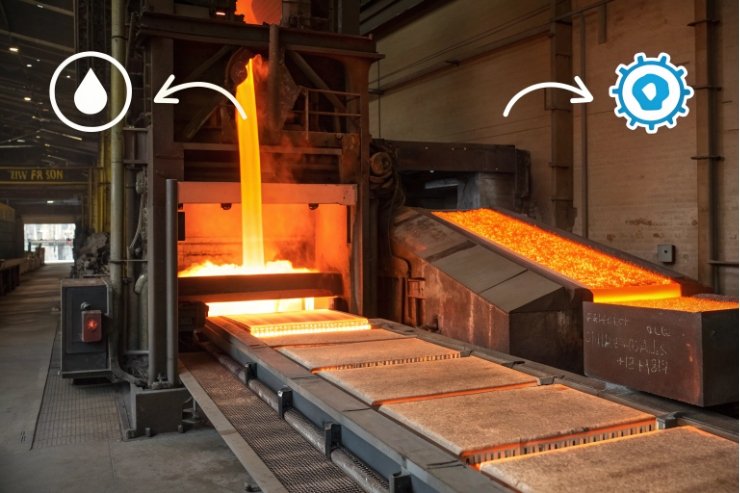
Virgin glass batch contains sand, soda ash, limestone, and other additives. These must react and melt from scratch. Cullet is already fully formed glass. When you add cullet:
- Melting starts at lower effective temperature
- Reaction time is shorter
- Furnaces need less fuel or electricity to reach the same melt quality
Industry and sustainability teams increasingly refer to broader glass sector decarbonisation analyses 2 to benchmark energy and emissions levers, including higher cullet use.
CO₂ emissions drop in two places:
- Less fuel burned in the furnace
- Fewer emissions from quarrying and transporting virgin raw materials
A simplified view:
| Average PCR % in furnace | Energy use vs 0% baseline | CO₂ footprint vs 0% baseline* |
|---|---|---|
| 0% | 100% | 100% |
| 30% | ~92–94% | ~88–92% |
| 60% | ~84–88% | ~80–85% |
| 90%+ | ~70–80% | ~60–70% (depends on many variables) |
*Rough directional ranges, not exact guarantees; real numbers depend on furnace tech and fuel.
Does high-PCR glass keep the same performance?
From a packaging point of view, you care about:
- Chemical inertness with your formula
- Mechanical strength in filling, transport, and daily use
- Dimensional stability for closures and pumps
- Aesthetic quality (tone, bubbles, surface)
Chemically, PCR glass behaves like standard soda-lime glass. It is still inert, non-porous, and compatible with alcohol, oils, surfactants, and most cosmetics.
Performance only suffers if:
- Cullet streams bring in incompatible contaminants (ceramics, metals)
- Furnaces are pushed too hard without enough QC
- Quality checks for impact, pressure, and visual defects are weak
Most modern PCR programs run inline inspection (camera checks, surface and internal defect detection) plus routine lab tests. When you visit a plant, ask to see:
- Energy and cullet dashboards
- QC charts for impact and internal pressure
- Scrap and re-melt rates at forming and final inspection
If those are under control, you can treat PCR glass bottles as operational “drop-ins” for virgin glass in your process.
How to frame the benefit in brand language
PCR glass gives real numbers your ESG team can use, but the shopper only sees the bottle. Good stories are simple:
- “Bottle made with at least 40% post-consumer recycled glass.”
- “Glass made from recycled household bottles, reduced energy and CO₂ in production.”
- “Designed for circularity: recycled glass today, recyclable again tomorrow.”
When you connect furnace gains to plain language on pack and in B2B decks, your sustainability effort becomes visible and concrete, not just a hidden technical detail.
What certifications and claims (e.g., ISO, recycled content) do buyers require?
Buyers now ask two questions very fast: “How much is recycled?” and “Can you prove it?”
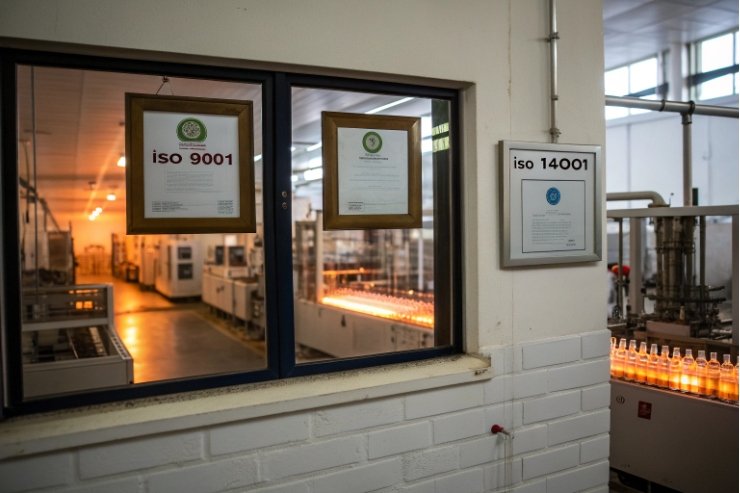
Most buyers want a certified quality and environmental system (ISO 9001/14001) plus credible recycled-content proof, such as third-party PCR verification, chain-of-custody documents, or recognized eco-labels.
Core factory and process certifications
Before PCR numbers, many brands treat ISO and similar systems as a basic filter:
- ISO 9001 quality management standard 3 – quality management. Shows the plant can run controlled processes and trace batches.
- ISO 14001 environmental management standard 4 – environmental management. Shows systematic work on emissions, waste, and resource use.
- ISO 45001 / OHSAS – health and safety, for responsible production.
- ISO 50001 (where used) – energy management. A nice plus when you talk about furnace optimization.
For food or pharma-adjacent uses, you may also see:
- GMP-style controls
- BRCGS / similar standards for packaging
These certificates do not prove recycled content, but they prove the factory can implement and maintain a PCR program reliably.
Proving recycled content in the bottle
Recycled-content claims are now under real scrutiny. Buyers and regulators want more than a vague “eco glass” line.
Common proof types include:
-
Third-party PCR or recycled-content certification
For example, UL 2809 recycled content validation 5 to support tenders, audits, and ESG reporting. -
Chain-of-custody documentation
Purchase records for cullet, internal mass-balance calculations, and batch records that show how much PCR went into each production campaign. -
Self-declared claims under ISO 14021 self-declared environmental claims 6 logic
Some plants issue technical datasheets that list minimum average PCR % over a defined period, with internal audit backing.
From a buyer’s point of view:
| Document / claim type | What it proves | Where it is most useful |
|---|---|---|
| ISO 9001 / 14001 certificates | Structured systems and continuous improvement | Supplier pre-qualification |
| Third-party PCR / recycled content cert | Independent verification of recycled share | Corporate ESG reporting, big retail tenders |
| Technical sheet with min. PCR % | Practical design and marketing decisions | Pack design, on-pack claims, sales tools |
| Cullet sourcing and mass-balance data | Depth of circular economy integration | Detailed ESG or LCA work |
The safest route is to build your pack claims around “at least X% post-consumer recycled glass” using the lowest guaranteed PCR level in your contracts, not best-case peaks.
Claim language and regulatory alignment
As rules tighten (for example in the EU), vague marketing language can become a risk. To stay safe:
- Avoid “100% recycled” if closures, pumps, or decorations are not recycled or recyclable.
- Use clear qualifiers: “glass bottle made with min. 35% PCR glass”.
- Keep documentation ready in case retailers or regulators ask for proof.
Buyers will increasingly expect this to be normal, not special. Plants that already have a clean documentation trail will be easier partners in the next wave of packaging rules.
How do MOQ, pricing, and supply stability compare to virgin flint glass?
Switching to PCR glass is not only a technical choice. It also touches budgets, planning, and how much risk a team can accept in peak season.
PCR glass usually comes with similar or slightly higher MOQs, a modest price premium in some regions, and more dependence on local cullet streams; with the right contracts and planning, it can still be as stable as virgin flint.
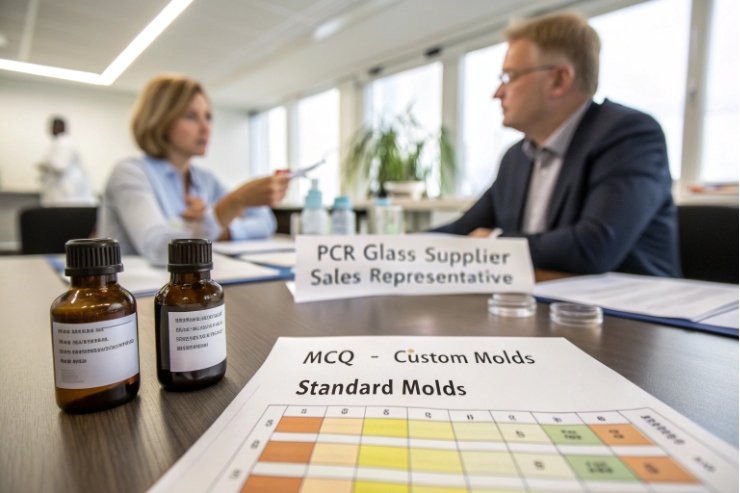
MOQ and flexibility
Glass plants change furnace recipes slowly. High-PCR campaigns often run for dedicated periods or on furnaces configured around recycled content. That means:
- MOQs can be higher for specific PCR percentages, especially for clear flint with tight color control.
- Small brands may access PCR through shared standard molds and colors, rather than very custom shapes at first.
- Large buyers can negotiate dedicated runs or even dedicated high-PCR furnaces.
Typical patterns:
| Aspect | PCR glass (general) | Virgin flint glass |
|---|---|---|
| New custom mold MOQ | Medium–high | Medium |
| Standard mold MOQ | Similar, sometimes slightly higher | Widely flexible |
| Color / tone options | More constrained for high flint PCR levels | Broad, including ultra-clear extra flint |
If you want full custom heavy flint with very high PCR and tight aesthetic tolerances, expect higher MOQs and more time to tune the process.
Pricing and cost trends
Today, PCR glass pricing sits on several forces:
- In some regions, clean cullet is valuable and needs its own logistics, which can add cost.
- In others, landfill and carbon costs make high-PCR glass cheaper or similar over the full life of the furnace.
So you may see:
- A small premium vs standard flint on a unit basis for dedicated PCR specs.
- A neutral or even better cost position when you factor in energy savings, tax or fee reductions, and brand value.
The most transparent way is to ask suppliers for:
- Price deltas at several PCR levels (for example 20%, 40%, 60%)
- Energy and CO₂ savings data you can integrate into your own LCA models
- A clear explanation of how they secure cullet supply
Supply stability and risk management
The real bottleneck in many markets is not the furnace. It is the quality and quantity of cullet—and regional US EPA glass recycling data 7 can help you sanity-check supply assumptions:
- Clear, high-grade flint cullet is in strong demand.
- Color-mixed cullet is easier to use for amber or green, or for coated bottles.
- Seasonal swings in container glass recycling can affect cullet flow.
You can reduce risk by:
- Designing some color flexibility into the pack (smoke, amber, opaque) so you can accept higher cullet levels more easily.
- Agreeing on a PCR range instead of a single figure (for example “35–50% PCR”) to give the plant room to optimize.
- Spreading sourcing across plants or regions with robust recycling systems.
In many of our projects, once a plant has a stable cullet network and you accept a sensible PCR range, supply becomes just as predictable as virgin flint—only with a better sustainability story behind every pallet.
Conclusion
PCR glass turns used bottles into new premium packaging, cutting CO₂ and energy while keeping the same protection, feel, and brand impact—once you design with cullet, color, and supply realities in mind.
Footnotes
-
Defines cullet and explains why recycled glass can lower energy and emissions. ↩ ↩
-
Industry overview of decarbonisation levers in glass, including recycled cullet strategies. ↩ ↩
-
Clarifies what ISO 9001 covers and why quality certification matters for packaging suppliers. ↩ ↩
-
Explains ISO 14001 environmental management and how it supports credible sustainability programs. ↩ ↩
-
Shows how UL 2809 validates recycled-content claims for procurement, audits, and ESG reporting. ↩ ↩
-
Helps structure compliant recycled-content and “green” claims using ISO 14021 principles. ↩ ↩
-
Provides official recycling and material-flow data to estimate cullet availability by market. ↩ ↩






