
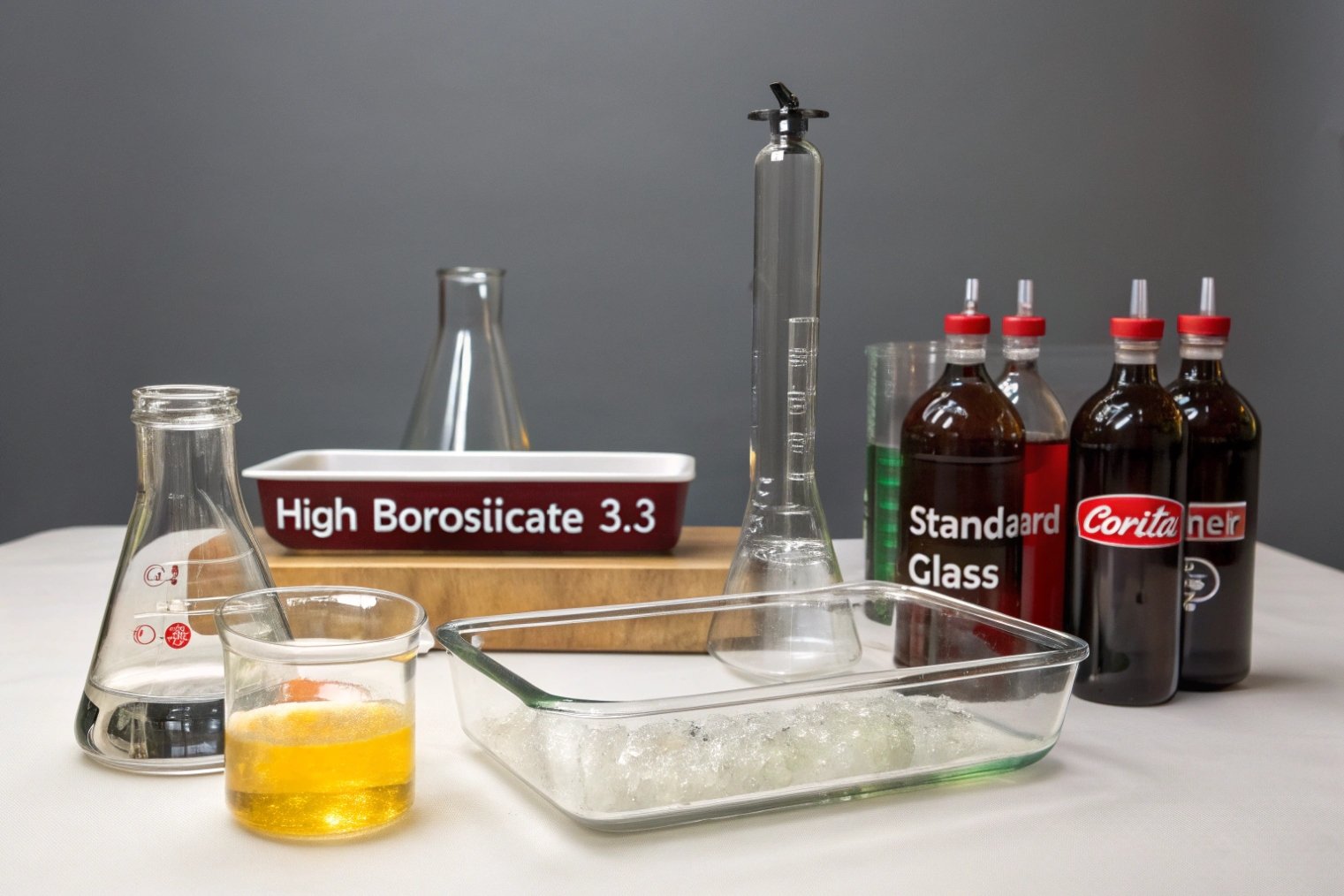
People see “high borosilicate 3.3” on a box and assume it is unbreakable, but the real story is more nuanced than the marketing.
High borosilicate glass (3.3) is a low-expansion silica–boron glass with excellent thermal-shock and chemical resistance, but higher cost, slower forming, and recycling limits compared with standard soda-lime.
For labware and cookware, DURAN® borosilicate glass 3.3 1 can be a fantastic choice. For everyday bottles of juice, beer, or sauce, it is usually unnecessary and can even create supply and price headaches. Let us unpack where it truly adds value.
What exactly is high borosilicate 3.3 glass?
Many people lump all “heat-resistant glass” together, but high borosilicate has a very specific recipe.
High borosilicate 3.3 is a glass with high silica and about 12–13% boron trioxide, engineered to have a very low thermal expansion coefficient of ~3.3×10⁻⁶ K⁻¹.
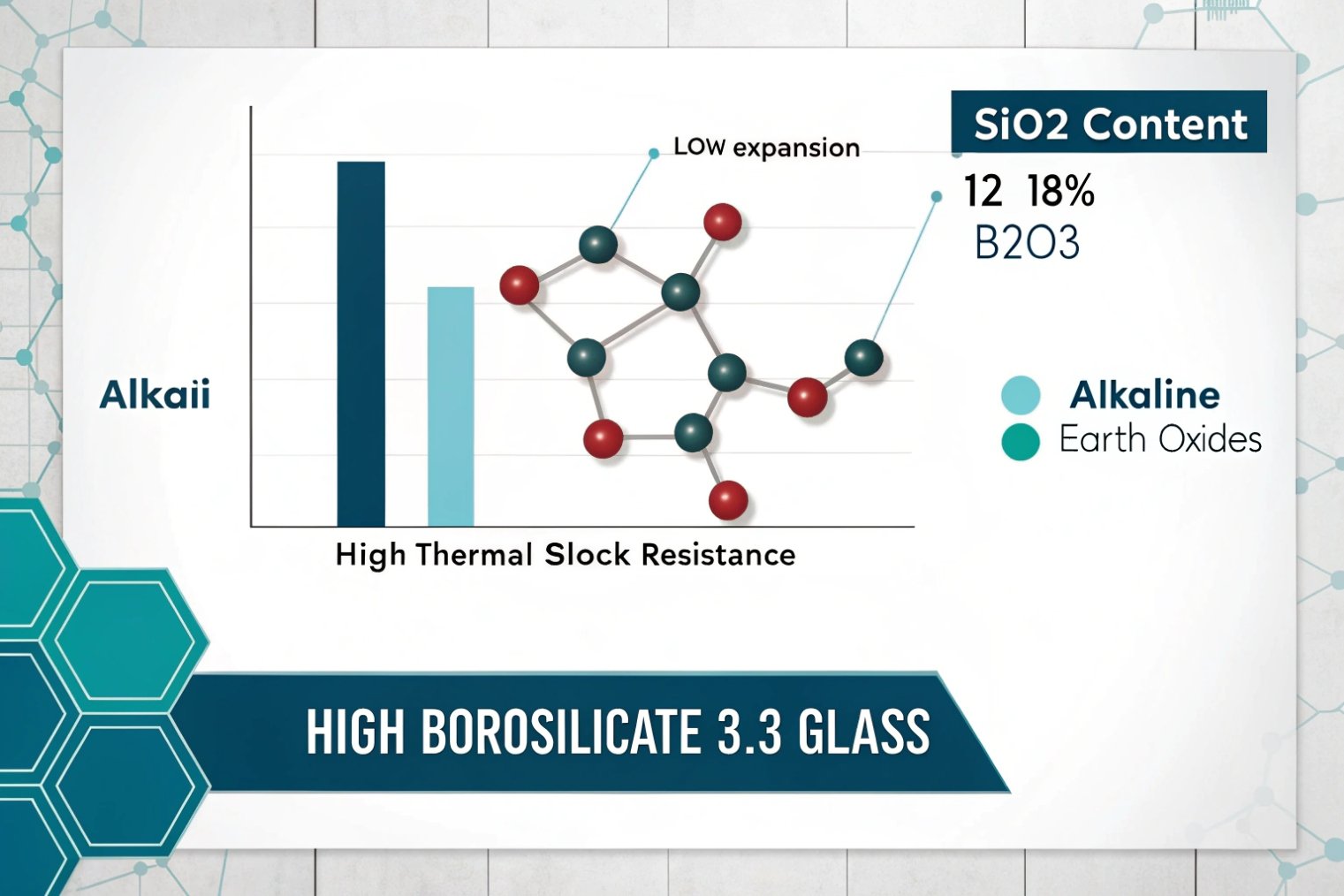
In standards language, it is commonly referenced as the ISO 3585 borosilicate glass 3.3 standard 2.
Composition and key properties
High borosilicate glass (often called “borosilicate 3.3”) sits in a different family from soda-lime:
- Network formers: high SiO₂ plus about 12–13% boron trioxide (B₂O₃) 3.
- Modifiers: controlled amounts of alkali and alkaline earth oxides.
- CTE (thermal expansion): a very low coefficient of thermal expansion (CTE) 4 of ~3.3×10⁻⁶ K⁻¹, much lower than soda-lime (~8–9×10⁻⁶ K⁻¹).
- Thermal points: transformation around 525 °C, softening around 820 °C, working range much higher than everyday glassware (see a published example in this SG 3.3 borosilicate properties sheet 5).
That low expansion is the “3.3” in the name. It means the glass changes size very little when heated or cooled, so internal thermal stresses grow much more slowly.
Typical uses reflect this:
- Laboratory glassware (beakers, flasks, media bottles).
- Pharmaceutical Type I containers.
- Cookware, oven dishes, coffee pots and kettles.
- Lighting and certain electronics parts.
Even with these advantages, high-boro is still glass: hard, brittle, and vulnerable to sharp impact or deep surface flaws.
High-boro vs soda-lime at a glance
| Aspect | High borosilicate 3.3 | Soda-lime container glass |
|---|---|---|
| Main oxides | SiO₂ + ~13% B₂O₃ + modifiers | SiO₂ + Na₂O + CaO (+ MgO, Al₂O₃) |
| Thermal expansion (CTE) | ~3.3×10⁻⁶ K⁻¹ | ~8–9×10⁻⁶ K⁻¹ |
| Typical ΔT tolerance | ~180 °C (or more, when designed well) | Much lower; sensitive to fast shocks |
| Typical applications | Labware, cookware, Type I vials | Food & beverage bottles, jars, jars, jars |
| Recycling compatibility | Separate stream required | Fits standard packaging cullet loop |
So when we call something “high borosilicate 3.3,” we are not just marketing. We are talking about a well-defined glass family with a clear performance envelope.
How does its thermal-shock resistance and chemical durability compare to soda-lime?
This is usually the first technical question: “Can my glass survive going from fridge to oven or autoclave without popping?”
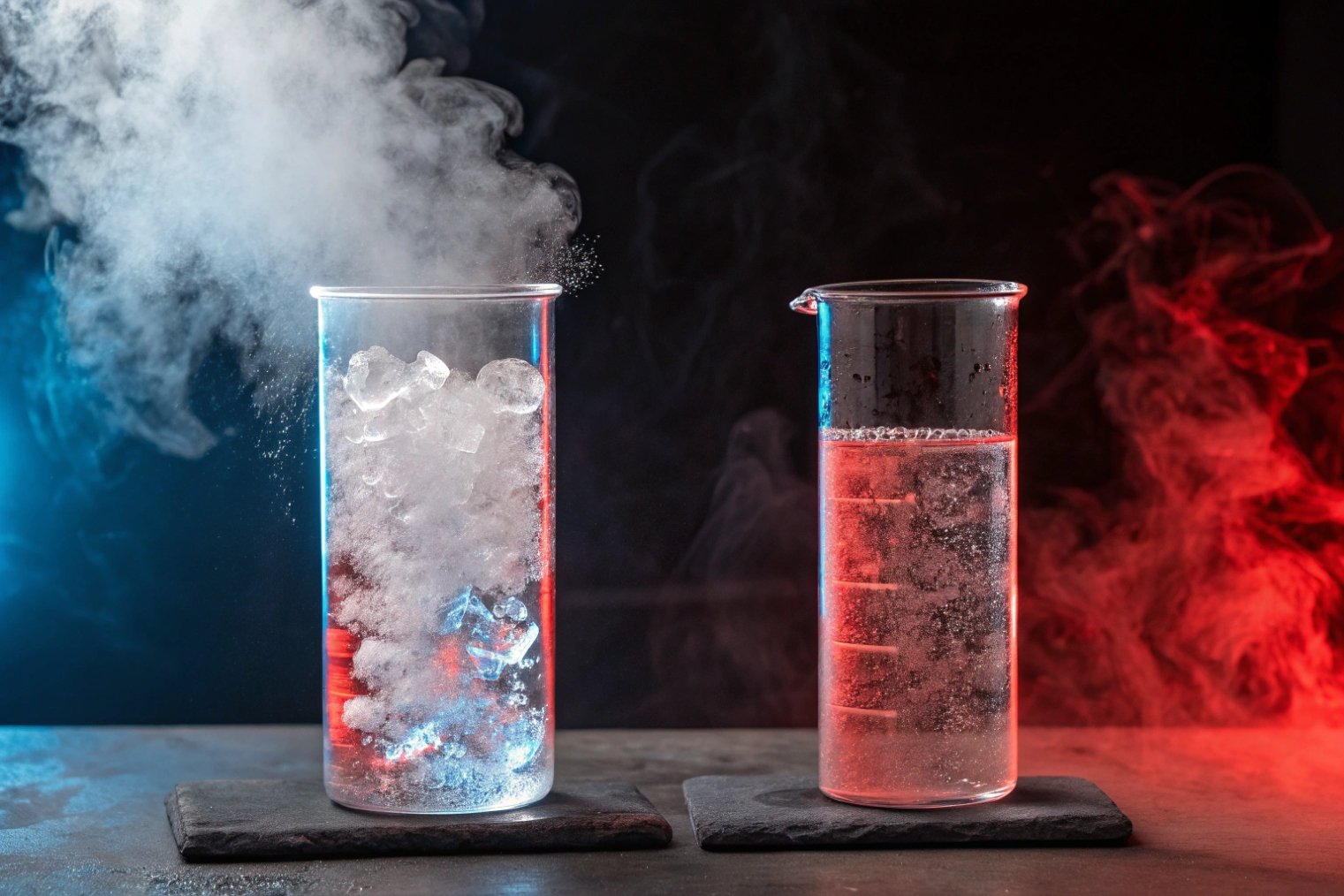
High borosilicate handles much larger and faster temperature swings and offers superior chemical durability for most acids, salts, and solvents compared with soda-lime, though both are still vulnerable to hydrofluoric acid and strong hot alkali.
Thermal-shock resistance: where high-boro shines
Because thermal stress is roughly proportional to E · α · ΔT, lowering the expansion coefficient α directly reduces stress for a given temperature jump.
For practical use:
- High-boro 3.3 can usually tolerate temperature differentials around 180 °C (≈330 °F) in one step when designed correctly.
- Soda-lime containers may crack with much smaller sudden jumps, especially if there are surface flaws or uneven thickness.
That is why high-boro cookware can:
- Move from room temperature into a hot oven more safely.
- Handle boiling liquids and rapid cooling cycles better.
- Survive autoclave or sterilization cycles in lab use.
However, it is still not magic:
- Direct flame on a cold, thick piece or very uneven heating can still crack it.
- It remains brittle under impact; dropping it onto a hard floor can still shatter it.
Tempered soda-lime, on the other hand, can offer better impact resistance due to its surface compression layer, but it does not match borosilicate for repeated large thermal shocks.
Chemical durability for labware and cookware
High borosilicate also has excellent chemical resistance:
- Very good resistance to water, most acids, neutral and acidic salts, many organic solvents, and halogens in solution.
- Significantly lower leaching of alkali ions compared with soda-lime under the same conditions.
There are still known “enemies”:
- Hydrofluoric acid (HF) will attack any silica-based glass.
- Hot, concentrated phosphoric acid and strong hot alkalis can slowly corrode even borosilicate.
For labware and cookware this means:
- It is safe for most kitchen acids (vinegar, tomato, citrus), salts, and oils.
- It tolerates repeated washing and sterilizing without clouding as quickly as soda-lime.
- It is ideal for many chemical reactions and storage conditions in the lab.
Performance comparison for real use
| Property / scenario | High borosilicate 3.3 | Soda-lime container glass |
|---|---|---|
| Rapid temperature change | Much more tolerant (large ΔT) | Sensitive; avoid sudden hot/cold shock |
| Oven + fridge cycling | Generally suitable (within spec) | Not recommended unless specially tempered |
| Acidic food and beverages | Very high durability | Very good but slightly more leaching |
| Autoclave / steam sterilizing | Standard operation for labware | Only for special containers, limited use |
| Impact resistance | Good but brittle | Tempered soda-lime can be tougher |
For anything that sees frequent high heat, abrupt cooling, or aggressive cleaning, high-boro is clearly ahead. For a standard jam jar or beer bottle, the extra thermal margin is rarely used.
What are the trade-offs in cost, forming speed, and weight?
Once performance looks attractive, buying teams immediately ask: “What does it do to my price, my line speed, and my logistics?”
High borosilicate is more expensive per kilo, often runs on slower or smaller forming lines, and requires separate recycling, but its density is slightly lower, so finished pieces can be a bit lighter for the same geometry.
Cost drivers
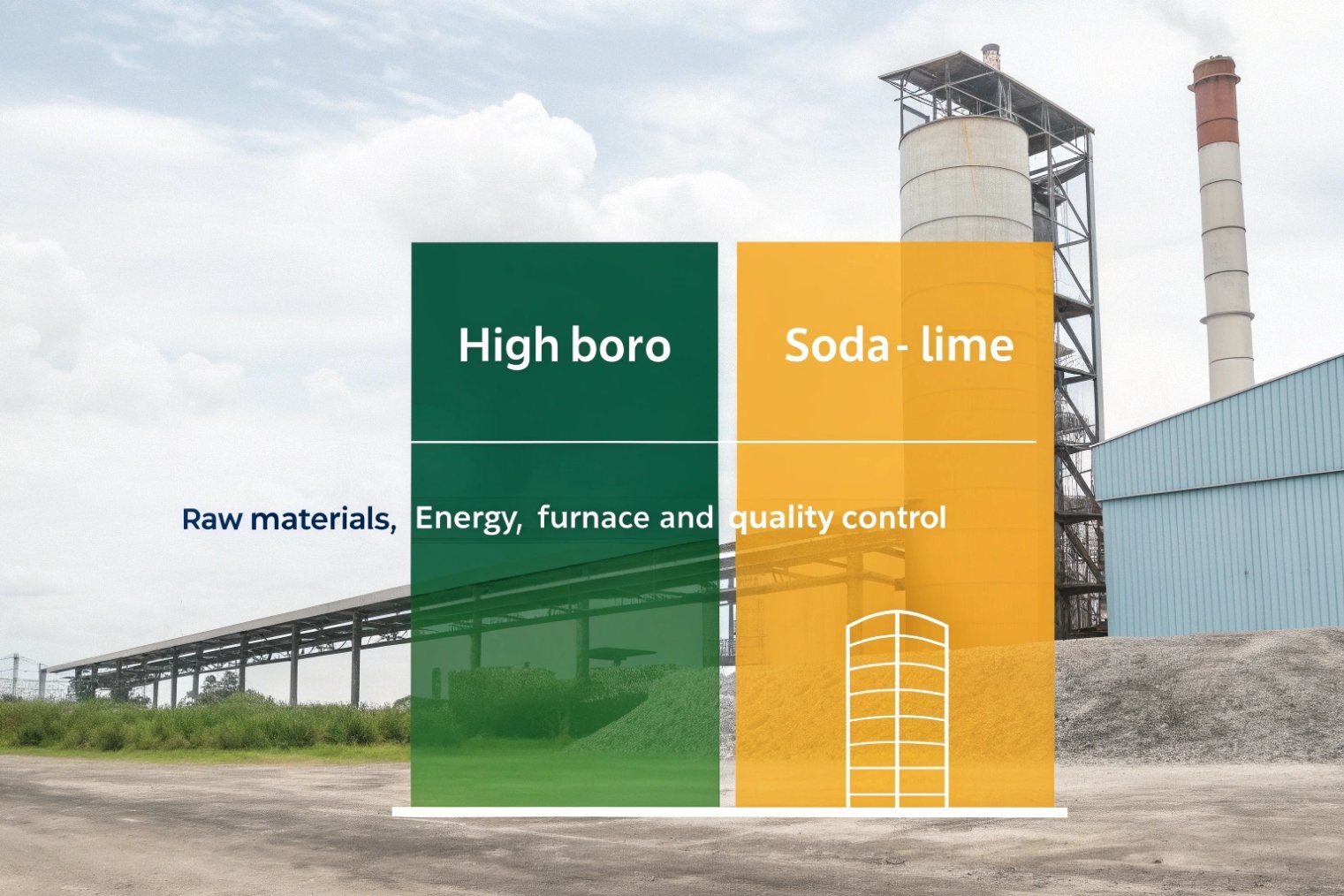
Several factors push high-boro cost above soda-lime:
- Raw materials: boron compounds (borax, boric acid) and higher-purity silica are more expensive than standard container batch.
- Furnace design and energy: borosilicate often needs higher-grade refractories and specific furnace conditions; unit volumes are lower than soda-lime packaging, so fixed costs spread over fewer tons.
- Specialized lines: many high-boro products (labware, cookware, pharma vials) run on dedicated equipment with more complex forming steps and higher quality requirements.
As a result, cost per piece is noticeably higher than an equivalent soda-lime bottle or jar, especially when you factor in reject rates and quality checks for demanding applications.
Forming speed and design freedom
Soda-lime container glass 6 benefits from:
- Highly optimized IS machines for very high speeds.
- Massive global know-how in container shapes, weights, and line integration.
High-boro forming lines are:
- Often slower, with smaller cavities and more specialized tooling.
- Focused on labware shapes, cookware, and specialty bottles, not mass-market beverage formats.
- Less common globally, so capacity can be tighter and lead times longer.
Complex shapes, very thick walls, and deep punts are possible, but all of that further slows forming and raises cost.
Weight considerations
On a pure material level, borosilicate has a slightly lower density than standard soda-lime:
- High-boro: about 2.2–2.3 g/cm³
- Soda-lime: around 2.5 g/cm³
This means:
- For the same exact geometry, a high-boro bottle can be a bit lighter.
- In practice, many high-boro items are designed with specific strength margins, so real weight differences depend more on design than density.
For container logistics, the savings in freight weight are usually small compared with the premium in material and forming cost.
Trade-off summary
| Factor | High borosilicate 3.3 | Soda-lime container glass |
|---|---|---|
| Raw material cost | Higher (boron, higher-purity silica) | Lower, high-volume commodity |
| Furnace / line scale | Smaller, specialized | Very large, highly optimized |
| Forming speed | Lower on average | Very high on container lines |
| Density | Slightly lower | Slightly higher |
| Recycling | Needs a separate recycling stream for heat-resistant glass 7 | Fits standard bottle cullet loop |
| Typical unit price | Premium | Baseline for mass packaging |
So high-boro pays for itself when high performance is non-negotiable. In low-margin packaging, these trade-offs are difficult to justify.
When is high-borosilicate glass overkill for beverage or food packaging?
With all these advantages, it is tempting to specify high-boro for every “premium” bottle. But in most real beverage and food scenarios, it is over-engineering.
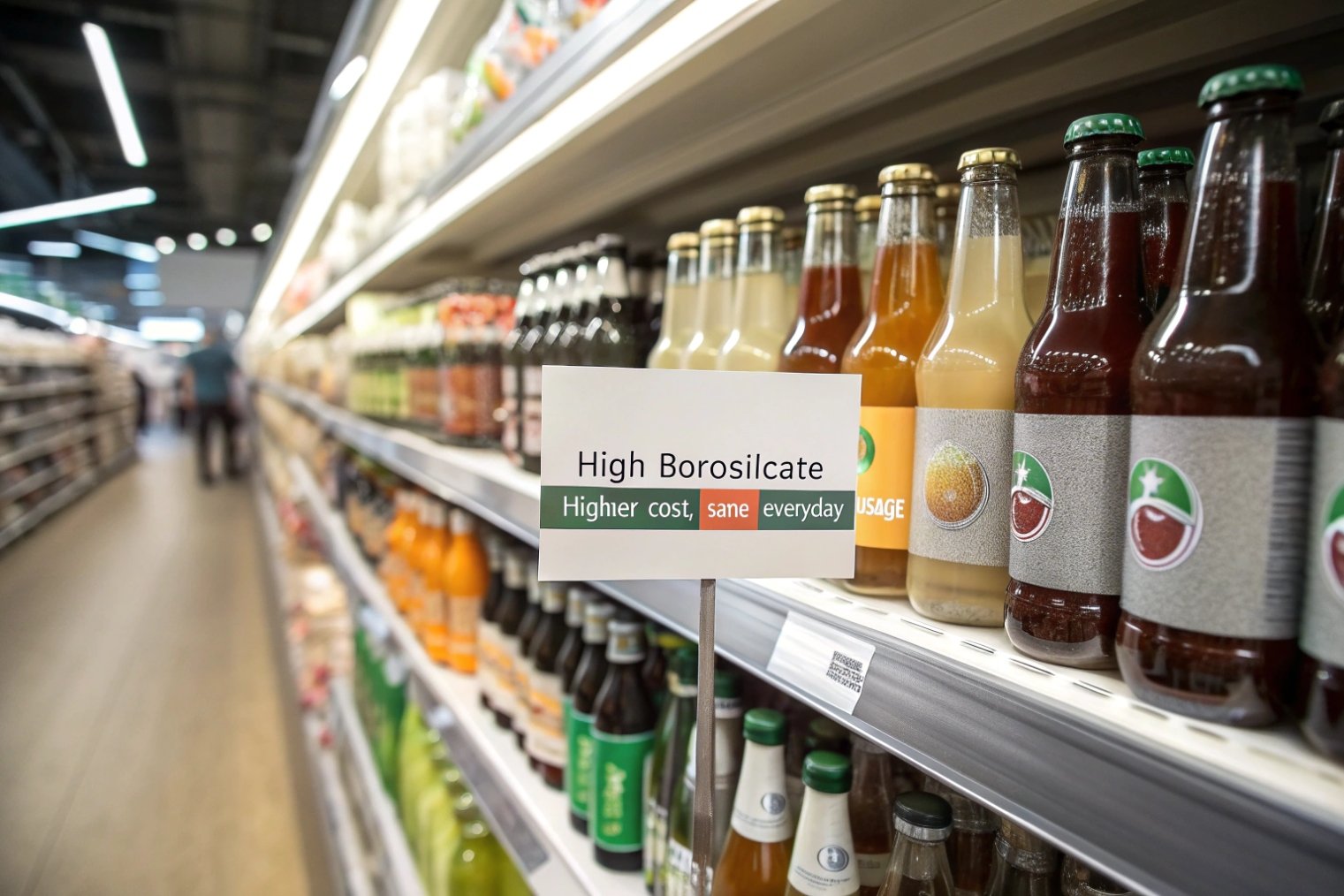
High-boro is overkill for typical beverages, sauces, and shelf-stable foods that never see extreme thermal shock or harsh chemicals; standard soda-lime (sometimes tempered) already meets safety and durability needs at a much lower cost.
Where soda-lime is fully sufficient
Most packaged foods and drinks go through fairly moderate thermal and chemical conditions:
- Hot-fill around typical process temperatures, followed by controlled cooling.
- Pasteurization or mild heat treatment for some products.
- Storage at ambient or refrigerated temperatures.
- Contact with acidic foods, sugar, salt, oils, alcohol at household concentrations.
Standard soda-lime container glass is designed exactly for this. With proper:
- Bottle design and annealing.
- Quality control on defects.
- Correct filling and cooling profiles.
these containers perform reliably without needing borosilicate chemistry.
Even for carbonated drinks and sparkling wines, the key is internal pressure design, wall thickness, and impact resistance, not high-temperature performance.
Where high-boro actually makes sense in food and beverage
High-boro can be justified when packaging must:
- Withstand repeated oven use (true oven-to-table dishes and lids).
- Sit directly on a flame or cooktop (some kettles and coffee makers, though many use other materials).
- Survive long, repeated autoclave cycles in food or pharma processing.
- Tolerate extreme rapid temperature swings (for example, specialized lab-food crossover equipment).
In these cases, the extra cost lands inside a product that is already high-margin or safety-critical.
Overkill scenarios to avoid
For most of these, high-boro offers little practical benefit but adds cost and complexity:
- Standard juice, water, soft drink, beer bottles.
- Condiment and sauce jars filled hot but cooled in a controlled way.
- Ready-to-drink coffee or tea bottles that never go straight from freezer to oven.
- “Premium look” spirits bottles where sparkle and weight can be achieved with high-flint soda-lime instead.
On top of that, using high-boro for mainstream packaging:
- Breaks compatibility with standard recycling streams (borosilicate in soda-lime cullet is a contaminant).
- Limits supplier choices, because far fewer plants melt borosilicate in bottle formats.
- Pushes cost above what many consumers are willing to pay for the product inside.
Decision guide
| Use case / scenario | Recommended glass family |
|---|---|
| Mass-market beverages and foods | Soda-lime container glass |
| Beer, sauces, jams (hot-fill / pasteurized) | Soda-lime (or tempered if needed) |
| Oven-to-table baking dishes, lids | High borosilicate |
| Lab media bottles, Type I vials | High borosilicate |
| Coffee carafes for direct heat | High borosilicate (or metal) |
| Premium spirits bottle, no extreme heat | High-flint soda-lime |
If a package never sees conditions that push soda-lime near its limits, upgrading to high-boro is mostly a cost and logistics penalty without real benefit.
Conclusion
High borosilicate 3.3 is outstanding for heat and chemical stress, but for everyday food and beverage bottles, well-designed soda-lime usually gives all the performance you need at a much friendlier cost.
Footnotes
-
Verify temperature limits, durability claims, and typical applications for borosilicate 3.3 glass. ↩ ↩
-
See the formal standard definition and key requirements for borosilicate glass 3.3. ↩ ↩
-
Quick reference for B₂O₃ identity and basic properties that influence borosilicate formulations. ↩ ↩
-
Refresher on how CTE is defined and why it drives thermal-stress risk. ↩ ↩
-
Look up published thermal points (annealing/strain/softening) for SG 3.3 borosilicate glass. ↩ ↩
-
Learn what “soda-lime container glass” is and why it dominates food and beverage packaging. ↩ ↩
-
Understand why heat-resistant/borosilicate items are usually excluded from standard bottle-and-jar recycling. ↩ ↩






