
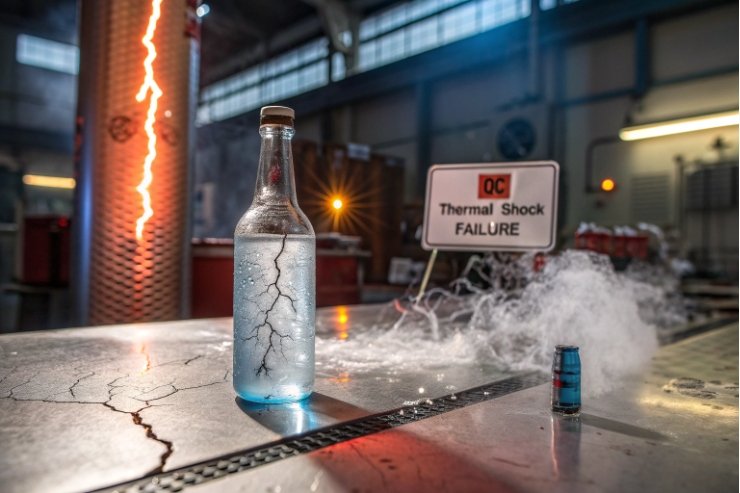
Thermal shock breaks bottles, cracks cookware, and ruins lab runs. One wrong temperature jump can turn a “safe” glass part into scrap in seconds.
High borosilicate (borosilicate 3.3) is a silica-and-boron glass with very low thermal expansion (~3.3×10⁻⁶ K⁻¹), so it handles rapid temperature changes and many chemicals far better than soda-lime glass, but it costs more and is slower to form.
Glass choices always look simple on a spec sheet. In real factories and real kitchens, the “best” glass can become the wrong glass once cost, speed, breakage, and user behavior show up. This guide makes the trade-offs clear.
What is high borosilicate glass (3.3), and what does “3.3” actually mean?
Most buyers hear “borosilicate” and assume it is a single material. That leads to wrong expectations, wrong testing, and expensive returns when the part meets the wrong standard.
High borosilicate (often called 3.3) is defined by its very low thermal expansion, around 3.3×10⁻⁶ K⁻¹, which comes from adding boron oxide to a silica-rich network; that low expansion is the main reason it survives thermal shock so well.
A practical way to avoid “marketing borosilicate” confusion is to reference the ISO 3585 borosilicate glass 3.3 specification 1.
Composition that drives behavior
High-boro is not “magic glass.” It is a specific balance of a few oxides that change how the network bonds and moves under heat. The boron content reduces expansion and also improves chemical resistance in many environments. Still, different suppliers and standards can vary a bit, so the safest habit is to ask for a datasheet (for example, a SCHOTT DURAN® borosilicate glass 3.3 datasheet reference 2), not a marketing label.
| Property driver | What changes in the glass network | What it means in real use |
|---|---|---|
| Higher SiO₂ + boron trioxide (B₂O₃) 3 | Tighter, more stable structure | Lower expansion, better thermal stability |
| Low alkali content | Fewer mobile ions | Less leaching, better water resistance |
| Higher working temperatures | Glass stays “stiffer” at heat | Harder forming, slower cycle time |
Typical temperature points people confuse
Many users mix up “max operating temperature” with “thermal shock resistance.” A glass can tolerate a high steady temperature but still fail if the temperature changes too fast. For 3.3 borosilicate, typical reference points are often listed around a transformation point near ~525 °C and softening around ~820 °C (values vary by brand and sheet thickness). If you want a public reference for typical ranges, see published tables like BOROFLOAT® 33 technical data 4 and then validate on your actual part.
| Term | What it describes | Why buyers should care |
|---|---|---|
| Transformation point | Where internal stress relaxes faster | Sets annealing strategy and stress risk |
| Softening point | Where shape starts to deform under load | Limits for forming and high-heat fixtures |
| Thermal expansion (CTE) | How much it grows per degree | Main predictor of thermal shock behavior |
A practical takeaway for sourcing
When a customer says “high borosilicate,” the real question is: do they need low expansion, or do they only want “heat resistant” marketing? In my own packaging conversations, defining the actual failure mode (thermal shock, impact, corrosion, line speed) saves the project.
How does thermal-shock resistance compare to soda-lime glass?
Thermal shock is the fastest way to lose money in glass. It looks random, but it is usually predictable: stress builds when one area expands faster than another.
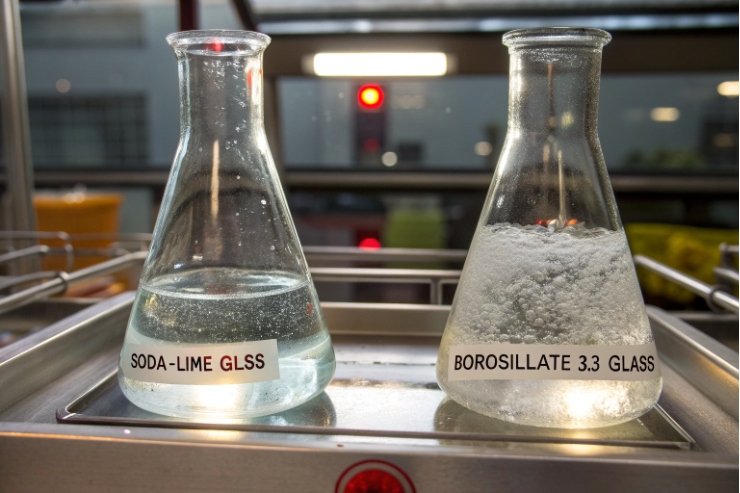
High-boro usually beats soda-lime by a wide margin in thermal shock because its expansion is much lower, so the stress from a sudden temperature difference is much smaller; soda-lime often needs tempering or thicker design to survive similar shocks.
Why low expansion matters more than “heat resistance”
Thermal shock failure is mostly about stress, not melting. Stress rises with expansion, temperature gradient, and geometry—so the key number is the coefficient of thermal expansion (CTE) 5. Low-CTE glass makes the same temperature jump less dangerous. That is why borosilicate is a default for lab beakers, condensers, and cookware that sees hot-and-cold cycling.
| Factor | What increases thermal shock risk | What reduces risk |
|---|---|---|
| Thermal expansion (CTE) | Higher CTE (typical soda-lime) | Low CTE (3.3 borosilicate) |
| Temperature gradient | Fast heating/cooling, cold rinsing hot parts | Slow ramps, pre-warming, even heating |
| Geometry | Thick walls, sharp corners, heavy bases | Uniform thickness, smooth radii |
Real-world comparison in plain language
Soda-lime can be safe for many kitchen and packaging cases, especially when it is tempered or when temperature changes are controlled. But soda-lime is unforgiving when users do “human things,” like pouring boiling liquid into a cold glass, placing a hot jar on a wet counter, or washing a hot vessel in cool water. Borosilicate is more forgiving, but it is not unbreakable. A thick borosilicate part can still fail if the outside cools fast while the core stays hot.
| Scenario | Soda-lime outcome (typical) | High-boro outcome (typical) |
|---|---|---|
| Hot liquid into cold vessel | Higher crack risk | Lower crack risk |
| Oven-to-room-air cooling | Often OK if slow | Usually OK, more margin |
| Hot vessel onto wet surface | Can crack fast | Can still crack, but less often |
| Direct flame on cold glass | High risk | Still risky if uneven or thick |
What “~180 °C difference” really means
You will see claims that borosilicate tolerates large temperature differentials (often quoted around ~180 °C). In practice, the safe differential depends on shape, thickness, stress from forming, and surface scratches. For buyers, the better approach is to test the actual design under the actual use cycle, not chase a single number.
Is high-boro more chemically durable for labware and cookware?
Chemical durability is not only about “will it dissolve.” It is also about what it releases, how surfaces change, and how fast corrosion grows under heat.
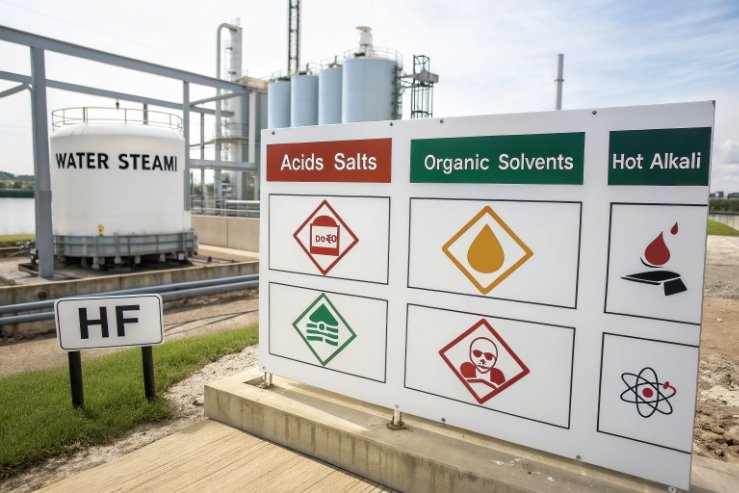
High-boro is generally more chemically durable than soda-lime in water and many chemicals because it has fewer mobile alkali ions, so it leaches less and resists corrosion better; exceptions still exist, like hydrofluoric acid and strong hot alkalis.
What “chemical resistance” should mean for buyers
For labware, durability means low extractables, stable volume markings, and surfaces that stay smooth after many cleanings. For cookware, it means not picking up odors, not staining easily, and not reacting with acids or salts in food. High-boro performs well here because its network is more resistant to attack by water and many acids.
| Environment | Typical high-boro behavior | Notes buyers should know |
|---|---|---|
| Water, steam | Very good resistance | Low leaching helps taste and purity |
| Many acids, salts | Very good resistance | Common lab acids are usually fine |
| Organic solvents | Often very good | Solvent compatibility still depends on temperature |
| Strong alkalis (hot) | Can attack glass | Risk rises with heat and concentration |
| Hydrofluoric acid | Serious attack | Not a “glass” problem, HF is special |
Why soda-lime struggles in aggressive cleaning
Soda-lime has more alkali content, so water and detergents can extract ions over time, especially at high temperature. In kitchens, that can look like haze or “dishwasher clouding.” In labs, it can contaminate sensitive work or change surface quality.
| Use case | Key chemical risk | What high-boro changes |
|---|---|---|
| Autoclave cycles | Hot water + pressure | Better stability and lower leaching |
| Reflux / boiling acids | Heat accelerates corrosion | Higher resistance, longer life |
| Strong alkaline cleaners | Silicate network attack | Still a concern, but often improved |
Chemical durability does not replace good design
Even the best glass fails if it is scratched, poorly annealed, or stressed by metal fixtures. For cookware, lids, rims, and sharp transitions often become the first failure points. For labware, joint fit and wall thickness matter as much as chemistry. My rule is simple: use chemical durability as a baseline, then protect the part with good geometry and correct annealing.
What trade-offs exist in cost, forming speed, and weight?
A material is never “better” for free. High-boro gives safety margin in heat and chemistry, but it asks for payment in manufacturing difficulty.
High-boro usually costs more because it needs higher melting and working temperatures, tighter process control, and slower forming, and while density can be similar, designs sometimes end up heavier if extra thickness is used for handling and impact safety.
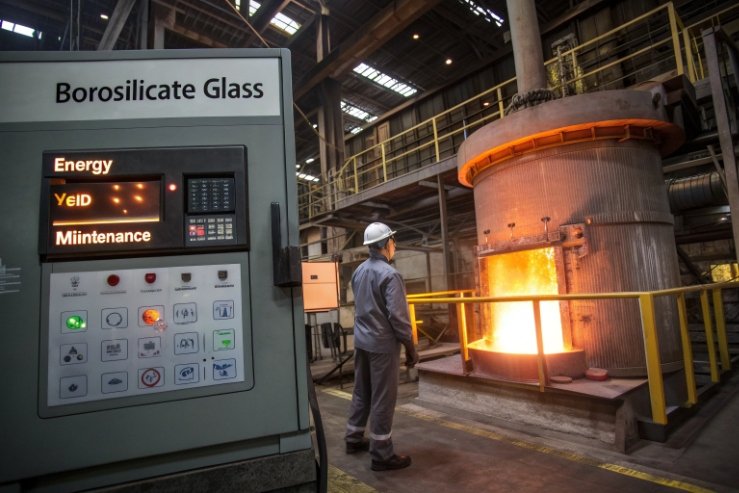
Cost: raw materials, energy, and yield
Boron compounds add cost. The furnace often runs hotter. Forming windows can be narrower. All of that pushes up cost per piece. Yield can also suffer if a line built for soda-lime tries to run borosilicate without the right setup.
| Cost driver | Why it increases cost | What to ask a supplier |
|---|---|---|
| Higher melt/working temps | More energy and furnace demand | Furnace capability and stable melt control |
| Process control | Stress and defects are less forgiving | Annealing schedule and stress inspection |
| Slower cycle time | More time per unit | Real line speed and scrap rate history |
| Tooling and wear | Different viscosity behavior | Mold life, maintenance plan |
Forming speed: why “harder to make” is real
Borosilicate can behave differently in the forming range. That can limit how fast a gob can be pressed or blown without defects. It can also limit very complex shapes unless tooling and temperature control are excellent. For packaging, speed matters because beverage and food plants buy millions of units, and a small cycle-time change becomes a big cost difference.
| Topic | Soda-lime advantage | High-boro advantage |
|---|---|---|
| Mass production speed | Typically faster | Typically slower |
| Tooling ecosystem | Mature and widely available | More specialized |
| Defect sensitivity | More forgiving in some lines | Better high-heat stability after forming |
Weight: what buyers often misunderstand
People sometimes say borosilicate is “lighter.” Density is not dramatically lower in practice. The real weight outcome comes from design choices. If a product needs impact resistance, designers may add thickness, which adds weight. If the product needs only thermal shock resistance, borosilicate can sometimes use a thinner wall, which reduces weight. So weight is not a material promise. It is a design result.
| Design goal | Likely weight outcome | Why |
|---|---|---|
| Thermal shock margin | Can be thinner | Low CTE reduces stress |
| Impact resistance | May be thicker | Glass is still brittle |
| Premium feel | Often heavier by choice | Market preference, not physics |
When is high-boro overkill for beverage or food packaging?
The biggest mistake is using high-boro as a “quality badge” when the real failure mode is not thermal shock or corrosion. That adds cost but does not reduce breakage.
High-boro is often overkill for beverage bottles and many food jars because typical filling, storage, and consumer use do not create extreme thermal shock, and soda-lime already meets safety, cost, and high-speed forming needs; high-boro is better saved for hot-cold cycling, aggressive contents, or sterilization stress.
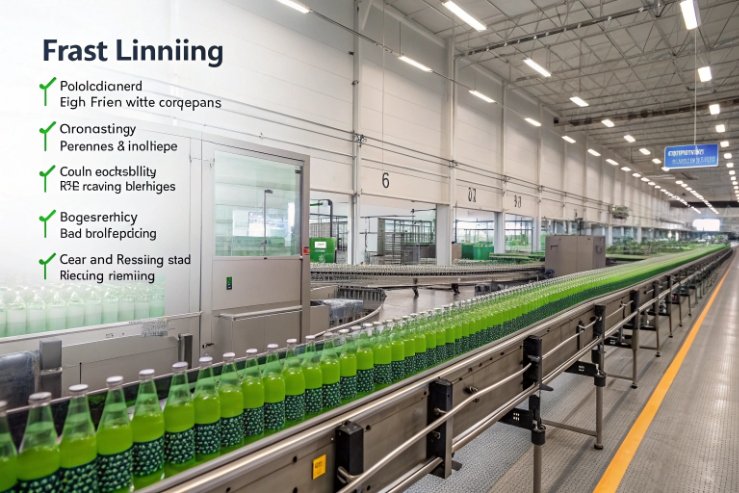
Packaging reality: most products live in mild conditions
Most beverages are filled cold or warm, then stored near room temperature. Even hot-fill cycles are usually controlled. In these cases, the main breakage driver is impact in logistics, not thermal shock. Tempered or well-designed soda-lime container glass 6 often wins because it is cheaper and easier to produce at speed.
| Packaging case | Typical stress | Best default glass choice |
|---|---|---|
| Carbonated beverage bottles | Impact + pressure + line speed | Soda-lime (designed for pressure) |
| Spirits and wine | Impact + premium look | Soda-lime, heavier premium designs |
| Standard food jars | Mild heat + logistics | Soda-lime |
| Frozen-to-microwave consumer use | Severe thermal shock | Borosilicate (or change the use method) |
When high-boro makes business sense in packaging
High-boro is not only for labs. It can be smart when the use cycle includes real thermal shock, repeated sterilization, or aggressive formulas. It can also help when a brand promise depends on “direct heat,” “oven safe,” or “boiling safe,” and the customer behavior is unpredictable.
| Situation | Why high-boro helps | What to verify before launch |
|---|---|---|
| Reusable food containers | Many hot/cold cycles | Thermal shock testing on final geometry |
| Premium functional beverages with extreme use | Users add boiling water or ice often | Consumer misuse scenarios |
| Pharma and high-purity applications | Low extractables needed | Type classification and leach testing |
| High-heat kitchen products | Oven use, rapid cooling | Tempering plan vs boro option |
A simple decision rule used in sourcing
In sourcing discussions, the clean rule is: pay for high-boro only when it reduces a real failure cost. If the product breaks from impact, spending on thermal shock resistance does not help. If the product fails under heat cycling, spending on borosilicate can cut warranty claims and protect the brand.
| Question to answer | If “yes” | If “no” |
|---|---|---|
| Will users do hot-to-cold jumps? | Consider high-boro | Soda-lime is usually enough |
| Is chemical purity critical? | Consider high-boro | Soda-lime may be fine |
| Is high-speed low cost required? | Soda-lime wins | High-boro can be acceptable |
| Is impact the main breakage driver? | Improve design/packaging | High-boro may not help |
A final practical note: borosilicate usually needs a separate recycling stream for borosilicate glass 7, so “sustainability” may not improve unless your recovery system is set up for it.
Conclusion
High borosilicate wins on thermal shock and chemical durability, but it loses on cost and speed. Use it when heat cycling or purity is the real risk, not as a label.
Footnotes
-
Official ISO reference for borosilicate 3.3 definition and requirements. ↩ ↩
-
Supplier overview of DURAN® borosilicate 3.3 and typical performance positioning. ↩ ↩
-
Quick chemistry reference for B₂O₃ identity and basic properties in glass formulations. ↩ ↩
-
Published example of borosilicate temperature-property ranges (annealing/softening context). ↩ ↩
-
Clear definition of CTE and why it drives thermal-stress risk in glass. ↩ ↩
-
Packaging-focused primer on soda-lime glass and why it dominates bottle/jar production. ↩ ↩
-
Explains why borosilicate/Pyrex is commonly excluded from curbside glass recycling streams. ↩ ↩






