Light can be a friend or an enemy. It helps sell a product on the shelf, but it also slowly destroys aroma, flavor, color, and active ingredients inside the bottle.
Glass bottle transmittance is the fraction (often shown as %) of incident light at a given wavelength that passes through the glass, and it is the key link between glass color, thickness, UV/visible exposure, and real shelf life performance.
Once transmittance is measured as a spectrum using a UV–Vis spectroscopy transmittance scan 1, I can see how much UV, blue, and visible light actually reaches the product. Then I choose glass color, thickness, and coatings to keep sensitive products safe without killing shelf appeal.
How does glass color and thickness affect UV/visible light transmission?
Many people think “brown is safe, clear is not”. This is only half the story. Color is important, but thickness and chemistry change the picture a lot.
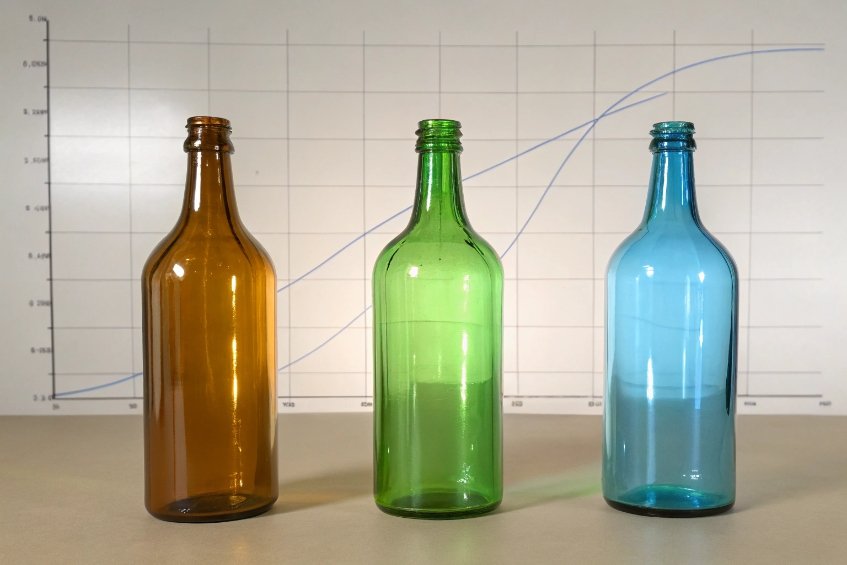
Glass color and thickness control how much UV and visible light passes through the bottle. Darker or more strongly colored glass, and thicker walls, reduce transmittance in a predictable way that follows Beer–Lambert law behavior 2.
What transmittance really measures
Transmittance is simple in math and powerful in practice:
- (T = I\text{transmitted} / I\text{incident})
- Often reported as %T = 100 × T
- Absorbance is (A = -\log_{10}(T))
For packaging work, we usually care about spectral transmittance:
- UV: about 200–400 nm
- Visible: about 380–780 nm
- Sometimes near-IR if the product is heat sensitive
A single “transmittance” number always belongs to a defined wavelength or band. For example:
- “%T at 370 nm ≤ 10%” for a beer bottle
- “UV transmittance 300–380 nm ≤ 1% integrated” for a pharma vial
- “Luminous transmittance 65%” for how bright the bottle looks to the eye
So when someone sends a spec with “transmittance = 90%” but no wavelength, it is not useful.
Role of glass colorants
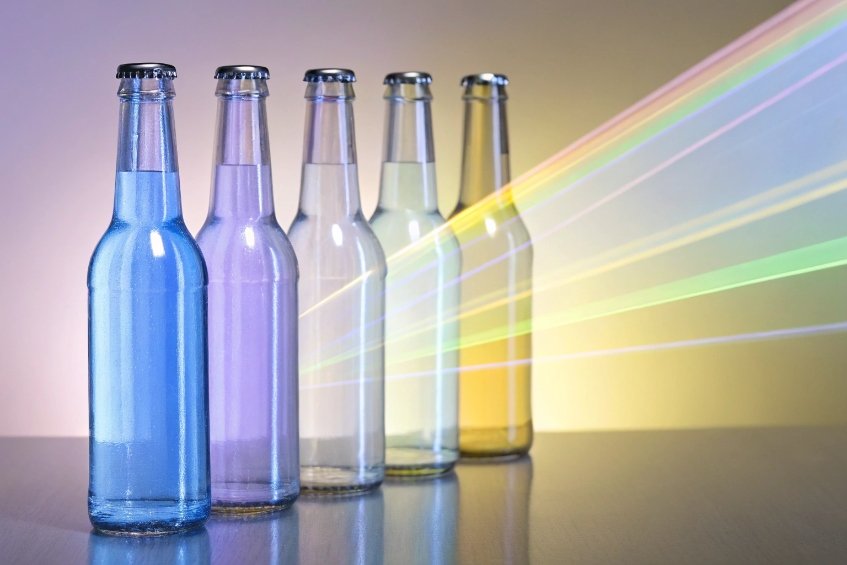
Base soda–lime glass is almost clear. It lets most visible light and a lot of near-UV pass. Colorants change that:
-
Flint (clear) glass
High transmittance across visible. Often more than 80–90% in the middle of the spectrum. It also lets a lot of UVA and some UVB reach the product. -
Green glass
Iron and other oxides give green or olive tones. Green glass cuts some UV, but it still passes a lot of longer UVA and blue light. It is better than flint, but not a true UV shield. -
Amber / brown glass
Mixed metal oxides and sulfur species create strong absorption in the UV and blue range. Amber glass can block almost all UV below about 400–450 nm and also reduce blue light. This is why beer bottles and many pharma bottles are amber.
In practice, different factories and formulations give slightly different curves, but the rank is stable:
Clear → highest UV/blue transmittance
Green → medium
Amber → lowest
Color is not only about UV protection. It also affects luminous transmittance, which is the visible spectrum weighted by the human eye sensitivity curve V(λ). This tells me how “bright” the product will look on the shelf. Amber glass with strong UV blocking can still give acceptable brightness if the formulation is tuned.
Thickness and Beer–Lambert behavior
Color is not enough. The glass must also be thick enough, and the path length matters in a strict way.
Beer–Lambert law says:
- Absorbance is proportional to path length and concentration of colorants.
- So thicker glass or more intense color gives lower transmittance.
- Doubling thickness does not cut transmittance in half. It changes it on a log scale.
This is why:
- A thin amber vial might still show higher UV transmittance than a thick green bottle at some wavelengths.
- Heel zones of bottles (thicker) often give lower transmittance than sidewalls.
- Shade variation and thickness variation can show up as visible brightness bands on a full shelf.
A simple way to think about it is:
| Glass type | Approx. UV (300–400 nm) | Visible (400–700 nm) | Typical use case |
|---|---|---|---|
| Clear | Very high %T | Very high %T | Products not sensitive to light |
| Green | Medium %T | High %T | Wine, some oils, intermediate risk |
| Amber | Very low %T | Medium %T | Beer, pharma, high light sensitivity |
In real projects, I always ask for the full spectral curve with thickness noted. Without thickness, the %T numbers are almost meaningless.
Which spectrophotometer methods and units report transmittance?
Many QA sheets show “%T” and “OD” side by side. It looks complicated, but the instruments and units are actually simple once we link them to packaging questions.
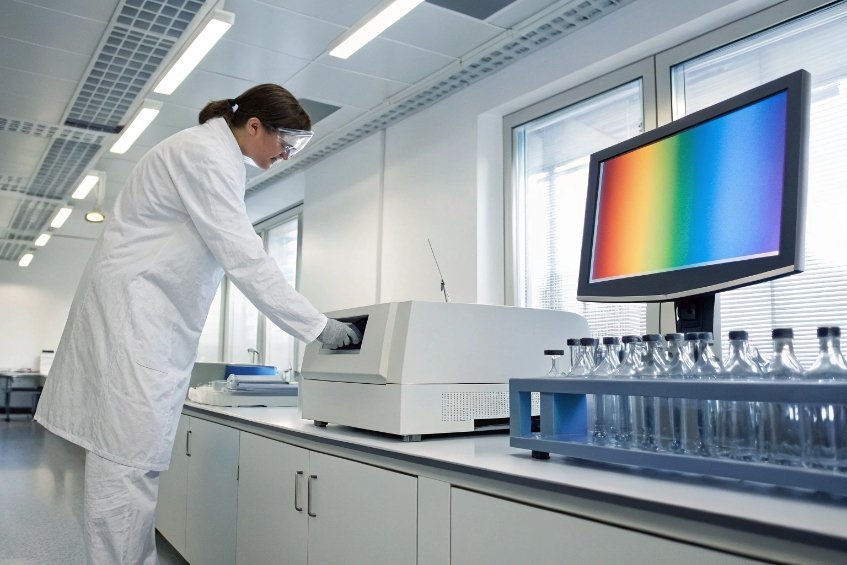
Spectrophotometers for glass bottles usually use UV-Vis measurement in % transmittance or absorbance units, sometimes with an integrating sphere transmittance setup 3 to include scattered light, and often also report luminous transmittance and haze.
UV–Vis spectrophotometer basics
A standard UV-Vis spectrophotometer:
- Sends a narrow band of light through the sample
- Measures light intensity before and after the sample
- Scans over a wavelength range, for example 200–800 nm
- Reports T, %T, A, and sometimes OD in one run
For flat coupons cut from bottles, the setup is simple. The sample sits in the beam at normal incidence. For full bottles, things are more complex because of curvature, refraction, and multiple passes through the wall. Some labs still cut flat segments; others use holders designed for curved surfaces.
There are two main optical approaches for transmission:
-
Parallel beam / normal incidence
Measures directly transmitted light in line with the beam. Mostly counts unscattered light. -
Integrating sphere
Captures both direct and diffusely transmitted light inside a coated sphere. Gives total transmittance and allows haze measurement.
%T, absorbance, OD, luminous transmittance
The usual units are:
- Transmittance, T: 0–1
- %T: 0–100%
- Absorbance, A: dimensionless
- Optical density (OD): often used interchangeably with absorbance in this context
The math links them:
- (T = I/I_0)
- %T = 100 × T
- (A = -\log_{10}(T))
So if %T = 1%, T = 0.01, and A ≈ 2. That means two “orders of magnitude” attenuation.
For human vision, instruments also calculate luminous transmittance:
- This is a weighted sum of spectral transmittance using the photopic luminous efficiency function V(λ) 4.
- It tells me how bright the bottle looks, not just how much UV it blocks.
Haze comes from the ratio of diffuse to total transmitted light. Frosted, matte, or sandblasted bottles have higher haze and lower clarity even if %T is not very low.
Bottle vs flat sample and method choice
The method choice depends on what question I want to answer.
| Method / setup | What it measures | When I use it |
|---|---|---|
| Flat coupon, parallel beam | Spectral %T and A, no scattering detail | Comparing glass formulations and colors |
| Flat coupon, integrating sphere | Total %T and haze | Checking coatings, frosting, matte effects |
| Curved bottle in special holder | Approx. “real” %T through wall | Quick QA checks on actual bottles |
| Whole bottle with internal beam path | Complex multi-pass transmission | Special R&D, not routine |
For routine QA, many factories run flat coupons from each color and thickness and log:
- Spectral UV transmittance below 400 nm
- Luminous transmittance 380–780 nm
- Maximum %T allowed at key wavelengths (for example 370 nm, 400 nm, 450 nm)
This ties directly to product protection requirements.
When should UV-barrier coatings supplement amber or green glass?
Amber and green glass already do a lot of work. But some products are so light-sensitive, or shelf life is so long, that base glass is not enough. Sometimes marketing also demands clearer glass than the product really “deserves”.
UV-barrier coatings make sense when base glass alone cannot keep UV and blue light low enough, or when a clear or lightly tinted appearance must still protect very sensitive formulas.
Limits of base-glass protection
Base glass protection has three main limits:
-
Color vs branding
Amber gives strong protection but hides product color. Many premium brands want pale tints, flint, or special decorative effects. That reduces natural protection. -
Thickness limitations
Lightweight bottles and vials have thinner walls. Beer–Lambert still applies, so thinner glass transmits more light at the same colorant level. -
Extended shelf life and harsh lighting
Long distribution chains, glass doors on fridges, supermarket spotlights, and e-commerce warehousing all add more hours of light exposure one layer at a time.
If spectral data shows that the combination of color and wall thickness still gives too much %T in the critical UV/blue range, coatings become a strong tool.
Types of UV-barrier coatings
Several coating strategies are common in packaging:
-
Hot-end and cold-end functional coatings
These are often used anyway for scratch resistance and lubricity. By adding UV-absorbing components, they can further reduce UV transmittance. -
External amber or color spray on flint
A clear bottle gets an external colored layer. This can give UV protection close to full amber while keeping internal glass composition unchanged. -
Printed or full shrink-sleeve labels
High-coverage labels and sleeves act as physical light shields. Opaque or metallized sleeves can block almost all UV and a lot of visible light on covered areas. -
Advanced barrier films or ALD coatings
Thin inorganic layers deposited on glass can cut UV more sharply while also improving chemical resistance. This is more common for pharma vials and high-value cosmetics. -
Decorative frost/matte finishes
These reduce direct transmission and increase scattering. They lower brightness and can protect sensitive spots, but their UV effect is not always strong unless pigments are UV-active.
Decision guide: when coatings are worth it
I think in three steps:
-
Measure spectral transmittance of the bare bottle
Use real thickness, real color, and realistic path lengths. -
Compare to product needs
- For beer and some wines: very low %T in 300–500 nm, especially 350–450 nm.
- For pharma actives, vitamins, and fragrances: strict limits below 400 nm, sometimes even 450 nm.
- For oils and juices: reduced blue and UV to slow oxidation and color loss.
-
Decide on coatings or labels
- If amber glass alone already gives near-zero %T in the critical band, coatings may not be needed.
- If green or flint glass is desired for look, coatings or sleeves are often the only way to get protection and branding together.
A simple way to summarise choices:
| Product type | Base glass | Coating / sleeve need |
|---|---|---|
| Standard soft drink | Flint or light tint | Usually not needed |
| Craft beer, hoppy styles | Amber | Sleeve or coating if under harsh lighting |
| White / rosé wine | Flint / green | Strongly recommended for long shelf life |
| High-value cosmetics | Flint / tinted | Often use UV coating + decorated sleeve |
| Sensitive pharma vials | Amber / flint | UV-barrier coatings are common |
The final choice is a balance between protection, cost, and brand design. But without good spectral data, this choice is blind.
How does light exposure impact flavor, aroma, and shelf life?
Light damage feels slow and invisible. Bottles sit on a shelf; nothing seems to change. Then one day the beer smells like a skunk, the white wine tastes like wet wool, or the cosmetic serum turns yellow.
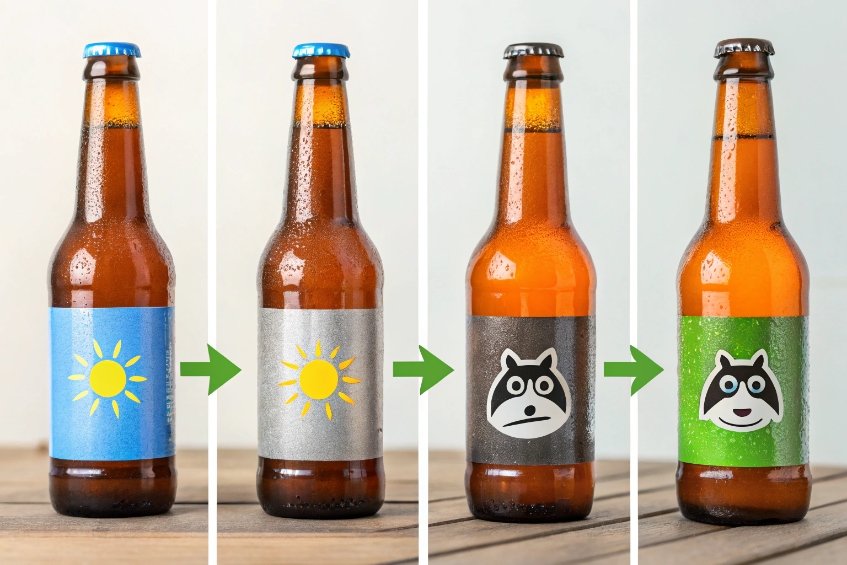
Light in the UV and blue range can drive photochemical reactions in the product that create off-flavors, off-odors, color changes, and loss of actives, often long before the “use by” date.
Which wavelengths do the damage?
The worst trouble usually comes from:
- UVB (280–315 nm) and UVA (315–400 nm): These carry more energy per photon. They excite light-sensitive molecules such as riboflavin, some vitamins, and colorants.
- Violet and blue light (about 400–500 nm): These can still trigger photo-oxidation and “lightstruck” reactions in beverages and oils.
The product formulation defines the exact sensitivity:
- Beer has iso-α-acids and riboflavin that react together under light to form very pungent sulfur compounds.
- Wine has riboflavin, methionine, and other components that form “goût de lumière”.
- Edible oils and fats contain unsaturated lipids that oxidize under light to give rancid notes.
- Vitamins, fragrances, and APIs in cosmetics and pharma often have strong chromophores with sharp UV bands.
Beer and lightstruck flavor
Beer is a classic example and a good warning for other products.
When beer in clear or green bottles sees light in the 300–500 nm range:
- Riboflavin absorbs the light and goes to an excited state.
- That excited riboflavin helps break iso-α-acids.
- One product of this process is the lightstruck flavor compound 3-methyl-2-butene-1-thiol (3-MBT) 5.
3-MBT has an extremely low sensory threshold and a “skunky” aroma. The beer is still safe to drink but the flavor is ruined. This can happen in hours under strong light, not months.
Amber glass cuts most of the responsible wavelengths, so the reaction slows dramatically. Extra coatings or sleeves can push the risk even lower for long storage or strong lighting.
Wine, oils, juices, cosmetics, and pharma
Other products suffer in similar but not identical ways:
-
White and rosé wines
Light can generate off-flavors described as wet wool or cabbage. It can also bleach delicate color and reduce freshness. Green or amber glass plus coatings and tight control of UV below 400 nm are common solutions. -
Oils and fatty foods
Sunflower oil, olive oil, and other high-unsaturation products oxidize under light. This leads to rancid aromas, off-notes, and lower nutritional value. Green or amber bottles reduce the rate; fully opaque containers or sleeves offer even more protection. -
Fruit juices and functional drinks
Vitamins like C and B2, natural pigments, and flavor compounds break down under UV and blue light. The drink can brown, fade, or lose declared functional benefits. -
Cosmetics and pharmaceuticals
Many actives have strict stability requirements. UV exposure can change their structure and reduce potency. This is why so many pharma vials and droppers use amber or coated flint.
Linking light exposure, transmittance, and shelf life
To link lab testing to real shelf life, I connect three pieces:
-
Product sensitivity data
From stability studies or literature: which wavelengths cause breakdown, and how fast at a given dose. -
Glass and coating transmittance
Full spectral curve for the actual bottle, at real thickness. -
Expected light environment
Store lighting type, intensity, distance from lamps, time on shelf, and whether products sit in glass-door fridges or open displays.
Then I can estimate the light dose inside the bottle:
- Dose at wavelength λ ≈ incident intensity × transmittance at λ × exposure time
If the dose for a given wavelength band is above the level known to cause noticeable change before end of shelf life, then packaging must be upgraded: darker glass, lower %T in that band, added coatings, higher label coverage, or secondary packaging like cartons and trays.
A simple summary of risk looks like this:
| Product | Key sensitive compounds | Critical range (approx.) | Main sensory impact |
|---|---|---|---|
| Beer | Iso-α-acids, riboflavin | 300–500 nm | Skunky “lightstruck” aroma |
| White / rosé wine | Riboflavin, amino acids | 320–440 nm | Wet-wool, cabbage notes |
| Edible oils | Unsaturated lipids | 320–460 nm | Rancid, cardboard flavors |
| Juices | Vitamins, pigments | 300–450 nm | Browning, flavor fading |
| Cosmetics/pharma | APIs, fragrances, vitamins | 280–450 nm | Potency loss, odor changes |
When transmittance is controlled and matched to product sensitivity, glass stops being a passive container. It becomes an active part of the protection system.
Conclusion
Glass transmittance is the quiet bridge between color, coatings, and real product life; once it is measured and managed, light damage stops being a mystery.
Footnotes
-
Explains UV–Vis scans and how %T and absorbance are generated across wavelength. ↩ ↩
-
Shows why transmittance drops exponentially with thickness and colorant concentration. ↩ ↩
-
Illustrates integrating-sphere measurement of total and diffuse transmittance (haze) for matte or frosted glass. ↩ ↩
-
Provides the official V(λ) dataset used to calculate luminous transmittance (perceived brightness). ↩ ↩
-
Background on 3-MBT, the key “skunky” compound in lightstruck beer tied to 300–500 nm exposure. ↩ ↩