
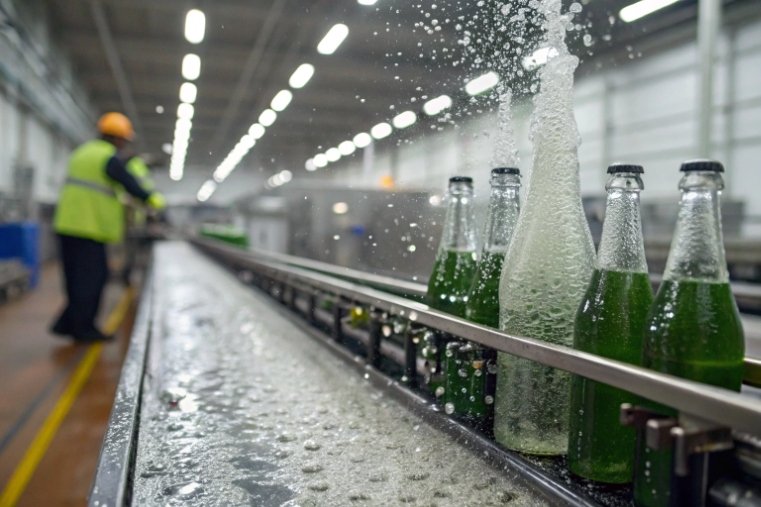
Glass bottles usually fail without warning. One moment they look perfect, the next you hear a “ping” or a full shatter on the filling line or during transport.
Glass bottle shock resistance is the ability of a container to survive sudden thermal or mechanical loads—temperature jumps, drops, knocks—without cracking or breaking.
When buyers understand how shock resistance is tested and how design, heat treatment, and packaging work together, they can cut breakage, protect products, and reduce logistics costs.
How is impact resistance tested (drop, IK, and edge-impact methods)?
Every supply chain adds impacts: conveyor transfers, case packing, warehouse handling, and truck vibration. Real-world damage is messy, so we use lab tests to simulate it.
Impact resistance of glass bottles is mainly measured with controlled drop tests, pendulum (IK-style) impact tests, and edge-impact tests [^1] that target the critical heel and finish areas.
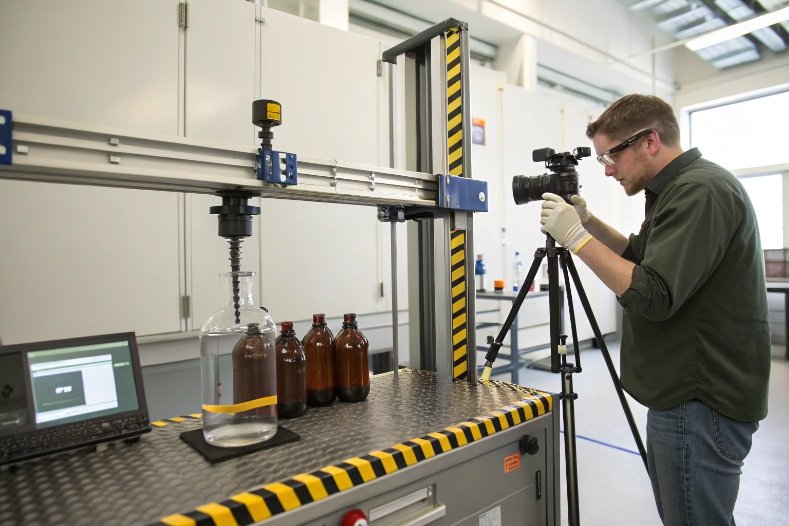
Drop tests
Drop tests are simple and intuitive. A filled or empty bottle is dropped from a set height onto a rigid surface like steel or thick plate glass. The test records whether the bottle survives, how it fails, and at what height failures start to appear.
Typical variables:
- Drop height (for example 30–150 cm)
- Impact orientation (base first, sidewall, shoulder, or corner)
- Fill level and product type (water, carbonated beverage, oil)
- Temperature of bottle and contents
Drop tests show:
- Realistic worst-case handling damage (like warehouse drops)
- The weakest region of the bottle geometry
- The performance of packaging around the bottle (cartons, dividers, trays)
Pendulum impact / IK-style tests
Pendulum impact tests are more controlled. A striker with known mass swings from a set height and hits the bottle at a precise location. The energy at impact can be calculated in Joules or inch-pounds.
This method:
- Gives repeatable, comparable results between designs
- Focuses on specific areas (heel, sidewall, shoulder, finish)
- Helps tune wall thickness and local geometry
IK ratings are common in other industries (like enclosures). For bottles, similar principles apply: more energy absorbed without fracture means better shock resistance.
Edge-impact tests
Edge-impact tests attack the most vulnerable zones:
- Heel (where sidewall meets base)
- Finish and thread area
- Mold seams and embossed areas
Special jigs hold the bottle at an angle as a striker hits the heel or base edge. Most glass failures start at the heel, because stress concentrates there when the bottle lands on an uneven surface.
These edge tests show:
- How well heel design spreads stress
- Whether mold seams or decoration create dangerous stress peaks
- Sensitivity to minor misalignment during filling and conveyor transfers
| Test Type | What It Simulates | Key Output |
|---|---|---|
| Free drop | Handling drops in warehouse / retail | Surviving drop height |
| Pendulum impact | Local blow (knock, conveyor impact) | Energy at failure (J or in-lb) |
| Edge-impact | Heel / finish strike on hard point | Cracks at heel or shoulder |
Impact testing plus thermal shock testing together give a full picture of






