
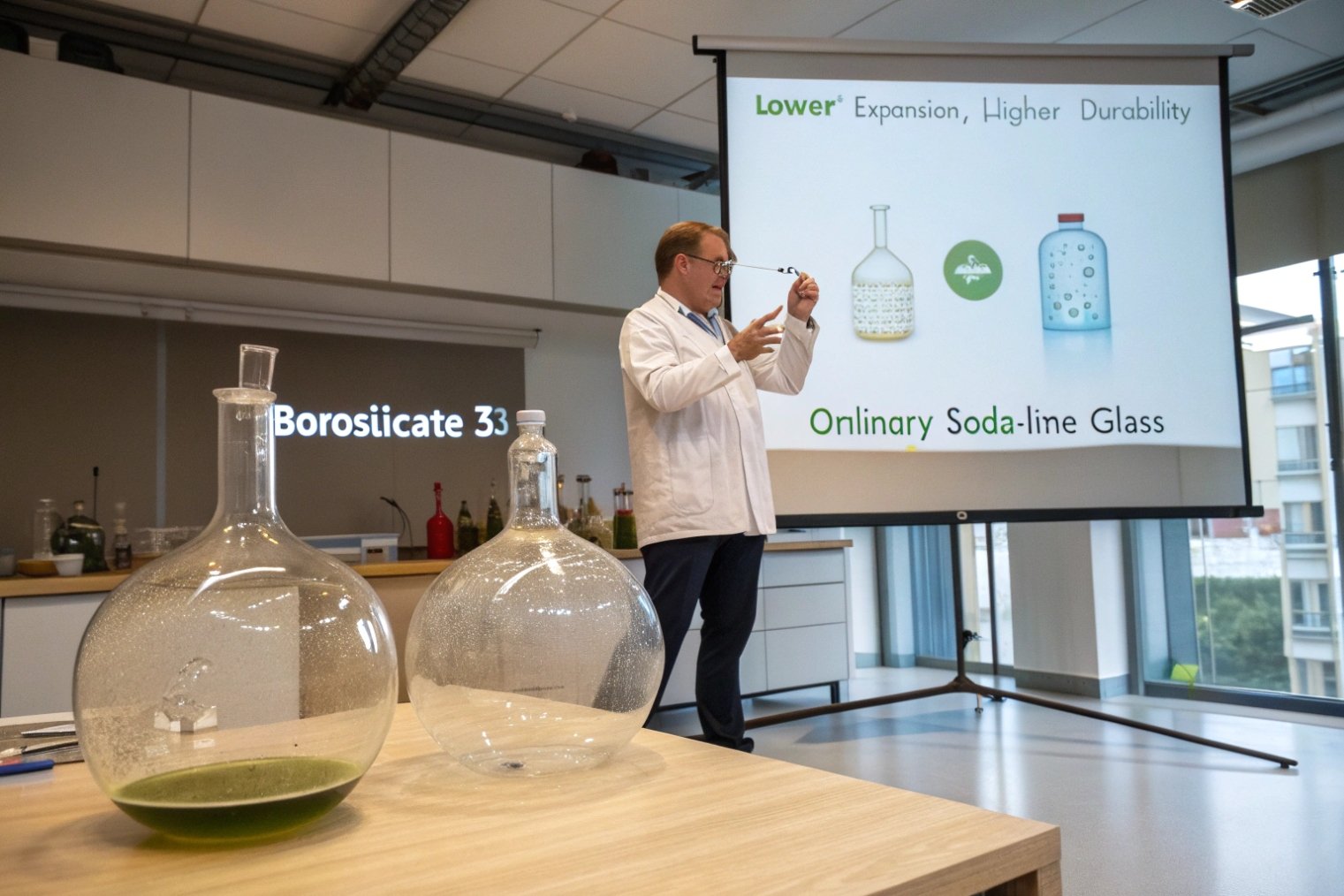
Many people hear “borosilicate glass” and think only of lab beakers, not bottles or cookware. That is a shame, because this material quietly solves real problems in daily use.
Borosilicate glass is a silica-based glass that adds boron trioxide for very low thermal expansion, strong thermal-shock resistance, and high chemical durability, so it outperforms ordinary soda-lime glass in hot-cold, chemical, and flavor-sensitive uses.
In glass packaging and cookware projects, the question is never “Is borosilicate good?”. The real question is “Where does it add enough value to justify the higher cost and stricter processing?”. To answer that, it helps to break the topic into structure, performance, applications, and trade-offs.
What exactly is borosilicate glass 3.3?
Most people know borosilicate as “lab glass” or “oven glass”, not as a material with a specific formula. That gap causes confusion when we compare it with ordinary soda-lime bottle glass.
Borosilicate glass is a silica-based glass that includes boron trioxide, often around 3.3×10⁻⁶ K⁻¹ linear thermal expansion for “3.3” grade, which gives very low expansion, high thermal stability, and strong resistance to devitrification during repeated heating.
Composition and key numbers
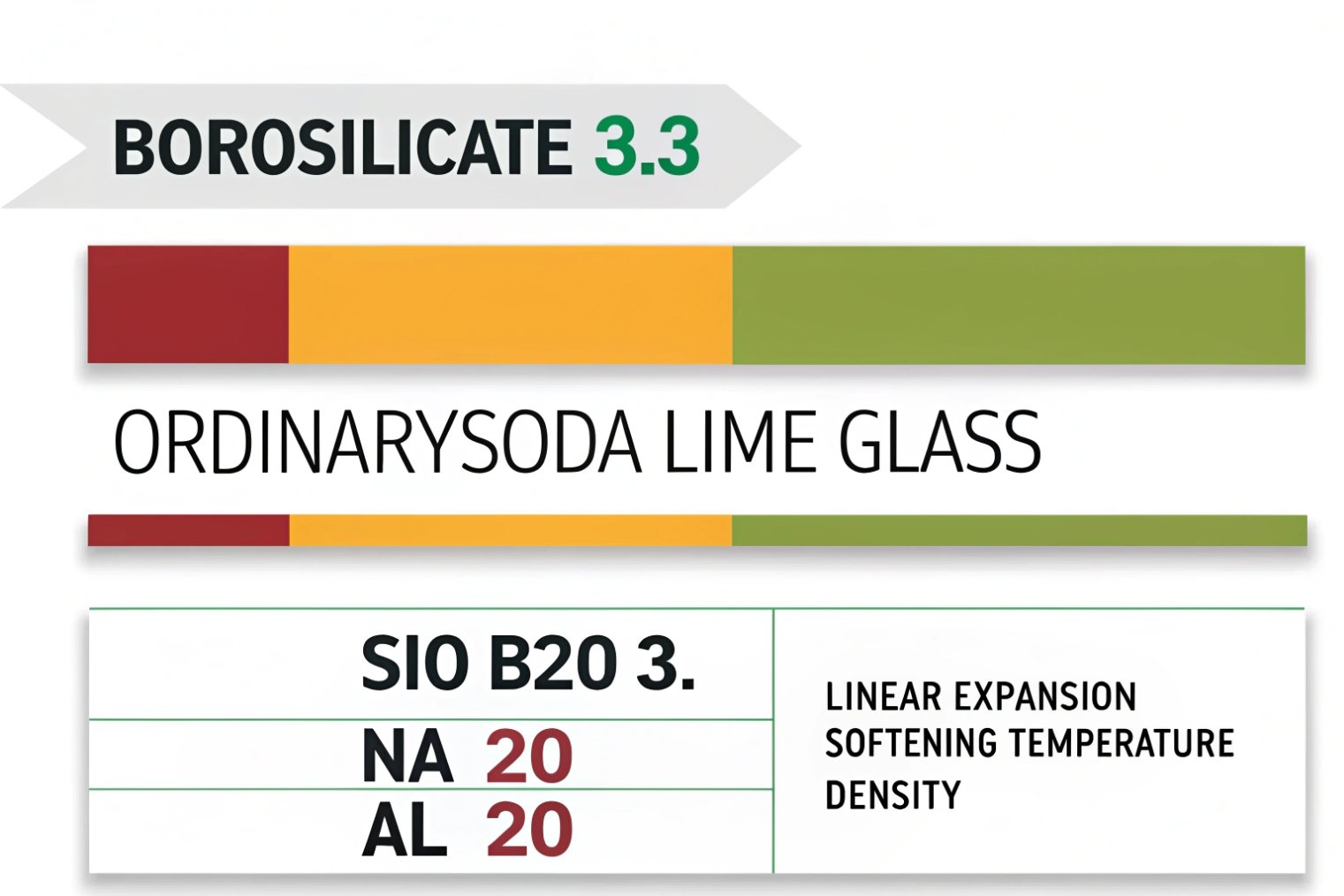
Borosilicate glass is still a silica network, but boron trioxide (B₂O₃) 1 and some alumina sit inside that network and change how it moves with heat.
Typical picture:
| Aspect | Borosilicate 3.3 | Ordinary soda-lime glass |
|---|---|---|
| Main oxides | SiO₂, B₂O₃, Na₂O, Al₂O₃ | SiO₂, Na₂O, CaO |
| Linear expansion (20–300°C) | ~3.3×10⁻⁶ K⁻¹ | ~8–9×10⁻⁶ K⁻¹ |
| Transformation temp | ~525 °C | ~520 °C (but with higher expansion) |
| Softening temp | ~820 °C | ~720–740 °C |
| Density | ~2.23 g/cm³ | ~2.4–2.6 g/cm³ |
| Refractive index (nd) | Lower | Higher |
The “3.3” label many engineers use refers to that very low linear thermal expansion. The lower the expansion, the less the glass grows or shrinks when it heats or cools. That is the root of its famous thermal-shock resistance.
In technical sourcing, many lab-grade 3.3 materials are referenced to the ISO 3585 borosilicate glass 3.3 specification 2.
Because the working and softening temperatures are higher, the melt needs more heat and tighter control during forming. So production lines for borosilicate are not the same as lines for cheap bottle glass. Compositions need tight control, or the expansion moves out of the 3.3 range and the thermal-shock benefit drops.
From a user side, these details show up in simple ways. Borosilicate items feel slightly lighter than a same-size soda-lime piece, the glass stays clear after many heat cycles, and dimensions stay stable in ovens, autoclaves, and dishwashers. For brand owners, that stability supports precise closure systems and long-term fit between bottle and cap.
How do thermal-shock advantages show up in real use?
Most glass failures that users remember as “poor quality” are not chemical failures. They are thermal-shock failures: a pan cracks under cold water, or a bottle bursts during hot-fill.
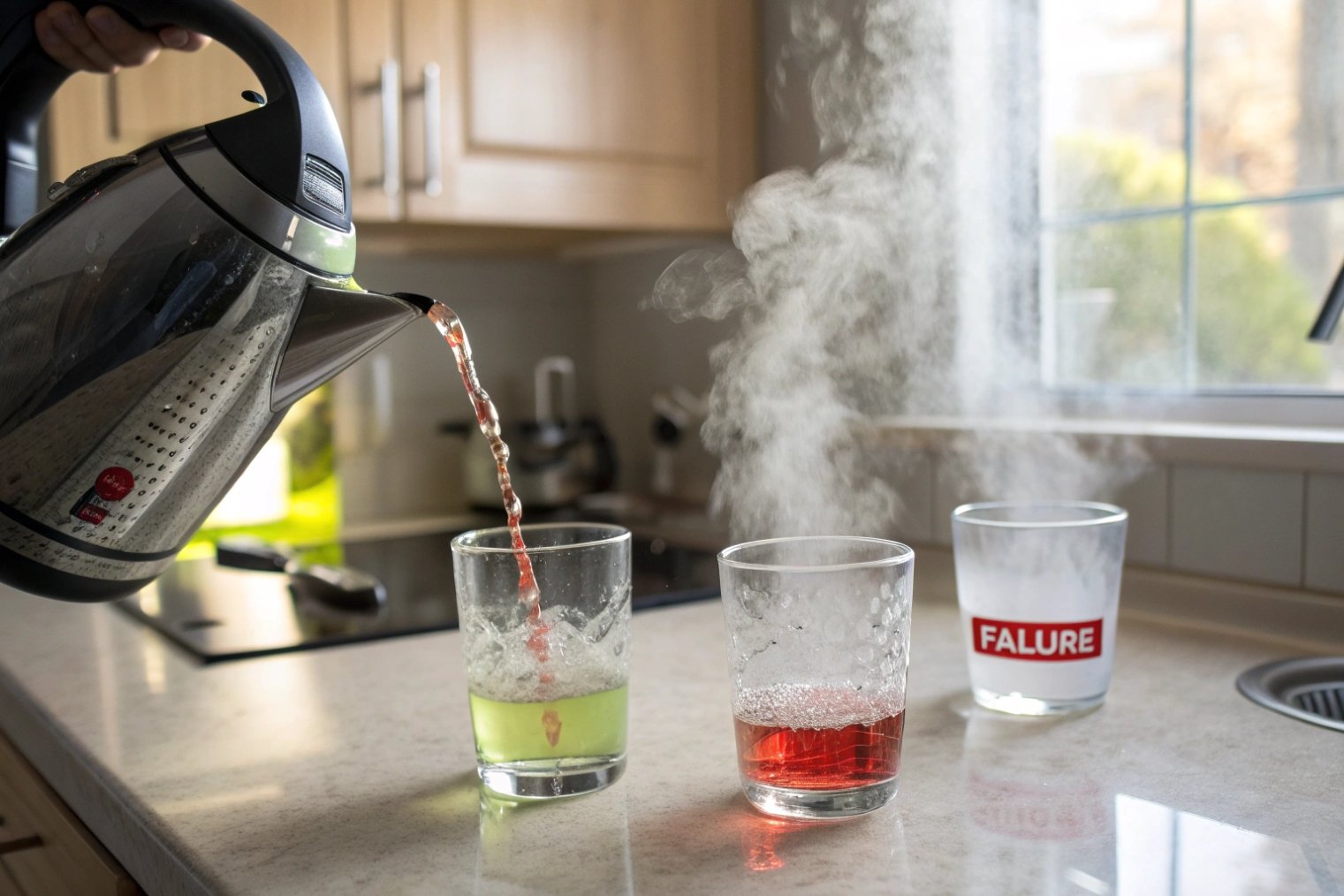
Because borosilicate glass has much lower thermal expansion than soda-lime, it tolerates fast temperature swings without building up dangerous internal stress, so it survives hot-fill, oven-to-counter moves, and lab flame heating much better.
What thermal shock really means on the table or line
A thermal shock 3 event is simply stress from temperature difference across the glass wall. When the inside gets hot faster than the outside, it wants to expand. If the outside is still cool and stiff, the wall goes into tension and the glass cracks.
Key practical differences:
| Use scenario | Borosilicate 3.3 behavior | Soda-lime behavior |
|---|---|---|
| Boiling liquid into room-temp jar | Usually survives if thickness is reasonable | High risk of cracking or base break |
| Oven to room-temp counter | Designed products handle the jump | Needs tempered type; still some failures |
| Flame under beaker or kettle | Can tolerate direct flame in lab and stove designs | Ordinary glass is unsafe |
| Hot-fill juice at 85–95 °C | Better safety margin, less breakage | Needs careful pre-heating and design |
In cookware, this means baking dishes that can handle uneven oven zones and then meet a cool countertop. In labware, this means beakers and flasks that can sit on a hotplate or under a flame. In packaging, it points to hot-fill or retort processes where the product goes in hot or the packed item goes into a sterilization cycle.
One point is still important. Borosilicate is not a magic unbreakable material. Under impact, especially sharp impact on an edge, it still behaves as a brittle glass. Tempered glass 4 can often survive more drops than non-tempered borosilicate. So the right choice depends on the main failure risk: thermal shock or impact.
For food and beverage packaging, thermal-shock resistance becomes interesting when you combine glass with pasteurization, retort, or “bake-in-pack” products. For simple cold-filled sauces or dry foods, soda-lime is usually enough and more economical.
How does borosilicate’s chemical resistance help in daily packaging?
Thermal shock is easy to show in a demo. Chemical resistance is quieter. It shows up after months or years, when labels fade, flavors change, or the glass surface looks hazy.
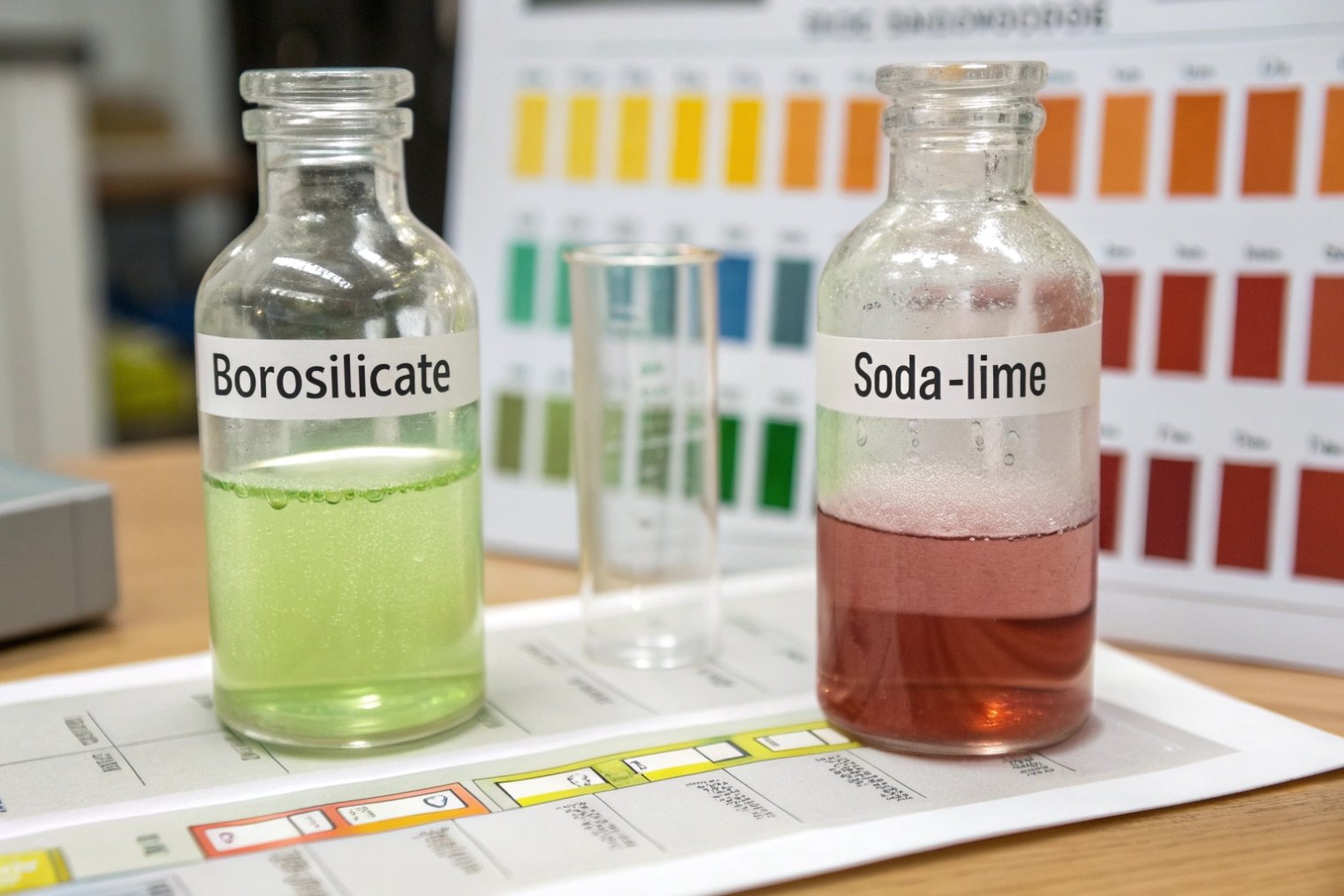
Borosilicate glass resists water, most acids, salts, halogens, and many organic solvents better than soda-lime, while remaining non-porous and flavor-neutral, so it protects sensitive formulas and prevents leaching, staining, or odor carry-over.
What it resists well (and what it does not)
Chemically, borosilicate sits in a high durability class. The boron and alumina in the network reduce how fast water or ions attack the glass.
Simplified picture:
| Medium / chemical family | Borosilicate 3.3 | Soda-lime glass |
|---|---|---|
| Water and steam | Very high durability | Good, but more long-term attack |
| Most acids (except HF) | Very resistant | Often slightly less resistant |
| Salts and halogens | Very resistant | Good to moderate |
| Organic solvents | Very resistant | Good |
| Strong hot alkalis | Vulnerable at high temp | Also vulnerable |
| Hydrofluoric acid (HF) | Strongly attacks, dissolves glass | Same, also attacked |
So borosilicate is a great choice for:
- Acidic foods like vinegar, lemon concentrate, pickles.
- Active ingredients in cosmetics and serums.
- Lab reagents that must stay pure over long storage.
- Strong flavors that you do not want to migrate to the next product.
The glass surface is non-porous and chemically inert in normal use. It does not absorb color or odor. It also leaches fewer ions into sensitive products. That helps keep taste clean in premium beverages and keeps assay results stable in lab samples.
There are still limits. Very strong alkalis at high temperature will attack even borosilicate. Hydrofluoric acid (HF) 5 will attack almost any common glass, including borosilicate. For industrial users, these edge cases matter. For food, beverage, and cosmetics, the main story is long-term clarity, no haze, and no strange taste after storage.
From a packaging supplier view, this chemical stability also supports decoration. Coatings, print, and electroplating sit on a stable surface that does not slowly roughen. So decoration holds its look longer in the market.
Which packaging and cookware really need borosilicate?
Not every bottle, jar, or pan needs borosilicate. For many products, it would just raise cost without real benefit. The key is to match the material to the stress profile.
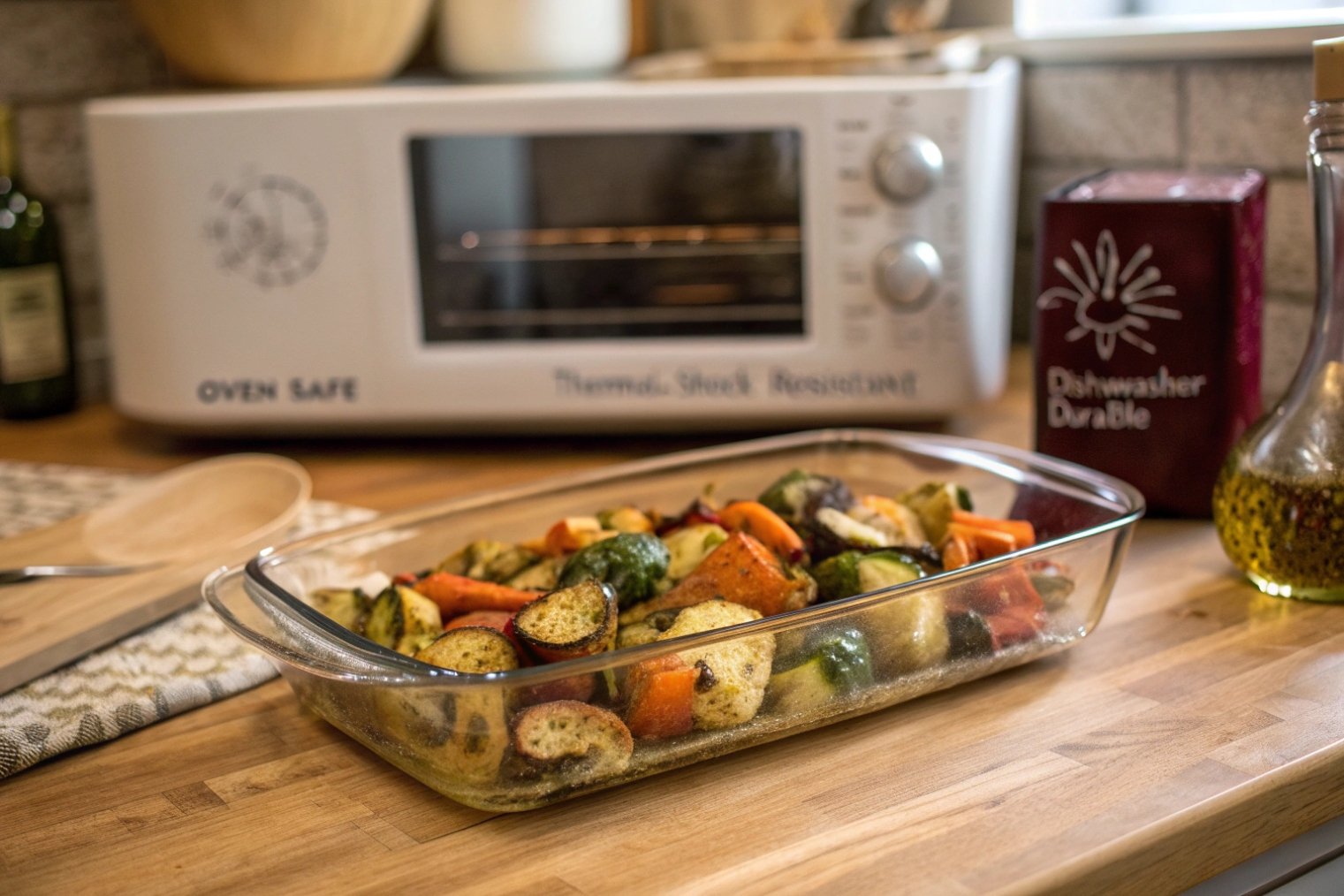
Borosilicate makes the most sense where products face repeated heating, hot-fill, strong acidity, or long shelf life with sensitive flavors, such as ovenware, lab glassware, coffee and tea equipment, and premium concentrated food or cosmetic packaging.
High-value use cases that benefit most
Here are typical segments where borosilicate’s advantages really show:
| Segment / product type | Why borosilicate helps | Typical examples |
|---|---|---|
| Ovenware and bakeware | Thermal-shock and high softening temperature | Baking dishes, roasting pans, pizza plates |
| Coffee and tea equipment | Direct heat, hot water, flavor neutrality | Pour-over brewers, kettles, double-wall cups |
| Lab and pharma containers | Chemical resistance and dimensional stability | Beakers, flasks, vials, sight glasses |
| Premium food and beverage packs | Hot-fill, acidity, flavor and aroma protection | Concentrates, vinegar, cold-brew, kombucha |
| High-end cosmetic and skincare | Formula sensitivity and solvent resistance | Serums, essential oils, active ampoules |
In cookware, the benefits are easy to feel in daily life. A borosilicate baking dish can go from freezer (with careful use) to oven with much lower risk. Coffee tools made from borosilicate do not cloud from repeated hot water cycles and keep flavor clean for delicate aromas.
In packaging, the benefits are more about product claim and risk management. For example:
- A vinegar or lemon concentrate in borosilicate packaging has a very robust chemical barrier.
- An essential oil blend in a borosilicate dropper bottle avoids interaction between volatile components and the glass.
- A ready-to-eat meal in a borosilicate tray can handle both cooking and serving in one piece.
There is one more class that often benefits: industrial sight glass. Here, thermal-shock and chemical resistance are both important, because hot, sometimes corrosive process fluids touch the glass.
For standard table water bottles, simple jars for cookies, or cold-filled sauces, soda-lime glass remains the workhorse. The extra performance of borosilicate would not pay back its cost.
What are the weight and cost trade-offs vs soda-lime glass?
Many people expect borosilicate to be both heavier and more expensive than ordinary glass. The reality is a bit more subtle: it is often slightly lighter per volume, but total cost is higher.
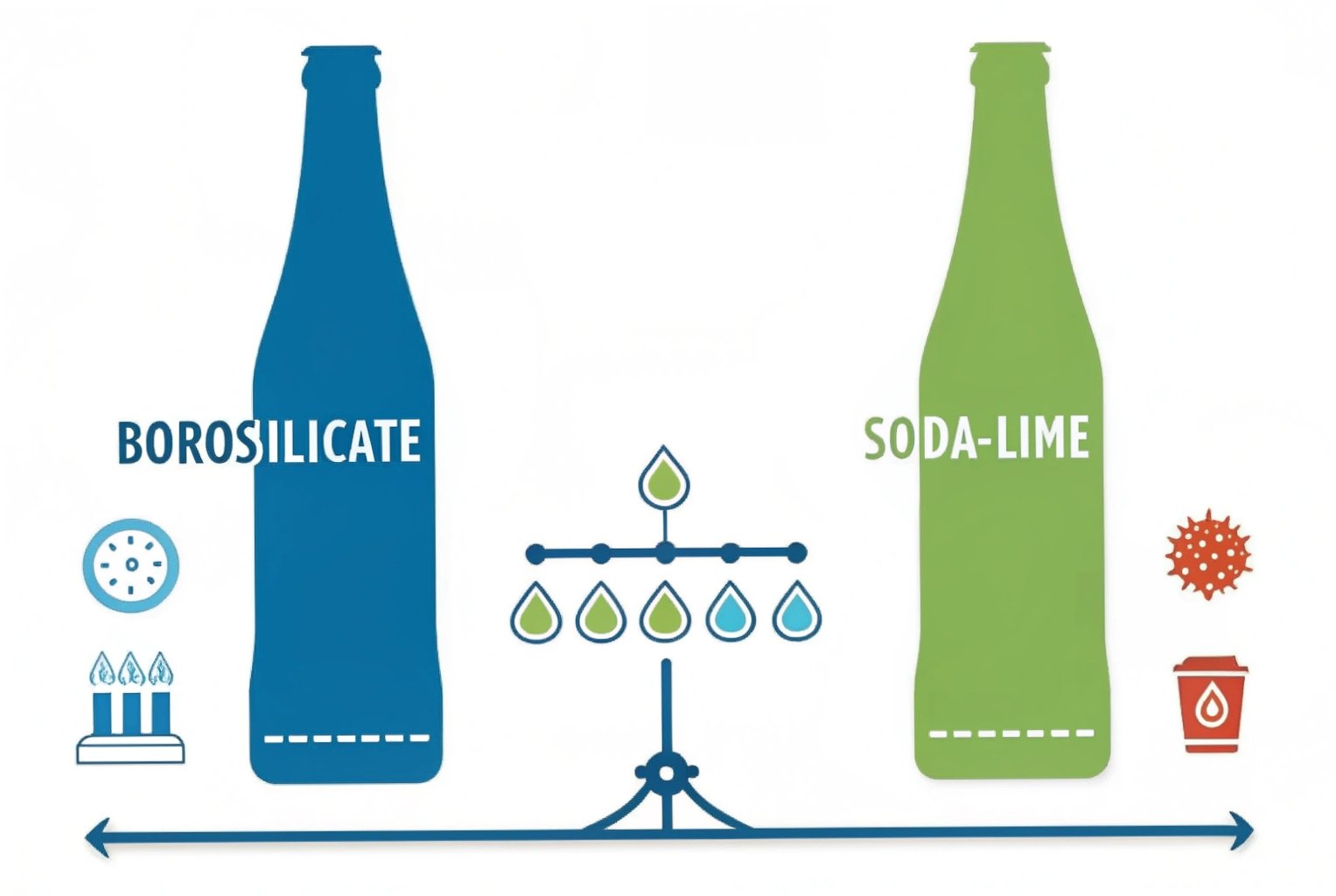
Borosilicate glass has slightly lower density but higher melting and forming temperatures, stricter composition control, and smaller production base, so parts can be a bit lighter yet usually cost more than soda-lime per unit.
Density, wall thickness, and real cost per piece
On paper, borosilicate has lower density than soda-lime. So one cubic centimeter weighs less. But design and processing also affect final piece weight and cost.
Simple comparison:
| Factor | Borosilicate 3.3 | Soda-lime glass |
|---|---|---|
| Density | Slightly lower | Slightly higher |
| Typical wall design | Sometimes thicker for robustness | Often optimized for mass-market lines |
| Melt temperature | Higher | Lower |
| Forming complexity | Harder; tighter process window | Easier; well-known on many lines |
| Raw material cost | Higher due to boron and quality | Lower |
| Unit cost (similar size) | Usually higher | Usually lower |
Because working temperature is higher, furnaces for borosilicate need more energy and more resistant refractories. The composition window is tighter, so process control must be strict. Not every bottle plant can run borosilicate at all. Many of the practical limits trace back to viscosity landmarks like the glass softening points 6 used in forming and high-heat design.
From a project view, this means:
- Weight: you can design a borosilicate bottle that is slightly lighter for the same strength, but not by a huge margin. In some cases, you may choose thicker walls to gain safety for thermal shock.
- Cost: the unit price per bottle, jar, or dish is almost always above soda-lime. For niche designs, tooling and setup cost can also be higher, especially at low volumes.
- MOQs: because of the special melt and dedicated line time, minimum order quantities may be higher than for standard soda-lime items.
So borosilicate should be seen as a performance material, not a commodity. It makes sense when the value of lower breakage, stronger product claims, or special user experience is higher than the extra cost per unit.
Are there recycling or availability downsides to borosilicate?
The last question often comes from sustainability or operations teams. They like the performance, but they worry about recycling streams and supply security.
Borosilicate glass is recyclable, but it usually cannot enter normal soda-lime bottle cullet streams, and it has fewer production lines worldwide, so it needs separate sorting and has more limited mass-market availability.
Sorting, cullet, and supply
From a chemistry standpoint, borosilicate glass can be melted and re-formed. The problem is compatibility with huge soda-lime recycling loops.
Key points:
| Aspect | Borosilicate 3.3 impact | Comment |
|---|---|---|
| Mixed into soda-lime cullet | Small amounts can disrupt melting and QA | Changes viscosity and expansion |
| Standard city recycling | Often treated as contamination | Lab glass, cookware often rejected |
| Dedicated borosilicate streams | Possible but less common | Needs special collection and partners |
| Availability of factories | Fewer plants worldwide | More planning for projects |
Most municipal systems are tuned for container glass, which means soda-lime. Even a small percentage of borosilicate in the cullet can shift furnace behavior and product quality. This is why guidance for container-glass recycling streams 7 often treats borosilicate cookware and lab glass differently than bottles and jars.
For brand owners, this has two practical effects:
- On-pack recycling claims need careful wording. It is easy for users to put borosilicate into general glass bins, but it may not be recycled there. In some regions, partners can build a separate stream, but this is not yet the norm.
- Supply planning is more important. There are fewer large-scale borosilicate furnaces than soda-lime furnaces. So capacity is not as elastic. Lead times and MOQs can be higher.
From a sustainability view, borosilicate still has strengths. The long life and breakage resistance under heat reduce waste. The material is inert and safe in landfills. With the right partners, closed loops for industrial scrap are possible. But today, it is not as integrated into public “bottle bank” recycling as soda-lime.
Conclusion
Borosilicate glass is best used as a targeted performance material, not a universal replacement, where its thermal-shock, chemical, and stability advantages clearly outweigh cost and recycling limitations.
Footnotes
-
Chemical profile of boron trioxide, including structure and safety notes relevant to glass formulations. ↩︎ ↩
-
Datasheet shows standardized borosilicate 3.3 properties and ISO 3585 reference used across lab glass. ↩︎ ↩
-
Overview of how rapid temperature gradients create cracking and why low expansion improves thermal-shock resistance. ↩︎ ↩
-
Explains how surface compression makes tempered glass tougher and why it often outperforms annealed glass in impacts. ↩︎ ↩
-
Safety guidance explains why hydrofluoric acid etches glass and requires plastic-compatible handling and storage. ↩︎ ↩
-
Definition of softening point helps interpret glass temperature limits for forming, deformation, and heat fixtures. ↩︎ ↩
-
Practical recycling guidance shows why Pyrex/borosilicate is kept out of container-glass recycling streams. ↩︎ ↩






