
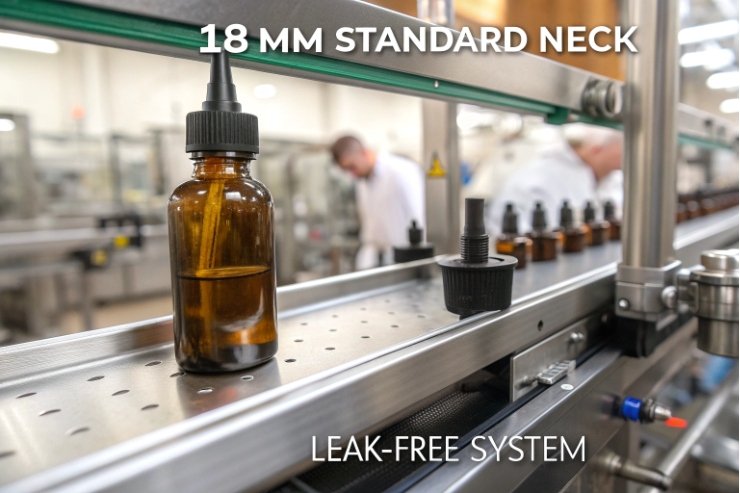
If the neck finish is wrong, even the best essential oil or serum will end up leaking, clogging, or failing torque tests.
A DIN-18 neck is a standardized 18 mm screw finish used on “Euro” dropper bottles, designed so droppers, orifice reducers, and TE/CRC caps from different suppliers can fit and seal consistently.
When we design small glass bottles for essential oils, tinctures, or cosmetic actives, DIN-18 is usually the first neck code on the drawing. It gives a shared geometry for glass and closures, so you do not fight with random threads and mystery leaks later. The key is understanding what the code really means, which closures it accepts, and how to check your own bottles.
What are the exact DIN-18 dimensions and thread specs for glass bottles?
A lot of buyers know “DIN-18” as a label on a catalog page, but they never see the drawing behind it.
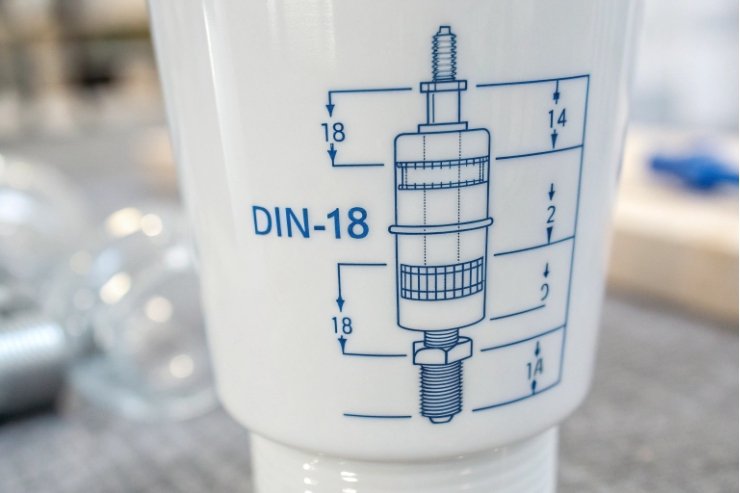
DIN-18 is a European neck finish standard with a nominal 18 mm outer thread diameter, a defined neck height, a single continuous thread, and a tamper-evident ring position that all compatible closures follow.
How the DIN-18 code is structured
The “DIN” in DIN-18 comes from Deutsches Institut für Normung 1, the German standards body. The “18” refers to the nominal outer diameter of the thread in millimeters. So when we talk about DIN-18, we are talking about a family of necks with three key ideas:
- The T dimension (thread outside diameter) is around 18 mm.
- The neck height from the sealing land to the tamper-evident ring is standardized.
- The thread form (shape, pitch, number of turns) is fixed so closures can screw on and seal the same way on any DIN-18 bottle.
In practice, you will often see GL18 used as a twin designation—many suppliers reference GL 18 thread 2 alongside DIN-18/GL18 language to highlight cross-fit expectations.
Key geometry elements you will see on a drawing
Even if you do not have the official DIN file in front of you, most DIN-18 neck drawings share these features:
- Single-start thread
One continuous thread that wraps a little more than one full turn around the neck. - Top sealing surface
A flat “land” where the cap liner or integrated seal compresses onto the glass. - Controlled neck height
A defined distance from the top land down to the tamper-evident (TE) bead or ring. - TE bead / transfer ring
A glass ring under the thread that catches the TE band on caps. - Chamfer and lead-in
Small angles at the start of the thread and top edge to help closures start smoothly.
In simple terms:
| Feature | What it is | Why it matters |
|---|---|---|
| Nominal Ø 18 mm | Outer thread diameter around 18 mm | Tells you which closure “size” to use |
| Single-start thread | One spiral thread, about one full turn | Smooth capping and consistent torque |
| Defined neck height | Set distance top land → TE ring | Ensures liners compress correctly |
| TE bead / ring | Glass ridge under threads | Allows tamper-evident and CRC designs |
| Flat top land | Sealing surface for liner or integrated gasket | Actual barrier against leaks and oxygen |
The exact tolerances (to tenths of a millimeter) sit in the DIN / GL standard and your glass supplier’s drawing. For daily work, it is enough to know: if the bottle is labeled DIN-18 or GL18, the neck is designed to work with standard DIN-18 droppers and caps across sizes from about 2.5 ml up to 100–200 ml.
Which closures fit DIN-18—droppers, orifice reducers, TE/CRC caps, or misters?
One of the biggest advantages of DIN-18 is closure flexibility. You can keep the same neck finish and change only the “head” to build different product types.
DIN-18 accepts a wide family of closures: euro-droppers, plug-in orifice reducers with screw caps, glass pipette droppers, tamper-evident and child-resistant caps, and even fine misters designed for 18 mm finishes.

Here is how we usually group the options:
| Closure type | Typical construction | Best for |
|---|---|---|
| Euro-dropper system | Orifice insert + TE cap | Essential oils, tinctures, low-dose liquids |
| Orifice reducer + cap | Simple insert + screw cap | Carrier oils, serums, DIY blends |
| Glass pipette dropper | Glass pipette + bulb + screw collar | Cosmetic serums, CBD oils, dosing by ml |
| TE screw cap (no insert) | PP or phenolic cap, often with liner | Bulk oils, pharma, lab reagents |
| CRC cap | Child-resistant + sometimes TE features | Medicines, higher-risk actives |
| Fine mist sprayer | Mini atomizer with 18 mm collar | Room sprays, toners, light fragrances |
For many essential-oil lines, starting from proven Euro dropper bottles 3 (bottle + matched reducer/cap family) is the quickest way to reduce fit surprises.
All of these are available with DIN-18 compatible threads and sealing geometry. So, for example, a 10 ml amber DIN-18 bottle can move between:
- An EO euro-dropper closure for aromatherapy.
- A pipette dropper set for face serum.
- A CRC cap for an intense active blend.
The neck does not change; only the closure does. This is a huge advantage for inventory and tooling.
Things to check when choosing a DIN-18 closure
On the closure spec sheet, you want to see any of the following codes:
- DIN-18
- GL18
- 18 DIN / 18-415 (for some hybrid designs)
Then look for three more details:
-
Sealing system
Is there a built-in cone seal, a flat liner (PE, TPE, PTFE-faced), or a dropper insert that acts as the seal? -
Tamper-evidence
Does the cap have a TE band that locks under the glass ring? If yes, the bottle’s TE ring diameter and height must match. -
Material compatibility
If you sell regulated or higher-risk products, confirm any required testing standards for child-resistant caps 4 in your target market.
When those three pieces align with a DIN-18 neck, you can mix bottle and closure suppliers much more safely without redesigning the glass every time.
How does DIN-18 differ from 20/410 and 18/415 neck finishes in compatibility?
On spec sheets, DIN-18 often sits next to codes like 18-415 or 20/410. They look similar, but they are not all interchangeable.
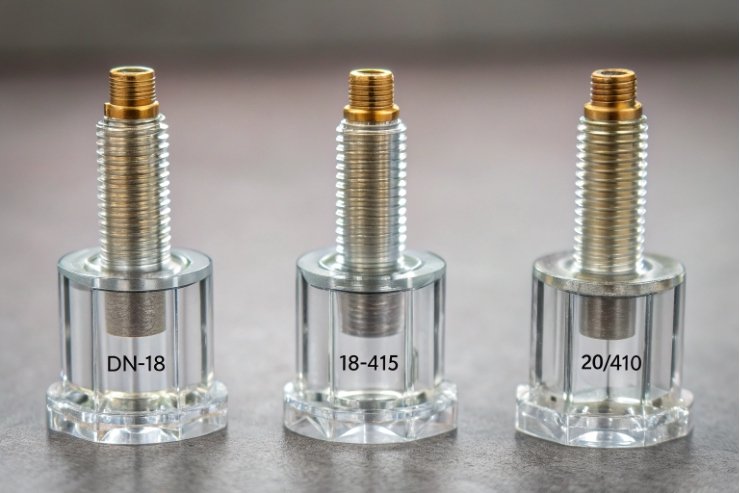
DIN-18 is a European dropper standard; 18/415 and 20/410 are GPI/GCMI continuous-thread finishes. The numbers may overlap, but the thread height, profile, and sealing land are defined by different systems.
DIN / GL vs GPI/GCMI systems
Two main “languages” are in play:
- DIN / GL finishes (like DIN-18, GL18) for dropper and lab-style glass, common in Europe.
- GPI/GCMI continuous-thread (CT) neck finishes (like 18-415, 20/410) described in closure/neck guides such as this overview of neck and closure threads and dimensions 5.
They use similar ideas but different details:
- The first number is still the nominal outer diameter in millimeters.
- The second part (400 / 410 / 415) describes thread height and style, not the same TE geometry as DIN.
So:
- 18-415 is a CT finish with 18 mm nominal diameter and a “415” thread profile.
- 20/410 is a CT finish with 20 mm nominal and “410” profile.
DIN-18 has its own set of dimensions; it is not simply “18-something” in GPI.
Where there is real compatibility and where there is not
In the market, you will sometimes see bottles or closures labeled “DIN-18 / 18-415”. This usually means the neck is designed so that:
- It follows DIN-18 glass geometry.
- It is also compatible with closures sold as 18-415, especially droppers and caps.
This works because some closure makers intentionally harmonize thread and sealing land so one part can run on both finishes. But this is a design choice, not a guarantee from the standard itself.
For 20/410, the situation is clearer: the neck is larger (≈20 mm) and the closure will not fit on an 18 mm neck. This size is common for cosmetic pumps and atomizers, not euro dropper bottles.
A simple comparison:
| Finish code | System | Nominal Ø | Typical use case | Interchange with DIN-18? |
|---|---|---|---|---|
| DIN-18 | DIN / GL | 18 mm | Euro dropper bottles, pharma, EOs | Base standard |
| GL18 | DIN / GL | 18 mm | Same as DIN-18 | Functionally same as DIN-18 |
| 18-415 | GPI / CT | 18 mm | Droppers, caps, some EO bottles | Sometimes, if designed as dual-fit |
| 20/410 | GPI / CT | 20 mm | Cosmetic pumps, sprayers, lotions | No, different diameter |
So the safe rule is:
- Never assume a 20/410 closure will fit any 18 mm neck.
- Treat “DIN-18 / 18-415” combos as a specific product design, not a universal standard.
- Always cross-check bottle and closure drawings, or test samples, before locking a combination into production.
How do I measure my bottle to confirm it’s DIN-18 and avoid leak issues?
Many leak and torque problems start because the bottle was “assumed” to be DIN-18, but the actual neck did not match the closure standard.
To confirm DIN-18, measure the outer thread diameter, check neck height and TE ring position, and compare them to DIN-18/GL18 drawings; then always validate with physical leak tests before mass filling.
Tools you need for a quick check
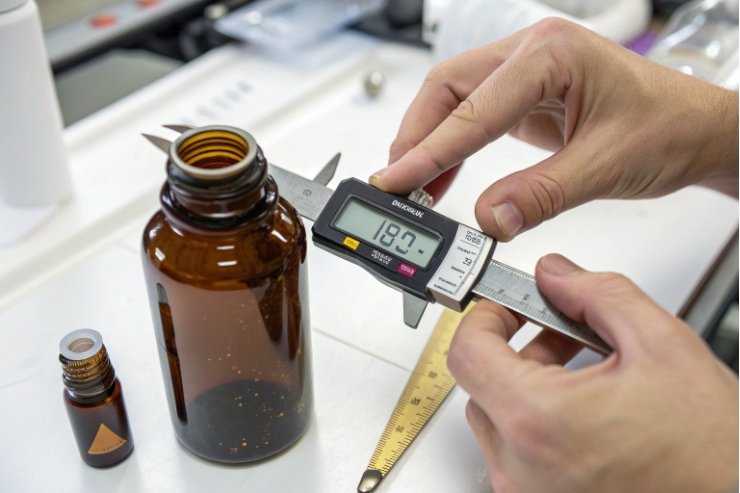
You do not need a lab to do a basic verification. A simple kit is enough:
- A digital caliper 6 (0.01 mm resolution is ideal).
- A small ruler or height gauge.
- A few standard DIN-18 closures (euro-dropper, cap, etc.).
With these, you can run a 5–10 minute check on any new bottle sample.
A four-step measurement routine
-
Measure the outer thread diameter
Use the caliper across the threads at the widest point. If the value is around 18 mm (for example, 17.8–18.3 mm), this supports DIN-18 or 18-415. If you see ~20 mm, it is likely a 20/410 or similar. -
Measure the neck height
Measure from the flat sealing land on top down to the start of the TE bead or shoulder. Compare this with your supplier’s DIN-18 or GL18 drawing. A big mismatch here can kill liner compression and lead to leaks. -
Inspect threads and TE ring
Count how many turns the thread runs around the neck (usually just over one full turn for DIN-18). Look for a well-defined TE ring under the thread if you plan to use TE caps. If the neck has multiple turns and no TE bead, it may be a CT finish, not DIN-18. -
Do a real closure fit test
Take a known DIN-18 cap or euro-dropper closure. Screw it on by hand. It should:- Start smoothly without cross-threading.
- Reach firm resistance at a consistent position.
- Sit straight, with no obvious tilt or gap.
Then fill the bottle with water or test liquid and run a basic leak test—if you need a formal reference method, see the ASTM D3078 bubble emission leak test 7.
Simple cues to separate DIN-18 from 20/410 on the bench
If you do not have drawings in front of you, these quick cues help:
| Check point | Likely DIN-18 | Likely 20/410 |
|---|---|---|
| Outer thread Ø | ~18 mm | ~20 mm |
| Application | Essential oils, pharma drops | Pumps and sprayers for cosmetics |
| TE ring presence | Very common | Less common in basic 20/410 |
| Typical closure type | Euro-dropper, TE cap, CRC | Lotion pump, fine mist sprayer |
Whenever a dimension or detail feels “off”, ask the glass supplier for the full neck drawing and naming. It is much cheaper to catch a mismatch at sample stage than to discover leaks in the first production shipment.
Conclusion
A DIN-18 neck is more than an 18 mm screw—understanding its geometry, compatible closures, and how it differs from GPI finishes is the easiest way to avoid leaks, rework, and confusion in essential oil and dropper packaging.
Footnotes
-
Official DIN standards body overview; helps confirm DIN naming and standards context. ↩ ↩
-
Example reference for “GL 18 thread” usage in lab-style screw-cap systems. ↩ ↩
-
Practical overview of Euro dropper bottle formats commonly paired with DIN-18 style closures. ↩ ↩
-
U.S. testing procedure reference for child-resistant packaging requirements. ↩ ↩
-
Clear explanation of CT neck/closure thread systems and how finish codes map to dimensions. ↩ ↩
-
Quick guide to measuring outside diameters accurately with calipers. ↩ ↩
-
Standardized leak-test method reference for validating closure seals before scale filling. ↩ ↩






