
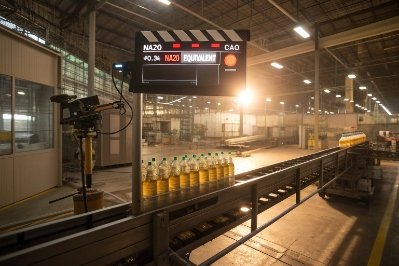
A bottle can look fine today and fail durability or forming tomorrow. The hidden cause is often a small chemistry drift that nobody tracked until rejects rise.
The Na₂O/CaO ratio is one of the main “control knobs” in soda-lime bottle glass. More Na₂O improves meltability and forming speed, while more CaO improves chemical durability and stability. The right balance protects strength, CTE, and production yield.
How Na₂O/CaO acts like a steering wheel for cost, quality, and line stability
Na₂O and CaO play different roles inside the same glass network
Soda-lime bottle glass 1 works because the recipe is a compromise. Na₂O is a strong modifier. It helps silica melt at workable temperatures. It also lowers viscosity, so gobs form easier and cycle times improve. CaO is a stabilizer. It makes the glass network more resistant to water attack and product contact. It also helps the glass stay “quiet” over time.
This is why the Na₂O/CaO ratio matters more than either number alone. A plant can hit Na₂O and miss CaO, and the bottle can melt fine but age badly. A plant can hit CaO and run Na₂O low, and the bottle can be durable but harder to melt and harder to form.
The ratio is also a language that reduces buyer disputes
Buyers rarely ask for “ratio” in a PO. They ask for durability, shelf stability, and breakage performance. Still, internally the ratio is a strong early warning metric. When the ratio drifts, issues often follow:
-
Chemical durability 2 results scatter more
-
Coefficient of Thermal Expansion 3 (CTE) shifts and stress behavior changes
-
Forming temperatures drift to keep weight stable
-
Devitrification risk 4 rises if the whole alkaline earth balance shifts
A stable ratio does not guarantee perfection, but it keeps the glass inside a known window where the line settings still make sense.
A practical view: what shifts when Na₂O/CaO moves
| If Na₂O/CaO moves… | Melt and forming behavior | Bottle behavior in use | Common risk |
|---|---|---|---|
| Higher ratio (more Na₂O vs CaO) | Easier melting, lower viscosity, faster forming | Higher ion mobility, lower chemical stability | More leaching risk, more “soft” surface behavior |
| Lower ratio (more CaO vs Na₂O) | Higher viscosity, slower melting, tighter working range | Better stability and durability | Higher devit risk if balance is off, higher energy cost |
| Ratio fluctuates shift-to-shift | Forehearth adjustments increase | QA results become noisy | Claims and re-tests increase |
| Ratio locked in a narrow window | Stable temperatures and cycle | Stable durability and appearance | Fewer disputes and fewer surprises |
The key habit that keeps this ratio useful
The ratio must be tracked in finished glass chemistry, not only in batch weights. Cullet swings can change Na₂O and CaO delivery. Label ash and mixed cullet streams can push chemistry in quiet ways. In my workflow, the simplest rule is: if a plant is proud of its cullet ratio, it should be even more proud of its chemistry tracking.
A good ratio strategy is never “high” or “low” by opinion. It is “right for this SKU and this line.” That sets up the next sections, which break the topic into clear procurement and engineering decisions.
A stable Na₂O/CaO ratio is not only a glass design concept. It is a daily production control that buyers can feel in consistency.
Now let’s define what “balance” really means in glass design language.
What does Na₂O/CaO balance mean in glass design?
When teams say “the chemistry is balanced,” they often mean the line is not fighting the melt. That balance is built from a few oxide relationships, and Na₂O/CaO is one of the most important.
Na₂O/CaO balance means the recipe has enough Na₂O to melt and form efficiently, and enough CaO to stabilize the network for durability, predictable CTE, and long-term clarity. It is a trade between process ease and product stability.

Balance is a design choice, not a fixed textbook ratio
No single Na₂O/CaO ratio fits every bottle. A lightweight water bottle, a returnable beer bottle, and a hot-fill sauce bottle do not live the same life. Each SKU pushes a different risk:
-
lightweight pushes strength and forming stability
-
returnable pushes abrasion and wash durability
-
hot-fill pushes thermal stress and surface stability
So the balance should be tied to the product and the process.
A useful way to think about it is this: Na₂O buys meltability and speed. CaO buys stability and durability. A plant must choose how much “speed budget” it can spend before durability becomes risky.
Balance must include the rest of the recipe, not only two oxides
The ratio is not isolated. MgO, Al₂O₃, and SiO₂ all change how Na₂O and CaO behave. If Al₂O₃ is raised, the network becomes tighter, and the same Na₂O/CaO can feel “stiffer.” If MgO rises, durability can improve without pushing CaO too high. So the ratio is best used as a leading metric inside a full chemistry window, not as the only control.
Procurement can reduce arguments by defining:
-
Na₂O and CaO target ranges
-
a ratio control band (as an internal SPC rule, or as a shared acceptance rule for strict programs)
-
a test bundle that ties chemistry to performance (durability, CTE, and forming stability data)
| Spec element | Simple wording style | Why it works |
|---|---|---|
| Finished chemistry | “Na₂O and CaO within agreed ranges” | Prevents recipe hiding behind batch weights |
| Ratio control | “Na₂O/CaO monitored and controlled within a narrow band” | Catches drift early |
| Performance link | “Durability and CTE validated against the same chemistry window” | Converts chemistry into buyer language |
| Change control | “Any raw source or cullet change triggers a chemistry check” | Avoids surprise failures |
Balance is not only chemistry. Balance is also a method for avoiding daily firefighting. Once the meaning is clear, the next step is why the ratio controls durability, CTE, and meltability at the same time.
Why does the ratio govern durability, CTE, and meltability?
Many teams try to tune one property and forget the others. Then the line improves for a week, and customer complaints arrive later.
The Na₂O/CaO ratio governs meltability because Na₂O lowers melting temperature and viscosity. It governs durability because CaO stabilizes the network and reduces leaching. It governs CTE because modifiers like Na₂O generally raise expansion while stabilizers help control structural response.

Meltability: Na₂O is the fast path to lower viscosity
Na₂O helps break up the silica network so the batch melts sooner and flows easier. This supports:
-
lower furnace energy per ton (up to a point)
-
smoother fining and mixing
-
a wider forming window at a given temperature
But extra Na₂O can also increase volatilization and sensitivity to furnace conditions. So “more Na₂O” is not always stable. It can become a short-term fix that increases long-term drift.
Durability: CaO is the anchor that keeps the glass stable
CaO helps reduce how easily water can attack the network. It tends to reduce ion mobility 5 and supports a more durable surface. This matters for:
-
beverage taste stability in long storage
-
label adhesion stability in humid environments
-
reduced dulling and haze growth over time
If the ratio drifts upward (more Na₂O vs CaO), durability can drop even if the bottle still passes quick appearance checks. That is the type of problem that creates late claims.
CTE: thermal expansion follows network looseness and modifier content
CTE is not only a lab number. It shows up as thermal stress behavior during hot-fill, annealing sensitivity, and sudden crack risk under temperature gradients. In simple terms:
-
a more modifier-heavy network tends to expand more with heat
-
a more stabilized network tends to behave more predictably
So ratio changes can push the stress state of the bottle. A line can compensate by changing annealing and temperatures, but that compensation costs time and yield.
| Property | What higher Na₂O/CaO tends to do | What lower Na₂O/CaO tends to do | What to watch on the line |
|---|---|---|---|
| Meltability | Improves | Worsens | Furnace energy and fining stability |
| Viscosity at forming | Drops | Rises | Forehearth temperature drift |
| Chemical durability | Often worsens | Often improves | Durability scatter and leaching trend |
| CTE / thermal stress sensitivity | Often rises | Often stabilizes | Thermal cracks and stress pattern |
The ratio links the factory and the market. That is why it needs to be set with both forming speed and strength in mind. The next section focuses on choosing Na/Ca for specific SKUs.
How to choose Na/Ca for forming speed and strength?
Every project wants faster forming and fewer breakages. The trick is that the same chemistry move rarely improves both at once.
Choose Na/Ca by starting from the forming window and the end-use risk. Use enough Na₂O to meet melting and cycle goals, then add enough CaO (and supporting oxides) to hold durability and stress margins. Confirm with trials and lock a chemistry window that survives cullet variation.
Start from the SKU reality: what is the main failure mode?
Different bottles fail in different ways:
-
high-speed beverage lines fail by handling scuffs and random impacts
-
lightweight bottles fail by thin-wall variation and stress
-
hot-fill bottles fail by thermal stress and durability drift
So the “right” Na/Ca choice starts by listing the top two risks for that SKU. Then chemistry can be tuned to reduce those risks.
Use a two-step tuning method that keeps learning clear
Step 1: Set a target viscosity behavior for the forming temperature range.
This is where Na₂O matters most. If the viscosity is too high, the line slows and thickness variation rises.
Step 2: Stabilize durability and strength margins with CaO and the full stabilizer package.
This is where CaO matters most. If durability is weak, late failures rise. If the surface becomes too reactive, haze and label issues rise.
A practical approach uses small changes and tight monitoring. If Na₂O and CaO both move at the same time, it becomes hard to learn what caused the result. The best results come from disciplined, single-variable changes supported by X-ray fluorescence 6 (XRF) and line SPC.
Typical decision rules that keep projects calm
-
If the line fights viscosity and cycle time, Na₂O may be low or the whole melt is too stiff. Still, raising Na₂O should be paired with a durability check.
-
If durability scatter rises and leaching fails appear, CaO may be low relative to Na₂O, or cullet chemistry may be drifting.
-
If devitrification signs appear, pushing CaO too high can be part of the problem, especially if the temperature profile has cold spots.
| SKU goal | Na/Ca bias that often helps | Must-have validation | Hidden trap |
|---|---|---|---|
| Higher forming speed | Slightly higher Na₂O/CaO (within window) | Viscosity proxy + reject trend | Durability drops later |
| Higher durability | Slightly lower Na₂O/CaO (more stabilizer) | Durability + leaching trend | Viscosity rises and causes thin walls |
| Lightweight stability | Balanced ratio + stronger network support | Stress + impact + weight SPC | Over-correcting only one oxide |
| Hot-fill stability | Stability-focused balance | Thermal cycle + stress checks | Ignoring annealing drift |
This tuning becomes much easier when the plant uses models and data instead of only experience. That leads to the final question: are data models predicting the best Na/Ca by SKU?
Are data models predicting optimal Na/Ca by SKU?
Trial-and-error costs time. It also creates risk, because each trial can produce off-spec glass and extra waste.
Yes. Many plants now use data models to estimate how Na₂O/CaO will change viscosity, CTE, and durability trends by SKU. The best systems combine physics-based glass property models with plant SPC and defect data, so the “optimal” ratio is tied to yield and customer outcomes.

What “models” usually mean in real factories
Most useful systems are not one magic AI tool. They are a stack:
-
a property model that estimates viscosity-temperature behavior 7 and CTE trends from chemistry
-
a melt and forming dashboard that tracks forehearth temperatures, gob behavior, and defect rates
-
a quality model that links chemistry drift to durability and breakage outcomes
-
a rule set that suggests “safe moves” for each SKU family
In practice, the model does not replace glass engineers. It reduces the search space. It helps avoid changes that would obviously break the process window.
Why SKU-level optimization is realistic now
Plants have more data than before:
-
continuous furnace and forehearth temperature data
-
camera-based defect counts and reject reasons
-
chemistry results by shift
-
customer claim patterns by lot
When these datasets are cleaned and aligned, even simple regression models can predict which direction will help. More advanced machine learning can handle interactions, like how Na₂O/CaO behaves differently when cullet ratio changes.
How to use models without creating new disputes
A model output is not a contract. The acceptance should still be based on measured chemistry and measured performance. The smart approach is:
-
use the model to propose a target window
-
validate with controlled trials
-
lock a chemistry window and a change-control process
| Model input | What it predicts | How it helps procurement | What still needs testing |
|---|---|---|---|
| Finished glass chemistry (Na₂O, CaO, others) | Viscosity and CTE trends | Stable forming and fewer deviations | Real durability tests by lot |
| Line process data | Reject and defect sensitivity | Lower scrap and better delivery | Root-cause proof for buyers |
| Cullet composition trend | Drift risk | Fewer surprise quality swings | Cullet audit and sorting checks |
| Historical claims | Risk by SKU | Better spec setting | Confirmation on new fills |
Data models are becoming a practical tool for Na/Ca decisions. Still, the best programs keep the basics strong: clear chemistry windows, stable raw control, and test methods that buyer and supplier can both reproduce.
Conclusion
Na₂O/CaO is a core balance between meltability and stability. Tight ratio control supports forming speed, durability, and predictable CTE, and data models can now guide SKU-specific windows.
Footnotes
-
A guide to the primary composition used in the manufacturing of commercial glass containers and bottles. ↩ ↩
-
Explore the factors that influence the chemical stability and resistance of glass surfaces to environmental degradation. ↩ ↩
-
Detailed overview of thermal expansion coefficients and their critical importance in material science and glass production. ↩ ↩
-
Technical insights into the transition from a glassy state to a crystalline state during industrial manufacturing processes. ↩ ↩
-
Scientific principles behind ion movement in solid materials and its impact on chemical leaching and durability. ↩ ↩
-
Learn about the elemental analysis method used for quality control and batch consistency in glass plants. ↩ ↩
-
Technical measurements determining how glass thickness and flow change across various furnace and forming temperatures. ↩ ↩






