
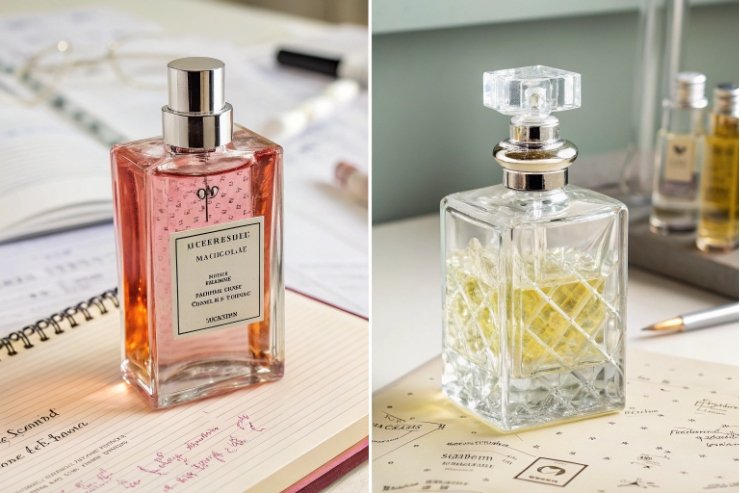
Perfume is chemistry in a bottle, and packaging is the last piece of the formula. When it is wrong, even a beautiful fragrance leaks, discolors, or dies on the shelf.
To choose perfume packaging, match bottle size and pump to your retail plan, protect the juice from light and oxygen, pick the right atomizer system, and balance MOQ, tooling, decoration, safety, and tests.
Good perfume packaging is more than a pretty flacon. It is a small engineering project that links formula, brand story, filling line, transport, and regulations. When these parts work together, you get a bottle that sprays well on day one and smells right on day one thousand.
Which bottle size, neck finish, and pump output best match your fragrance and retail planogram?
Size, neck, and pump feel like small details, but they control how the perfume lives in stores and in the user’s hand.
Choose bottle sizes that match your price ladder, a standard neck for sourcing and filling, and a pump output that fits your fragrance strength and spray ritual.
Start with your range architecture and channels
First, look at how the perfume will sit on the shelf and online.
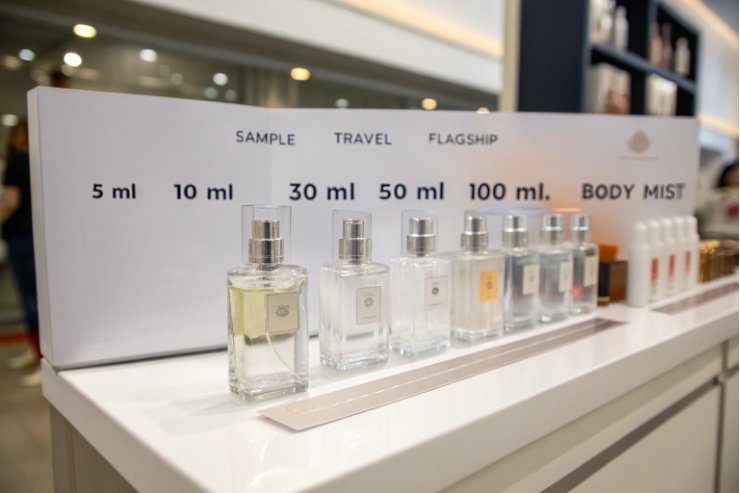
- Core EDP or EDT often sits at 30 / 50 / 100 ml.
- Travel and discovery formats may use 5–15 ml sprays.
- Body mists or hair mists can go to 150–250 ml.
A simple matrix helps connect size with role:
| Size (ml) | Typical role | Main channel |
|---|---|---|
| 5–10 | Sample, discovery set, GWP | E-com, gift, counters |
| 15–30 | Travel, entry price point | Travel retail, online, niche |
| 50 | Core SKU, hero format | All channels |
| 75–100 | Premium / flagship size | Department stores, boutiques |
| 150–250 | Mist, flankers, body products | Mass, body care, online |
Planogram height and shelf depth also matter. A retail planogram 1 may look great in renderings but still fail if the bottle is too tall for standard shelves or closed cabinets.
{: #fnref1 }
Neck finishes and pump compatibility
Next, decide the neck standard. For fine fragrance, common choices are crimp necks around the FEA neck finish 2 standards, or threaded necks (crimp-on versus screw-on pumps).
{: #fnref2 }
Standardizing necks across your line gives three big wins:
- You can buy pumps in larger volumes.
- You simplify changeovers on the filling line.
- You reduce mold complexity and cost across bottle families.
Make sure the glass supplier and pump supplier share a common neck drawing. Tolerances on the neck diameter, height, and bead profile will affect crimp quality or torque window.
Pump output, spray pattern, and headspace
Pump output should match the formula strength and the brand’s “dose” idea.
- Typical fine fragrance pumps sit around 0.05–0.12 ml per stroke.
- Intense parfums may use the lower range.
- Light body mists often use higher outputs for a cloud effect.
If you want a concrete sourcing reference, some suppliers publish dosage options in microliters 3 (for example 70–140 mcl) so you can align spray feel with positioning.
{: #fnref3 }
Pump design also controls:
- Droplet size and spray cone.
- Force needed to press the actuator.
- Risk of drips and hanging drops on the nozzle.
Always run line trials with the real juice. Check:
- Number of sprays per bottle (for claims).
- Any changes in spray pattern after stability tests.
- How much headspace remains; too much air speeds oxidation.
For flammable alcohol bases, good seals around the pump gasket and dip tube are essential. They limit evaporation and keep the flash point and composition stable over time.
Glass color and coatings vs. UV/solvent exposure: what ensures long-term scent stability?
The same formula in clear glass and in deep tinted glass will age differently on a sunny shelf. Packaging either protects the juice or slowly cooks it.
Use the right glass color, coatings, and internal compatibility to block UV, resist solvents, and keep fragrance color and smell stable through real shelf life.
Glass type, color, and UV protection
Most perfume bases are ethanol-rich and sensitive to light. UV and high-energy visible light can:
- Break down top notes.
- Shift color towards yellow or brown.
- Create off-odors over time.
So glass color is not only a design choice. It is also a functional filter.
| Glass color | UV protection (roughly) | Visual effect | Typical use |
|---|---|---|---|
| Clear / flint | Low | Shows juice color clearly | When formula is very stable |
| Light tint | Medium | Soft brand hue, some protection | Mass fragrance, body mists |
| Deep tinted | High | Strong color statement | Premium, unisex, dark juices |
| Opaque / coated | Very high (if well done) | Full color freedom | Trend, seasonal, high-sensitivity |
Deep tinted or coated glass is often the safest choice for formulas with natural citrus, green, or delicate floral notes.
External coatings and internal resistance
Coatings give two extra tools:
- External lacquers for color and finish (gloss, matte, gradient).
- Cold-end coatings for scratch resistance and line performance.
For external lacquers, check:
- Solvent resistance. The coating must not soften or peel after contact with alcohol, fragrance, or cleaners.
- Adhesion through ASTM D3359 tape tests 4 and scratch tests.
- Oven resistance if you combine lacquers with hot-stamped or screen-printed decoration.
{: #fnref4 }
Glass itself is inert toward typical perfume solvents. However, avoid internal coatings that are not designed for high-ethanol systems. They can cloud, flake, or migrate.
Stability and light testing
Do not guess. Test.
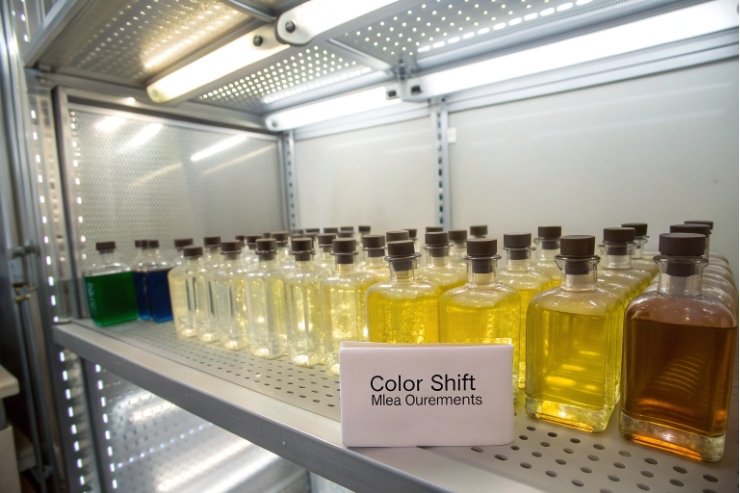
Use climate chambers and UV cabinets to simulate:
- Elevated temperature (for example, 40 °C) and humidity.
- Cycles of light and dark.
- Long storage, often 3–6 months accelerated, linked to real shelf life.
For each test point, check:
- Color of the juice (Lab values, not only visual).
- Odor profile vs. fresh standard.
- Any particles, haze, or coating defects.
Light sometimes sneaks in through the shoulder and neck where glass is thinner. So test full, closed bottles with caps and pumps, not only empty glass. This is where a small design change in shoulder thickness or lacquer coverage can make a large stability difference.
Crimp vs. screw atomizers and cap systems: which delivers better sealing, feel, and anti-leak performance?
The atomizer is the “engine” of the perfume experience. It also sits at the center of leak risk and evaporation.
Crimp pumps give very strong sealing and a traditional fragrance feel, while screw pumps offer flexibility and refill options; the right choice depends on brand position, leak risk, and line capability.
Crimp systems: classic fine fragrance standard
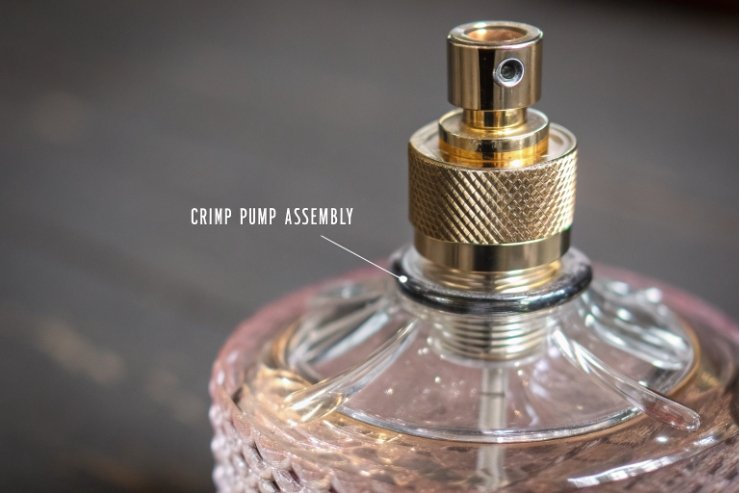
Crimp pumps are mechanically fixed around a crimp bead on the neck. They are the norm for many prestige brands.
Strengths:
- Very good seal integrity when crimped correctly.
- Clean, low-profile collar for luxury aesthetics.
- Harder to tamper with, especially with crimped collars and fitted caps.
Points to watch:
- You need crimping equipment and regular head maintenance.
- Neck and bead tolerances must be tight.
- Refill or rework is harder; pumps are not designed for removal.
Screw systems: flexible and refill-friendly
Screw pumps use threaded necks, like many skincare bottles.
Strengths:
- Easier to remove for refill or recycling designs.
- Filling and rework can be simpler, since you can unscrew pumps.
- Cap torque can be adjusted after filling without special crimp tools.
Some modern fragrance programs build the story around screw-on neck finishes for refillability 5, which can also simplify rework on the line.
{: #fnref5 }
Risks:
- More dependent on torque settings and liner quality for sealing.
- Higher chance of users opening the pump, which may expose the juice to air.
- Threads must be compatible across glass supplier and pump supplier drawings.
Caps, overcaps, and user feel
Atomizer choice interacts with caps and overcaps.
Caps should:
- Cover and protect the actuator.
- Match the overall weight and feel of the bottle.
- Optionally offer tamper evidence through break rings, labels, or shrink bands.
Many brands use heavy caps with metal, zamac, or thick plastic over an inner core. This gives a luxury feel but adds weight. If you pursue a more sustainable direction, you can:
- Use lighter mono-material caps.
- Move tamper evidence into a simple shrink band or label.
A quick comparison:
| Feature | Crimp pump system | Screw pump system |
|---|---|---|
| Seal strength | Very high, if crimp is correct | High, depends on torque and gasket |
| Tamper resistance | Strong | Moderate |
| Refill possibility | Low (needs tools) | High (user can unscrew) |
| Equipment need | Crimping heads and control | Standard capping heads |
| Aesthetic | Classic fine fragrance look | More casual / modern / refill stories |
Whatever system you choose, do not skip leak tests. Test upright, on side, and inverted, at ambient and elevated temperature. Perfume is often flammable, so leaks are a safety and regulatory problem, not only a waste problem.
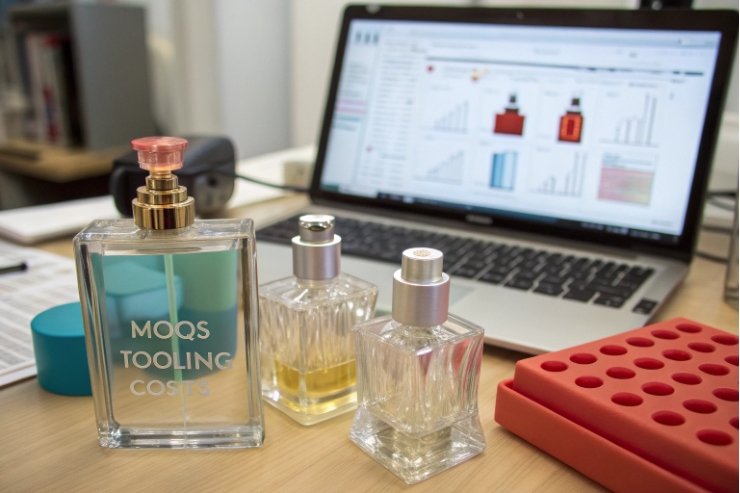
How do MOQ, tooling, decoration options, and compliance testing impact launch timing and cost?
Many perfume launches slip not because of the formula but because the pack is too complex for the schedule and budget.
MOQ, molds, decoration, and testing decide how fast and how safely you can launch; align them early with your volume forecast, route to market, and regulatory duties for flammable products.
MOQs, stock vs. custom, and tooling
Start with a clear view of volume:
- Are you launching a niche line with a few thousand pieces?
- Or a broad retail scent with hundreds of thousands expected?
For lower volumes, it often makes sense to:
- Use stock glass bottles with custom pumps, caps, and decoration.
- Accept standard necks and base shapes.
- Invest more in graphics, color, and outer box design.
For higher volumes or long-term icons, custom glass is worth it. But then you must plan:
- Tooling costs for bottle molds and, sometimes, cap molds.
- Lead times for design, 3D models, pilot molds, and first shots.
- Ownership and maintenance terms for molds with the glass maker.
A small overview:
| Choice | Upfront cost | Flexibility | Typical use |
|---|---|---|---|
| Stock bottle | Low | Limited shape change | Fast launches, tests, niche lines |
| Custom bottle | Medium–High | Full shape control | Core lines, long-term icons |
| Custom cap only | Medium | Strong brand cue | When budget blocks custom glass |
Decoration, lead times, and compatibility
Decoration layers add time and risk. Common options:
- Screen printing (ceramic or UV).
- Hot stamping and metallic foils.
- Lacquer spray, gradient effects, internal tinting.
- Labels, metallized labels, or plaques.
Each extra process step means:
- More handling and potential for scrap.
- More compatibility checks with your high-solvent juice.
- Extra lead time in the critical path.
It helps to lock a decoration hierarchy:
- Core elements that cannot change (logo, legal text, brand color).
- Variable elements for limited editions and sets.
- Optional extras like charms or accessories that you can add or drop late.
Compliance, transport, and e-commerce tests
Most perfumes are flammable liquids (often UN/NA 1266 6). So packaging must support:
{: #fnref6 }
- Correct hazard labeling and icons.
- Safe shipping under ADR, IATA, IMDG, and related rules.
- Protection against breakage and leaks in normal and e-commerce channels.
For transit and e-com, work with your pack and glass suppliers on:
- Drop tests for single units and shipper cartons.
- Vibration and compression tests for pallet loads.
- ISTA 3-Series protocols 7 style tests for e-commerce, where parcels see many falls and conveyor drops.
{: #fnref7 }
Also add stability studies:
- Temperature and humidity cycles in climate chambers.
- Freeze–thaw tests if your route sees winter extremes.
- Long-term storage under room conditions, with periodic checks of odor, color, and spray.
These steps cost money and time, but they prevent returns, leakage claims, fire risks, and damage to brand trust. It is cheaper to adjust a cap torque or insert design in the lab than to explain a recall.
Conclusion
Good perfume packaging balances chemistry, brand, and logistics: pick the right bottle and pump, protect the juice from light and leaks, and plan tooling, decoration, and tests early so launch stays smooth.
Footnotes
-
Definition and examples of planograms to plan shelf height, depth, and product placement. ↩ ↩
-
Industry overview of FEA and screw neck finishes to align bottle drawings with pump suppliers. ↩ ↩
-
See published fragrance pump dosage options (mcl) for choosing stroke volume and spray feel. ↩ ↩
-
Official ASTM method for tape adhesion rating of coatings, useful for verifying lacquer durability. ↩ ↩
-
Example of a prestige fragrance pump designed for refillability via screw-on neck finishes. ↩ ↩
-
NOAA emergency guidance for UN/NA 1266 to understand flammability hazards and response considerations. ↩ ↩
-
ISTA’s official list of 3-Series test procedures used to simulate parcel and distribution hazards. ↩ ↩






