
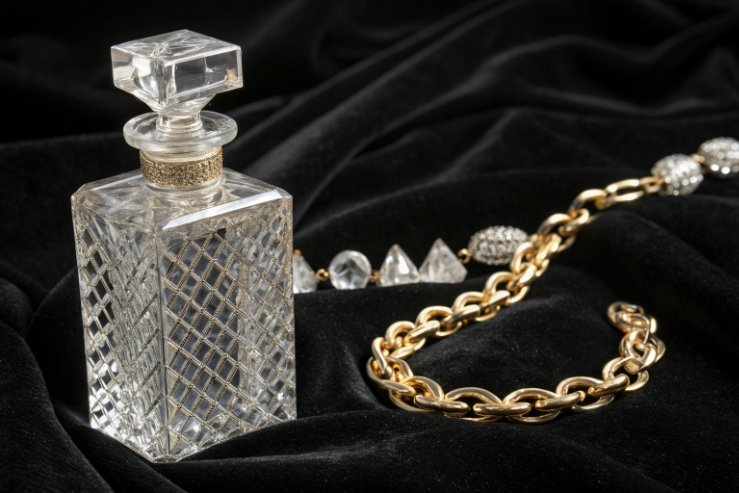
A crystal bottle can look flawless in photos, then arrive with haze, stress cracks, or a loose stopper. That is expensive and hard to explain to a luxury buyer.
Premium crystal quality comes from composition, optical cleanliness, tooling polish, wall uniformity, and stress control. Decorative steps can also damage clarity, so the process must protect the surface from melt to packing.
In my work, “quality” is not one feature. It is a chain. If one link slips, the bottle may still look good in a carton, but it will fail in the customer’s hand. The safest approach is to judge crystal bottles in four layers: material grade, forming quality, stress control, and decoration discipline.
Luxury buyers often say “crystal” when they mean “brilliant and clean.” In factories, crystal is a formula, and formula drives optics, weight, and durability.
Yes. Raw material purity and metal-oxide recipe set brilliance and clarity, while lead content and labeling grade define what you can claim. Premium crystal also needs optical cleanliness, meaning no stones, bubbles, cords, or color tint.
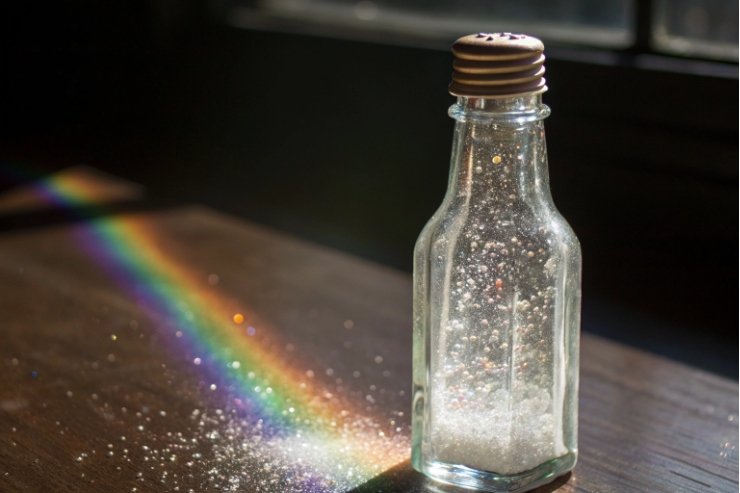
Crystal is a recipe, not just a look
A premium crystal bottle starts with the batch. The biggest drivers are:
- Silica quality and low iron to keep the glass colorless.
- Fining and refining control so bubbles and seeds are minimized.
- Metal-oxide additions that raise refractive index 1 and sparkle.
Lead crystal uses PbO to raise refractive index and density. That gives stronger “brilliance” and a heavier hand feel. It also makes the melt easier to work for sharp facets and complex shapes. But lead also raises questions about food contact and long-term storage, so many brands now choose lead-free “crystal” formulas that use zinc, barium, potassium, or other oxides to reach similar optical targets (see EU crystal glass classifications 2).
Clarity grade is mostly “defect discipline”
Premium clarity is not only about refractive index. It is also about defect control. These defects matter most:
- Stones/inclusions (hard particles) that catch light and ruin clarity.
- Bubbles/seed that look like dust trapped in the glass.
- Striae/cords defects 3 that bend light and create waves or distortion.
- Color tint from iron or batch drift, which breaks the luxury feel.
If a bottle is for spirits, even a small tint can change the perceived color of the liquid. If it is for perfume, tiny bubbles can make the liquid look cloudy even when the perfume is perfect.
Lead content can create a premium optical look, but it does not guarantee premium manufacturing. A lead-free crystal bottle can look better than a poorly made lead crystal bottle.
The better question is: what is the brand promise?
- If the bottle is a decorative perfume bottle that will not touch food, lead content may be more acceptable.
- If the bottle is a spirits bottle meant for long storage, lead-release and labeling rules become serious, so lead-free crystal may be safer for the brand.
| Crystal decision point | What “premium” means | What to specify to the factory | What can go wrong |
|---|---|---|---|
| Composition | brilliance + weight + workability | recipe family (lead vs lead-free), target refractive look | haze, tint, soft surface |
| Clarity | “water clear” | defect limits for bubbles/stones/cords | sparkle looks dirty |
| Color tone | consistent across lots | ΔE color tolerance, iron control | mixed-tone shipments |
| Compliance | safe use claims | food-contact plan, migration testing plan 4 | audit risk, blocked import |
The fastest way to avoid surprises is to define “crystal” in your contract as measurable targets: visual defect limits, color tone tolerance, and the compliance statement needed for the final market.
How do mold polish and wall uniformity affect brilliance and strength?
Many people think brilliance is only a material feature. In real production, brilliance is also a surface feature. Light needs a clean, smooth surface to reflect and refract the way designers want.
High mold polish improves surface gloss and reduces cold-mold marks, so brilliance looks sharper. Wall uniformity reduces optical distortion and removes weak points, so the bottle stays strong and less crack-prone.
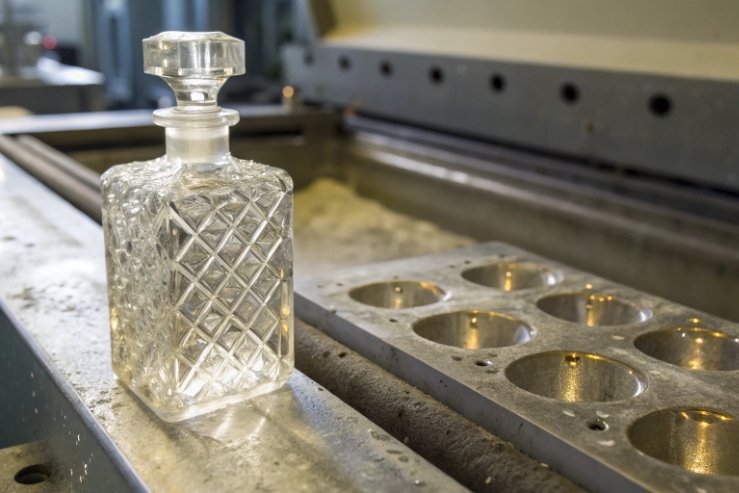
Mold polish sets the “first surface”
The mold is the bottle’s first mirror. If the mold surface has micro-scratches, the glass surface copies them. Even a small texture can show as haze under bright retail light. For crystal bottles, the polish level and mold maintenance frequency must be higher than for standard container glass.
Common mold-related defects that reduce premium feel:
- cold-mold marks and dull areas
- seam lines that feel sharp or look heavy
- “orange peel” texture on broad panels
- scratches from worn guides and tongs
A premium program uses:
- polished cavity surfaces
- controlled lubrication and clean air
- strict mold change intervals
- gentle handling after forming
Wall uniformity drives both look and safety
Uniform wall thickness matters for three reasons:
- Optical distortion: uneven thickness bends light and makes the bottle look wavy.
- Strength: thin spots become stress concentrators. Cracks start there.
- Decoration stability: plating and coating look uneven when thickness and temperature vary.
Luxury bottles often have thick bases, deep punts, or heavy shoulders. Those shapes can trap thickness variation if the process is not stable. Good factories control gob weight, timing, and mold temperature so thickness is consistent across cavities.
Dimensional accuracy is part of “quality”
A crystal bottle is still a functional package. Neck roundness and finish size matter for:
- stopper fit and sealing
- cap torque and liner compression
- evaporation control for volatile perfume
- leakage control during shipping
If the finish is even slightly off, the bottle can pass a visual check but fail in use.
| Build feature | Brilliance impact | Strength impact | What to control in production |
|---|---|---|---|
| Mold polish | higher gloss, less haze | indirect | cavity polish, maintenance schedule |
| Seam quality | cleaner reflections | fewer crack starters | alignment, trimming, inspection |
| Wall uniformity | less distortion | fewer weak spots | gob weight, forming timing |
| Base/heel design | better luxury “stance” | high impact zone | heel thickness map, handling control |
| Finish accuracy | cleaner presentation | fewer chips during closure | gauges, roundness checks |
When a brand wants “museum-level clarity,” the process cannot treat polishing as optional. Mold polish, guide wear, and handling scratches will decide the final look as much as the material recipe.
Which annealing and stress tests ensure crack-free performance?
A crystal bottle can look perfect, then crack from a small tap during packing. That failure is usually hidden stress, not bad luck.
Controlled annealing reduces residual stress, and stress testing verifies the state of anneal. Polariscopic stress checks, thermal shock screening, and mechanical tests like impact and drop help ensure the bottle stays crack-free from line to customer.
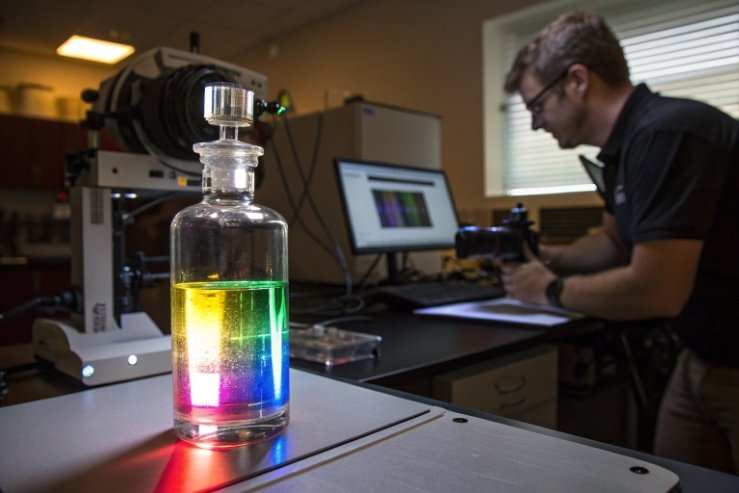
Why annealing matters more for crystal bottles
Crystal bottles often have:
- thicker bases and decorative geometry
- sharp transitions for premium silhouettes
- heavy mass that cools unevenly
Uneven cooling creates residual stress. Residual stress makes glass behave like it is already “half broken.” Then a small scratch, a temperature change, or closure pressure can start a crack.
A strong annealing program focuses on:
- stable lehr temperature zones
- correct soak time near the annealing range
- controlled cooling through the critical range
- cavity-level monitoring when thickness differs across molds
Stress tests that give real confidence
A premium QC plan uses a mix of non-destructive and destructive checks.
Non-destructive
- Polariscopic stress checks 5 to verify the state of anneal.
- Visual stress pattern checks focused on heel, shoulder, and finish.
Destructive / performance
- Impact testing on heel and shoulder, because those are common crack-start zones.
- Drop testing in realistic packed format, because the carton and dividers change outcomes.
- Leak testing after stopper or cap application, because closure force can expose stress.
For decorative crystal bottles used for spirits, internal pressure is not a core risk like Champagne. Still, closure application and shipping vibration can create localized loads. For perfume bottles, the biggest “functional” risk is leakage and evaporation, so fit and seal testing matters as much as glass strength.
Thermal tests are still useful
Even when the bottle is not hot-filled, temperature swings happen in real life:
- winter trucks and warm warehouses
- air freight cargo holds
- hot retail lights near windows
A thermal shock screening test 6 can expose stressed bottles because stress + ΔT is a common crack trigger. It is also useful after heavy decoration steps that add heat, like curing coatings.
| Test type | What it catches | Why it matters for crystal | Typical action if it fails |
|---|---|---|---|
| Polariscopic stress check | poor anneal, hidden stress | prevents random cracks | adjust lehr profile, slow cooling |
| Drop/impact | crack starters, weak heel | protects shipping performance | improve thickness map, handling, carton |
| Dimensional gauge | finish mismatch | prevents leaks and loose stoppers | tighten mold control, rework tooling |
| Leak/seal test | closure fit, evaporation | protects perfume and spirits | adjust stopper, liner, tolerances |
| Thermal screening | stress sensitivity | simulates rough storage | improve anneal, reduce sharp transitions |
A crack-free program is not one test. It is repeatable annealing plus trend charts. When stress drift appears, the factory needs a written reaction plan, not a debate.
Do engraving and plating steps risk haze, scratches, or color shift?
Decoration sells luxury, but decoration also adds risk. Every extra handling step is a chance to damage the surface that customers touch and see.
Yes. Engraving, sandblasting, acid etching, coating, and plating can create haze, micro-scratches, and color shift. The risks are manageable when the surface is protected, cleaning is controlled, and coatings are validated for adhesion and chemical resistance.
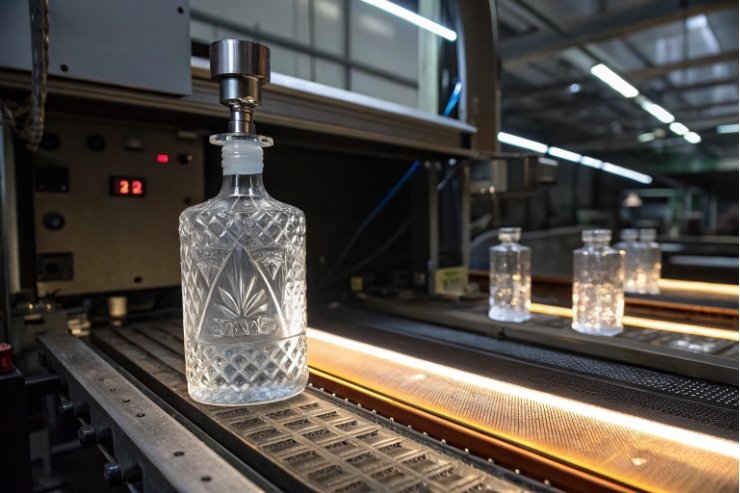
Where haze and scratches come from
Common causes include:
- Abrasive handling during engraving or polishing.
- Dirty fixtures that rub fine particles into the surface.
- Over-aggressive cleaning that etches the glass and creates a dull film.
- Contact between bottles during curing or transport.
For crystal, micro-scratches show more because light reflections are sharper. So a scratch that is “acceptable” on normal glass becomes a major defect on crystal.
Plating and metallization risks
Electroplating or physical vapor deposition (PVD) metallization 7 can create a premium metal look, but it has special failure modes:
- Color shift across lots due to thickness variation of the coating layer.
- Haze under coating if the glass was not perfectly clean before deposition.
- Adhesion failure if surface energy prep is inconsistent.
- Edge chipping around logos and sharp corners, where coatings are thin.
If a plated bottle goes into a humid market, corrosion resistance and topcoat quality matter. A luxury bottle that oxidizes or fingerprints easily will be returned even if the glass is perfect.
Engraving and cutting risks
Cutting and engraving can raise brilliance, but the edge quality must be controlled:
- sharp edges can chip in packing
- deep cuts can create stress concentration
- polishing must remove micro-cracks created by abrasion
This is why premium houses treat polishing as structural, not only cosmetic.
How to protect quality through decoration
A disciplined decoration process usually includes:
- clean-room style cleaning before any coating
- soft-contact fixtures and dedicated trays
- protective films during multi-step processing
- controlled curing temperatures to avoid thermal shock
- final inspection under strong point light, not only ambient light
| Decoration step | Main quality risk | What premium factories control | What to check in inspection |
|---|---|---|---|
| Sandblasting/frosting | haze, uneven texture | media size, pressure, masking | uniform frosted tone, sharp edges |
| Acid etching | over-etch, dull film | time, chemistry, rinse quality | clarity in clear zones, no streaks |
| Laser engraving | micro-cracks, burn marks | power, focus, cooling | no halo, no stress lines |
| Paint/spray | scratches, peel, color drift | cleanliness, cure profile | adhesion, rub resistance, ΔE |
| Plating/PVD | color shift, poor adhesion | surface prep, thickness control | color match, fingerprint resistance |
The simplest way to reduce decoration risk is to define “inspection lighting” and “handling rules” in the project. Luxury defects often hide under weak lighting. A bottle can pass in a dim room and fail under boutique spotlights.
Conclusion
Premium crystal bottles are built from clean recipes, polished tools, uniform walls, and low stress, then protected through decoration with strict handling and inspection so brilliance stays perfect to the customer.
Footnotes
-
Explains how refractive index affects light bending and perceived brilliance in glass. ↩ ↩
-
EU directive defining “crystal glass” categories and permitted labeling based on lead oxide content. ↩ ↩
-
Defines striae/cords as optical inhomogeneities that distort clarity in glass products. ↩ ↩
-
EU food-contact materials framework—useful starting point for migration testing and compliance planning. ↩ ↩
-
Overview of how a polariscope reveals residual stress patterns in transparent materials like glass. ↩ ↩
-
ISO method reference for thermal shock resistance and endurance testing of glass containers. ↩ ↩
-
Primer on physical vapor deposition used for decorative metallization and functional thin-film coatings. ↩ ↩






