
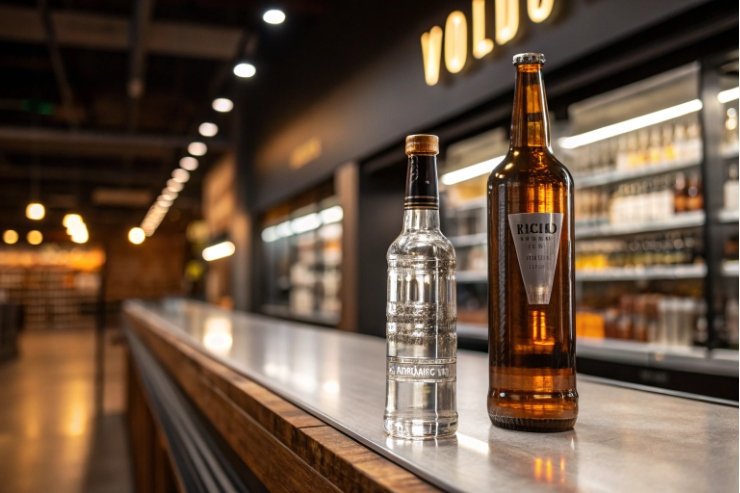
On the shelf they both look like “just glass,” but vodka bottles and beer bottles solve very different problems in engineering, branding, and logistics.
Vodka bottles are low-pressure, brand-led display pieces with heavy bases and precise T-top finishes; beer bottles are pressure-rated, standardized containers optimized for carbonation, light protection, and high-speed filling.
Once you look at pressure, closures, glass color, and decoration side by side, it becomes clear why these two families of bottles evolved in such different directions and why copying a beer spec for vodka (or the reverse) creates trouble. Beer also has to manage light exposure—amber glass remains common to reduce lightstruck off-flavors 1.
Do spirits favor heavy bases and brand-led shapes?
The short answer is yes. Spirits glass lives in a very different world from beer glass. Still vodka does not need to fight internal CO₂ pressure, so designers can “spend” that strength budget on shape and presence.
Vodka bottles favor tall profiles, heavy bases, and distinctive silhouettes that turn the bottle into a brand object, while beer bottles stay closer to standardized longnecks or stubbies to protect carbonation and packing efficiency.
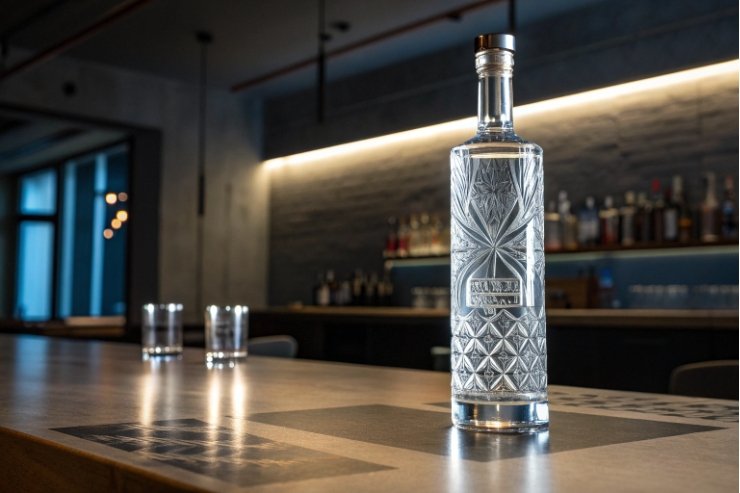
At bar level, that difference is obvious: vodka wants to look like a premium column of crystal on the back bar. Beer wants to sit comfortably in cases, fridges, and six-pack carriers without drama.
Shape and weight: display vs distribution
For vodka, the glass is part of the story:
- Tall, straight-sided or slightly faceted cylinders that create a clean “tower” on back bar.
- Very heavy bases that shift the center of gravity downward and amplify the sense of luxury in the hand.
- Custom shoulders, cut-outs, or integrated ribs that make the silhouette recognizable even from a distance.
Because there is no carbonation, the structural design can be optimized around hand-feel and brand impact rather than pressure. It is common to see vodka bottles with:
- Thicker bases than beer bottles of the same volume.
- Slimmer body walls in the upper section to keep overall weight manageable.
- More freedom in body diameter, as they are rarely sold in tight multi-packs.
Beer bottles live in a different universe:
- They must handle internal pressures from CO₂ plus thermal changes during pasteurization or warm transport.
- They need to fit standard cartons, crates, and bottling lines shared by many brands.
- They are bought and moved in multi-packs, so “odd” shapes cause headaches and breakage.
So beer designs tend to:
- Stick closer to standard longneck, steinie, or Euro shapes.
- Use more conservative wall distributions.
- Focus on efficient nesting in six-packs and cases.
A simple comparison:
| Aspect | Vodka bottle | Beer bottle |
|---|---|---|
| Main job | Brand icon + safe spirit storage | Hold carbonated beer safely |
| Shape freedom | High (brand-led) | Medium (line and case constraints) |
| Base weight | Often very heavy | Moderately heavy, optimized vs pressure |
| Display vs distribution | Optimized for back bar and gifting | Optimized for crates, coolers, and multi-packs |
From a manufacturer’s view, vodka glass is where creative form and premium weight are expected. Beer glass is where consistency, safety, and efficiency quietly win.
How do T-tops vs crowns change finish tolerances?
Closures define a lot of the hidden engineering in a bottle. A vodka bottle finish has to manage a rigid T-top and tamper band; a beer finish has to hold a crimped crown against gas pressure. The tolerances and risks are not the same.
T-tops require tight dimensional control on inner/outer diameters for a friction-fit cork or plug plus decorative overcap, while beer crowns rely on a bead and liner compression to seal pressure, with a different tolerance balance around the crown ring.
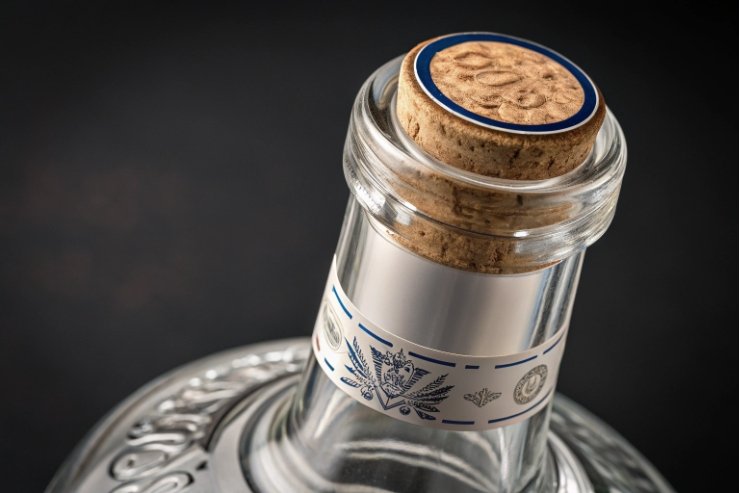
Behind the scenes, the glass at the very top of the bottle is doing a lot of work. I have seen more project delays caused by finishing tolerances than by any fancy embossing on the body.
Spirits finishes: bar-top corks and screw systems
Typical vodka closures:
- Bar-top (T-top) closures 2 with natural or synthetic cork plugs.
- ROPP (roll-on pilfer-proof) screw caps 3 with tamper bands.
- Sometimes a T-top sitting over a hidden screw system on special designs.
For T-tops, the glass finish must:
- Hold a precise inner diameter for the plug, so insertion and pull-out forces stay in a narrow, comfortable band.
- Maintain a refined outer diameter and roundness for decorative sleeves or metal collars.
- Present a smooth sealing land so the cork or plug can form a tight, vapor-resistant fit.
Too tight, and bartenders struggle to remove the closure or chips appear on the inner rim. Too loose, and you get micro-leaks, evaporation over time, or poor tamper-evidence performance.
Screw finishes introduce their own demands:
- Thread pitch and depth must be controlled so caps run smoothly at speed.
- The top sealing surface must be flat and within a small height tolerance to ensure proper compression of the liner.
Beer finishes: crowns and swing-tops under pressure
Standard beer closures:
- Pry-off or twist-off crowns, built on the crown cap closure 4.
- Swing-tops with a ceramic or plastic head and rubber gasket (less common).
For crowns, the neck finish is simpler in form but still demanding:
- The crown bead (the rolled-out ring) must present a consistent profile for the metal skirt to crimp around.
- The top surface must be within a small height band relative to the support ring to ensure even liner compression.
- Internal pressure adds more stress on that bead and liner interface, so variability quickly shows up as leaks or flat beer.
Twist-off crowns add shallow threads under the crown bead. Here, tolerances on thread major/minor diameters matter, but the sealing still relies on liner compression, not on the threads themselves.
Different tolerance priorities
You can think of it like this:
| Feature | Vodka T-top / screw finish | Beer crown finish |
|---|---|---|
| Main risk if off-tolerance | Hard-to-open, seepage, crooked collars | Gas loss, leaks, burst risk |
| Critical dimensions | ID/OD of bore, land flatness, thread | Crown bead shape, top height, support ring |
| Visual expectations | Perfectly straight collar and cap | Cap can mask some variation |
So vodka finish control is heavily about fit and appearance of a relatively complex closure stack. Beer finish control is more about pressure safety and cap performance around a simpler, very robust seal.
Are pressure/ΔT specs lower for still spirits?
Yes, very much so. Still spirits do not carry dissolved CO₂ the way beer does, and they are not pasteurized in-package, so the stress picture is completely different. This difference drives both geometry and glass weight strategy.
Pressure and thermal-shock requirements are lower for vodka bottles than for beer bottles, because still spirits face almost no internal carbonation pressure and fewer high-ΔT processes, which allows more decorative freedom and focus on base heft instead of pressure strength.
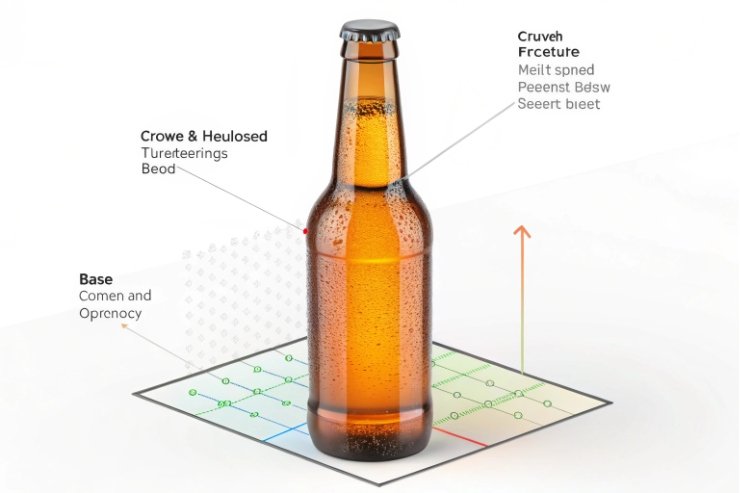
Internal pressure: beer vs vodka
Beer:
- Carries significant dissolved CO₂.
- Can see internal pressures on the order of multiple bar in warm conditions (tracked via CO₂ pressure–temperature charts 5).
- Often passes through pasteurization or at least warm distribution.
Designers therefore:
- Size glass thickness and profile to meet specific burst pressures.
- Add generous safety factors to account for handling and defects.
- Keep shapes conservative around the heel and base to avoid stress concentrations.
Vodka and other still spirits:
- Contain little to no dissolved CO₂ for pressure purposes.
- Sit near atmospheric pressure in normal use.
- See small pressure variations from temperature but nothing like a carbonated drink.
So the internal pressure spec is much lower. The bottle still needs a burst margin for safety (for example, if someone pressurizes it by mistake), but this is more modest.
Thermal shock and processing
Beer bottles can be asked to survive:
- Tunnel pasteurization (for example, going from ambient into 60–80°C water and back).
- Rapid chilling and re-warming in consumer hands or vending machines.
That implies a certain ΔT resistance and drives:
- Wall and base design with even profiles.
- Limits on how extreme embossing and waists can be.
Vodka bottles usually:
- Are filled at room or mild temperatures.
- Are not pasteurized in the bottle.
- Live mostly at ambient, with the “coldest” stress being freezer storage in some markets.
So ΔT requirements are lower. Thick decorative bases, deep punts, and complex shoulders can be used with less fear of thermal shock… as long as the bottle is not abused (like going straight from freezer into a hot dishwasher).
Freedom and responsibility in spirits glass
Lower pressure and ΔT constraints give more freedom to:
- Push tall, slim profiles.
- Add strong embossing or facets.
- Carve out heavy, sculpted bases.
But they do not remove structural responsibility. A flawed heavy base can still break if dropped. A very tall bottle can still topple and chip.
A simple engineering contrast:
| Design driver | Vodka / still spirits | Beer / carbonated |
|---|---|---|
| Internal pressure | Low | High |
| ΔT during processing | Low–medium | Medium–high |
| Main risk focus | Impact, chipping, tipping | Burst, thermal shock, impact |
| Design trade space | More decorative freedom | More conservative for safety |
In essence, vodka bottles use “saved” strength headroom to look and feel more like luxury objects, whereas beer bottles spend that headroom defending against pressure and heat.
This is where vodka glass really pulls away from beer. A standard amber longneck can look nice, but decoration is usually label-led. Premium vodka often treats the entire bottle as a 3D light sculpture.
Premium vodka favors high-clarity flint glass plus decoration routes like frosting, internal or external lacquering, metallic accents, heavy screen printing, and sometimes partial metallization, all orchestrated to create a strong back-bar icon.
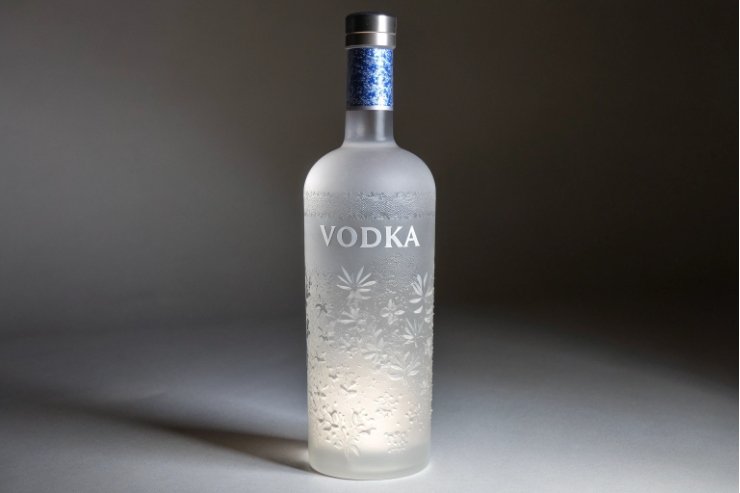
Common techniques include:
- High-clarity extra flint glass 6 to showcase “purity” and support lighting effects.
- Frosting or satin finishes on all or part of the body for soft light and touch.
- UV or lacquer sprays in gradients or solid blocks to create color identity.
- Screen printing with opaque whites and metallic inks for sharp logos and text.
- Hot stamping for gold, silver, or colored foils on crests and key lines.
- Partial metallization (base, shoulder, or pattern) for dramatic, mirror-like elements.
- Deep embossing or debossing for logos, patterns, or geographic motifs.
Because the liquid itself is clear and stable against light compared to beer, the décor can be far more experimental without worrying about skunking or color shifts from UV.
Label strategy vs “no-label look”
Many premium vodkas reduce or even remove traditional paper labels:
- Branding is printed or foiled directly onto the glass.
- Small, almost invisible back labels carry legal details.
- Decorative collars, medallions, or charms add extra cues for limited editions.
This “no-label” look reads as cleaner and more expensive than a visible paper panel. It also helps the bottle stay photogenic from all angles for social media and bar displays.
In contrast, beer usually:
- Relies on paper front and back labels as primary branding.
- Uses neck labels, foils, or printed crowns for secondary cues.
- Keeps glass itself simpler to respect pool standards or to reduce cost.
Decoration vs recyclability and cost
Premium décor comes with trade-offs:
- Each extra spray or metallization pass adds cost and carbon.
- Heavy coatings and full-body foils can complicate recycling.
- Many SKUs must balance “luxury” with retailer margins and price ladders.
From a sustainability angle, even spirits brands increasingly cite the benefits of recycled glass cullet 7 (lower furnace energy and emissions) when making “premium but responsible” packaging choices.
A realistic premium vodka décor map:
| Element | Typical vodka approach | Typical beer approach |
|---|---|---|
| Glass color | Extra-clear flint, sometimes tinted | Mostly amber / green / flint by style |
| Primary branding | Direct print on glass | Paper / film label |
| Special effects | Frosting, gradients, foils, metallization | Embossing, simple foils, special labels |
| Closure aesthetics | Tall, custom caps and T-tops | Crown color and simple neck foils |
When a vodka brand gets decoration right, the bottle almost sells itself from across the room. When it goes too far—too many effects, no clear hierarchy—the pack can start to look busy and cheap. The trick is controlled richness, not chaos.
Conclusion
Vodka and beer bottles may both be glass cylinders at heart, but they live under different rules: vodka glass is a low-pressure, brand-driven display piece built around T-top precision and premium décor, while beer glass is a pressure-rated workhorse tuned for CO₂, light protection, and efficient multi-pack life.
Footnotes
-
Definition of lightstruck beer chemistry (MBT) and why amber glass protects hop aroma. ↩ ↩
-
Bar-top closure basics for spirits bottles: cork shank fit, removal feel, and sealing. ↩ ↩
-
Explains how ROPP cappers roll threads and tamper bands onto aluminum caps for spirits lines. ↩ ↩
-
Engineering history of the crown cap and why it enabled reliable sealing for carbonated beverages. ↩ ↩
-
CO₂ solubility/pressure chart used by brewers to match carbonation volumes to temperature and package pressure. ↩ ↩
-
Overview of extra flint glass and other glass types for premium spirits packaging and clarity-driven branding. ↩ ↩
-
Data on how increasing cullet lowers furnace energy and emissions in glass container production. ↩ ↩






