
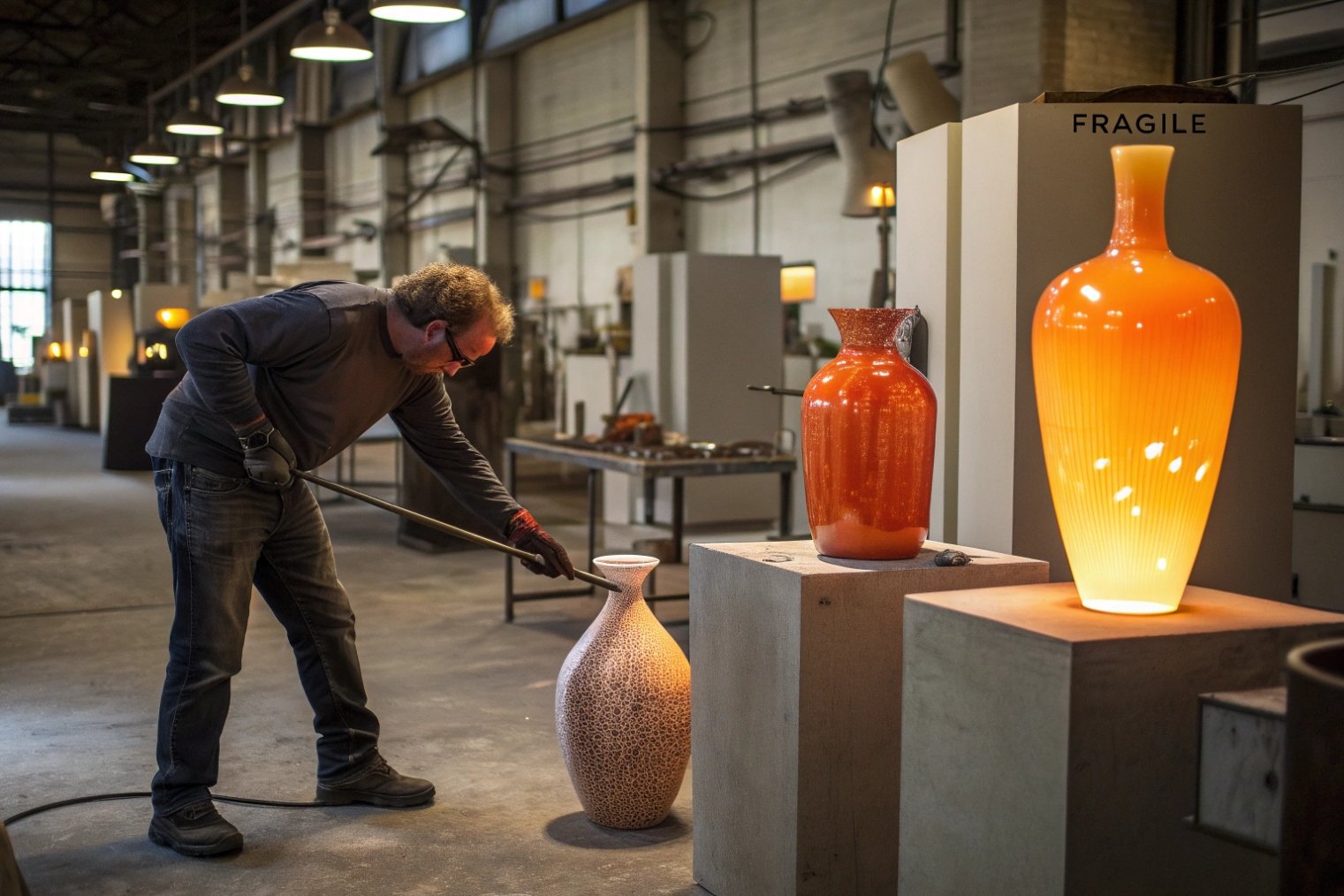
Hand-blown vases look effortless in a gallery, but on the bench they fight gravity, heat, color stress, and shipping damage at every stage.
Artisans control symmetry and thickness through heat, rotation, tools, and templates; color overlays push compatibility limits; annealing schedules decide survival rates; and smart packaging keeps irregular shapes alive in transit.
From gather to gallery, every decision adds or removes risk. When we understand how makers manage temperature, color, stress, and packing, it becomes clear why true hand-blown work is both expensive and never “perfect” in the factory sense.
How do artisans control symmetry, thickness, and weight?
Molten glass does not want to be symmetrical. It wants to slump, oval, and thicken at the base while the neck thins and twists.
Blowers control symmetry and thickness by juggling heat, rotation, molds, and measuring tools, then trim or grind bases so finished weight and stance feel balanced in the hand.
Managing heat and gravity instead of fighting them
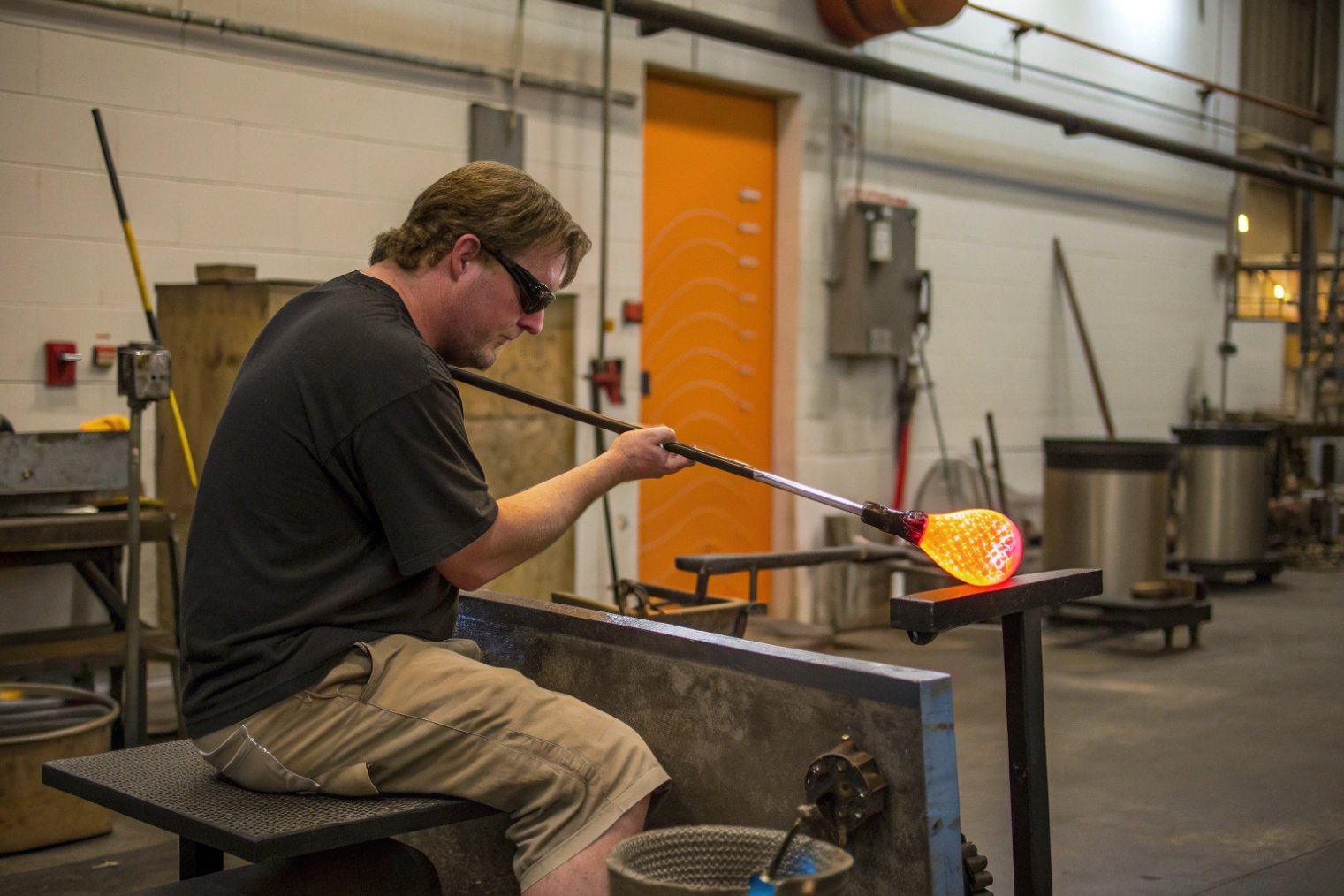
For a vase, the main “enemies” are gravity and cooling. The glass cools fastest at the surface and thins where it stretches. The maker has only a short window to correct shape before it stiffens.
Some core tools and habits:
- Constant rotation on the bench so the vessel does not sag to one side.
- Targeted reheats in the glory hole reheating furnace 1 to soften only the area that needs work.
- Marvering on a steel or graphite surface 2 to center and smooth the bubble.
- Blocks and jacks to form even shoulders and necks.
To keep symmetry, blowers often:
- Use the marver to “true up” the bubble early.
- Use optical cues from reflections on the hot surface to spot bulges.
- Spin the piece and watch the silhouette against a straight line or mark on the wall.
If the profile looks right at a given heat, they lock it quickly with a brief cool or light marvering so gravity has less time to pull it out of shape again.
Building even wall thickness and realistic weights
Thickness is more subtle. The glass is thicker near the blowpipe and thinner near the tip if left alone. Artisans tweak this several ways:
- Pre-shaping the bubble longer or shorter before dropping into any optic mold.
- Using gravity stretches: holding the piece down or up to move glass into the base or neck.
- Spot heating with a torch to soften local thick areas and pull them out.
- Controlling blow pressure and timing so the bubble expands more where it is stiffer.
A simple way many studios think about it:
| Stage | Main risk | Common correction |
|---|---|---|
| First bubble | Too thick near pipe | Stretch and marver to even cylinder |
| Mid-forming | Thin shoulder, heavy base | Reheat shoulder, swing to move glass up |
| Final shaping | Oval mouth, thin lip | Reheat lip, use jacks and template ring |
Weight control is part planning, part selection:
- Plan gather size for a target weight range.
- Use simple gauges or calipers on hot pieces to check diameter and height.
- Weigh sample vases once cool; adjust gather or blowing for the next batch.
- Sort finished vases by weight and visual match, especially for pairs and sets.
Absolute precision is not realistic in true hand work, but tight bands are. Over time, a studio builds “muscle memory” recipes for each shape: number of gathers, how long to hang, how hard to blow, when to move from shaping to punty transfer.
Which color overlays and gradients are hardest to reproduce?
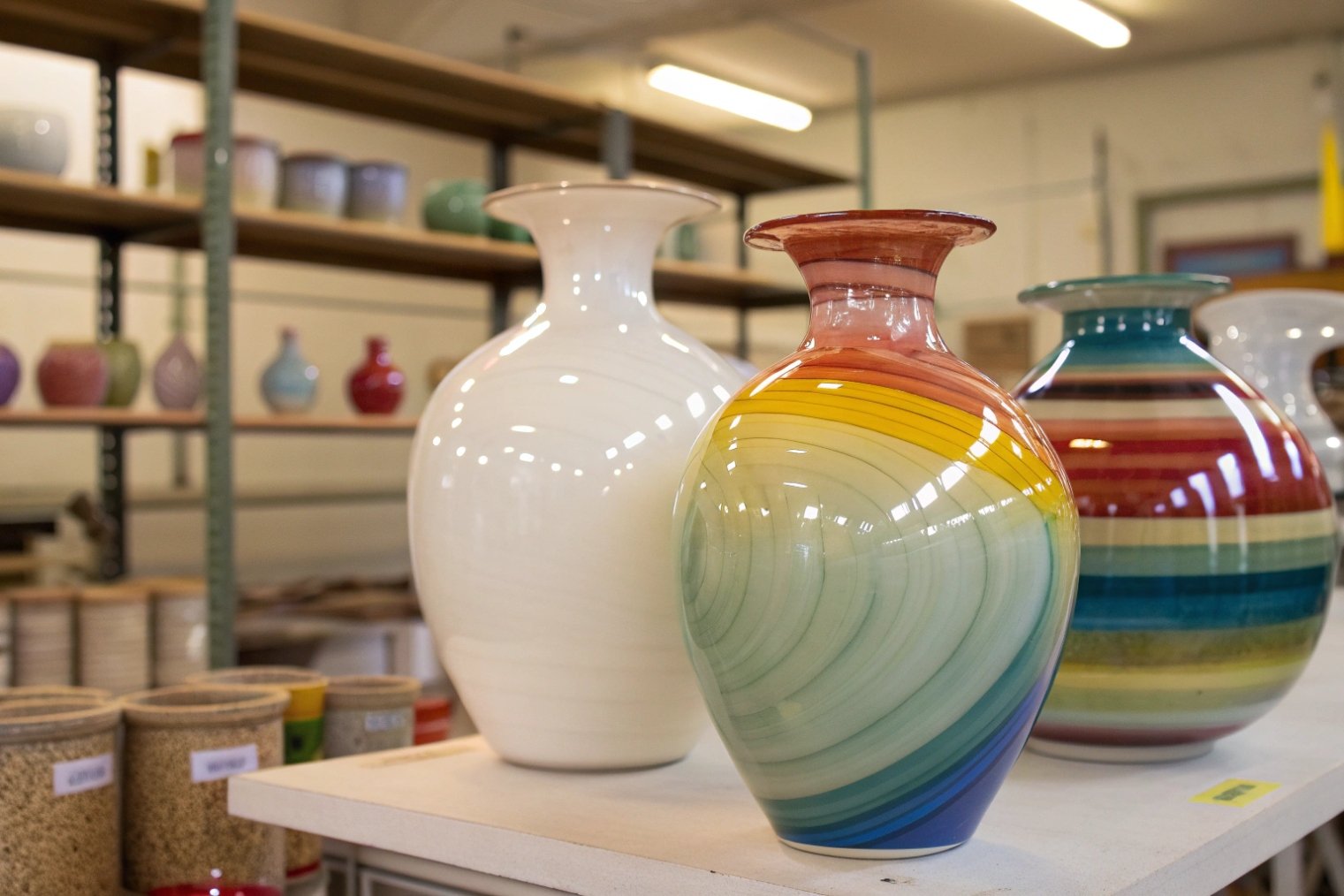
Color is where many lovely sketches die. Some combinations are stable in a kiln but crack in real vases, or look great once and then refuse to repeat.
Multi-layer overlays, dense opal cores with transparent skirts, and long vertical gradients are hardest to repeat, because small changes in compatibility, temperature, and timing change stress and color density.
Compatibility is more than a single COE number
In hand-blown vases, color usually comes from:
- Colored overlay gathers over a clear or tinted core.
- Color bars or rods picked up and melted into a bubble.
- Frit and powders rolled on and cased in clear.
The first trap is compatibility. Many makers look only at the nominal coefficient of thermal expansion (COE) 3. In reality, color glasses can match COE but still stress each other because of differences in:
- Viscosity curves at working temperature.
- Strain behavior around the annealing range.
- Density and stiffness of opal or heavy-metal rich formulas.
For the vase, that mismatch shows as:
- Fine stress rings where color layers meet.
- Cracks along color seams or between lip wrap and body.
- Distortion or warping during annealing and cold work.
To reduce risk, studios often:
- Keep to a single color system or brand for complex pieces.
- Run strip tests and ring tests before using a new color in big work.
- Avoid mixing heavy opals with very stiff transparents unless well tested.
Why gradients and “soft” effects are so demanding
Certain looks are especially hard to repeat:
- Tall vertical fades from dense color at the base to clear at the rim.
- Multi-band fades (for example, blue-to-green-to-clear).
- Thin lip wraps in contrast colors over cased bodies.
- Powder-only veils that must stay even and not clump or burn out.
These depend on tight control of:
- How much color is in each layer.
- How far the color is stretched during blowing and swinging.
- How long the piece sits in the heat, which can burn out or trigger devitrification on the surface 4.
- Where reheats are aimed, because reheating one band more than another shifts the gradient.
A high-level view:
| Effect type | Key difficulty | Typical studio strategy |
|---|---|---|
| Heavy overlay + clear core | Stress between layers | Limit size, test cycle, keep within one color family |
| Long vertical gradient | Matching stretch and heat each time | Standardize swing times and blows |
| Multi-color bands | Each color behaves differently | Pair “friendly” colors, avoid extreme mixes |
| Opal over transparent | Opal devit and stress | Shorter hot time, careful annealing |
When clients ask for “exact” color sets, the honest answer for hand-blown work is that each piece will live in a band, not at a single Pantone swatch. The tighter we want that band, the more time and scrap the studio must accept.
How does annealing schedule affect rejection rates?
Most vase failures do not happen in front of the furnace. They happen on the studio shelf a week later, in a gallery, or even at the customer’s home.
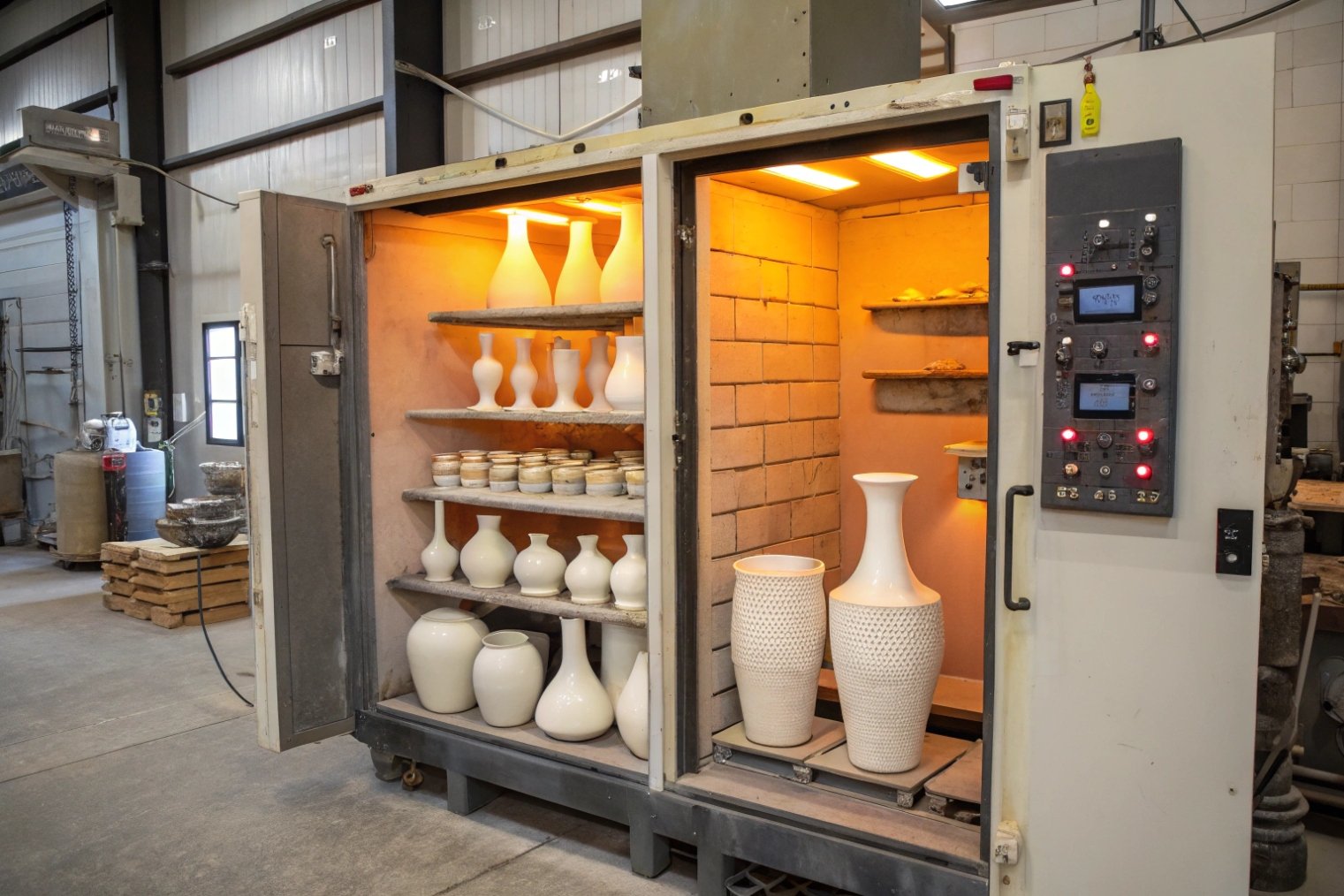
The annealing schedule behind each form and color stack largely decides rejection rates; wrong soak times or cool-down speeds lock in hidden stress that later turns into delayed cracking.
Thick bases and uneven walls need their own curve
Hand-blown vases rarely have uniform thickness. Bases are heavy, bodies are thinner, and lips can be reinforced or flared. Off-center shapes and handles add more mass on one side.
If we use a generic annealing cycle, typical problems appear:
- Hairline cracks at the heel or up the side.
- Star cracks starting from the base center.
- Cracks following color boundaries.
- Spontaneous breaks with no obvious impact.
To avoid this, studios:
- Group vases by size, wall profile, and thickness before loading the kiln.
- Use more conservative schedules for the largest or most complex pieces.
- Log actual kiln curves and adjust when seasons change or load patterns differ.
A practical schedule always centers on the annealing process 5—equalize, soak, then cool slowly through the strain range.
Color and decoration change annealing risk
Heavy overlays, opal colors, and applied decoration (like thick trails or prunts) modify how heat moves through the piece. The studio often needs special schedules for:
- Very thick or tall vases.
- Vases with dense color caps or heavy foot rings.
- Sculptural vases with pulled or folded walls.
In practice, many teams keep a simple table:
| Vase type | Example load choice | Annealing approach |
|---|---|---|
| Small, clear vases | Mixed load, many per shelf | Shorter soak, faster slow cool |
| Large, thick-base vases | Few per shelf, space around them | Longer soak, slower cool through strain |
| Heavy color overlay pieces | Separate run or top shelf | Most conservative schedule |
| Sculptural or asymmetrical | Single layer, no stacking | Extra soak, often test piece first |
For premium work, many studios also spot-check residual stress with a polariscope stress viewer 6 before pieces leave the workshop.
What packaging solutions protect irregular shapes in transit?
The last risk is not in the kiln. It is in the truck. Irregular hand-blown vases are hard to pack: off-center weight, flared lips, handles, and textured surfaces all hate standard boxes.
The most reliable packaging cradles the vase on multiple soft contact points, keeps it away from box walls, and uses double boxing, void control, and clear orientation marking to survive parcel and freight handling.
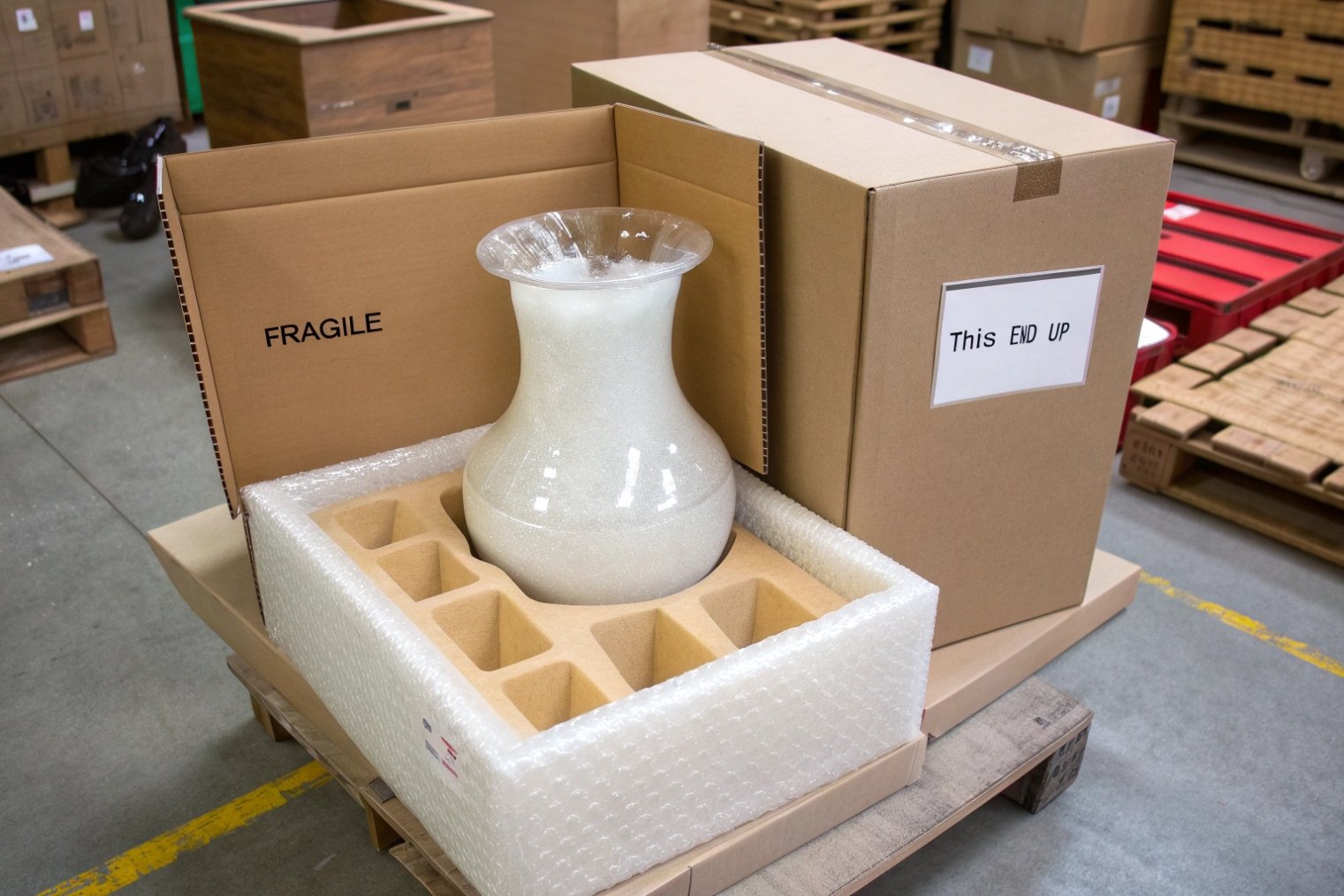
Supporting the shape, not crushing the details
A good rule: glass should never carry shock on one sharp point like a lip or handle. Instead, we spread loads over stronger zones such as the base and lower body.
Common elements for hand-blown vases:
- Soft inner wrap: tissue or foam sheet to protect the surface from scratches.
- Custom supports: die-cut foam, molded pulp, or hand-built cardboard collars around the body and base.
- Neck and lip guards: foam rings or caps to keep pressure off thin rims.
- Void fill that locks, not floats: firm paper honeycomb, air cushions locked in place, or engineered foam, rather than loose fill that settles.
A simple packaging layer table:
| Layer | Purpose |
|---|---|
| Inner wrap | Protect finish, prevent scuffing |
| Form-fit support | Hold vase away from walls |
| Inner box | First structural shell |
| Cushion layer | Absorb external shocks |
| Outer box | Main defense against impact and crush |
For very irregular pieces, suspension systems work well. The vase sits in a flexible film or fabric frame inside the box, so shocks dissipate through the suspension rather than going straight into the glass.
Balancing protection, cost, and customer experience
Heavier glass and more elaborate shapes already cost more to ship. Over-packing can push freight costs too high, but under-packing leads to breakage and replacements, which are worse.
To find a middle ground, studios often:
- Standardize a few inner box sizes and foam sets that fit many pieces.
- Follow a proven double-boxing method for fragile items 7 for export and parcel shipments.
- Test setups with “drop tests” from realistic heights on corners and edges.
- Mark UP, FRAGILE, and “Do not stack” clearly, while assuming real-world handling will still be rough.
For wholesale orders, palletization matters too. Vases should be:
- Packed so there is no direct glass-to-glass contact, even across boxes.
- Stacked with top sheets and corner protectors.
- Strapped and wrapped to stop lateral movement.
In practice, the best packaging solutions are those that are boring to the shipper: no surprises, no special instructions, just a system that quietly protects each odd-shaped, one-of-a-kind vase from studio to client.
Conclusion
Hand-blown vases live at the edge of control: heat, gravity, color, stress, and shipping. When artisans manage each step with intention, the result feels effortless in the customer’s hands.
Footnotes
-
Explains what a glory hole is and why targeted reheats keep shape control. ↩ ↩
-
Definition of marvering helps explain how artists center and smooth hot glass early. ↩ ↩
-
Shows why expansion numbers don’t guarantee compatibility and how makers test glass families. ↩ ↩
-
Clarifies devitrification causes and prevention when opal colors or long heat times create surface haze. ↩ ↩
-
Quick definition of annealing and why slow cooling prevents delayed cracking in blown forms. ↩ ↩
-
Overview of polariscopes/strain viewers for spotting residual stress before pieces ship. ↩ ↩
-
Practical packing guidance for breakables, including cushioning and the double-box approach. ↩ ↩






