

Thin or thick walls in glass bottles do not come from one bad shift. They build up from small variations in gob, forming, and mold condition that drift over time.
Wall thickness variation in glass bottles mainly comes from gob weight and temperature, forming timings and pressures, mold temperature and wear, parison sag, and push-up design. SPC thickness maps and weight control keep these factors in line.
When wall distribution is wrong, bottles can be both heavy and weak at the same time. Too much glass sits in safe areas, while critical zones run thin. Once we see which process lever moves which part of the wall, we can tune the line instead of just adding weight.
Do gob weight, temperature, and settle-blow timing drive wall variation?
When gob weight or temperature wander, every downstream setting has to work harder. If they move too far, no forming tweak can fully recover a clean, uniform wall.
Gob weight, gob temperature, and settle-blow timing are major drivers of thin or thick walls. They decide how much glass enters the mold, how fluid it is, and how it spreads before final blow.
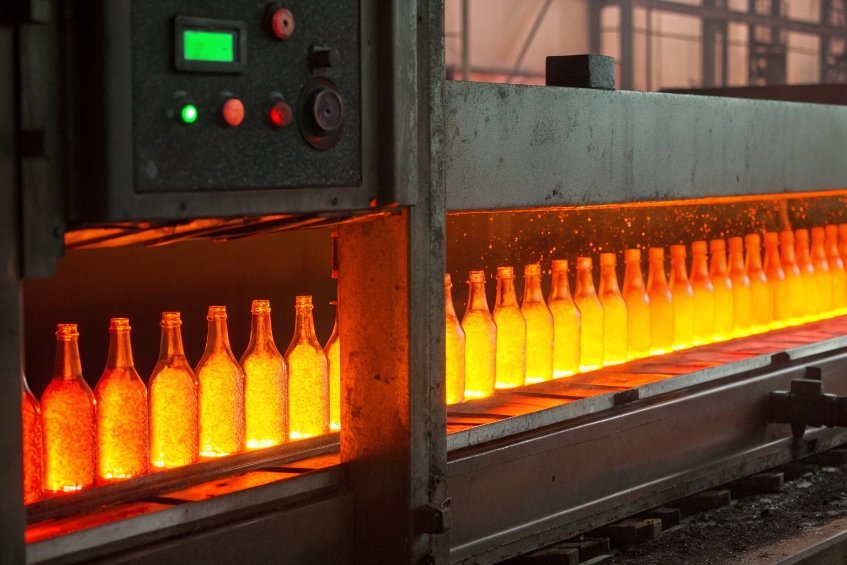
How gob and early forming set the whole thickness profile
Gob control is the first “thickness setting”. If the gob is light, all walls tend to thin out. If it is heavy, walls or base grow thick. But it is not only the total weight. Temperature and shape decide how that weight flows.
Key gob variables:
| Factor | If too low | If too high |
|---|---|---|
| Gob weight | Global thinning, underweight bottles | Global thickening, overweight bottles |
| Gob temperature | Poor spread, thick shoulders/bases | Excess stretch, thin lower body/heel |
| Gob centering | One side thin, opposite side thick | Repeat unilateral bias across run |
Off-center gob loading or misaligned parisons push glass to one side of the blank. That side stays heavy, while the opposite side thins. This shows later as unilateral wall variation in body and heel. In many thickness maps, you can see one “heavy” quadrant opposite a “thin” quadrant. That pattern nearly always points back to gob and parison centering—often tied to feeder design and gob shape 1 more than operators expect.
Settle-blow and counter-blow timings then shape the early distribution. If settle-blow is too short or too weak, glass does not settle evenly into the shoulder and heel of the blank. If it is too strong or too early, you can blow glass away from some regions, leaving thin bands. Clear understanding of settle-blow and counter-blow forming stages 2 helps teams connect “timing tweaks” to real wall outcomes.
Typical timing issues:
| Forming step | Fault | Likely effect on walls |
|---|---|---|
| Settle-blow start/stop | Too early/long | Thin shoulders, uneven parison skin |
| Counter-blow / plunger | Wrong pressure or stroke | Thick ring near neck, thin mid-body |
| Final blow timing | Too early on hot parison | Over-stretched lower body, thin heel |
Stable thin-wall production always starts with stable gob weight and temperature, correct gob centering, and a settle-blow window that lets the parison “breathe” into the blank without over-driving thin zones. On high-speed lines, closed-loop systems like automatic gob weight control 3 are often the fastest way to reduce day-to-day thickness drift.
Can mold wear or misalignment skew thickness around the shoulder?
Even if gob and timing are right, worn or misaligned molds can turn a strong design into a weak container. Shoulder and heel are most sensitive.
Yes. Mold wear, mismatch, poor venting, and misalignment between blank, neck ring, and blow molds all create systematic thickness bias, especially around the shoulder and heel areas.
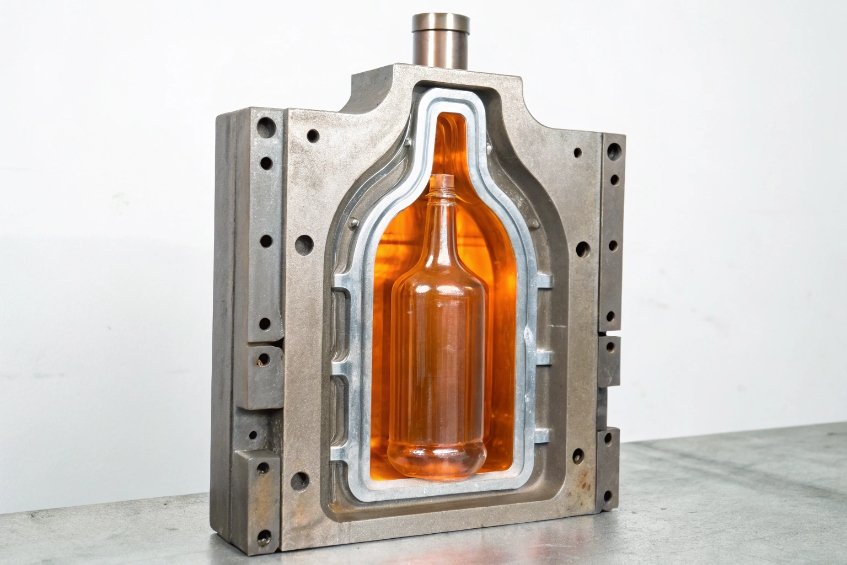
How mold condition quietly bends wall distribution
Mold cavities do not stay perfect forever. Contact with hot glass, coatings, and repeated cleaning slowly change dimensions and surface finish. Shoulders and corners tend to wear faster. A worn or polished shoulder chills the glass differently and changes how the parison stretches.
Simple mold condition map:
| Mold issue | Visual or measured effect |
|---|---|
| Shoulder wear / polishing | Thicker glass in worn zone, thin just below |
| Heel seat wear | Thin heel band, thick base or lower wall |
| Neck-ring damage | Bulky glass near ring, thin nearby wall |
| Poor venting | Local “hang-ups” and thicker glass behind vents |
Misalignment makes this worse. If the blank and blow mold centers do not match, the parison sits off center in the blow mold. One side touches earlier and freezes thicker. The opposite side keeps stretching and goes thin. This often appears as consistent thin and thick bands at fixed clock positions relative to the seam.
Shoulder and heel are classic stress zones. When a design already has tight radii, any extra thinning from wear or misalignment pushes these areas to the limit. In pressure or drop tests, cracks usually start exactly where a thin band crosses a stress peak.
Practical controls that help:
- Regular mold dimension checks and wear tracking per mold set
- Standard replacement limits for shoulder and heel wear
- Alignment checks after each mold change or repair
- Vent cleaning and pattern review when thickness maps show local bulges
When mold condition is part of a normal maintenance plan, wall bias becomes a slow, visible trend instead of a sudden surprise. A practical reference for common mold-driven issues is the container defect causes and remedies guide 4.
How do push-up height and parison distribution affect base thickness?
Base failures often come from a simple problem: the glass never reached the base where the design expected it. Push-up geometry and parison distribution decide how much glass ends up in the base and heel.
Push-up height, base design, and parison distribution control how glass flows into the base. If they are wrong, bases can be too thick and heavy, or too thin and prone to breakage, even with correct total weight.

Getting glass to the base, not just into the body
The base is both structural and visual. Too thin and it breaks or stones print through. Too thick and weight targets fail while the body still runs thin. The push-up shape is the main tool here. It also helps to align terminology (heel, base, punt/push-up) using a clear bottle bottom anatomy reference 5.
Key push-up parameters:
| Parameter | If too low / shallow | If too high / sharp |
|---|---|---|
| Push-up height | Thick center, thin heel and edge | Thin center, stress near inner radius |
| Push-up radius | Hard corners, local stress peaks | Smoother stress, better thickness spread |
| Contact ring design | High stress on narrow ring | Better load sharing on wider ring |
If the parison hangs low before final blow, glass tends to concentrate in the lower body and heel, sometimes leaving the central base thinner than planned. If the parison is too short or stiff, glass may not fully feed into the heel, which gives a thin heel band and overbuilt center.
Parison distribution comes from gob control, blank mold design, plunger or counter-blow settings, and take-out timing. Too long a take-out time or too much sag lets the hot parison stretch under its own weight. That transfers glass from upper body and shoulder down into the lower body. When final blow hits, the base and heel pull thin while mid-body gains thickness.
Typical base-related patterns:
| Observed issue | Likely cause |
|---|---|
| Thick base “plug” in the center | Low push-up, stiff parison, low final blow stretch |
| Thin heel band, reground breaks | High sag, long take-out, aggressive final blow |
| Asymmetric base thickness | Off-center parison, uneven cooling or mold alignment |
So a stable base needs both good geometry and good parison control. Adjusting only push-up height without checking parison length, sag, and final blow will not hold results. In practice, base thickness tuning often starts with parison distribution, then fine-tunes push-up and base radii to balance strength, stability, and weight.
Which SPC checks and weight maps keep wall uniformity in control?
Even with a good setup, real lines drift. Gobs warm up, molds age, and lehr conditions change. Without clear data, thin-wall or thick-wall issues only show up after customers complain.
SPC on bottle weight, automated or manual thickness maps, and structured section checks keep wall uniformity in control and give fast feedback when gob, forming, or mold conditions drift.

Turning thickness and weight into daily control tools
Weight is the simplest signal. Regular sampling and SPC charts show if gob weight or average bottle weight moves off target. But weight alone does not show where glass is going. Thickness maps do—and the fastest feedback often comes from reliable non-destructive wall thickness measurement methods 6.
A basic control set:
| Check type | What it shows | How often (typical) |
|---|---|---|
| Total bottle weight | Gob / overall forming drift | Shift or hour |
| Section weights (cuts) | Where along height glass is moving | Daily or per mold set |
| Thickness profiles | Circumferential thin / thick zones | Shift or per problem line |
| Polariscopic stress | Annealing issues that affect wall behavior | Daily or per job |
Section weight maps are very practical. Bottles are cut into fixed height zones (finish, shoulder, upper body, mid-body, heel, base). Each section is weighed. Over time, these weights show whether glass is moving up, down, or sideways. For example, if heel and base weights fall while total weight is stable, some other zone is getting too heavy. That often links back to sag, timing, or mold temperature.
Automated thickness gauges add circumferential information. They reveal thin and thick bands at specific clock positions. That pattern can be tied to gob centering, mold alignment, or local mold temperature and cooling.
SPC then turns these measurements into a living system, using control-chart logic like the NIST/SEMATECH SPC control chart guidance 7:
- Control charts for gob weight and total weight
- Control limits and trend rules for section weights
- Routine review of thickness maps by job and section number
- Standard reactions when signals trigger (e.g., check gob temp, mold alignment, cooling pattern)
In my experience, the best results come when process teams see these maps every day, not just during problem solving. Over time, they learn to read the shapes and link them to real machine settings. Thin-wall and thick-wall issues become something they catch early and correct with small adjustments, long before they become a rejection or a complaint.
Conclusion
Wall thickness is not random. Gob control, forming settings, mold condition, base design, and SPC work together to keep glass where it should be: strong in critical zones, light where it can be.
Footnotes
-
Details how feeder setup changes gob shape/centering, driving consistent one-side thin/thick patterns. ↩ ↩
-
Clarifies settle-blow and counter-blow stages so timing changes map to shoulder/heel thickness outcomes. ↩ ↩
-
Explains closed-loop gob weight control to stabilize container mass and reduce thickness drift. ↩ ↩
-
Lists common mold, alignment, and venting issues that create systematic thickness bias and defects. ↩ ↩
-
Defines heel/base/push-up features so teams align design language with base thickness troubleshooting. ↩ ↩
-
Shows practical approaches to measuring glass wall thickness for bottles without cutting samples. ↩ ↩
-
Provides control chart fundamentals and rules to detect drift before thin-wall defects become rejects. ↩ ↩






