
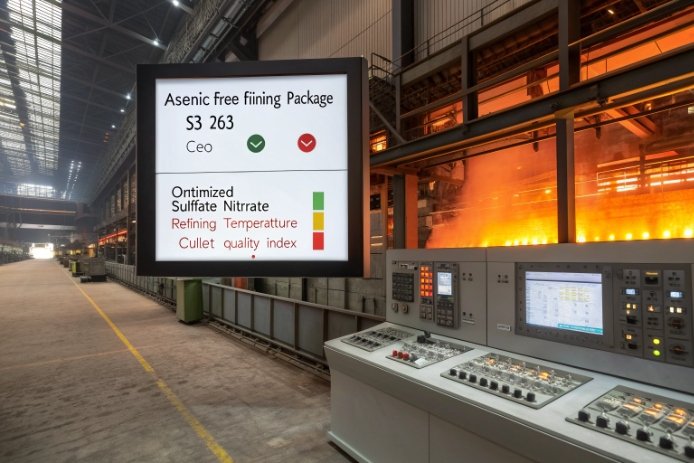
Bubbles and color drift can turn a good bottle run into scrap. When arsenic is removed, many lines lose fining margin and defects spike.
Arsenic worked because it buffered redox and released oxygen late in the melt, which grew bubbles and helped them rise out. Modern replacements combine sulfate systems, multivalent oxides like tin, tighter redox control, and furnace bubbling to hit the same clarity without arsenic.
The arsenic-free fining decision map for real production
A good fining plan is not “pick one additive.” It is a package: gas chemistry + melt viscosity + time + furnace flow. Arsenic used to cover gaps in all four. When it is gone, the gaps show up as seeds, reboil, foam, and color swings.
Step 1: define what “fining success” means on your line
Most plants mix three targets, so the project stays confused. It helps to separate them:
- Seed count at the gob: what the IS machine will stretch into defects
- Reboil margin: whether bubbles come back in the forehearth/feeder
- Color stability: whether redox drift changes iron state and tint
These targets are linked, but they are not the same.
Step 2: choose your main fining mechanism
Arsenic and antimony are classic “variable-valence oxygen” fining agents. Sulfate fining is a different path. Bubbling is a flow and mass-transfer path. Tin can act like the first group, but it behaves differently in different base glasses. Cerium is often more useful as an oxidizer/decolorizer, even when it can participate in redox.
Step 3: qualify the new system as a redox system, not as a dosage
Most scale-up failures come from this: the team changes the fining agent but keeps the old carbon, sulfate, cullet, and burner balance. Then redox shifts and the melt does something new. The “replacement” looks bad, even when it could work with a new redox setpoint.
A practical selection table
| Replacement route | What it does well | Main risk | When it is the best fit |
|---|---|---|---|
| Optimized sulfate fining (Na2SO4 + redox control) | Strong fining at high temperature, scalable | Foam and SOx control, sensitive to reduction | High-tonnage container glass with stable furnace control |
| Tin-based redox fining (SnO2/SnO) | Oxygen fining without arsenic, good for some high-durability glasses | Needs oxidizers to hold Sn4+, can affect devit in some systems | Pharma and high-durability compositions, premium clarity targets |
| Cerium-assisted redox control (CeO2) | Strong oxidizer, improves color consistency and Fe state | Cost, can shift UV/appearance, fining effect depends on base glass | Flint stability projects, “green shift” control |
| Mechanical bubbling / oxygen boosting | Improves convection, speeds refining, helps homogeneity | Hardware, refractory wear, control complexity | When the bottleneck is residence time and melt mixing |
| Nitrate as an oxidizer (supporting role) | Pushes melt more oxidizing, helps other fining chemistry work | NOx/emissions and batch handling | Used as a helper, not a solo fining strategy |
If the goal is “arsenic-free with no yield loss,” the fastest route is usually a hybrid: sulfate + tighter redox + some form of bubbling, plus tin or cerium only if the product needs it.
A plant does not need to copy a textbook recipe. It needs a stable, measurable redox target and a qualification plan that matches its furnace and pull.
Now it helps to zoom in on what arsenic used to do, because that shows what the replacement must cover.
A replacement only works when it replaces the function, not the name.
What was arsenic’s historical function in fining?
When arsenic leaves the batch, the first weeks often feel like the furnace “forgot how to refine.” Seeds rise, foam changes, and color drifts.
Arsenic’s historical fining function was oxygen-based refining through its As(V)/As(III) redox pair. It could release oxygen late in the melt, which enlarged bubbles so they rose faster, and it also buffered redox to keep fining and color more consistent.

Late oxygen release: why arsenic was unusually effective
Many fining agents release gas early, when the melt is still full of undissolved batch and viscosity is high. That gas can get trapped. Arsenic oxides were valued because they could release oxygen “late,” when the glass was hot and the melt could let bubbles grow and rise. This “late-stage oxygen” behavior is also why patents and technical reviews call arsenic particularly effective as a fining agent. A clear statement shows up in fining-agent patent literature: arsenic oxides are effective because they release oxygen late in the melt stage. (See US Patent 6166007A 1)
Redox buffer: why fining and color moved together
Arsenic did not only create gas. It helped hold redox in a usable band. That matters because:
- sulfate fining depends on oxidation/reduction balance,
- iron color depends on Fe2+/Fe3+ balance,
- reboil risk rises when redox shifts in the cooling/conditioning zones.
So arsenic helped in two places: bubble removal and day-to-day stability.
Older furnaces had fewer sensors and less control. Cullet quality also swung more. A variable-valence fining agent acted like insurance. It did not fix bad operations, but it reduced the penalty of small process drift.
| Old arsenic benefit | What the line saw | What the lab saw |
|---|---|---|
| Late oxygen fining | Fewer seeds, fewer airlines | Lower bubble counts |
| Redox buffering | Less tint drift in flint | Smaller ΔE variation |
| Reboil control | Fewer surprise bubbles at feeders | Cleaner glass in conditioning |
This history matters because the replacement must cover oxygen fining and redox stability. Many projects fail because they replace only one of those.
The next step is picking replacements that can match the fining efficiency without bringing the same hazard story.
Which alternatives match fining efficiency without toxicity?
When the goal is “no arsenic and no performance drop,” the safest path is not a single new oxide. It is a system that avoids high-concern toxicants and still delivers late-stage refining.
The strongest alternatives are optimized sulfate fining with strict redox control, tin-based multivalent fining in suitable glass families, and furnace bubbling/oxygen boosting to increase refining rate. Cerium can support redox and color but is often a helper more than a full arsenic substitute.
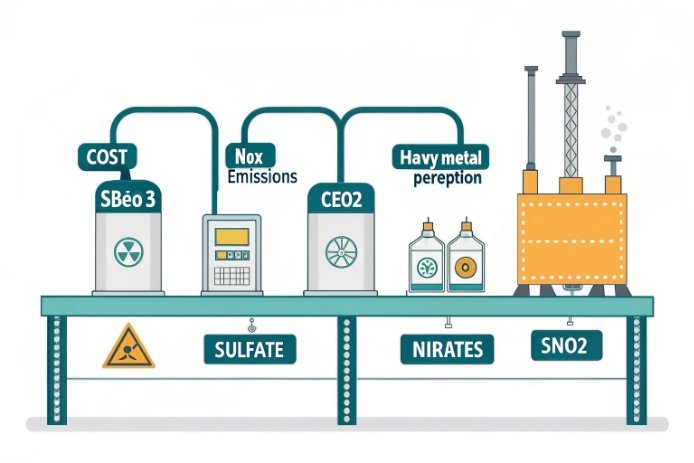
Sulfate fining: the workhorse in high-tonnage glass
Sodium sulfate is widely used in industrial glass as a fining agent. Its key reaction in oxidized melts releases SO2 and O2 at high temperature, which supports refining. A common reference point places sulfate decomposition and fining onset around the mid-1400°C range in oxidized melts. (See sulfate fining mechanism 2)
This route scales well and is already the backbone for many container furnaces. The trade-off is control. Sulfate interacts strongly with reducing agents and organics in cullet. In a more reducing melt, sulfate can convert to sulfide, which changes foam, color, and fining behavior. (Read sulfate redox issues 3)
Tin-based fining: a practical arsenic replacement in some glass families
Tin is another multivalent system (Sn4+/Sn2+) that can generate oxygen. Technical training materials describe tin oxide fining and note that oxidizers (often nitrates) are used to keep tin in the 4+ state during melting. (See tin fining overview 4)
This is not only theory. A pharma glass reference from Corning describes replacing arsenic with tin for fining in an aluminosilicate pharmaceutical glass composition. (See Corning pharma glass 5)
Tin is not “free.” It can affect crystallization tendencies depending on composition and furnace history. That is why tin-based systems must be tested against stone/devit risk, not only bubble counts.
Cerium systems: strong oxidizer and color stabilizer, sometimes a fining helper
Cerium can exist as Ce3+/Ce4+. That redox couple is why cerium is often discussed as arsenic-like in principle. Some technical literature notes cerium’s redox equilibrium allows it to be used as a fining agent in glasses, behaving similar to arsenic oxide. (See cerium in glass 6)
In bottle practice, CeO2 is often used more for redox control and decolorizing support (oxidizing Fe2+ to Fe3+) than as the sole fining engine, because cost and side effects can be real.
Mechanical and oxygen routes: bubbling and oxy-fuel as “chemical fining reducers”
Bubbling systems inject gas into molten glass to increase convection, improve temperature uniformity, and speed refining. Industrial suppliers describe bubbling as a way to enhance melting performance and homogeneity. (See bubbling systems 7)
This route is attractive because it avoids adding a heavy-metal fining agent. Still, bubbling does not automatically replace chemical fining for every furnace. It reduces the need for chemical “insurance” by improving residence time and mixing.
| Replacement goal | Best match (most common) | Why it works |
|---|---|---|
| High-tonnage bottles, stable quality | Sulfate + tight redox | Strong industrial standard, scalable |
| Premium clarity and stable redox | Sulfate + bubbling + small helper oxide | Better mixing + better gas control |
| Pharma/high-durability families | Tin-based fining + oxidizer control | Proven route in some pharma glasses |
| Flint tint stability | Cerium as redox helper | Stabilizes iron state and color |
The best “non-toxic” plan depends on what the customer means by “non-toxic.” Many brands now treat arsenic as unacceptable and also treat antimony as a watched substance. That makes qualification planning very important.
How to qualify Sb, Ce, and nitrate systems at scale?
Small lab melts can lie. They do not reproduce furnace residence time, cullet variability, burner gradients, or forehearth conditioning. That is why scale qualification must be written like an operations project.
Qualify Sb, Ce, and nitrate systems by locking a redox target, running step trials with strict measurement, and validating not only bubble counts but reboil, foam, color drift, and emissions. Sb can work well but brings classification concerns, while nitrates mainly act as oxidizers that support other fining chemistry.
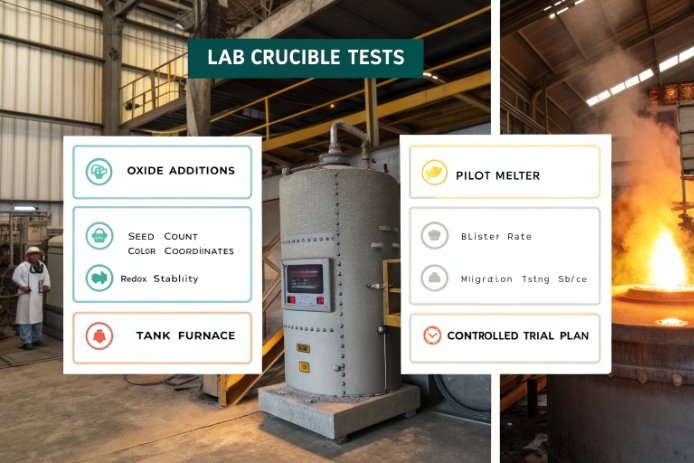
Start with a test design that protects production
A scale trial needs guardrails:
- define the acceptance metrics before the first batch change,
- define the stop rules (seed spike, foam risk, color shift),
- define the sampling plan (melt chemistry, gob defects, bottle inspection).
What to measure during qualification
A replacement project fails when it measures only “seed count.” These are the minimum checks that matter:
1) Bubble/seed count at the feeder and in formed ware
2) Reboil indicator (bubbles rising after refining zone, change in bubble size distribution)
3) Redox proxy (Fe2+/Fe_total if applicable, or an internal oxygen potential approach)
4) Foam behavior and sulfate retention
5) Color drift (ΔE over shift and after cullet swings)
6) Emissions impact (SOx, NOx changes when nitrates or sulfate balance shifts)
How to treat Sb, Ce, and nitrate in a real fining package
Sb (antimony): Sb is a proven multivalent fining family, but it can trigger regulatory and customer concern. ECHA’s substance information for diantimony trioxide states harmonized EU classification as “suspected of causing cancer.” (See ECHA Sb2O3 data 8)
So Sb qualification must include dust control, exposure controls, and customer restricted-substance checks. The goal is to use the lowest effective dose with stable redox, not to “dose until it looks safe.”
Ce (cerium): CeO2 can stabilize oxidation state and help keep iron in a less green state. It may help fining in some systems, but it should be qualified for side effects: UV absorption, cost, and any impact on devit or viscosity.
Nitrates: Nitrates (like sodium nitrate) are best treated as oxidizers that shift early melt chemistry. They are often used to keep multivalent fining agents in their higher oxidation state during early melting, which sets up later oxygen release at high temperature. (See nitrate usage 9)
Nitrates also mean emissions planning, because they can increase NOx if not managed.
A scale qualification checklist table
| Phase | What to do | Pass signal |
|---|---|---|
| Lab / pilot melts | Screen fining strength and color drift | Lower bubbles without new haze or devit risk |
| Furnace trial (low step) | Add small dose change, hold 3–7 days | Bubble trend improves with stable foam |
| Furnace trial (mid step) | Introduce cullet variability challenge | Redox and color stay stable |
| Furnace trial (full) | Run production pull and speed | Scrap rate stays flat or improves |
| Validation | Document metrics, SDS, customer specs | Customer audit-ready package |
A good project ends with a new “redox operating window,” not just a new additive. That is what protects the result once the excitement is gone.
Now the last question is the fun one: can we remove chemical fining at all?
Will nano-bubble or oxygen sparging displace chemical fining?
Many plants want a future with fewer chemical flags. Bubbling looks like the clean path, so it is tempting to expect it to replace fining additives.
Oxygen sparging and bubbling will reduce dependence on chemical fining by improving melt convection, homogeneity, and refining rate, and they are already commercial. “Nano-bubble” concepts are active in liquids, but in molten glass the temperature and viscosity make true nanobubble stability unlikely, so full displacement of chemical fining is not a near-term expectation.
What bubbling really does in container furnaces
Bubbling injects gas into the melt. That creates rising plumes. Plumes increase circulation. Better circulation does three things:
- moves cold glass into hotter zones faster,
- helps bubbles rise and escape,
- reduces temperature gradients that cause defects and reboil.
Industrial suppliers describe bubbling as a tool to improve homogeneity and melting performance, and it is used between melting and refining zones in many designs.
This is already commercially real. It is not a lab idea.
Why sparging alone does not always replace chemical fining
Chemical fining has a special advantage: it generates gas inside existing bubbles and can enlarge them even when convection is limited. Bubbling helps bubbles leave the melt, but it does not always create the same “late-stage oxygen growth” effect that arsenic once gave. Many furnaces still keep a chemical fining base (often sulfate) and use bubbling to reduce how hard the chemistry must work.
Nano-bubbles: why the hype does not map cleanly to molten glass
Nanobubble technology is growing fast in water and process liquids. Reviews describe nanobubbles as stable in liquids and useful for mass transfer. (See nanobubble stability review 10)
Molten glass is not a liquid like water. It is a high-temperature, high-viscosity melt. Gas solubility, bubble coalescence, and surface tension behavior are very different. At refining temperatures, bubbles tend to grow, merge, and rise. That works against “stable nanobubbles” as a long-lived tool.
So “nano-bubble fining” is not the likely path for container furnaces in the next few years. The more realistic path is:
- better bubbling and oxygen boosting,
- more oxy-fuel and electric boosting for stable temperature control,
- better sulfate/redox control,
- more tin-based fining in specific high-value glass families.
A near-term forecast that matches plant reality
| Technology | 0–3 year impact on bottles | Why |
|---|---|---|
| Bubbling / oxygen boosting | High and growing | Proven hardware, clear ROI in pull and quality |
| Better sulfate/redox control | High | Low capex, strong effect when disciplined |
| Tin-based fining in niches | Medium | Works well in some families, needs careful control |
| Cerium as helper | Medium | Useful for color stability, cost sensitive |
| Nano-bubble refining in molten glass | Low | Mechanism does not fit melt physics well |
Chemical fining will not vanish soon. Still, its role will shrink where furnaces add better flow tools and better sensors.
Conclusion
Arsenic worked because it gave late oxygen fining and redox buffering. The best replacements combine sulfate systems, tin or cerium where needed, and bubbling to recover fining margin without arsenic.
Footnotes
-
Patent detailing the mechanism of arsenic oxide as a glass fining agent. ↩
-
Study on sulfate fining efficiency and SO2 release in glass melts. ↩
-
Technical article on sulfate redox reactions and foam formation in glass furnaces. ↩
-
Overview of tin oxide as a fining agent alternative to arsenic. ↩
-
Corning’s description of arsenic-free pharmaceutical glass tubing. ↩
-
Research on cerium oxide’s redox behavior and fining potential in glass. ↩
-
Parker O-Ring Handbook (placeholder for bubbling system technical guide). ↩
-
ECHA classification and labeling information for Diantimony Trioxide. ↩
-
Study on the role of nitrates in glass batch reactions and fining. ↩
-
Review article discussing the stability and applications of nanobubbles in liquids. ↩






