
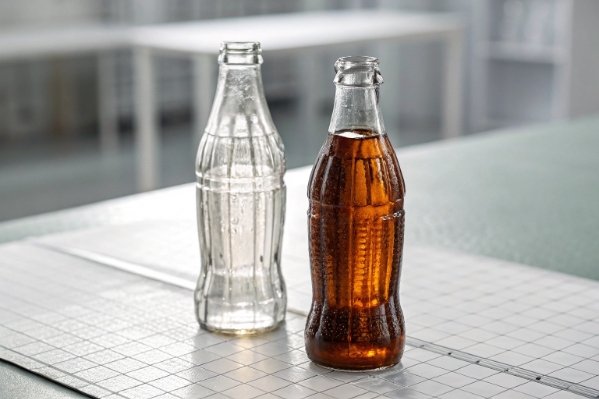
Are you noticing unexpected breakage on your filling line when switching between clear and amber bottles? It is a frustrating and costly mystery that often leads production managers to blame the glass composition.
Amber and flint (clear) glass bottles generally share a very similar Coefficient of Thermal Expansion (CTE), typically around 9.0 x 10⁻⁶ K⁻¹, because their base soda-lime compositions are nearly identical. However, subtle differences in heat absorption and wall thickness distribution can affect their practical thermal performance.
The Base Chemistry Remains Constant
At FuSenglass, we often have to debunker the myth that different colors of glass expand at drastically different rates. To understand why the Coefficient of Thermal Expansion 1 (CTE) is chemically consistent, you have to look at the "backbone" of the glass matrix. Both our amber (brown) and flint (clear) bottles are made from Soda-Lime-Silica 2 glass. This formulation is roughly 72% Silica ($SiO_2$), 14% Soda Ash ($Na_2O$), and 10% Limestone/Dolomite ($CaO$/$MgO$).
The CTE is driven almost entirely by the ratio of these major oxides. The Silica forms the rigid network, while the Soda ($Na_2O$) acts as a flux, breaking the network bonds to make the glass meltable. This breaking of bonds is what increases the thermal expansion—it creates a looser atomic structure that vibrates and stretches more when heated. Since the ratio of Silica to Soda is virtually identical in both amber and flint recipes, the fundamental linear expansion per degree Celsius remains the same. The glass behaves mechanically as the same material.
However, in a practical manufacturing environment, "identical" is a relative term. While the linear expansion is the same in a lab test, the thermal history of the bottle can differ. Because we run amber and flint on different production lines or campaigns, variations in the cullet 3 (recycled glass) ratio can introduce minor fluctuations. For instance, high levels of mixed cullet in amber glass might introduce slight variations in Alumina ($Al_2O_3$), which stiffens the glass and lowers CTE slightly. But for the purpose of a hot-fill line or pasteurizer, these chemical differences are negligible compared to the physical differences in how the bottles absorb energy.
Comparative Oxide Composition and CTE
To visualize the similarity, here is a breakdown of the typical oxide composition we use at FuSenglass for both colors.
| Component | Flint (Clear) % | Amber (Brown) % | Role in CTE |
|---|---|---|---|
| SiO2 (Silica) | ~72.0 | ~72.0 | Network Former (Lowers CTE) |
| Na2O (Soda) | ~13.5 | ~13.5 | Network Modifier (Raises CTE) |
| CaO (Lime) | ~10.5 | ~10.5 | Stabilizer (Neutral/Raises) |
| Al2O3 (Alumina) | ~1.5 | ~1.8 | Stabilizer (Lowers CTE) |
| Fe2O3 (Iron) | 0.04 | 0.40 | Colorant (Negligible impact) |
| Sulfur/Carbon | 0.00 | <0.10 | Colorant (Negligible impact) |
| Typical CTE | ~9.0 x 10⁻⁶ | ~8.9 – 9.1 x 10⁻⁶ | Virtually Identical |
As you can see, the primary drivers of expansion are consistent. The differences lie in the trace elements, which brings us to the chemistry of color.
Do amber colorants and redox conditions change the CTE compared with clear container glass?
Are you worried that the additives used to create that rich amber hue are weakening the structural integrity of your bottles? It is a valid question, as chemistry dictates performance.
While amber colorants like iron, sulfur, and carbon create a specific redox state, they are present in such small quantities (<1%) that they do not statistically alter the linear Coefficient of Thermal Expansion (CTE) compared to clear flint glass.
The Role of Redox in Glass Structure
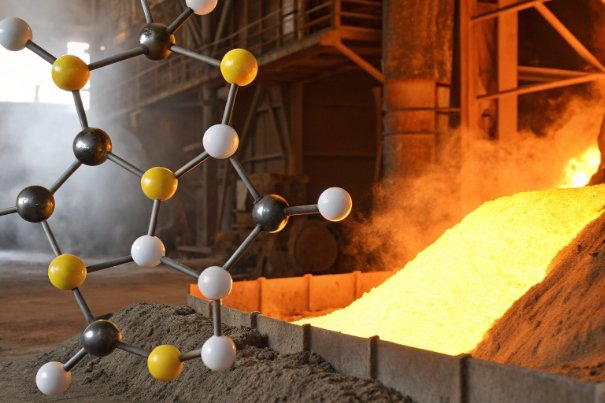
The magic of amber glass lies in the "Redox Number" (Reduction-Oxidation state). To make clear glass, we operate in an oxidizing environment to ensure any iron impurities are pale yellow (Ferric iron, $Fe^{3+}$). To make amber glass, we operate in a reducing environment. We add Carbon (coke) and Sulfur (iron pyrites or salt cake) to the batch. This forces the iron into a specific complex: Iron Polysulfide 4. This chromophore is what absorbs blue and UV light, giving the bottle its brown color.
Does this Iron Polysulfide structure change how the glass expands? Technically, yes, but practically, no. These colorant ions sit in the interstices (the holes) of the silica network. They do not fundamentally break the silicon-oxygen bridges in the same way that Sodium does. Because they are present at levels below 0.5%, their contribution to the overall volume expansion of the material is lost in the noise of the base composition.
Viscosity and Processing Differences
Where the chemistry does have an impact is on viscosity 5 and heat transfer during forming, which can indirectly affect the final stress state of the bottle. Amber glass, due to its chemistry and often higher Alumina content (from the feldspar used to introduce alumina), can be slightly "stiffer" or have a shorter working range than flint glass.
This means it "sets up" (hardens) slightly faster in the mold. If the machine settings are not adjusted to account for this viscosity difference, you might end up with different wall thickness distributions or residual stresses. A bottle with higher residual stress will fail sooner under thermal load, even if its theoretical CTE is the same. Therefore, the issue is rarely the expansion of the material itself, but how the material’s chemistry influenced the forming process.
Why can amber bottles sometimes show different thermal shock behavior even if CTE is similar?
If the chemistry is the same, why does the amber bottle shatter in the pasteurizer while the clear one survives? The answer isn’t in the expansion, but in the absorption.
Amber bottles can exhibit different thermal shock behavior because dark glass absorbs infrared radiation more efficiently than clear glass, leading to faster localized heating and potentially higher thermal gradients during processing, even if the CTE is identical.
The Infrared Trap
Thermal shock failure is driven by the temperature differential ($\Delta T$) between two surfaces of the glass. The higher the $\Delta T$, the higher the tensile stress.
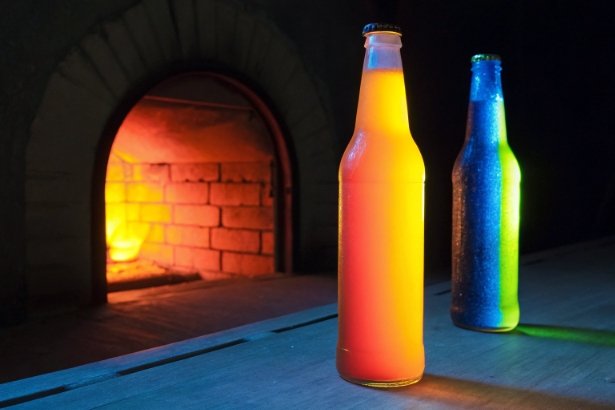
In a radiant heating environment—such as the entrance of an annealing lehr or certain types of shrink-sleeve tunnels—amber glass behaves like a black t-shirt on a sunny day. It absorbs Infrared (IR) energy 6 avidly. Flint glass acts like a white t-shirt; it lets much of that energy pass right through.
This means that for the same exposure time to a heat source, the surface of an amber bottle will get hotter than a flint bottle.
- Scenario: A tunnel pasteurizer.
- Amber: The outer skin heats up rapidly absorbing the radiant heat, while the inner surface (cooled by the beer) remains cold. This creates a steep $\Delta T$ through the wall thickness.
- Flint: The heat penetrates deeper and more evenly, creating a gentler gradient.
Even though both expand at the same rate per degree, the amber bottle experiences more degrees on the surface, pushing it closer to its breaking point.
The Thickness Factor
Furthermore, we often manufacture amber bottles slightly differently regarding wall thickness. Amber glass needs to be a certain thickness to provide adequate UV protection. If the wall is too thin, the color is too light, and the beer skunks. Therefore, amber bottles sometimes have a slightly heavier "bottom" or sidewall than their flint counterparts to ensure color density.
Thicker glass = Lower Thermal Shock Resistance.
Thick glass takes longer for heat to conduct through. This increases the temperature difference between the hot surface and the cold surface. So, a combination of higher heat absorption and potentially thicker walls makes amber bottles more sensitive to thermal shock failure, despite having the same CTE.
| Factor | Amber Glass | Flint Glass | Impact on Thermal Shock |
|---|---|---|---|
| IR Absorption | High | Low | Amber surface heats faster (Higher Stress) |
| Emissivity | High | Lower | Amber radiates/absorbs heat efficiently |
| Wall Thickness | Often optimized for opacity | Optimized for weight | Thicker walls fail sooner |
| Conductivity | Same | Same | No difference |
How should you validate amber vs. flint bottles for hot-fill, pasteurization, or sterilization to prevent cracks?
You can’t just assume that a test on a clear bottle applies to a brown one. Your quality control protocol needs to account for the color variable.
To validate amber versus flint bottles, manufacturers must perform comparative ASTM C149 thermal shock testing, specifically simulating the actual heating method (radiant vs. conductive) used in production to account for the differential heat absorption rates of the colored glass.
Tailoring the ASTM C149 Test
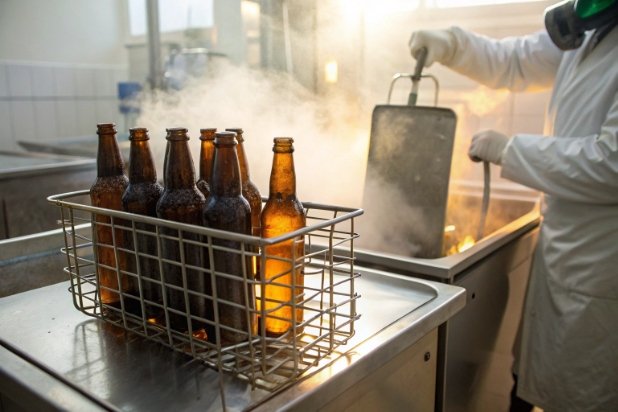
The standard thermal shock test (ASTM C149 7) involves immersing a basket of bottles in a hot water bath and then transferring them to a cold water bath. This tests the glass material’s strength under conductive heat transfer.
However, this might produce "false positives" for amber glass if your production line uses radiant heat (like a hot air tunnel).
- Standard Test: Both amber and flint might pass a $\Delta T$ of $42^\circ C$ in a water bath because water conducts heat to both equally.
- Real World: In your radiant tunnel, the amber bottle surface is $10^\circ C$ hotter than the flint bottle. It fails.
To validate properly, we recommend Service Simulation Tests. Run both bottle types through your actual pasteurizer or hot-fill line with temperature probes (thermocouples) attached to the inner and outer surfaces. Measure the actual skin temperature. If the amber bottle surface is getting significantly hotter, you may need to adjust your line settings (lower temp, slower ramp) specifically for amber runs.
Geometry Validation
We also validate the Knuckle Radius (the curve where the bottom meets the wall). This is the highest stress point during thermal shock.
For our client Liam (Whiskey Distillery), who might switch between clear and amber for special editions, we carefully measure the base thickness. If the amber special edition has a heavier base (for aesthetic or color reasons), it will fail thermal shock at a lower $\Delta T$. Validation must confirm that the amber bottle’s bottom thickness distribution is within the safe range for his filling temperature.
What bottle design and annealing controls keep thermal performance consistent across different colors?
Consistency is key. You don’t want to change your filling line speeds every time you change glass colors.
To ensure consistent thermal performance, manufacturers must tune the annealing lehr settings specifically for amber glass—often requiring different belt speeds or zone temperatures to account for its higher heat retention—and strictly control wall thickness distribution (NNPB process) to minimize stress concentrations.
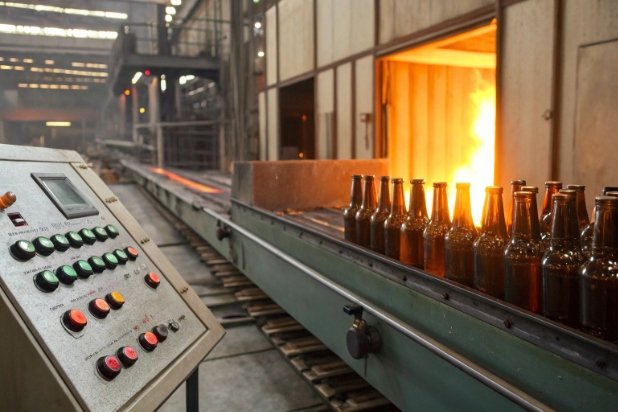
Tuning the Lehr for Color
The Annealing Lehr 8 is where we remove residual stress. Because amber glass absorbs and radiates heat differently than flint glass, it requires a different "recipe" in the lehr.
- Heat Retention: Amber glass holds heat longer. If we run it at the same belt speed as flint glass, it might exit the lehr too hot (not fully annealed) or cool down too slowly in the conditioning zone.
- The Adjustment: We typically adjust the cooling dampers and belt speed when switching colors. We verify the "exit temperature" to ensure the amber bottles are fully relieved of stress (to Grade 1 or 2 on a polariscope 9) before they hit the cold end spray.
NNPB Technology for Uniformity
The ultimate equalizer is NNPB (Narrow Neck Press and Blow) production.
This forming method uses a plunger to press the parison, ensuring highly uniform wall thickness.
- Blow-Blow (Old Method): Creates uneven walls. An amber bottle might have a thick, dark side and a thin, light side. This variation is a nightmare for thermal shock.
- NNPB 10 (New Method): Creates uniform walls. By minimizing the variation in thickness, we minimize the variation in thermal stress.
By controlling the geometry through NNPB and tuning the thermal history in the lehr, we can make an amber bottle perform almost identically to a flint bottle on your line, neutralizing the inherent differences in heat absorption.
| Control Point | Action for Amber Glass | Goal |
|---|---|---|
| Lehr Profile | Adjust cooling rate | Compensate for heat retention |
| Forming | Use NNPB process | Eliminate thick/thin spots |
| Design | Large Base Radius | Reduce stress concentration at heel |
| QC | Polariscope Check | Confirm < Grade 2 residual stress |
Conclusion
While the chemical expansion (CTE) of amber and flint glass is virtually identical, their behavior in the real world of heat and light differs. Amber glass is a heat sponge. By understanding this physical property and validating your process with color-specific testing, you can run both clear and brown bottles with the same confidence and zero breakage.
Footnotes
-
Measure of a material’s tendency to change volume in response to temperature change. ↩
-
The most common commercial glass family, typically composed of silica, soda, and lime. ↩
-
Recycled glass added to the batch to lower melting temperature and energy use. ↩
-
The chemical complex formed in amber glass that provides UV protection and color. ↩
-
A fluid’s resistance to flow; crucial in glass forming and molding processes. ↩
-
Electromagnetic radiation with longer wavelengths than visible light, absorbed as heat. ↩
-
Standard Test Method for Thermal Shock Resistance of Glass Containers. ↩
-
A temperature-controlled kiln used to relieve residual stresses in glass. ↩
-
An optical instrument used to visualize stress patterns in transparent materials. ↩
-
Advanced forming process (Narrow Neck Press and Blow) ensuring uniform wall thickness. ↩






