
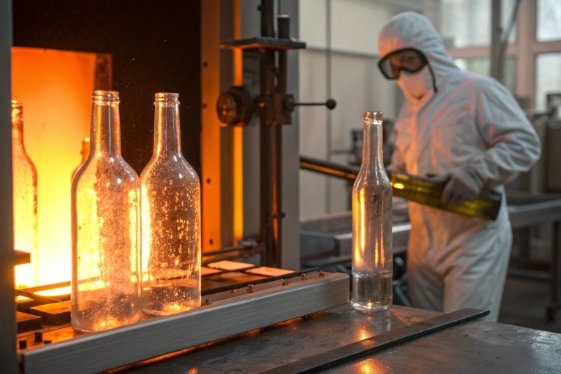
When a client tells me they need a bottle that can survive "anything"—from freezing liquid nitrogen to boiling sterilization—I don’t recommend standard glass. I point them to the thermal tank of our industry: High-Borosilicate Glass.
The primary advantage of high-borosilicate glass is its extremely low Coefficient of Thermal Expansion (CTE), which creates exceptional dimensional stability. This allows it to withstand severe thermal shocks (ΔT > 120°C) without shattering, making it the only viable choice for aggressive sterilization, cryogenic storage, and high-precision pharmaceutical applications.
The "Super-Glass" Difference
In the world of B2B glass packaging, "borosilicate" is often thrown around as a synonym for "high quality," but few buyers understand the physics behind it. I’ve spent hours explaining to purchasing managers why this glass costs two to three times more than the standard bottles coming off my lines.
The magic lies in the Boron Trioxide 1 ($B_2O_3$). In standard soda-lime glass 2, we use silica, soda ash, and limestone. It’s great for wine and jam. But when we replace the alkali components with boron, we fundamentally change the atomic structure of the glass network.
The result is a material that simply refuses to move when heated.
Why Expansion Matters
Thermal expansion is the enemy of structural integrity. When you heat a material, it wants to grow. If you heat it unevenly (like filling a cold bottle with hot liquid), one part grows while the other stays small. This fight creates stress.
Borosilicate glass effectively opts out of this fight. It expands so little that the stress generated is negligible compared to the strength of the glass. This is why you can take a Pyrex dish out of the oven and put it on a cold counter (though I still don’t recommend it for industrial reliability!).
For my clients in the pharmaceutical and lab sectors, this isn’t just a luxury; it’s a safety requirement. If an ampoule explodes during an autoclave cycle 3, it ruins the entire batch. Using borosilicate is their insurance policy.
| Feature | Standard Glass | Borosilicate Glass |
| :— | :— | :— |
| Primary Component | Silica + Soda + Lime | Silica + Boron Trioxide |
| Thermal Behavior | Expands/Contracts Rapidly | Remains Stable |
| Typical Use | Beverage, Food, Cosmetic | Labware, Injectables, Tubing |
| Price Point | Economic | Premium |
How much lower is the CTE of high-borosilicate glass compared with standard soda-lime glass bottles?
Understanding the numbers helps justify the investment. If you are an engineer, you need the Coefficient of Thermal Expansion (CTE) data to calculate your safety margins.
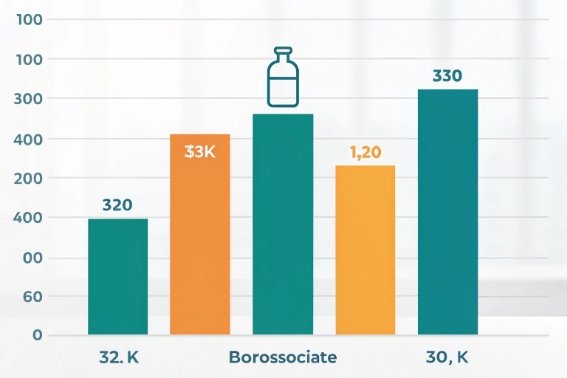
High-borosilicate glass (often called "3.3 Borosilicate") has a CTE of approximately $3.3 \times 10^{-6}/K$. In stark contrast, standard soda-lime glass has a CTE of about $9.0 \times 10^{-6}/K$. This means soda-lime glass expands nearly three times as much as borosilicate for every degree of temperature rise.
The "Rule of Three"
I often use the "Rule of Three" to help clients visualize the difference. Imagine you have a long rod of glass. If you heat it up:
-
The Soda-Lime rod stretches by 3mm.
-
The Borosilicate rod stretches by only 1mm.
This massive reduction in movement is what gives borosilicate its superpowers.
Types of Borosilicate
Not all borosilicate is created equal. In the industry, we classify them by their expansion rates:
-
3.3 Borosilicate (High Boro): This is the premium standard (like Pyrex 4 or Duran). It has the lowest expansion and highest chemical resistance. It is used for reactor vessels and critical vials.
-
5.0 / 7.0 Borosilicate (Neutral Glass): This is "Type I" pharmaceutical glass. It has slightly higher expansion than 3.3 but is still far superior to soda-lime. It is easier to process and form into ampoules and vials.
When I work with a client like "Katarina" from Russia, who needs vials for a freeze-dried vaccine, we discuss these specific numbers. The freezing process (lyophilization 5) involves dropping the temp to -50°C and then heating it up. Soda-lime glass would shatter from the contraction. Borosilicate 5.0 handles it with ease.
CTE and Dimensional Stability
This low CTE also means the bottle keeps its shape better. For high-precision dosing pumps or airtight seals that must hold a vacuum 6 during sterilization, the lack of expansion prevents the cap from loosening.
| Glass Type | CTE ($\alpha$) | Expansion Multiplier |
| :— | :— | :— |
| Borosilicate 3.3 | $3.3 \times 10^{-6} K^{-1}$ | 1x (Baseline) |
| Borosilicate 5.0 | $5.0 \times 10^{-6} K^{-1}$ | 1.5x |
| Soda-Lime (Type III) | $9.0 \times 10^{-6} K^{-1}$ | 2.7x |
| Lead Crystal | $\approx 10.0 \times 10^{-6} K^{-1}$ | 3.0x |
Why does a lower CTE improve thermal shock resistance for hot-fill, sterilization, and lab applications?
The connection between "expansion" and "breakage" is direct. It all comes down to the internal tug-of-war I mentioned earlier.
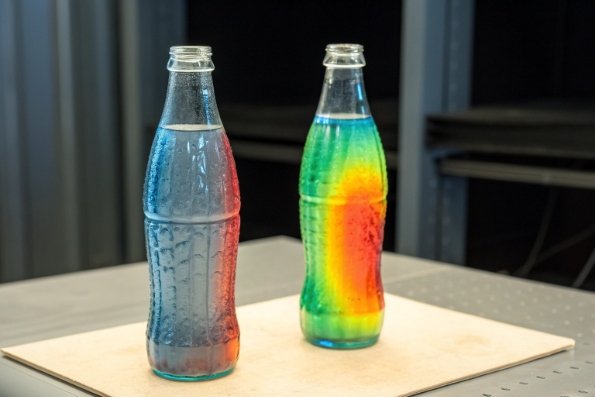
A lower CTE minimizes the mechanical stress generated by temperature gradients. Since the glass expands less, the difference in volume between the hot inner wall and the cold outer wall is small. This prevents the tensile stress from exceeding the glass’s breaking threshold, allowing safe processing at much higher ΔT limits.
The Mechanics of Survival
Let’s break down a typical Autoclave Cycle (Steam Sterilization).
-
Rapid Heat Up: The outside heats up fast.
-
Hold: Everything stabilizes at 121°C.
-
Rapid Cool Down (The Danger Zone): Cold water sprays the outside, or steam is vented.
During the cool down:
-
Soda-Lime: The outer skin cools to 60°C and tries to shrink violently. The inner core is still at 120°C and stays expanded. The outer skin pulls so hard it rips itself apart. Result: Explosion.
-
Borosilicate: The outer skin cools to 60°C but barely shrinks because its CTE is low. The inner core is still hot, but the difference in size is tiny. The tension is weak. Result: Survival.
Application Specifics
-
Hot-Fill (Sauces/Juices):
For a standard jam filled at 85°C, soda-lime is fine. But if you are doing a "Hot Fill and Hold" at 95°C+ followed by a flash cooler, borosilicate eliminates the need for slow, energy-wasting cooling tunnels. You can cool it as fast as you want.
-
Lab Applications:
In a lab, a beaker might go from a Bunsen burner ($>200^{\circ}C$) straight to a benchtop. Only 3.3 Borosilicate can handle a $\Delta T$ of 160°C without flinching.
-
Freeze-Drying (Lyophilization):
This is the ultimate test. The glass must survive freezing to -50°C and then vacuum heating. The thermal stress is reversed (contraction vs expansion), but the low CTE protects it both ways.
Calculating the Safety Factor
We use the Thermal Shock Resistance 7 ($\Delta T_{max}$) formula roughly as:
$$ \Delta T_{max} = \frac{\sigma (1-\nu)}{E \alpha} $$
Where $\alpha$ is the CTE.
Since $\alpha$ is in the denominator, lowering the CTE triples the thermal shock resistance.
| Material | Safe $\Delta T$ (Thermal Shock) | Typical Application Risk |
| :— | :— | :— |
| Soda-Lime | ~42°C | High (Requires tempered cooling) |
| Borosilicate 3.3 | ~160°C | Very Low (Can be abused) |
| Treated Soda-Lime | ~50°C | Moderate (Careful handling needed) |
What trade-offs come with high-borosilicate bottles (cost, forming difficulty, chemical durability, decoration compatibility)?
Nothing is perfect. While borosilicate is the king of thermal performance, it is a nightmare to manufacture and expensive to buy.
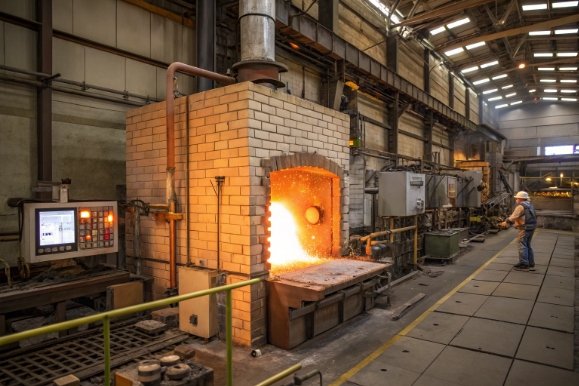
The main trade-offs are significantly higher costs (2-4x soda-lime), higher melting temperatures requiring specialized furnaces, and limited decoration options due to the high curing temps needed. Additionally, borosilicate is harder to form into complex, artistic shapes compared to the more fluid soda-lime glass.
1. The Cost Barrier
Borosilicate requires higher temperatures to melt (approx. $1600^{\circ}C$ vs $1500^{\circ}C$) and raw materials that are more expensive (Borax).
-
Energy Cost: We burn way more gas to keep the furnace running.
-
Refractory Wear: The higher heat eats our furnace bricks faster.
-
Production Speed: It is generally stiffer and sets faster, often requiring slower machine speeds.
For a client like "Chen" in Malaysia looking for a low-cost, mass-market solution, borosilicate is a non-starter. It would bankrupt his margin.
2. Forming Complexity
Soda-lime glass is like honey; it flows easily into molds. We can make intricate engravings, sharp corners, and fancy shapes.
Borosilicate is more like taffy. It is "short"—it hardens quickly.
-
Design Limits: We usually stick to simple shapes: cylinders (vials), simple rounds (reagent bottles). You rarely see a fancy, twisted perfume bottle made of boro.
-
Tubing vs. Molded: Many high-quality boro vials are not molded but made from "tubing glass 8"—drawn tubes that are cut and formed. This limits the geometry to… well, tubes.
3. Decoration Challenges
If you want to print a logo on glass, you use ceramic ink 9 and bake it on.
-
Soda-lime inks bake at $\sim 600^{\circ}C$.
-
Borosilicate needs special inks and higher baking temps because the glass surface is so chemically inert it doesn’t want to bond with the paint.
-
Decals: Traditional decals might flake off if not formulated specifically for boro expansion rates.
4. Chemical Durability (A Double-Edged Sword)
Actually, this is a "Trade-up," not a trade-off. Borosilicate is incredibly chemically resistant (Hydrolytic Class 1 10). It won’t leach alkali into your product.
- The downside: It is so stable that it’s hard to etch or treat if you want to modify the surface.
| Feature | Soda-Lime | Borosilicate | Impact on Buyer |
| :— | :— | :— | :— |
| Unit Cost | $0.10 – $0.50 | $0.30 – $1.50 | Massive budget impact |
| Shape Flexibility | High (Any shape) | Low (Simple shapes) | Limits branding design |
| Colors | Flint, Amber, Green, Blue | Clear, Amber (Limited) | Hard to get custom colors |
| MOQ | High (100k+) | Variable (Tubing is flexible) | Tubing allows smaller runs |
How do you choose between high-borosilicate and soda-lime bottles based on your temperature process and budget?
Making the right choice requires balancing your technical needs with your financial reality. You don’t buy a tank to drive to the grocery store.
Choose borosilicate if your process involves extreme temperature jumps ($\Delta T > 50°C), freezing, or critical pharmaceutical sterility. Choose soda-lime for standard beverages, cosmetics, and foods where the process is controlled and cost is the primary driver.

My Decision Framework
When I consult with a new client, I walk them through this simple logic flow to stop them from over-engineering (spending too much) or under-engineering (risking breakage).
Step 1: Analyze the Thermal Process
-
Question: What is the maximum sudden temperature change ($\Delta T$) the bottle will see?
-
< 40°C: (e.g., Room temp filling, or hot fill with tunnel cooling). Use Soda-Lime.
-
40°C – 50°C: (e.g., Aggressive washing). Use Treated Soda-Lime (Type II).
-
> 60°C: (e.g., Freezing, Oven sterilization, Lab use). MUST Use Borosilicate.
-
Step 2: Assess the Product Value
-
Question: What is the cost of failure?
-
Low: (e.g., A $2 jar of salsa). If 1 in 10,000 breaks, it’s acceptable. Use Soda-Lime.
-
High: (e.g., A $500 vial of cancer drug). If 1 breaks, it’s a disaster. Use Borosilicate.
-
Step 3: Check the Budget
-
Question: Can the COGS (Cost of Goods Sold) absorb a 3x packaging cost?
- Borosilicate is rarely used for FMCG (Fast Moving Consumer Goods) for this reason.
Step 4: Aesthetic Needs
-
Question: Do you need a crystal-clear heavy bottom (punt) for a premium look?
-
Borosilicate usually looks "laboratory-like"—thin and functional.
-
Soda-lime can be made thick and luxurious (like perfume bottles).
-
Real World Examples
-
Scenario A: The Juice Maker
Client wants to hot-fill juice at 90°C.
-
Analysis: We can install a stepped cooling tunnel to keep $\Delta T$ under 40°C.
-
Verdict: Soda-Lime. Save the money.
-
-
Scenario B: The Vaccine Lab
Client needs vials for lyophilization (-45°C) and autoclave (+121°C).
-
Analysis: The $\Delta T$ is extreme. Soda-lime will shatter.
-
Verdict: Borosilicate 5.0 (Tubing Glass).
-
-
Scenario C: The Baby Bottle Brand
Client wants a glass baby bottle that won’t break if parents put it from fridge to bottle warmer.
-
Analysis: Safety is paramount. $\Delta T$ is unpredictable in home use.
-
Verdict: Borosilicate 3.3. (This is a common consumer use for boro).
-
| Factor | Go Soda-Lime | Go Borosilicate |
| :— | :— | :— |
| Max $\Delta T$ | $< 42^{\circ}C$ | $> 50^{\circ}C$ |
| Product Type | Food, Drink, Cosmetic | Pharma, Lab, Chemical |
| Wall Thickness | Thick / Heavy | Thin / Uniform |
| Priorities | Cost, Shape, Weight | Safety, Stability, Inertness |
Conclusion
High-borosilicate glass is the ultimate thermal shield, offering a CTE three times lower than standard glass. While it comes with a premium price tag and design limitations, it is the only responsible choice for high-stress thermal environments where failure is not an option.
Footnotes
-
Key oxide added to silica to create heat-resistant glass structures. ↩
-
The most common commercial glass family, prone to thermal shock. ↩
-
Sterilization process using high-pressure steam to kill microorganisms. ↩
-
Brand name synonymous with borosilicate glass and thermal resistance. ↩
-
Freeze-drying process essential for preserving sensitive pharmaceutical compounds. ↩
-
Absence of matter used to preserve sterility and product stability. ↩
-
Measure of a material’s ability to withstand sudden temperature changes. ↩
-
Glass formed from drawing molten tubes rather than direct molding. ↩
-
Durable printing medium fused to glass at high temperatures. ↩
-
Highest standard of chemical resistance preventing interaction with contents. ↩






