
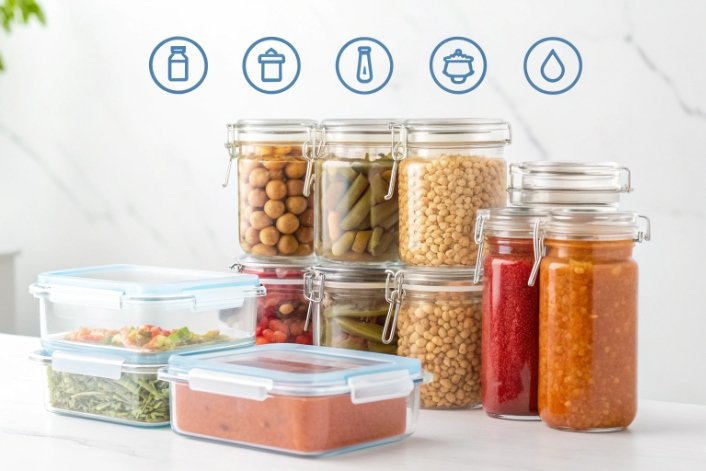
Too many container choices, plus growing fear of plastics, can make even a simple jar decision feel risky and confusing.
Glass jars are chemically inert, easy to seal, and very reusable, so they are usually safer for long-term storage than plastic, especially for acidic, oily, or reheated foods, as long as you respect heat limits and closure design.
In daily work with brands and food operations, glass jars keep showing the same pattern. Food tastes stay clean, labels look sharp, and containers last a long time, but only when everyone understands the limits. So in this article, the focus is not just “glass vs plastic”. The focus is how glass behaves with acids, oils, heat, air, light, and cleaning, and what that means for your process, your HACCP plan, and your total packaging cost.
Is glass safer than plastic for acidic, oily, or hot foods?
Many people feel uneasy heating food in plastic, but they still worry about glass breaking with hot soup or sharp tomato sauce.
For acidic, oily, or hot foods, glass is generally the safer choice because it is non-porous and chemically inert; the main risk is not chemicals, but thermal shock.
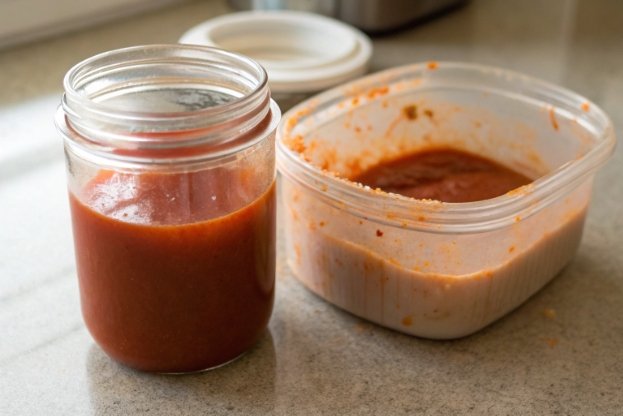
How glass and plastic behave with acids and oils
Glass is non-porous and chemically inert in food-contact use 1. It does not absorb food smells or colors and it does not release chemicals into food, even when food is acidic, salty, or fatty. This is why high-acid products like tomato sauces, pickles, citrus-based dressings, and fermented foods so often sit in glass on store shelves.
Many plastics, even “food-grade” ones, can release small amounts of additives like plasticizers or other residual chemicals. The effect increases with heat, time, and contact with acidic or oily foods. Recent work on microplastics shows that heating food in plastic can release millions of micro- and nanoplastic particles into food in just a few minutes of microwaving 2. That does not mean all plastic containers are “poison”, but it does push more critical applications toward glass.
For oils and fatty products, glass again has a clear edge. Some plastics slowly absorb oils or allow them to permeate, which can lead to off-odors, paneling, or softened walls over time. Good glass jars, paired with the right liner, give a strong barrier against both oxygen and oil migration, which matters for nut butters, infused oils, and rich sauces.
Heat, hot fills, and thermal shock
For heat, the question is not “Is glass safe?” but “Is this glass made and rated for the temperature change in my process?”. Most canning jars are soda-lime glass formulated for boiling-water or pressure canning with tested processes 3. They work safely when you preheat jars, leave tested headspace, and follow research-based times and temperatures.
The main glass risk is thermal shock. If you move jars too fast between extreme temperatures, they can crack or shatter. This can happen when you:
- Pour boiling liquid into a cold, thick jar
- Move a jar straight from freezer to hot water or microwave
- Take a very hot jar and place it on a cold, wet surface
Guides on microwaving mason jars say to treat them gently: bring fridge-cold jars closer to room temperature first, heat in short bursts, keep metal lids off, and let jars cool down slowly.
When plastic still makes sense
There are still roles for plastic. Tough PP or HDPE containers can be lighter and safer in settings with children, outdoor catering, or delivery, and they survive drops that would break glass. For short-term cold storage of non-acidic foods, and where you do not reheat inside the container, well-chosen plastic can be acceptable.
For long-term storage, frequent reheating, or high-acid and high-fat recipes, glass carries clear safety and quality advantages.
| Scenario | Glass jar (with rated lid) | Typical plastic container |
|---|---|---|
| Acidic foods (tomato, citrus) | Chemically inert, no leaching, no staining | Possible leaching and staining over time |
| Oily / fatty foods | Strong barrier, no softening or grease bleed-through | Some plastics absorb oil, can warp or smell |
| Hot filling / reheating | Safe when jar is rated and heated gradually | Heat can warp, cloud, or shed particles |
| Light-sensitive oils/herbs | Needs amber glass for UV protection | Some opaque plastics block light but may leach when hot |
Can glass jars be vacuum-sealed or pasteurized reliably?
Many small producers buy a jar sealer on the internet and hope it “turns” their sauce into a shelf-stable product.
Yes, glass jars can be vacuum-sealed and pasteurized very reliably, but only when you pair canning-grade jars with the right lids, tested processes, and realistic shelf-life expectations.
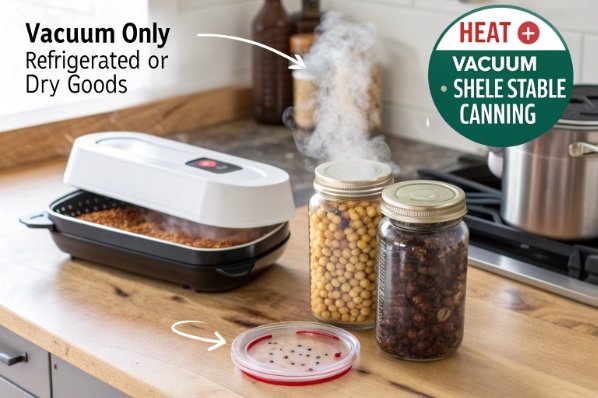
Vacuum sealing vs true canning
Vacuum-sealing a jar and heat-processing a jar are two very different things.
Jar vacuum sealers that sit over a metal lid simply pull out most of the air and help the lid grip the rim. They can extend the life of dry goods and some refrigerated foods by cutting oxygen and moisture. But they do not heat the food. So they do not destroy pathogens and they do not create a fully shelf-stable product.
University extension guidance is clear that vacuum sealing does not replace heat processing or refrigeration 4:
- Vacuum-sealed jars are fine for dry goods like grains, nuts, and dehydrated fruits.
- They can also be used for refrigerated sauces, relishes, and cut produce, but the jars still need cold storage.
- They are not a replacement for boiling-water or pressure canning, and should not be used to “shortcut” home-canning rules.
Pasteurization, hot-fill, and standard canning
For shelf-stable foods, glass jars shine when you follow established canning science. Standard canning jars plus metal lids with plastisol sealing compound are designed for:
- Boiling-water canning of high-acid foods
- Steam canning of high-acid foods, with tested times and controls
- Pressure canning of low-acid foods, when recipes are approved
When you fill hot food into hot jars, leave the tested headspace, and process for the correct time, several things happen:
- Heat destroys targeted pathogens and many spoilage organisms.
- Air is forced out of the headspace.
- On cooling, a strong vacuum forms and pulls the lid down against the jar.
- The gasket material forms a hermetic seal.
Headspace is not a small detail. Too little and food can bubble under the lid and block the seal; too much and you may not drive out enough air to get a strong vacuum.
Oven “dry canning”, where jars are heated in a regular oven, is not safe. Dry heat penetrates slowly, temperatures are uneven, and jars can explode. Authoritative canning guides warn clearly against this method.
Practical choices for small operations
In practice, an operation usually ends up with three tiers:
| Method | What it does well | What it cannot safely do |
|---|---|---|
| Plain lidded jars (no vacuum) | Short-term fridge storage; quick-serve items | Shelf-stable storage; protection against pathogens |
| Machine or hand vacuum sealing | Extends shelf life of dry goods; adds oxygen control | Replace heat-processing; make low-acid foods shelf-stable |
| Boiling-water / pressure canning | Full pasteurization of approved recipes; long shelf life | Free-form recipes without testing; uncontrolled jar and lid reuse |
For a cottage producer of jam, pickles, or sauces, the simplest safe route is still standard canning jars, new canning lids, a boiling-water or pressure canner, and a recipe that comes from a trusted research-based source. Vacuum sealing then becomes a tool for dry ingredients, not a shortcut for heat processing.
How do lid liners and closures affect barrier and leakproofing?
Many people focus on jar shape and glass color, but forget that one weak lid can ruin the whole package.
Lid material and liner choice decide how airtight, leakproof, and light-safe a glass jar really is, especially for oils, sauces, and long-term pantry goods.
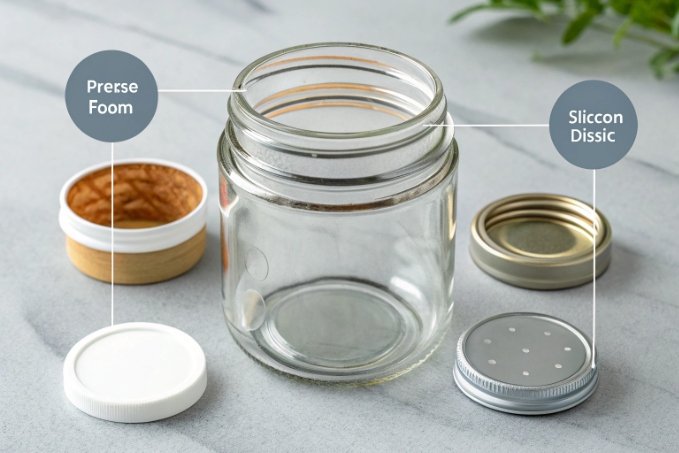
What lives inside the lid
A closure is more than “a lid”. Inside, there is almost always a liner or gasket that makes the actual seal. Different liner constructions balance cost, barrier strength, chemical resistance, leakproofing, and tamper evidence, and packaging guides offer detailed comparisons of common closure liner types 5.
Some of the most common types:
-
Foam liners (F217-style)
PE-faced foam. Good general barrier, stays in the cap, and reseals well. Not hermetic, and not tamper-evident. -
Pressure-sensitive (PS22)
Polystyrene foam with adhesive. Sticks to the rim the first time the lid is tightened, so the consumer must peel it off. Tamper-evident but not great for thin liquids. -
Polycone / polyseal
LDPE cone inside a cap that wedges into the jar mouth. Very leak-resistant and excellent for oils and other liquids. Reseals many times but is not tamper-evident. -
Plastisol in metal lug or CT caps
A bead of gasket inside a metal lid. Designed for hot-fill and canning with glass; cooling creates an airtight, hermetic seal, often with a “button” that pops on opening. -
Induction foil seals
Multi-layer constructions that weld a foil membrane to the jar rim using induction heat. Very strong oxygen and moisture barrier, plus tamper evidence. Usually combined with a secondary cap. -
Silicone lid liners and gaskets
High-purity silicone discs or gaskets under a band or snap lid. Flexible, high-temperature, BPA-free, and well suited to repeated use, dishwashing, and microwave reheating.
Good closures also manage venting when needed. Some liners include micro-vents so gassy products can off-gas without bloating the jar, yet still resist leaks.
Matching closures to real products
In real projects, the best closure is a match between product, logistics, and retail plan:
-
For dry goods (spices, nuts, grains), foam or pressure-sensitive liners are often enough. They control moisture and odor, give a clean opening, and do not demand special equipment.
-
For liquids and oils, polycone liners or plastisol-lined metal lids give a much tighter seal. They help avoid leaks in transit and reduce evaporation and oxygen pickup.
-
For shelf-stable hot fills, plastisol-lined twist-off or lug caps are standard. They are made for thermal cycling and long storage.
-
For high-value or very oxygen-sensitive products, induction seals offer the strongest barrier and tamper evidence, with a recloseable cap on top.
Light is also part of the barrier story. Clear glass shows off the product but gives poor protection against UV. Amber glass can block most damaging UV light and is a better choice for light-sensitive oils, herbs, and nutraceuticals.
Cheap plastic lids are often the weak point. Dishwasher heat can warp them, flatten gaskets, and slowly destroy the seal, even while the glass stays perfect. It is usually safer to hand-wash lids and bands, even when the jars themselves go through dishwash cycles.
| Liner / closure type | Best for | Barrier & leakproofing | Key limits |
|---|---|---|---|
| Foam (F217) | Dry foods, general pantry | Good moisture/odor barrier; reseals well | Not hermetic; no tamper evidence |
| Pressure-sensitive (PS22) | Dry goods, powders | Tamper-evident initial seal | One-time use; not ideal for thin liquids |
| Polycone / polyseal | Oils, extracts, chemicals | Very tight, leakproof wedge seal | Not tamper-evident |
| Plastisol in metal caps | Hot-fill foods, sauces, pickles | Hermetic seal after heating and cooling | Needs heat process; lid usually single-use |
| Induction foil + overcap | High-value, oxygen-sensitive products | Strongest O₂ and moisture barrier | Needs induction equipment |
| Silicone disc + band or lid | Reusable fridge/freezer, meal prep | Flexible, leakproof, food-safe, high-heat tolerant | Needs inspection for cuts or wear |
What cleaning and reuse cycles can operations expect?
Glass jars feel durable, but operations still need to know how many turns they can safely expect before quality or safety drops.
With sane handling, glass jars tolerate dozens or even hundreds of wash, fill, and reuse cycles; lids, gaskets, and labels usually wear out long before the glass.
Cleaning without killing the seal
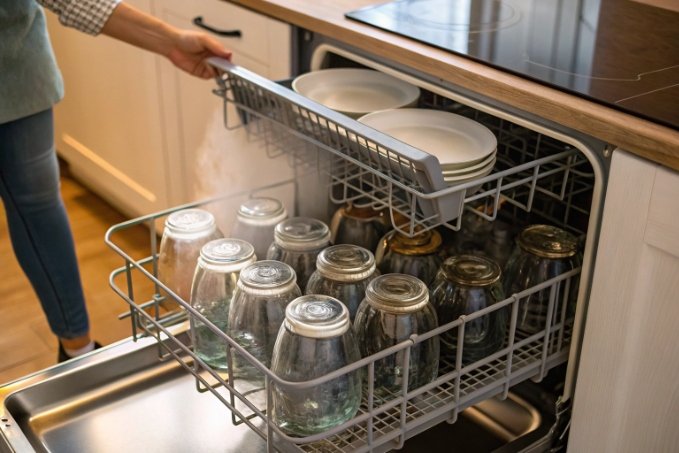
Glass is very forgiving in cleaning. It does not scratch or cloud easily, and it does not hold oils or odors when you use normal alkaline detergents. Most food-safe glass containers are dishwasher-safe, but there are a few simple rules:
- Let hot jars cool a bit before a cold rinse, and let fridge-cold jars warm slightly before going into very hot water. This reduces thermal shock.
- Wash lids and bands by hand in warm water and mild detergent. High dishwasher heat can warp plastic, thin metal coatings, and flatten gaskets.
- For stubborn residues, a baking-soda paste or bottle brush is usually enough. Avoid hard, abrasive pads that can etch glass over many cycles.
For microwave use, most guidance now says: check for microwave-safe symbols, keep metal parts out, bring jars to room temperature first, and heat in short bursts to reduce thermal stress.
How many times can you reuse jars and lids?
With proper handling, glass containers often last far longer than comparable plastic alternatives. In reality, the limit is not a fixed cycle count; it is about visible damage and the process you run.
-
Jar bodies
Reuse until you see chips, cracks, or heavy abrasion, especially on the rim. For canning, safety authorities say to discard any jar with damage on the sealing surface or any structural crack. -
Metal canning lids
Official advice is clear: single use only for new canning runs. After one full canning cycle, the sealing compound is indented and cannot be trusted again for shelf-stable products. Many operations reuse old lids only for refrigerator storage, if at all. -
Bands, snap lids, and plastic caps
These can often run many cycles, but they deserve regular inspection. Look for rust, warping, cracked hinges, or loose fit on the threads. -
Silicone gaskets and discs
Good silicone handles many cycles in dishwashers and freezers. Replace when you see cuts, permanent deformation, or smells that do not wash out.
For freezing, glass has one extra rule. Guides to freezing food in glass jars recommend straight-sided jars, generous headspace, and slow temperature changes 6. Sudden freezing of boiling-hot liquid in a shoulder jar is a good way to lose both jar and product.
Food safety, fridgescaping, and “pretty jars of produce”
A current trend is “fridgescaping”: packing cut fruits and vegetables into jars of water to make the fridge look more organized. The look is beautiful, but food safety experts are cautious.
Food-safety guidance for fresh-cut fruits and vegetables explains that cut produce has higher microbial risk and needs strict time–temperature control 7. Water gives bacteria an easy medium to grow, and sealed jars can trap that environment around the food.
For operations, this trend matters in two ways:
- You may choose to avoid long storage of raw produce in jars of water, especially for ready-to-eat items.
- If you use jars for prepped produce at all, treat them like any other high-risk refrigerated food: strict time–temperature limits, clear labels, and frequent rotation.
Used thoughtfully, jars reduce “out of sight, out of mind” waste because staff see exactly what is left and how it looks. Clear walls help with stock rotation and quality checks. But the protocol around those jars still needs to live inside your food safety system.
| Component | Typical realistic reuse pattern | Clear retire signals |
|---|---|---|
| Glass jar body | Many dozens of cycles in-house | Chips or cracks, especially on rim; deep scratches |
| Metal canning lid | One full canning use; maybe fridge use afterward | Any dent, rust, or previous canning use for shelf-stable |
| Band or plastic screw cap | Many cycles with gentle hand washing | Warping, rust, cracked threads, weak grip on jar |
| Silicone gasket / disc | Many cycles; freezer and dishwasher tolerant | Cuts, permanent flattening, trapped odors |
| Label and print | Often the first thing to fail | Peeling, smearing, unreadable codes |
Conclusion
For most acidic, oily, or heat-treated foods, glass jars plus well-chosen closures give safer, cleaner, lower-waste storage, as long as your sealing, heating, and cleaning practices match what the glass is built to do.
Footnotes
-
Overview of how glass’s non-reactive, non-porous structure protects food flavor and safety in packaging. ↩︎ ↩
-
Study showing microwaving plastic food containers releases millions of micro- and nanoplastics into food. ↩︎ ↩
-
Research-based guidance on safe boiling-water and pressure canning using standard glass jars. ↩︎ ↩
-
Extension article explaining that home vacuum packaging extends shelf life but is not a substitute for canning. ↩︎ ↩
-
Technical guide comparing common closure liners (foam, pressure-sensitive, induction, plastisol, etc.) and their best uses. ↩︎ ↩
-
Practical guide on safely freezing food in glass jars, including jar styles, headspace, and thawing tips. ↩︎ ↩
-
FDA guidance on microbial hazards and control measures for fresh-cut fruits and vegetables. ↩︎ ↩






