
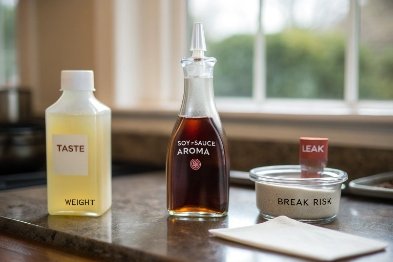
Soy sauce is salty, aromatic, and stubborn. If the package absorbs odor or leaks at the neck, the kitchen will smell like soy for days and the sauce will taste tired.
Glass soy-sauce bottles protect flavor and aroma because glass is inert and nonporous. They also look premium and clean. The trade-offs are weight and shatter risk, which can be reduced with smart shapes, sleeves, and the right cap and liner system that stops drips and crusty salt rings.
A good soy-sauce package is really two designs in one: the bottle that protects the sauce on the shelf, and the closure that controls pouring and prevents leakage after opening.
Does glass resist salt, acids, and odor transfer better than plastic?
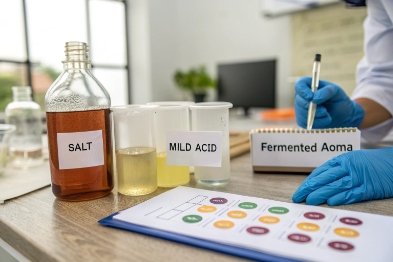
Soy sauce is a strong formula. It is high in salt, often slightly acidic, and full of fermented aroma compounds that can linger in packaging.
Yes. Glass is highly resistant to salt and mild food acids, and it does not absorb odors. Many plastics are food-safe, but they can hold “ghost smells” and can allow more oxygen transmission, which can speed aroma fade over long shelf life.
Why soy sauce benefits from an inert package
Three common quality problems for soy sauce packaging are:
- Oxidation that darkens color and flattens aroma.
- Odor transfer that makes the bottle smell permanently “soy.”
- Flavor pickup where the sauce tastes slightly “packaged” after long storage.
Glass handles all three well because it behaves like chemically inert and impermeable packaging 1 in normal food use:
- it is nonreactive with salty and acidic food systems
- it is nonporous, so it does not absorb the smell
- it is a strong barrier, so oxygen and moisture transmission through the wall is not a concern
Plastic can still work, especially for value formats and squeeze packs, but glass is the safer bet when the brand sells “authentic aroma” and wants stable color over time.
A realistic way to compare glass and plastic
Plastic does not automatically ruin soy sauce. The main differences show up when:
- shelf life is long
- distribution is warm
- the sauce is premium and aroma-driven
- the bottle is reused and washed
A useful way to make “barrier” measurable is to look at oxygen transmission rate (OTR) 2 and then confirm with real shelf tests.
| Factor | Glass | Plastic | What it means for soy sauce |
|---|---|---|---|
| Reaction with salt/acid | very low | low (varies by resin) | both are usable, glass is simpler |
| Odor absorption | very low | can be higher | glass stays neutral after washing |
| Oxygen barrier | excellent | lower | glass supports longer shelf life |
| Squeeze convenience | low | high | plastic wins for squeeze use |
If the goal is “clean taste and aroma for months,” glass is a strong choice. If the goal is “lightweight and squeeze,” plastic is often more practical.
Do dual-hole caps improve pour control and hygiene?
Many people love the classic soy-sauce “dual-hole” pourer, but they also complain about drips and crusty rings.
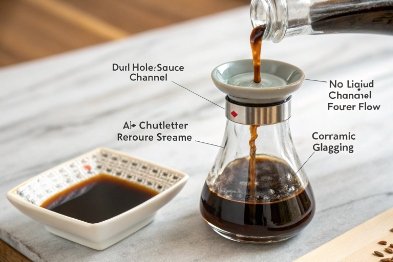
Dual-hole caps can improve pour control by separating flow and air intake, which reduces glugging and splashing. Hygiene depends on the design: a protected spout and a cap that closes tightly reduces dust contact and sticky buildup.
How dual-hole pourers work
A single-hole pourer often “glugs” because air cannot enter smoothly. A dual-hole system typically uses:
- one hole for liquid flow
- one hole for air return
This creates a smoother, steadier pour. That helps portion control, especially for table use and home cooking where people want a thin stream.
Hygiene is about protection and cleaning
A dual-hole pourer is only “more hygienic” when:
- the spout is covered between uses (flip top or screw cap cover)
- the cap seals well and does not leak into threads
- the design avoids deep crevices that trap residue
If the spout is always exposed, it can collect dust and kitchen aerosol. So the best dual-hole designs have an outer cap or a flip cover.
Pour control options worth comparing
| Pour system | Best use | Strength | Weakness |
|---|---|---|---|
| Dual-hole insert + cover | table and home cooking | smooth pour, less glug | needs cleaning to avoid crust |
| Single-hole spout | basic use | simple, cheap | glugging, splashing |
| Flip-top spout | quick pours | one-hand use | hinge traps residue |
| Pump | high-volume kitchens | controlled doses | more parts, cleaning burden |
For premium soy sauce, a dual-hole insert with a protective cover is often a good balance: controlled pour, good shelf look, and decent hygiene when the user closes it.
Are weight and shatter risks manageable in kitchens?
Glass is heavier and it can break. That is why buyers worry about kitchen use. Still, many households keep glass soy sauce without issues.
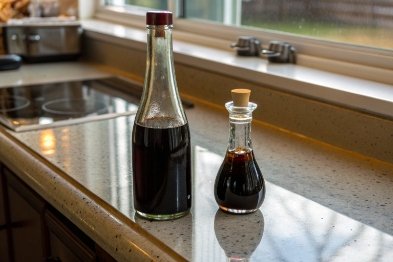
Yes, the risk is manageable when the bottle is sized well, has a stable base, and uses grip features like ribs or a silicone sleeve. For busy kitchens or kids-heavy homes, smaller glass sizes and protective sleeves reduce risk the most.
What makes glass manageable at home
Kitchen breakage often happens from:
- wet hands and slippery labels
- unstable tall bottles
- glass-to-sink impacts
- bottles stored high and dropped
So the design should focus on:
- lower center of gravity (wider base)
- textured grip (ribs, embossed panels)
- shorter height for common household sizes
- optional sleeve for extra grip and impact damping
Many brands succeed by using 150–250 ml glass formats for table use, then larger plastic refill formats for pantry storage.
How to reduce breakage without changing material
- Use cartons or dividers for multi-pack shipping.
- Use a slightly thicker heel area for impact resistance.
- Add a silicone sleeve or base ring for table versions.
- Avoid sharp base corners; prefer rounded heel geometry.
- Offer a “refill into glass” model so the glass bottle stays at home.
| Risk | Where it happens | Mitigation that works |
|---|---|---|
| Drop from counter | home kitchen | sleeve + wider base + shorter bottle |
| Slip from wet hands | cooking | textured grip + matte label finish |
| Sink impact | washing | advise hand wash, avoid banging |
| Shipping breakage | distribution | partitions + stronger corrugate |
Glass can be safe in kitchens, but only when the bottle is designed for daily handling, not only for shelf display.
Which closures prevent leakage and crystallized residue?
Soy sauce loves to creep. It wicks into threads, dries, and forms salty crystals that cause sticky caps and drips.
The best leak and residue control comes from a tight primary seal (liner or plug seal), a drip-reducing pourer geometry, and a closure that limits sauce contact with threads. Adding an induction seal for retail can also prevent leaks before opening.

What causes the crusty ring
Crystals form when small amounts of soy sauce stay exposed to air on the spout or threads. Evaporation leaves salt and sugars behind. This is made worse when:
- the pour stream hits the outside lip
- the bottle is over-tilted and sauce runs down the neck
- the cap seal is weak and sauce seeps into threads
- the user stores the bottle on its side
So closure design should aim to:
- keep the flow clean and centered
- create a tight seal at the top
- keep the threads dry
Closure systems that work well on glass soy sauce bottles
1) Continuous thread (CT) cap with liner
A continuous-thread screw cap 3 with a good liner can seal well and is easy to apply consistently. For soy sauce, the liner should resist salt and food acids and maintain compression. A good liner also reduces slow leakage that causes sticky caps.
2) CT cap + pourer insert (dual-hole) + protective overcap
This is common for table soy sauce. The insert controls flow, and the overcap keeps dust off and reduces evaporation at the spout.
3) Induction seal (inner) + CT cap (outer)
Using induction sealing 4 is strong for retail leak prevention and first-open protection. After opening, the user relies on the cap and pourer for daily sealing.
4) Plug seal / inner stopper
Some designs use an inner plug that seals against the bottle mouth rather than relying only on a flat liner. Plug seals can keep threads cleaner and reduce leakage if the geometry is correct.
What to specify to prevent leaks
- Correct finish dimensions and roundness, so the liner compresses evenly.
- Controlled cap torque so the seal is consistent.
- Liner material compatible with salty, acidic, and aromatic contents (for example, PTFE-faced liners 5 when chemical resistance is the priority).
- Inversion leak testing during QA, not only visual checks.
- Pourer lip design that reduces drips (anti-drip edge geometry).
| Goal | Best closure approach | Why it helps | QA test to use |
|---|---|---|---|
| Prevent retail leakage | induction seal + CT cap | true barrier before opening | vibration + inversion checks |
| Reduce drips at table | dual-hole insert + cover | smoother flow, less glug | pour test + drip count |
| Stop sticky caps | plug seal or strong liner | keeps threads drier | torque + leak trend charts |
| Preserve aroma long shelf | induction + low headspace | limits oxygen and aroma loss | shelf test + sensory check |
For soy sauce, “no leakage” is not only a seal problem. It is also a flow geometry problem. When the pour is clean, the residue problem drops sharply.
Conclusion
Glass soy-sauce bottles protect aroma and resist salt and odor transfer, while dual-hole pourers can improve control. The trade-offs of weight and breakage are manageable with smart design, and leak-free performance depends on the right liner, finish fit, and drip-control geometry. If sustainability messaging matters, align claims to local recycling reality—especially where colour-sorted cullet streams 6 affect what glass can become next.
Footnotes
-
Explains why container glass is inert and impermeable—useful for flavor and aroma protection. ↩︎ ↩
-
Defines OTR and why it’s a practical metric when comparing packaging oxygen barriers. ↩︎ ↩
-
Background on screw-cap closures and why thread geometry matters for sealing. ↩︎ ↩
-
Overview of induction sealing and why it improves first-open leak resistance. ↩︎ ↩
-
PTFE basics and why it’s valued for chemical resistance in liner-facing materials. ↩︎ ↩
-
Shows how colored-glass recycling works and why color sorting impacts circularity claims. ↩︎ ↩






