
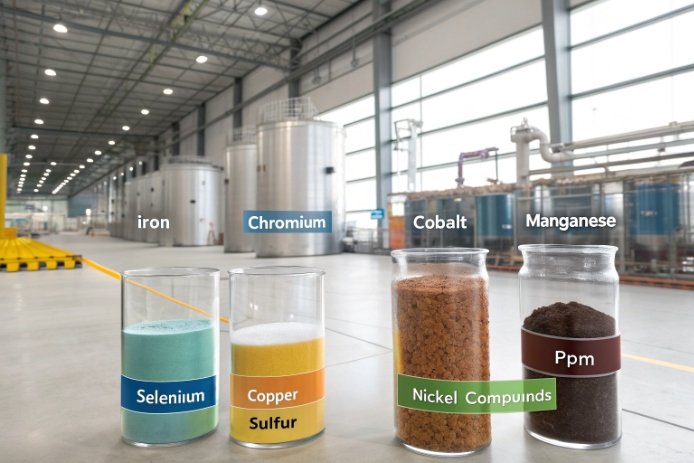
A “same recipe” bottle can still look different on the shelf. Most of the time, that gap comes from coloring ions 1 sneaking in through raw materials, cullet, or furnace carryover.
The main sources of coloring ions in bottle glass are trace impurities in sand and minerals, variable cullet chemistry, and deliberate colorant additions. Iron is the biggest driver because small Fe changes and redox shifts can move glass from flint to greenish, or shift amber tone.
The real map of “where color comes from”
Color in container glass 2 is not one lever. It is a network. The plant can hit the target one week and miss it the next week if any link drifts: sand lot, cullet mix, sulfate/redox, furnace atmosphere, or even batch dust carryover. The key is to separate color sources into two buckets:
1) Unwanted ions that arrive as impurities (Fe, Cr, Ti, Mn, Ni, Co traces, Cu traces, sulfur carryover, carbon, etc.).
2) Intentional colorants added to create flint, green, amber, and specialty looks.
Iron sits in the middle. It is both a contaminant for flint and a functional color partner for green and amber systems. It also reacts with furnace redox 3, so the same Fe content can look different depending on Fe²⁺/Fe³⁺ balance.
From a control view, I treat color consistency like a budgeting problem:
-
Raw materials set the baseline impurity budget.
-
Cullet sets the variability budget.
-
Intentional colorants and redox are the tools to “shape” the spectrum to the spec.
Typical coloring ions and where they come from
| Ion / species | What it tends to do visually | Common source | Why it becomes a problem |
|---|---|---|---|
| Fe (Fe²⁺/Fe³⁺) | Green/blue-green, yellow-brown; also UV absorption 4 | Sand, cullet, minerals, furnace dust | Small drift shows as tint drift |
| Cr | Green (strong), can deepen green | Cullet contamination, refractories, some raw materials | Hard to correct without over-coloring |
| Mn | Can decolorize (at some levels) or add pink/purple/gray | Some sands/minerals, old decolorizer practices | Sensitive to redox; can “bloom” color |
| Co | Strong blue | Contamination, specialty additions | Extremely strong; tiny overdose is visible |
| Ni | Gray/brown | Stainless contamination, cullet, some minerals | Adds unwanted dullness |
| Ti | Yellowing / haze effects | Sand, minerals | Increases warm tone and can lower flint brightness |
| Cu | Blue-green | Cullet contamination, intentional for some colors | Redox sensitive, can shift shade |
| S species (sulfide/sulfate) | Amber/brown (sulfide), or affects fining | Batch chemistry, fuel, furnace | Changes with redox and refining |
This is why the best color programs do not only set a “colorant recipe.” They also set a discipline around impurities.
Which raw materials commonly introduce iron (Fe) that turns glass green or amber?
A flint bottle can look “clean” in the lab and still look green under store lights. That usually means iron came in higher than expected, or redox pushed more Fe into Fe²⁺.
Iron most commonly enters bottle glass through silica sand, cullet, and natural carbonate/mineral raw materials. Sand lot variation is the largest risk by mass, and cullet variation is the fastest way to shift Fe and shade from batch to batch.

The biggest iron contributors in practice
1) Silica sand (the main one)
Sand is the dominant ingredient by weight in soda-lime container glass 5. Even “good” sand has some iron-bearing minerals. Two sand lots with the same average Fe₂O₃ can still behave differently if:
-
grain size distribution 6 changes (melting and mixing change),
-
heavy mineral fraction changes,
-
moisture and handling change (segregation in silos),
-
sampling is inconsistent.
For flint, sand is usually the first place to tighten specs. For green or amber, sand can still matter because it shifts the baseline that the color system must correct.
2) Cullet (the fastest driver of variation)
Cullet often contains:
-
higher iron than the original batch (depending on source),
-
color contamination (green/amber pieces in flint stream),
-
metals and ceramics (labels, closures, stones).
A small rise in cullet iron can show as a noticeable green cast in flint if redox is slightly reducing.
3) Carbonates and mineral additions
Limestone, dolomite, feldspar, nepheline syenite 7, and other mineral sources can carry iron as trace impurity. Many plants focus on sand and forget these. That is a mistake when the goal is tight flint color.
4) Batch dust / carryover and furnace environment
Dust returns, feeder carryover, and furnace crown/refractory wear 8 can introduce trace metals. It is not the main iron source, but it can explain “mystery drifts” when raw materials look stable.
A practical raw material control table
| Raw material | Iron risk level | Why it matters | Best control habit |
|---|---|---|---|
| Silica sand | Very high | Biggest mass input | Lot testing + supplier qualification |
| Cullet | Very high | Highest variability | Sorting + clear cullet specs |
| Limestone/dolomite | Medium | Hidden contributor | Periodic oxide checks (XRF) |
| Feldspar / alumina sources | Medium | Trace impurities | Control supplier and lot blending |
| Additives (sulfate, carbon) | Indirect | Changes redox and iron state | Tight dosing + stable redox control |
The most cost-effective move is almost always better sand control and better cullet discipline, before adding more colorants to “hide” drift.
How do cullet sources and contamination change color consistency from batch to batch?
Many plants increase recycled content and then wonder why color moves more. The reason is simple: cullet is not one material. It is many sources mixed together.
Cullet changes color consistency because different cullet streams carry different iron levels, different colorant history, and different contamination. Mixed-color cullet, ceramics, and metals can shift both the shade and the redox behavior of the melt, making batch-to-batch color harder to repeat.
What cullet variability looks like on the shop floor
Post-industrial cullet (internal, known)
This is usually the cleanest and most stable: reject ware from the same line, same color, same chemistry. It tends to improve consistency and melt efficiency.
Post-consumer cullet (external, variable)
This can be stable if the supplier has strong sorting and QC. It can also be a major variability source when:
-
“flint” contains light green pieces,
-
amber contains mixed greens,
-
ceramics and stones enter (leading to defects and local color streaks),
-
metal fragments enter (Ni, Cr, Fe contamination),
-
organic residues increase foaming and shift redox locally.
Contamination types that hit color the hardest
-
Mixed-color contamination: even small percentages of green in flint can show quickly.
-
Refractory/ceramic contamination: often affects defects first, but also adds trace oxides.
-
Metal contamination: can add Ni/Cr/Fe and create gray/brown dullness or unexpected shade shifts.
-
Label/organic contamination: changes redox demand, which changes Fe²⁺/Fe³⁺ ratio and shade.
What “batch-to-batch color swing” often means
It usually means one of these moved:
1) Cullet ratio (more or less cullet than target),
2) Cullet source (supplier mix changed),
3) Sorting efficiency (more off-color pieces slipped in),
4) Redox in furnace (same cullet but different iron state outcome).
Cullet control checklist that actually works
-
Separate storage and handling by color stream.
-
Use contracts that define allowable off-color % and contaminants.
-
Audit cullet lots with quick optical sorting checks.
-
Track “cullet fingerprint” in QC (oxide check + color trend).
The best plants treat cullet like a critical raw material, not like “free glass.”
What coloring agents are intentionally added for amber, flint, and specialty colors, and how are doses controlled?
Color is not only chemistry. It is also repeatability. The same colorant list can still fail if dosing is not stable or if redox is not held.
Amber, flint, and specialty colors use deliberate additives such as iron, sulfur compounds, carbon, chromium, cobalt, selenium, manganese, and copper depending on the target shade. Doses are controlled by tight feeder accuracy, standardized color concentrates, melt sampling, and inline color measurement tied to defined correction rules.

Flint (clear) glass: “colorless” is a system
Flint is usually achieved by:
-
using low-iron raw materials (especially low-Fe sand),
-
controlling redox to avoid excess Fe²⁺ green cast,
-
sometimes using decolorizing strategies depending on plant practice and regional norms.
Common intentional agents in flint programs:
-
Small balancing additives (varies by plant) to neutralize unwanted tint.
-
Oxidizing control to keep iron in a less green-causing state.
Flint control is less about “adding a colorant” and more about preventing impurities from showing.
Amber glass: controlled brown with redox-sensitive chemistry
Amber commonly uses:
-
Iron as part of the base system,
-
Sulfur chemistry (sulfide species contribute to amber/brown),
-
sometimes carbon/reducing agents to push the sulfur/iron system to the correct state,
-
optional additions depending on the exact amber tone required.
Amber is very sensitive to furnace atmosphere and batch redox balance. Two furnaces can run the same “paper recipe” and still make different ambers if combustion trim differs.
Green glass: often iron + chromium based systems
Green typically comes from:
-
iron (often unavoidable and partly desired),
-
chromium for stronger green depth (very powerful),
-
sometimes other modifiers depending on the target “emerald” or “dead-leaf” tone.
Chromium is strong and unforgiving. Tight dosing and stable cullet sorting matter.
Specialty colors: high strength colorants
Common examples:
-
Cobalt for blue (extremely strong, micro-level control needed),
-
Selenium for pink/red tones or warm shift (also redox sensitive),
-
Copper for blue-green effects (redox sensitive),
-
Manganese for purple/gray shifts or decolorizing roles in some systems,
-
Nickel sometimes used for gray tones (also can appear as contamination).
How doses are controlled in a modern plant
Good control is a mix of mechanical accuracy and feedback:
1) Feeding accuracy
-
Calibrated feeders and load cells
-
Moisture control in batch materials
-
Anti-segregation handling for fine colorants
2) Use of masterbatches or pre-mixes
Many plants prefer color concentrates 9 to reduce weighing error and segregation risk.
3) Closed-loop verification
-
Lab checks: oxide composition and redox indicators
-
Melt sampling: confirm shade and stability
-
Inline color at cold end: L*a*b* trend alarms and small correction rules
A simple dosing control table
| Color type | Typical intentional agents | Biggest control risk | Best control method |
|---|---|---|---|
| Flint | low-Fe strategy + redox control (sometimes decolorizers) | trace iron + redox drift | raw material specs + steady combustion |
| Amber | iron + sulfur system (often redox tuned) | furnace atmosphere swings | redox monitoring + stable batch |
| Green | iron + chromium (as needed) | Cr overdose, cullet mix | color concentrate + cullet discipline |
| Blue | cobalt | micro-overdose | masterbatch + tight feeder calibration |
| Pink/Red | selenium (and partners) | redox sensitivity | redox stability + sampling |
The message is simple: colorants do not “fix” variability. They amplify it if the plant is not stable.
How can manufacturers reduce unwanted coloring ions while keeping costs and recycled content targets?
Lower impurities often means higher raw material cost. Higher cullet often means higher variability. The sweet spot is process design, not just buying better sand.
Manufacturers reduce unwanted coloring ions by tightening sand and mineral specs, improving cullet sorting and contracts, using blended lots to smooth variability, and applying closed-loop color and redox control. This keeps cost controlled while still meeting recycled content targets.

Step 1: Buy “right enough” raw materials, then blend smart
Not every product needs ultra-low-iron sand. A smart approach is:
-
define color tolerance by SKU,
-
use tighter sand only for the most sensitive flint programs,
-
blend sand lots to reduce spikes instead of paying for premium across everything.
This keeps cost predictable.
Step 2: Make cullet a controlled input, not a surprise
To keep recycled content high without losing color consistency:
-
prefer post-industrial cullet where possible,
-
build strong specs with cullet suppliers (off-color %, ceramics ppm targets, metals limits),
-
add sorting tech and audits that match the plant’s sensitivity.
If the brand needs tight flint, the plant can still use high cullet, but the cullet must be “flint-grade,” not “mixed glass.”
Step 3: Reduce contamination cost by preventing it upstream
Many problems come from handling:
-
mixed bins,
-
dirty conveyors,
-
poor separation of colors,
-
untracked supplier changes.
Low-cost fixes often include better yard discipline, better container labeling, and tighter receiving inspection.
Step 4: Control redox so iron behaves the same
Even with stable Fe input, redox drift can shift shade. Control redox through:
-
burner balancing,
-
consistent batch moisture,
-
clear rules for oxidizer/reducer additions.
This reduces the need for heavy colorant “correction,” which is often expensive and creates side effects.
Step 5: Use “measure then correct” instead of “guess then chase”
A cost-effective control stack looks like:
-
incoming raw material Fe checks (especially sand),
-
cullet lot verification,
-
cold-end inline color monitoring,
-
periodic Fe²⁺ fraction checks to confirm redox behavior.
Corrections should be small and rule-based. Big corrections increase scrap.
A cost vs. stability decision matrix
| Lever | Cost impact | Color stability impact | Best use case |
|---|---|---|---|
| Premium low-Fe sand | High | High | tight flint, premium cosmetics |
| Better cullet sorting | Medium | Very high | high recycled content with strict color |
| Lot blending strategy | Low | Medium | smoothing supplier variability |
| Inline color monitoring | Medium | High | preventing large drifts and scrap |
| Extra colorant “to hide” | Medium to high | Low to negative | last resort only |
The most reliable path is not “add more colorant.” It is “reduce variability at the source, then control redox.”
Conclusion
Coloring ions come from sand, minerals, cullet, and intentional colorants. Tight specs, disciplined cullet control, and stable redox keep color consistent without sacrificing cost or recycled content goals.
Footnotes
-
Scientific overview of how transition metal ions impart specific colors to glass materials. ↩
-
Industry facts regarding the production, lifecycle, and recycling of container glass products. ↩
-
Explanation of reduction-oxidation chemistry control in glass melting furnaces to manage iron color. ↩
-
Details on ultraviolet radiation absorption properties in materials and their protective applications. ↩
-
Encyclopedia entry describing the chemical composition and properties of standard commercial glass. ↩
-
Technical definition of particle size spread in raw materials and its effect on melting. ↩
-
Mineralogy data for this alumina-rich raw material often used in glass batching. ↩
-
Analysis of how furnace lining materials degrade over time and contaminate the melt. ↩
-
Information on pigment systems and masterbatches used for precise coloring of industrial glass. ↩
-
Guide to optimizing burner fuel-to-air ratios for energy efficiency and atmosphere control. ↩






