
Bad glass does not always crack in the factory. It can fail on shelf, during filling, or in shipping. The root cause is often hidden in the recipe.
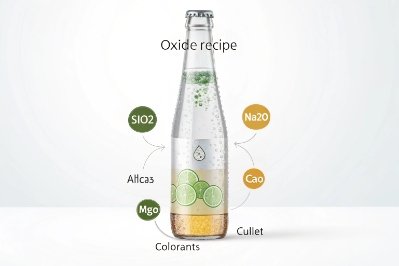
Bottle glass is mainly a controlled mix of silica plus fluxes, stabilizers, and minor oxides. That oxide balance sets melting cost, color, strength, chemical resistance, and the final transmittance profile of the bottle.
The bottle glass “recipe” is an oxide system, not a mystery
The four roles every bottle-glass recipe must cover
Bottle glass is not one material. It is a family of oxide systems designed to melt fast, form well, and survive real use. In daily packaging work, it helps to think in roles:
-
Network former: builds the glass structure (mainly SiO₂).
-
Flux: lowers melting temperature and viscosity so the furnace can run efficiently (Na₂O, K₂O, sometimes Li₂O).
-
Stabilizer: improves durability and strength so the bottle does not dissolve or weaken (CaO, MgO).
-
Modifiers and helpers: tune chemistry, color, and refining (Al₂O₃, Fe₂O₃, SO₃, etc.).
Each role fights another role. More flux lowers cost and raises throughput, but it can reduce durability. More stabilizer improves resistance, but it can increase melting difficulty. This is why bottle glass is always a balance, not a single “best formula.”
What most “standard” container glass contains
For mainstream packaging, the common base is a soda-lime glass 1 system. It is popular because it gives a wide forming window and low raw material cost. Still, the exact oxide ranges can vary by region, furnace technology, recycled glass cullet 2 content, and color target.
The table below shows the typical function of common oxides in bottle glass. This is the part procurement teams can use when they review a new supplier’s glass recipe.
| Oxide | Common role in container glass | What it tends to change | Risk if pushed too far |
|---|---|---|---|
| SiO₂ | main network former | strength, stability | high melt temperature, higher energy |
| Na₂O / K₂O | flux (alkali) | lower melting temp, faster melt | lower chemical durability, higher leaching risk |
| CaO | stabilizer | durability, hardness | higher melting difficulty if excessive |
| MgO | stabilizer/modifier | durability, viscosity control | can tighten forming window |
| Al₂O₃ | network enhancer | chemical resistance, strength | higher viscosity, harder melting |
| Fe₂O₃ | colorant/impurity | UV/visible absorption, tint | color drift and transmittance drift |
| SO₃ and refining agents | fining/refining | bubble removal, clarity | defects if out of control |
Why this matters for packaging decisions
A buyer often asks for “stronger bottles” or “better UV protection.” Those goals are not only about thickness or coatings. The base glass chemistry can shift transmittance, surface durability, and long-term stability.
When we design a packaging solution, the fastest way to avoid disputes is to connect requirements to oxide roles. That keeps discussions grounded. It also makes supplier audits easier, because every oxide has a job and a tradeoff.
The next sections break the topic into the questions that come up in real sourcing: what the standard soda-lime system looks like, why composition drives cost, how to map oxide ranges to requirements, and what new chemistries are showing up in sustainability programs.
What oxides form standard soda-lime glass systems?
Small recipe changes can feel harmless. Then the bottle color shifts, the transmittance curve moves, or the filling line sees more breakage.
Standard soda-lime container glass is built on SiO₂ with Na₂O (and sometimes K₂O) as flux, plus CaO and MgO as stabilizers, with smaller amounts of Al₂O₃ and trace oxides that control refining and color.

The core oxide set and why it became the default
Soda-lime container glass became the default because it balances three needs at the same time: low-cost raw materials, efficient melting, and acceptable durability for foods and drinks. The base structure is built using a silicon dioxide network 3. Soda (Na₂O) lowers melting temperature so the furnace can operate at a lower energy cost per ton and achieve good pull rate. Lime (CaO) and magnesia (MgO) stabilize the structure so the glass does not become too soluble or too soft.
Most container glass also includes a small amount of alumina (Al₂O₃). Alumina acts like a “strengthener” for the network. It can improve chemical durability 4 and reduce certain durability issues. The exact level depends on raw materials and the target performance.
Why composition balance drives cost and performance?
Glass can be cheap on a spreadsheet and expensive in the field. Breakage, rejects, and complaints are all hidden costs.
Composition balance drives cost because it sets melting energy, furnace pull rate, and defect risk. It drives performance because it controls durability, strength, color, and spectral transmittance that affect shelf life and brand consistency.
Performance lives in durability, strength, and optics
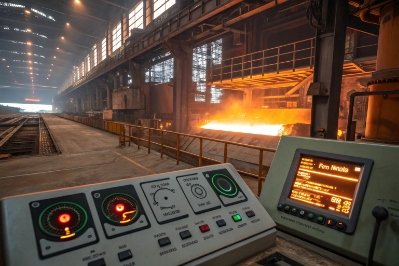
In packaging, performance is not one metric. It includes resistance to contents, thermal shock resistance 5 during hot-fill or pasteurization, and stable appearance.
The chemistry touches all of these. A small shift in iron can change the final spectral transmittance profile 6 of the bottle, impacting the shelf life of light-sensitive contents.
How to map oxide ranges to packaging requirements?
Many specs say “food grade glass” and stop there. That wording does not protect a brand. A real spec translates requirements into measurable oxide and optical controls.
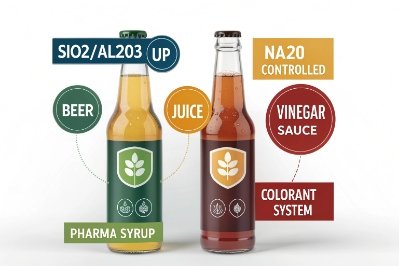
Map oxide ranges to requirements by starting with the fill risk (corrosion, light sensitivity, thermal process), then selecting glass families and tightening controls on alkali, alumina, iron, and recycled-content variability, backed by bottle-level transmittance and durability tests.
Step 1: Start with the fill and the process
Packaging requirements come from the product and the process. Higher durability targets often push toward better network stability, while light-sensitive targets push toward colorant control.
Are alternative chemistries emerging for sustainability?
Sustainability goals push hard on glass. Brands want lower carbon. Plants want stable melting. Buyers still want the same look and the same performance.
Yes. Sustainability is driving higher recycled content, lower-carbon melting strategies, and selective use of alternative glass families like borosilicate or aluminosilicate for special needs, but mainstream bottles still rely on optimized soda-lime because it scales well.
Low-carbon goals still must protect product quality
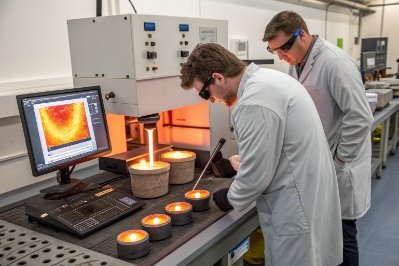
A sustainability-driven recipe change can create a quality risk. In some cases, high-end applications move toward borosilicate glass 7 when they need extreme thermal shock performance or superior chemical stability.
Conclusion
Bottle glass chemistry is an oxide balance. That balance controls melting cost, defects, durability, and spectral behavior. Clear specs should link oxide control to finished-bottle performance, especially for light-sensitive foods.
Footnotes
-
A comprehensive overview of the most common glass type used for windowpanes and glass containers. ↩ ↩
-
Insights into the environmental benefits and technical processes involved in using recycled glass for manufacturing. ↩ ↩
-
Technical details on the primary network-forming oxide that provides structural integrity to most glass systems. ↩ ↩
-
Scientific evaluation of a material’s ability to resist degradation when exposed to various chemical environments. ↩ ↩
-
Understanding the mechanical stress and potential failure caused by rapid temperature changes in glass materials. ↩ ↩
-
A technical guide to how different wavelengths of light pass through or are absorbed by glass. ↩ ↩
-
Learn about the properties of glass with high thermal shock resistance used in specialized industrial applications. ↩ ↩






