
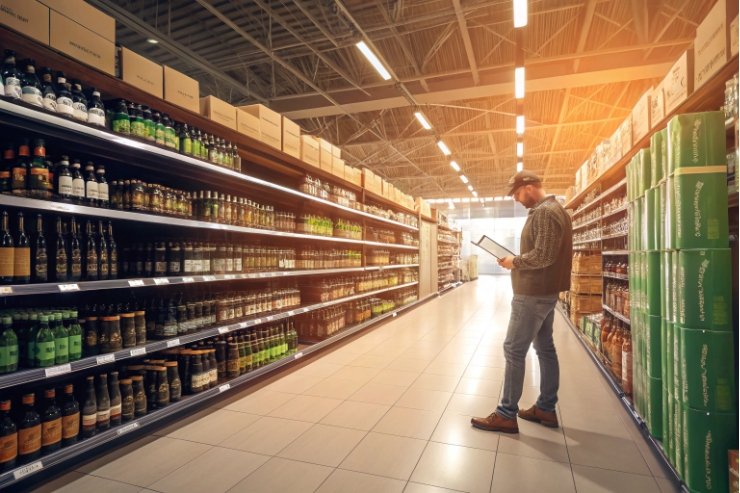
Walk down any beer aisle and it looks like chaos: long necks, stubbies, swing-tops, bombers, all mixed with cans. It feels impossible to tell structure from pure styling.
Beer bottles fall into a few clear families: longneck and steinie “workhorses”, swing-top and specialty forms, plus regional sizes and colors that balance light protection, pressure, returnability, and brand story.
Once you look at shape, color, weight, and size through a technical lens, the variety starts to make sense. Each choice comes from brewing style, logistics, and the image a brewery wants on shelf or on tap handles.
How do longneck, steinie, and swing-top forms differ?
Most brands start by copying whatever shape dominates their local market. That is safe, but it also makes your beer disappear into a wall of identical brown glass.
Longneck, steinie, and swing-top bottles differ in height, body width, neck length, and closure style, which changes how they pack, pour, and signal “mass-market”, “heritage”, or “craft/reusable” to drinkers.
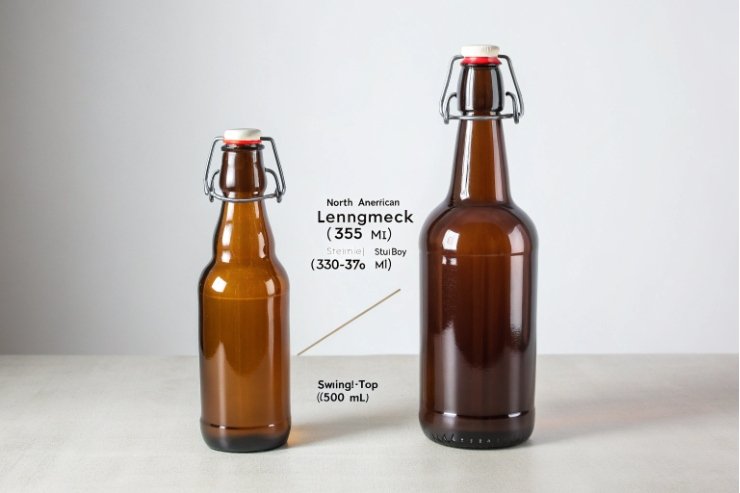
Longneck, steinie, swing-top: three very different “personalities”
When designing glass for breweries, these three shapes come up again and again. Each one solves a slightly different problem.
Longneck (ISB / North American standard)
The longneck (12 oz / 355 ml in North America, 330 ml variations elsewhere) is the classic tall silhouette: narrow body, long neck, crown finish. It’s often built around an Industry Standard Bottle (ISB) 1 footprint because:
- It runs smoothly on high-speed lines.
- It fits almost every cooler, shelf and bar back.
- It gives a big label panel and good hand grip.
For mainstream lagers and many craft beers in the US and Canada, this is the default. It tells the shopper “this is a beer you already understand.”
Steinie / stubby
Steinie or stubby bottles are shorter and wider, with a low center of gravity and a chunky feel. The steinie (stubby) bottle 2:
- Packs more efficiently in some carton sizes.
- Feels sturdy and nostalgic in the hand.
- Offers a more “collectible” look on shelf.
They were historically common in Canada and Australia, and they keep coming back in craft and retro-style launches because the silhouette stands out next to longnecks without asking for new line equipment.
Swing-top / flip-top
Swing-top bottles use a ceramic or plastic stopper on a wire bail, with a rubber gasket. This flip-top (swing-top) bail closure 3 changes not just the closure, but how the bottle behaves:
- You can reseal after opening, so they suit growlers, specialties, or table sharing.
- The closure itself becomes part of the brand language.
- They imply “refillable”, “craft”, or “heritage” even when used one-way.
They usually cost more and need more careful handling on the line, but they send a very strong message for farmhouse ales, Bavarian styles, or “old world” positionings.
Quick shape comparison
| Type | Typical volume | Look and feel | Best for |
|---|---|---|---|
| Longneck | 330–355 ml (12 oz) | Tall, familiar, efficient | Mainstream lagers, widely distributed crafts |
| Steinie | 330–375 ml | Short, stout, nostalgic | Heritage brands, retro launches, some exports |
| Swing-top | 330–750 ml | Craft, reusable, premium | Artisanal beers, specialties, refill concepts |
So when a brewery chooses between these, they are really choosing what the drinker should feel: familiar, retro, or craft-ritual.
Which colors—amber, green, flint—fit style and light defense?
Brewers care a lot about light, because “skunked” beer can ruin hard work in a single sunny afternoon. At the same time, marketing teams want color stories and clear glass to show the liquid.
Amber, green, and flint bottles balance light protection, style, and tradition: amber gives the best UV defense, green carries heritage cues, while flint shows off the beer but offers almost no light protection.
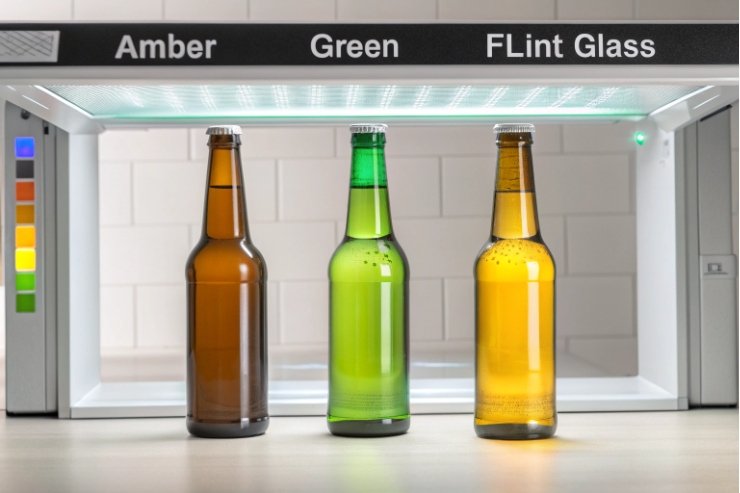
Why light matters so much for beer
Hop compounds react with UV and some visible light to create lightstruck flavor 4 off-notes. The classic “skunky” aroma is exactly this reaction. So the glass color is not only aesthetic; it is a technical choice.
Roughly:
- Amber glass blocks most of the UV range that causes problems.
- Green glass blocks some, but not as much as amber.
- Flint (clear) glass blocks very little UV.
If a beer is heavily hopped and sold in clear or green glass, the brand usually relies on modified hop extracts or very controlled storage to avoid lightstruck flavors.
Color roles by style and brand story
Each color also carries expectation:
- Amber: Serious, quality, craft, “this brewery cares about stability.” Very common for IPAs, pale ales, lagers that sit in mixed lighting.
- Green: European heritage, iconic imports, specific brand traditions. Many well-known European lagers keep green for recognizability, even if they must manage light risk in other ways.
- Flint (clear): Freshness, visible color, flavored or fruit beers, radlers, and some mass-market lagers that need to look “light” and approachable.
In practice:
| Color | Light protection | Typical message | Good fit for |
|---|---|---|---|
| Amber | Strong UV blocking | Serious, quality-focused, “correct” | Hop-forward beers, crafts, long shelf life |
| Green | Medium UV blocking | Continental, heritage, iconic | European-style lagers, brand-led stories |
| Flint | Very weak protection | Light, refreshing, flavor-first | Fruit beers, RTDs, beers with hop extracts |
Design tricks with color
To balance protection and branding, some breweries use evidence from studies comparing amber, emerald green, and flint glass 5 to guide packaging choices, then:
- Use amber for core SKUs, flint for controlled on-trade or small formats.
- Add printed or shrink labels that cover more of the bottle, adding extra shading.
- Combine tinted glass with strong outer cartons to avoid light in the supply chain.
So the right color is less about “which is coolest” and more about “how sensitive is this beer, in which channel, and what traditions does the brand want to echo?”
Do returnable/heavyweight specs change pressure limits?
Returnable bottles feel heavier and more solid, and they survive many trips in crates. One-way bottles feel lighter and often more sculpted. Many people assume heavier glass means higher pressure rating, but the reality is more nuanced.
Returnable and heavyweight bottles use thicker glass, reinforced geometry, and tougher impact specs because they face more handling cycles, but the internal pressure design window is driven mainly by beer style and safety standards, not just weight.

What “returnable” really means in glass design
In practice, a reusable beer bottle system 6 only works when bottles are designed for:
- Many washing cycles at high temperature and caustic concentration.
- Repeated mechanical impact in crates and conveyors.
- Printing and embossing that survive years of use.
This usually means:
- Thicker walls, especially in the base and shoulder.
- Generous radii in corners to avoid stress points.
- More conservative, “boring” geometry that protects against breakage.
One-way bottles can afford more adventurous shapes, deeper punt profiles, and thinner walls because they live only one trip.
Pressure and CO₂: same physics, different safety margins
Beer inside any bottle will sit somewhere around typical CO₂ volumes for the style 7 (from soft carbonation up to highly carbonated wheat beers or bottle-conditioned ales). Internal pressure rises with:
- Higher CO₂ levels.
- Higher storage temperatures.
Designers treat this with a safety margin. Thick, returnable bottles may be qualified to survive more impact at a given pressure, but both one-way and returnable glass must meet minimum burst tests and line safety rules.
So heavyweight specs do not mean “you can gas this beer to crazy levels.” They mean “this bottle will tolerate more abuse during transport and washing at a standard carbonation level.”
How returnable specs change shape and branding
Because returnables must fit shared crates and lines, they often share dimensions across brands in a region. That affects design choices:
- Height and diameter locked to pool standards.
- Label panel and neck shape more constrained.
- Embossing and color used to differentiate brands within the same base shape.
A quick comparison:
| Bottle type | Typical use | Design freedom | Durability focus |
|---|---|---|---|
| One-way, lightweight | Exports, cans-alternative, most crafts | High (shape, weight, decoration) | Single trip only |
| One-way, heavyweight | Premium crafts, specialties | Medium–High | Some safety buffer, one trip |
| Returnable / pool | Core lagers, mainstream regional beers | Medium (within pool limits) | Many cycles, washing, rough use |
| Heavy Belgian / 750 | Strong ales, bottle-conditioned beers | High but with thick glass | Extra pressure + cork/cage load |
If a brewer plans a returnable system, bottle design talks must start from crate and washer constraints. For one-way premium projects, there is more room to play with silhouette, but pressure and impact specs still set hard limits.
Which sizes dominate regional distribution?
Even great beer suffers if the format does not match local habits. A 750 ml bottle may be perfect for sharing in one market and feel “too much commitment” in another.
Beer bottle sizes are strongly regional: 330–355 ml dominates many single-serve channels, while 500 ml, 650 ml, 750 ml, and large share bottles serve different traditions, price points, and occasions across the world.

North America
In the US and Canada, the longneck 12 oz (355 ml) bottle remains the standard single-serve reference. Around it, you see:
- 11.2 oz (330 ml) for some imports.
- 22 oz (650 ml) “bombers” for craft specialties.
- 32 oz howlers and 64 oz growlers for draft takeaway.
- 40 oz and similar large formats targeting value and specific channels.
Cans have taken share, but for bottles, 355 ml still anchors the shelf.
Europe
Europe is more varied, but some patterns repeat:
- 330 ml for many ales, lagers, and craft formats.
- 500 ml as a core size, especially for German, UK, and Central/Eastern European beers.
- 750 ml or 660 ml for specialties, Belgian and farmhouse styles, and sharing bottles.
Returnable 330 and 500 ml bottles in pool systems remain important in markets with strong deposit and reuse traditions.
Latin America and other regions
Latin American markets, including Mexico and Brazil, have their own standards:
- 325–355 ml for individual bottles.
- Oversized regional icons like “caguama” / “ballena” (around 940 ml) for sharing and value.
In Asia-Pacific, you will see:
- 330 ml and 355 ml for single-serve.
- 620–640 ml long bottles for shared meals and bars.
A simplified regional map:
| Region | Main single-serve sizes | Common large / sharing sizes |
|---|---|---|
| North America | 355 ml, 330 ml imports | 650 ml, 32–64 oz growlers, 40 oz |
| Western Europe | 330 ml, 500 ml | 660–750 ml, 1 L in some markets |
| Central/Eastern Europe | 500 ml, 330 ml | 1 L returnables, some 750 ml specialties |
| Latin America | 325–355 ml | ~940 ml caguama, 1 L formats |
| Asia-Pacific | 330–355 ml | 620–640 ml long bottles |
When planning a bottle family for international distribution, it often makes sense to:
- Fix a core silhouette.
- Adapt height and diameter to regional volumes.
- Keep the same neck finish where possible for closure and line compatibility.
This way, the brand looks consistent worldwide, even though each market sees “its” normal size in hand.
Conclusion
Beer bottle choices are not random; they blend brewing needs, light and pressure control, logistics, and regional habits into shapes, colors, and sizes that quietly teach drinkers what to expect from every pour.
Footnotes
-
Specs and history of the longneck Industry Standard Bottle (ISB) and common beer bottle formats. ↩ ↩
-
Quick history of the steinie/stubby bottle and why it became a classic silhouette. ↩ ↩
-
How flip-top (swing-top) bail closures work, including stopper, wire bail, and resealability. ↩ ↩
-
Brewing-science definition of lightstruck flavor and the chemistry behind skunky off-notes. ↩ ↩
-
Technical study comparing beer flavor outcomes in amber, emerald green, and flint glass. ↩ ↩
-
Real-world example of a reusable beer bottle system, including deposit rules and qualifying bottle specs. ↩ ↩
-
Pressure/temperature chart explaining beer carbonation in volumes of CO₂ for draught systems. ↩ ↩






