
BaO can look like a fast way to upgrade shine and melting. Then stones show up, audits ask about barium release, and recycling partners complain.
BaO is great for high-index “crystal/optical” glass, but it is risky in packaging glass because barium migration limits are tightening in some markets, and Ba can react with sulfate fining to form stubborn inclusions.
Why BaO looks attractive but becomes a production and compliance headache
Barium oxide is not a “bad oxide.” It is simply a mismatch for most mass-production container lines. In many glass families, BaO raises refractive index 1 and can improve a premium “brilliance” look. That is why barium is common in optical and lead-free crystal designs. Still, bottles live in a different world. Bottles must run fast, stay defect-free, pass food or pharma tests, and stay compatible with standard soda-lime cullet loops. BaO pushes against several of those needs.
The first limitation is that BaO adds a new compliance topic. In food contact, most rules care about what migrates into food, not what oxides sit in the glass. But barium is on the list of metals regulators are paying more attention to for ceramic and vitreous food contact materials. Even if the glass is “safe,” brands and labs will ask for barium migration data and set internal limits.
The second limitation is process chemistry. Most soda-lime container furnaces fine with sulfate (often Na₂SO₄ plus a reducer). Barium and sulfate love each other. They can form BaSO₄ 2, which is extremely stable and hard to dissolve. In a bottle plant, that can show up as seeds, stones, or “white” inclusions. One stone can erase any strength benefit BaO might have delivered.
The third limitation is recycling. Container glass recycling depends on composition similarity. If BaO glass enters a standard soda-lime cullet stream, it can shift viscosity, thermal expansion, and quality control assumptions. It is the same reason special glasses are separated from container glass whenever possible.
Where BaO can make sense (but only with guardrails)
BaO can still be useful in small, controlled niches:
- premium, heavy bottles where refractive index and feel matter more than lowest cost
- tightly controlled cullet loops (high internal cullet, low external cullet)
- low-sulfate or carefully managed fining strategies
- customers who accept a documented barium migration profile
| Topic | Why BaO looks good | What it breaks in bottles | What to do instead (most lines) |
|---|---|---|---|
| Appearance | higher refractive index, “sparkle” | haze from crystals or inclusions | improve melt homogeneity, control Fe, use coatings |
| Melting | can act as a modifier in some designs | interacts with sulfate fining | optimize cullet %, SO₃, temperature profile |
| Durability | can improve some properties in some systems | creates new extractables questions | use Al₂O₃ tuning, surface treatments, clean cullet |
| Recyclability | fine in closed loops | contaminates standard soda-lime streams | keep to dedicated loops or avoid entirely |
If the goal is a reliable, low-defect bottle at scale, BaO is usually a last-step specialty tool, not a default ingredient.
A clear plan starts with the rules your customer will test against.
What food-contact rules and heavy-metal limits restrict BaO levels in packaging glass?
Food-contact teams do not buy “BaO.” They buy a migration result. That is where the limitations start.
In the EU, the main framework requires safe, low migration, and the Commission is moving toward adding more metal limits (including barium) for ceramic and vitreous food contact materials. In practice, some EU countries already set specific migration limits for barium in glass and glass-ceramics, so BaO recipes must be designed around those limits.
EU reality: framework rules plus national limits
Across the EU, food contact rules focus on safety and migration control. For non-plastics like glass, harmonized EU-wide numeric limits have been uneven. That is why national rules matter. A bottle that passes in one country can face extra migration requirements in another.
A practical example is the Netherlands, which has specific migration limits for several elements for glass and glass-ceramics. That list includes barium. When a customer sells across Europe, they often use the strictest national limit as the internal spec. So, even if a BaO bottle is technically safe, it may fail a buyer’s compliance checklist.
What about the US (FDA)?
In the US, packaging compliance is often handled as “safe under intended use,” supported by migration testing and supplier documentation. For glass, buyers usually rely on:
- a compliance statement based on intended use
- heavy metal screening (often customer-driven)
- migration tests requested by brands or retailers
So, there may not be a “BaO wt% limit” in the purchase contract, but there will be a “barium release” limit in the test plan.
How buyers should write a BaO-safe procurement spec
When customers ask for BaO-containing glass, the safest spec language is test-based:
- specify the food type (acidic drinks, alcoholic, oily, aqueous)
- specify migration conditions (time, temperature, food simulant)
- specify a barium migration limit and the method (ICP-OES/ICP-MS)
- specify that incoming cullet must not raise barium release above the limit
| Market risk area | What auditors ask | What to specify as a buyer | Why it matters |
|---|---|---|---|
| EU multi-country sales | “Which national limits apply?” | use strictest limit across target markets | avoids re-testing and relabeling |
| Brand restricted substance lists | “Is barium in the recipe?” | disclose BaO and provide migration report | prevents late-stage rejection |
| Retail compliance programs | “Can you prove low migration?” | periodic third-party migration testing | reduces batch-to-batch debate |
| Recycling partners | “Does it contaminate cullet?” | declare BaO glass stream control | avoids cullet rejection |
If the product is a mainstream beverage bottle, the simplest path is to avoid BaO. If the product is premium and needs BaO, the limit must be written into the compliance plan from day one.
Next, pharma and high-control customers care less about food rules and more about hydrolytic resistance and extractables profiles.
Does BaO raise extractables/migration risks, and how do bottles pass USP <660>/EP 3.2.1 and ISO 4802 tests?
Many teams confuse two ideas: hydrolytic resistance tests and elemental extractables screens. BaO touches both, but in different ways.
BaO can increase the need for elemental extractables control because barium may appear in leachables profiles, but USP <660>, EP 3.2.1, and ISO 4802 mainly classify glass by hydrolytic resistance (alkali/earth release under defined conditions), not by “BaO content.” Passing still depends most on surface quality, total alkali behavior, and glass type.
What the pharmacopeia tests actually measure
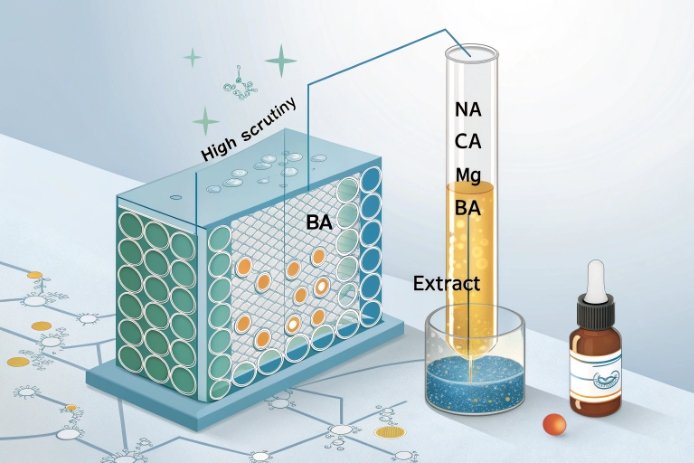
Hydrolytic resistance tests are designed to measure how much mineral content is released from the inner surface when exposed to water under controlled conditions. They typically report results in terms of titration or released ions. ISO 4802 3 methods focus on released alkali and alkaline earth species from the interior surface. EP 3.2.1 4 defines glass types and uses tests that classify hydrolytic resistance and surface behavior.
This matters because adding BaO does not automatically make a glass “fail.” A BaO bottle can still pass if:
- the base network is durable (SiO₂/Al₂O₃ are adequate)
- alkali mobility is controlled (Na₂O is not drifting high)
- the inner surface is smooth (low cords, low devit skins)
- the forming and annealing are stable (no surface microcracking)
Where BaO increases risk
BaO increases risk in two practical ways:
1) Elemental profile scrutiny: pharma and some cosmetics programs run ICP panels 5. If barium appears unexpectedly, the customer will ask why. Even if barium is not a regulated “elemental impurity” for the drug, it becomes a packaging change control issue.
2) Surface defects drive leaching: BaO can raise crystal and inclusion risk in some melts. Defects increase surface area and weak zones. Weak zones leach faster. So BaO can raise extractables indirectly by raising defect rates.
How to pass consistently (the practical checklist)
- Keep BaO low and steady. Do not let cullet creep push it higher.
- Lock sulfate fining behavior (or redesign fining) so BaSO₄ stones do not appear.
- Run hydrolytic resistance trending as a process KPI, not a once-a-year test.
- For pharma-like customers, add a “barium in extractables” line item and control limit.
| Test / expectation | What it proves | Where BaO matters | Best control knob |
|---|---|---|---|
| USP <660> | container glass quality and hydrolytic behavior | barium may show in elemental screen | smooth inner surface + stable base recipe |
| EP 3.2.1 | glass type and hydrolytic resistance classification | BaO affects acceptance via change control | stable composition + documentation |
| ISO 4802 | hydrolytic resistance of interior surfaces | BaO is an alkaline earth in the release profile | low defects + controlled alkali mobility |
| Customer E&L panel | extractables profile under product conditions | barium becomes a “why is it there?” question | ICP limits + batch/cullet discipline |
If the bottle must target pharma-grade expectations, BaO should only be used when the customer agrees to the elemental profile and the supplier can hold it steady.
Now comes the biggest operational limitation: running BaO with standard sulfate fining chemistry.
What processing drawbacks does BaO introduce—higher devitrification risk, fining interferences, or refractory corrosion?
Most BaO failures are not “property failures.” They are “process failures.” They show up as stones, haze, and unstable furnace behavior.
BaO can raise defect risk because barium forms very stable sulfates and can promote surface crystallization in certain compositions. It can also increase refractory attack risk in some melts, so BaO recipes demand stronger melting, mixing, and quality control than standard soda-lime bottles.
1) Fining interference: BaSO₄ stones and stubborn seeds
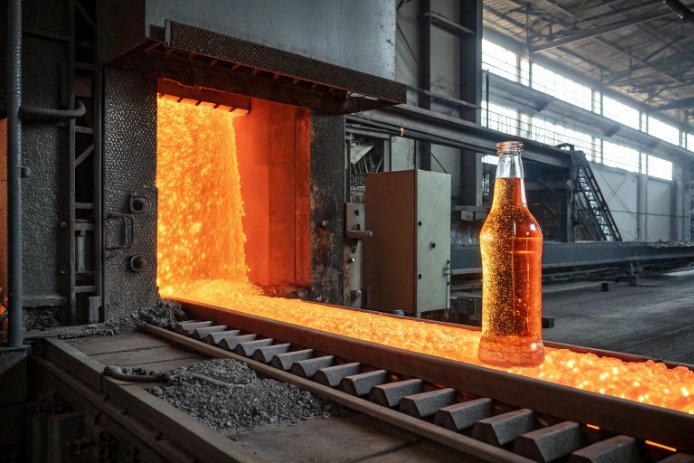
Most container plants fine with sulfate. Sulfate helps bubble removal and can also help sand dissolution. The issue is that barium has a strong tendency to form BaSO₄, which is extremely insoluble and stable. In a furnace, that can become:
- white stones
- seed clusters
- “snow” defects that survive into the bottle wall
When operators see a sudden rise in small bright inclusions after a BaO trial, this is often the reason.
2) Devitrification and surface crystallization
Barium-bearing silicate systems are used intentionally in glass-ceramics because they can crystallize under the right conditions. A bottle furnace does not want that behavior. Cold spots in forehearth channels, dead zones near the spout, or long residence on cooler refractories can trigger surface crystallization 6. Once a skin forms, it can break loose and enter the product as stones or cause haze streaks.
3) Refractory corrosion and wear sensitivity
Glass melts attack refractories by diffusion and dissolution mechanisms. When Ba is present, it becomes part of that chemistry. Some studies on barium-containing soda-lime melts describe alkali and alkaline earth diffusion into refractories 7 and dissolution of refractory phases. In a production furnace, the practical result can be:
- faster block wear in sensitive zones
- more refractory-related inclusions
- shorter campaign life if temperatures are pushed higher to dissolve Ba-bearing solids
Mitigation strategy that actually works
BaO can be run only when the line commits to:
- strict raw material grain size and mixing control
- steady sulfate fining feed with a clear “stone alarm” threshold
- stronger temperature uniformity in forehearth and feeders
- dedicated defect tracking and rapid response rules
| Processing risk | Typical symptom | Why it happens | Practical mitigation |
|---|---|---|---|
| BaSO₄ formation | white stones, seed clusters | Ba meets sulfate fining chemistry | lower sulfate load, redesign fining, tighter QC |
| Surface crystallization | haze streaks, devit lines | cold spots + Ba silicate tendency | stabilize forehearth profile, remove dead zones |
| Higher melting demand | slow refining, more cords | incomplete dissolution and mixing | higher hot spot control, better batch blanket management |
| Refractory wear inclusions | stones tied to furnace age | Ba-containing melt changes corrosion | wear monitoring, refractory selection, temperature discipline |
If the plant cannot control these factors, BaO will not deliver a premium bottle. It will deliver premium rejects.
Next is the property and lifecycle view: durability, thermal behavior, color, UV, and recycling.
How does BaO impact durability, thermal expansion, color/UV behavior, and recyclability with standard soda-lime cullet?
BaO changes more than one property at a time. That is why it is hard to “blend in” with soda-lime bottles.
BaO can raise density and refractive index and may increase microhardness, but it can also raise thermal expansion in some barium-rich systems and increase surface crystallization risk. BaO does not add strong UV blocking by itself, and it complicates recycling when mixed into standard soda-lime cullet streams.
Durability and chemical resistance
BaO is an alkaline earth modifier. In some glass families, barium can support certain durability targets, but bottles are judged by real-world performance: acidic beverages, dishwasher cycles, label removal, and shelf life. In that world, defects dominate. If BaO increases crystals or stones, chemical durability trends can look worse even if the bulk network is fine.
For customers who track taste and extractables, BaO adds an extra analyte. It is not always a regulatory blocker. It is an acceptance blocker when data is missing or drifting.
Thermal expansion and thermal shock
Barium-containing silicate systems can show higher thermal expansion 8 when BaO replaces other oxides in some compositions, and Tg can move downward in some barium-rich designs. That is not ideal for hot-fill or thermal shock. The only safe statement is this: BaO can move thermal expansion and characteristic temperatures enough that a bottle design may need re-validation.
Color and UV behavior
BaO is not a strong colorant. It generally does not “tint” the glass by itself. Still, it can change how other colorants dissolve and how the melt behaves. In clear flint, that matters because any haze or microcrystal scatters light and makes the bottle look “dirty.” For UV, BaO is not a UV absorber 9 like iron or cerium systems. UV protection still depends on Fe/Cr/amber chemistry and thickness.
Recyclability and cullet compatibility
Standard container glass recycling works best when the cullet 10 stays close to soda-lime composition. BaO glass is a “special composition.” If it enters a normal cullet stream:
- viscosity and fining behavior can shift
- defect risk can rise (especially if sulfate fining is used)
- customers may add barium screening to incoming QC
- closed-loop stability becomes harder if external cullet is used
A dedicated cullet loop can manage this, but an open recycling system usually cannot.
| Property area | BaO effect in practice | Bottle impact | Safer alternative |
|---|---|---|---|
| Brilliance / feel | higher refractive index, denser glass | premium look, heavier feel | design + surface quality + coatings |
| Thermal behavior | can shift CTE and Tg | thermal shock and hot-fill risk | adjust SiO₂/Al₂O₃, keep soda-lime base |
| UV protection | minimal by itself | still needs Fe/amber/Ce strategy | use proven UV systems |
| Chemical profile | adds barium to E&L story | more customer testing | keep recipe simple and stable |
| Recycling | special glass contamination risk | cullet limits and tighter QC | avoid BaO in mass-market packaging |
If the bottle is for mainstream food and beverage, BaO usually creates more problems than value. If the bottle is a premium niche, BaO can work only with tight controls, clear migration limits, and a dedicated recycling plan.
Conclusion
BaO can deliver a premium look, but it adds migration scrutiny, sulfate-related defect risk, and recycling complications, so it belongs in controlled specialty bottles, not standard lines.
Footnotes
-
How much light bends in glass, affecting its sparkle and clarity. ↩
-
Barium sulfate, a stable compound causing stubborn defects in glass. ↩
-
Global standard for testing water resistance of glass container surfaces. ↩
-
European pharmacopoeia section defining glass types for medical use. ↩
-
Sensitive lab method used to detect trace metals in glass extracts. ↩
-
Formation of crystals on glass surfaces, ruining clarity and strength. ↩
-
Heat-resistant materials lining the furnace, vulnerable to chemical attack. ↩
-
How much glass expands with heat, critical for thermal shock resistance. ↩
-
Additives that block harmful UV light, essential for product protection. ↩
-
Recycled broken glass, crucial for sustainable bottle production. ↩






