
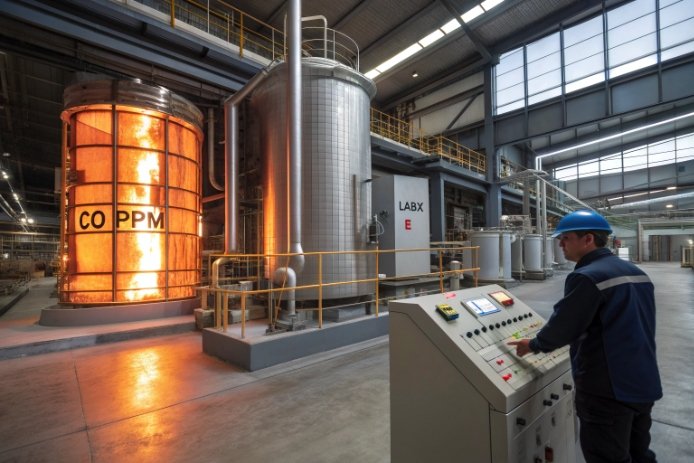
A cobalt-blue bottle can look perfect in one shift and wrong in the next. That drift usually starts in chemistry control, not in the mold.
Cobalt color is extremely strong, so the real challenge is stability: redox, cullet iron load, and mixing quality must stay consistent to keep the same blue tone and avoid cords or streaks.
A formulation-first roadmap for cobalt-blue bottles
Define the shade like a spec, not like a picture
A “nice blue” is not a usable target. A usable target is a measured target. The cleanest approach is to lock:
- bottle thickness for measurement (or a standard coupon thickness),
- the illuminant and observer settings,
- and the acceptable window (ΔE, plus direction limits on a and b).
This matters because cobalt gives strong chroma quickly. So a tiny drift can move the shade outside tight brand windows even if operators cannot see it on the floor.
Build a chemistry strategy that is robust to cullet swings
Cobalt is rarely the only color driver in container melts. Recycled cullet adds iron, and iron valence shifts with redox. That means cobalt must be tuned with:
- an iron baseline plan (total Fe and Fe²⁺ fraction) (see iron redox control 1),
- a sulfur plan (fining stability without unexpected ambering),
- and a control method that prevents redox gradients (cords).
A robust plan accepts that cullet ratios change and designs the correction method around that reality, instead of fighting it with large last-minute dosing.
Treat cobalt dosing like a “micro-ingredient” project
Because cobalt is powerful, the dosing method matters as much as the chemistry choice. The goal is to prevent local cobalt-rich zones that create streaks and cords. That usually means:
- using diluted cobalt masterbatch or frit,
- adding it in a controlled batch stream location,
- and mixing long enough to avoid segregation.
Keep redox stable so the blue stays the same
Cobalt’s “blue engine” is usually associated with Co²⁺ in oxygen coordination environments that produce strong absorption bands. If the furnace swings reducing, cobalt behavior can shift and the melt can also increase Fe²⁺, making the blue look different even if cobalt is unchanged. A stable oxygen activity band in the melt is a color control tool, not only a fining tool.
Design the process window so chemistry can do its job
If the melt is not homogenized, color issues will not be solved by adding more cobalt. Stable cobalt color needs:
- enough melting and fining time for dissolution and mixing,
- a thermal profile that avoids cold pockets and stagnant zones,
- and forehearth conditioning that does not create redox waves.
| Design item | What it controls | What usually breaks first if it drifts |
|---|---|---|
| Cobalt dosing method | local cobalt gradients | streaks, cords, “dirty” blue |
| Melt redox band | cobalt/iron valence balance | off-shade, ambering, reboil |
| Cullet purity and blend | iron baseline and variability | shade drift shift-to-shift |
| Mixing and residence | compositional uniformity | cords and batch-to-batch noise |
| Measurement protocol | acceptance consistency | false rejects or missed drift |
Moving from roadmap to execution, the next sections answer the four design questions that make or break cobalt-blue programs.
Even a strong formula fails without strong control points.
Which cobalt raw materials (CoO, Co₃O₄, cobalt carbonate) are best for bottle glass, and how do they impact color strength and stability?
A cobalt program can be expensive, so the wrong raw material choice wastes money and creates variability fast.
For container glass, CoO and Co₃O₄ are the most common practical sources because they feed cobalt into the melt as oxides with predictable behavior. Cobalt carbonate can work, but it adds extra gas release and can push local redox effects if dispersion is weak.
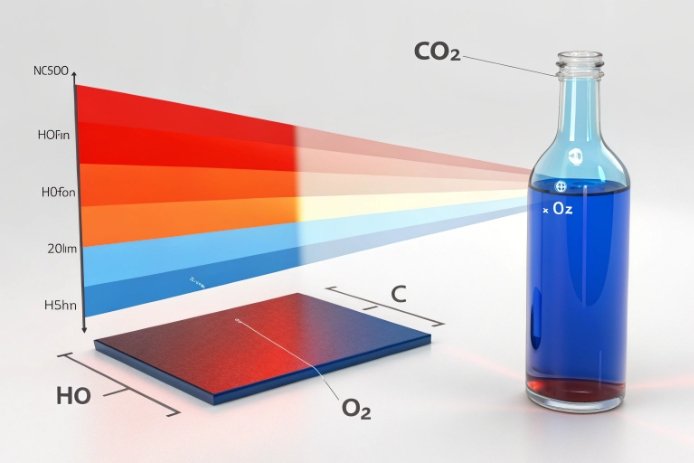
How each cobalt source behaves in batch and melt
CoO (cobalt(II) oxide) is often treated as a direct, predictable cobalt source. It is already in an oxide form, so it does not add extra CO₂ from decomposition. This helps stability when the goal is repeatable dosing and minimal side reactions.
Co₃O₄ (mixed-valence cobalt oxide) is widely used as well. In high-temperature melting, the melt chemistry tends to drive cobalt toward the valence state and coordination that the furnace redox supports. So Co₃O₄ can behave like a practical feedstock that converts in the melt to the active cobalt species needed for color. In many material descriptions, Co₃O₄ contains both Co²⁺ and Co³⁺, so it has an internal redox “buffer” feel, but the furnace still decides the final state.
Cobalt carbonate (CoCO₃) decomposes to cobalt oxides and releases CO₂ during heating. That extra gas release is usually small compared with the whole batch carbonate load, but it can still matter locally if cobalt carbonate is not well distributed. Local CO₂ release can change the micro-environment under the batch blanket and can amplify small mixing problems.
Purity and particle size matter more than most teams expect
For cobalt blue, ppm-level mistakes can show up. So impurities that are irrelevant in bulk raw materials can matter here:
- iron contamination can shift shade,
- sulfate or chloride impurities can create volatility and deposits,
- coarse particle size can dissolve slower and create streaks.
In practice, the best “raw material” is often not a pure oxide powder. It is a pre-diluted masterbatch (oxide diluted in sand or cullet fines) or a cobalt-bearing frit (see frit applications 2) that disperses more evenly in the batch stream. This lowers weighing error and improves distribution.
A simple selection rule that avoids pain
- If the plant has tight dosing and strong mixing: CoO or Co₃O₄ both work.
- If the plant struggles with cords or short residence time: prefer a diluted masterbatch or frit form.
- If the plant uses cobalt carbonate: only do it with excellent dispersion control and stable redox.
| Source | Color strength handling | Stability risk | When it is a good choice |
|---|---|---|---|
| CoO | very predictable dosing | low, if distributed well | stable flint/blue lines with strong QA |
| Co₃O₄ | strong, common feedstock | medium if redox swings | plants with stable oxygen control |
| CoCO₃ | workable but more sensitive | higher (gas + distribution) | only with strong mixing and tight lot control |
| Cobalt frit/masterbatch | easiest to distribute | lowest | high-volume plants needing repeatability |
The raw material decision must connect to the next lever: furnace atmosphere and redox. Even perfect raw materials produce unstable shade if oxygen potential swings.
How do furnace atmosphere and redox conditions influence cobalt valence states and the final blue tone?
A cobalt bottle that looks slightly “inkier” or slightly “washed” can be a redox story, not a dose story.
Cobalt blue is strongly linked to cobalt ions in specific oxygen coordination states. Furnace oxygen activity shifts cobalt valence balance and also shifts iron valence, so small redox drifts can move the blue tone even when cobalt ppm is unchanged.

What redox changes in the melt
Redox is the oxygen activity of the melt. When oxygen activity drops (more reducing), Fe²⁺ tends to increase. That alone can change the perceived cobalt blue because the background absorption changes. When oxygen activity rises (more oxidizing), Fe³⁺ fraction rises and the “base tint” shifts.
Cobalt also responds to the melt environment. Many technical discussions link strong blue absorption to Co²⁺ in tetrahedral-like coordination. If the local structure changes toward octahedral coordination or if the valence distribution changes, the shade intensity and band positions can shift. In bottle terms, this can show up as:
- the same cobalt dose looks darker one week and lighter the next,
- the same cobalt dose looks slightly greener or slightly more violet.
Why small drifts create big visible changes
Cobalt is a strong colorant at very low levels. This creates a steep response curve. A small drift in:
- oxygen activity (measured by redox sensors 3),
- iron redox fraction,
- or sulfate/reducer balance
can shift the spectral transmission enough to move outside a tight ΔE window.
Practical redox targets and how to hold them
A reliable redox strategy for cobalt bottles is not “run oxidizing.” It is “run stable.” That usually means:
- keep cullet organics low and consistent (see cullet quality 4),
- keep carbon additions stable (if any),
- keep sulfate additions stable so fining does not oscillate,
- and avoid big burner/firing swings that create gradients.
It also helps to measure redox close to where glass becomes gob. Forehearth conditions can differ from furnace conditions, and color customers judge the final bottle, not the melt tank.
| Redox condition | Common visual outcome in cobalt blue | Typical root cause | Best corrective style |
|---|---|---|---|
| More reducing than normal | “dirtier” tone, possible green shift | cullet organics spike, extra carbon | clean cullet, stabilize combustion, slow corrections |
| More oxidizing than normal | “cleaner” but sometimes lighter tone | excess air/oxygen, low reducer load | stabilize air/fuel, maintain steady sulfate |
| Oscillating redox | cords, shade bands, batch variation | fast adjustments and poor mixing | model-like slow trims, improve mixing |
| Local reducing pockets | streaks, uneven tone | batch blanket segregation, poor distribution | masterbatch dosing + better blanket control |
For cobalt programs, the safest rule is to treat redox as a controlled band with slow changes. A fast redox correction can “fix” today’s bottle and create tomorrow’s cords.
Once redox is stable, the next hard problem is consistent shade across different cullet ratios, because cullet changes iron and sulfur baselines.
How can you balance cobalt dosage with iron, chromium, and sulfur to hit a consistent target shade across different cullet ratios?
High recycled content is good business, but it can make color control harder if the chemistry model is weak.
To hit a stable cobalt shade across cullet swings, cobalt must be treated as a trim on top of an iron baseline, with chromium and sulfur constrained to narrow bands. The right method is a lag-aware color model tied to cullet lot tracking and redox control, not a fixed cobalt dose.

Start with the iron baseline, not the cobalt dose
Recycled cullet typically raises total iron and changes iron redox variability. If the iron baseline moves, cobalt blue will look different because the background absorption shifts. The most reliable workflow is:
1) lock cullet blending rules that smooth iron variation,
2) define an “iron window” (total Fe and, if possible, Fe²⁺ fraction),
3) then tune cobalt within that stable baseline.
Chromium: keep it either “designed-in” or “designed-out”
Chromium is extremely strong in green. Even trace chromium contamination in cullet streams can shift a cobalt blue toward teal. If chromium is part of the intended color, keep it tightly controlled and model it in the shade prediction. If chromium is not intended, treat it like a contaminant and tighten cullet specs and sorting.
Sulfur: protect fining without triggering ambering or cords
Sulfur chemistry is tied to redox. If sulfur balance shifts toward sulfide formation in a reducing pocket, it can add amber/brown tone or create bubble behavior changes that increase scattering. That scattering changes perceived shade. For cobalt bottles, the goal is not “maximum sulfate.” It is “stable sulfate and stable redox so fining remains steady.” (Read about sulfate fining 5)
A practical control method that works with cullet variability
The strongest method is a simple predictive “shade recipe” table or model that uses:
- cullet ratio and cullet lot ID,
- measured Fe₂O₃ total and, if possible, Fe²⁺ proxy,
- cobalt addition rate,
- and redox proxy.
Then cobalt becomes a small trim, not a big lever. When cullet iron rises, cobalt is adjusted slightly, and the combustion/redox band is held steady so the correction behaves predictably.
| Interaction | What it does to cobalt blue | Main risk | Best control lever |
|---|---|---|---|
| Iron total increases | blue looks darker/greener | off-shade and returns | cullet blending + small cobalt trim |
| Fe²⁺ fraction increases | blue shifts greener/“dirtier” | teal drift, cords | stabilize redox and organics |
| Chromium presence | blue shifts toward teal/green | inconsistent hue | strict cullet sorting or designed Cr band |
| Sulfur/redox imbalance | ambering, haze, cords | dirty tone and scattering | stable sulfate band + avoid reducing pockets |
If the goal is “same blue at 30% cullet and 70% cullet,” the plant needs a control system that treats cullet chemistry as a live variable, not as a fixed assumption.
Even with a strong model, the final shade still depends on process execution. That is why the last piece is process control to prevent streaks, cords, and lot-to-lot noise.
What process controls (batch mixing, melting temperature, fining time) minimize color streaks, cords, and batch-to-batch variation in cobalt-colored bottles?
Cobalt makes shade problems easy to see. The defects were often there before, but cobalt highlights them.
To minimize streaks and cords, the process must prevent local composition gradients: mix the batch well, distribute cobalt evenly, melt hot enough for dissolution, refine long enough for homogenization, and condition the forehearth to avoid stagnant zones.

Batch mixing and dosing controls
Cords are often caused by composition differences in the melt. If cobalt is not evenly distributed, those differences become visible as streaks. The best batch-side controls are:
- use cobalt in diluted form (masterbatch or frit),
- add it in a consistent location in the batch stream,
- avoid segregation by controlling particle size distribution (see batch mixing 6),
- and enforce tight weighing and feeder calibration.
A practical trick is to treat cobalt like a “micro-ingredient” with its own QC: lot certificate, moisture control, and a dosing verification routine.
Melting temperature and dissolution strategy
If melting is too cold or too fast for dissolution, cobalt can form local high-concentration streams that persist as striae. The solution is not always “more heat,” but it usually includes:
- adequate peak temperature in the melting/refining zone,
- sufficient residence time for full dissolution and mixing,
- and, when available, controlled stirring or bubbling to improve homogenization. (See bubbling benefits 7)
Fining time and homogenization
Fining is not only bubble removal. It is also time for mixing and chemistry equilibration. If fining time is cut too hard, the melt can carry striae forward. In cobalt bottles, this often looks like:
- shade bands in heavy sections,
- cords in sidewalls,
- or alternating shade in consecutive pallets when pull changes.
Forehearth conditioning: stop making gradients late
Even if the furnace is perfect, a forehearth with cold corners or stagnant pockets can create late composition and redox gradients. Those gradients can create cords or a subtle shade shift at the gob.
| Problem seen in bottles | Likely process root cause | Best control action | Quick verification |
|---|---|---|---|
| Blue streaks/cords | uneven cobalt distribution | masterbatch + better batch mixing | cord mapping, cut-section check |
| Shade banding shift-to-shift | pull/redox oscillation | slow correction rules, stable firing | trend redox proxy vs ΔE |
| Teal drift | Cr contamination or Fe²⁺ rise | tighten cullet sorting + stabilize redox | cullet audit + colorimetry 8 |
| “Dirty” blue (haze) | seeds/foam stability issue | stabilize sulfate/redox, refine better | seed count + haze metric |
| Batch-to-batch variation | dosing and lot variability | feeder calibration + lot blending | SPC charts 9 for Co addition |
Stable cobalt bottles come from a simple discipline: prevent gradients, hold redox steady, and measure color in a consistent way. When that discipline is in place, cobalt becomes one of the most reliable colored bottle programs, not one of the most stressful. (Read about sustainable glass melting 10)
Conclusion
Cobalt blue bottles succeed when cobalt dosing is precise, redox is stable, and cullet-driven iron variability is smoothed. A shade model plus strong mixing and refining prevents cords and off-shade lots.
Footnotes
-
Technical article on controlling iron redox state for consistent glass color. ↩
-
Overview of glass frit technologies and their applications in coloring. ↩
-
Information on in-line redox sensors for glass melting control. ↩
-
FEVE report on cullet quality and its importance in glass recycling. ↩
-
Discussion on sulfate fining chemistry and foam control. ↩
-
Guide to glass batch mixing principles and equipment. ↩
-
Explanation of furnace bubbling systems for melt homogeneity. ↩
-
Overview of color measurement techniques specifically for the glass industry. ↩
-
Introduction to Statistical Process Control (SPC) charts for quality monitoring. ↩
-
Strategies for sustainable and optimized glass melting processes. ↩






