
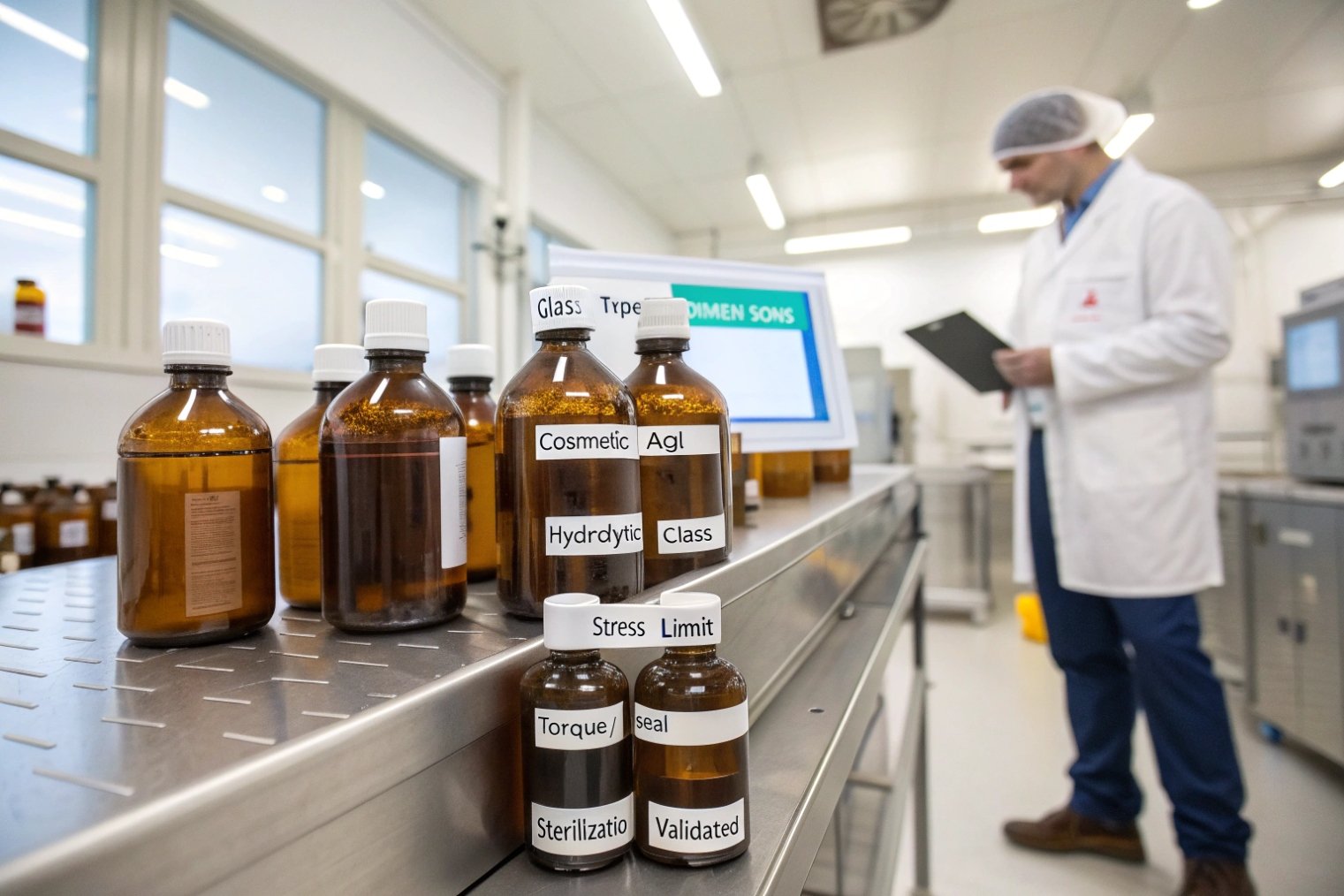
If acceptance criteria for bottles are vague, problems move from incoming inspection to the filling line, then into stability data and, finally, into complaints.
Core acceptance criteria for pharmaceutical glass bottles cover glass type, dimensions, cosmetic defect limits, hydrolytic and stress performance, torque and seal integrity with closures, plus validated sterilization compatibility and full lot documentation.
In practice, this means turning the “nice to haves” in drawings and standards into concrete pass/fail rules: zero tolerance for cracks, defined AQLs for cosmetic flaws, specific torque and leak targets for each closure, and documented proof that glass and closure survive sterilization and storage for the full shelf life.
What cosmetic limits apply to cracks, seeds, and stones in pharma bottles?
Cosmetic rules are where most day-to-day arguments between buyer and supplier happen, so they must be clear, written, and backed by sampling plans.
Cracks and serious checks are always critical (AQL 0), while seeds, stones, and cosmetic marks fall into major or minor categories with explicit AQL limits and clear definitions for size and location.
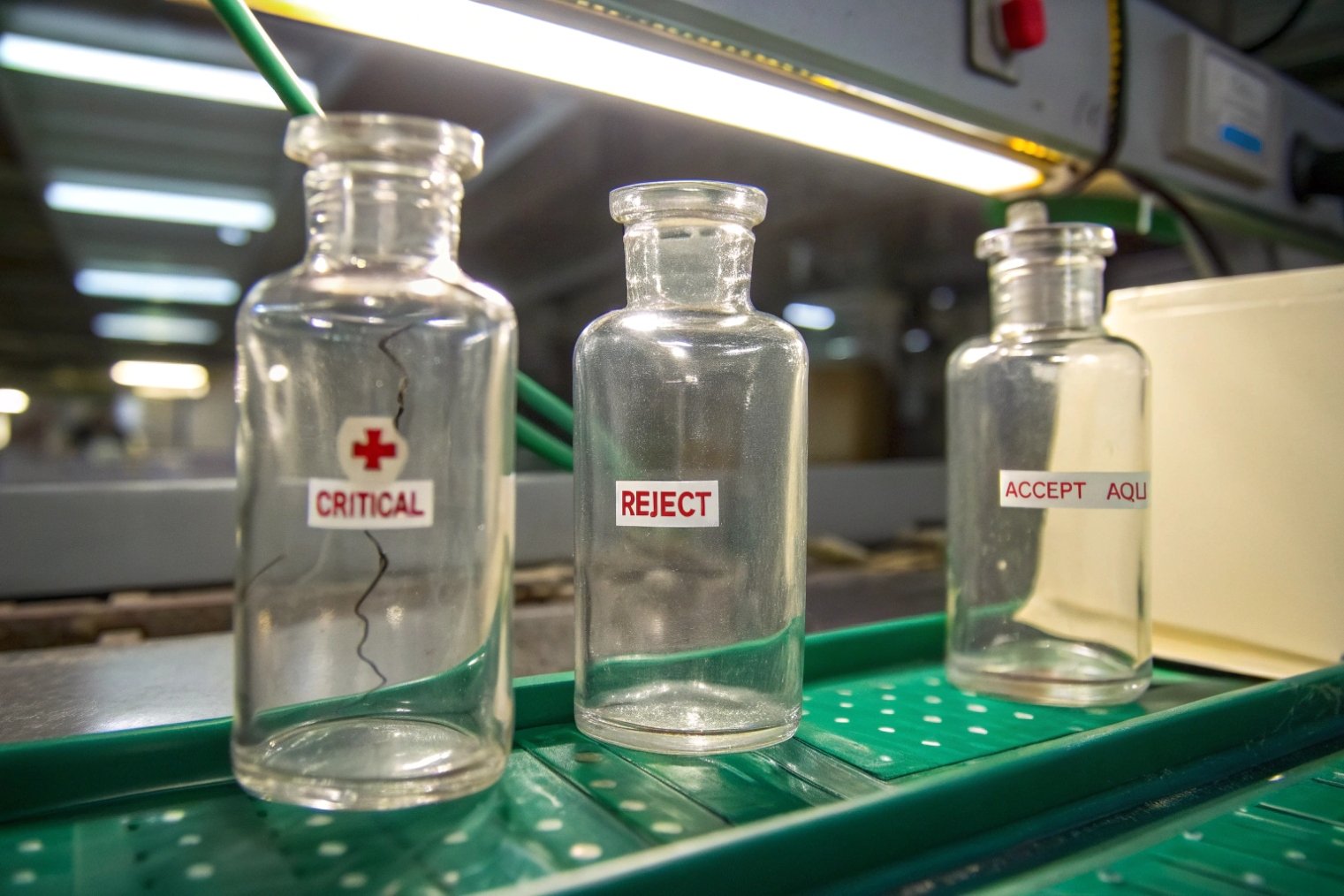
Defect classes and example limits
Every pharma QA system needs a defect lexicon for glass. At minimum, it should define:
- Critical defects – risk for patient safety, sterility, or machine jams.
- Major defects – affect function or perceived quality but not always safety.
- Minor defects – cosmetic only, acceptable within limits.
A typical mapping for bottles and vials looks like this:
| Defect type | Example classification | Typical acceptance intent |
|---|---|---|
| Cracks (anywhere) | Critical | Not allowed (AQL 0, c=0) |
| Finish chips / splits | Critical | Not allowed |
| Internal foreign body | Critical | Not allowed |
| Deep checks (stress lines) | Critical / major depending on location | Very low or zero AQL |
| Stones ≥ defined size | Major / critical if in contact zone | Very tight AQL (often ≤0.25–0.65) |
| Large seeds (bubbles) | Major if near seal / body, minor elsewhere | AQL for majors + minors |
| Light scuffing | Minor | Allowed within higher AQL (e.g., 2.5) |
| Colour variation | Minor | Allowed within brand limits |
Cracks, finish chips, and large checks always go to AQL 0. Any instance in the inspection sample rejects the lot unless a formal deviation and 100% sorting plan are approved.
For stones and seeds, two points matter:
- Size – above a set diameter, a stone or bubble becomes major or even critical.
- Location – defects in the finish, inner neck, or heel carry higher risk than those in the mid-body.
To make this work on the floor, it helps to keep a defect photo board and physical “golden samples” for the inspection team, so the line between minor, major, and critical is not decided fresh each shift.
AQLs and sampling to support defect limits
Sampling plans such as ANSI/ASQ Z1.4 sampling procedures and tables 1 or ISO 2859-1 sampling schemes indexed by AQL 2 allow you to set different AQLs for each defect class:
- Critical: AQL 0.0, c=0 – no defects in the sample.
- Major: low AQL (for example 0.25–0.65), small number of allowed defects.
- Minor: higher AQL (for example 1.0–2.5), more flexibility.
This is where the “core acceptance criteria” become real: not only “no cracks” in a specification, but a defined way to check and a defined sample size and decision rule for every incoming lot.
Which tests confirm hydrolytic resistance and internal stress in glass?
A bottle can look perfect and still fail chemically or mechanically. Hydrolytic resistance and internal stress tests show whether the glass will stay quiet over years of contact, sterilization, and transport.
Hydrolytic resistance is confirmed with pharmacopeial water-attack tests that classify Type I/II/III performance, and internal stress is checked with polarized-light strain inspection against defined optical limits.

Hydrolytic resistance and chemical durability
For pharmaceuticals, hydrolytic resistance is not optional. It is part of the glass type definition and must match the intended use (parenteral vs oral, aqueous vs dry).
Typical acceptance criteria include:
- Glass must meet the specified Type I, II, or III hydrolytic performance per USP ⟨660⟩ Containers—Glass 3 and/or Ph. Eur. general chapter 3.2.1 (glass containers for pharmaceutical use) 4.
- For internal surfaces, water attack at high temperature (often 121 °C) is used; methods aligned to the ISO 4802-1 hydrolytic resistance test 5 are commonly referenced for how this is executed and classified.
- For high-risk uses (parenterals, eye drops), your spec may require the highest class (for example HC1/Grade 1) on the internal surface.
Many buyers set a simple rule:
- If the bottle is for injectables or high-risk liquids, only containers with Type I performance are accepted.
- For oral liquids or solids, Type II or III is acceptable as long as stability data confirm no pH drift or precipitation.
Hydrolytic resistance may be checked as:
- A type test at supplier qualification and after significant changes (new furnace, new composition).
- A periodic verification (for example, once per quarter or per campaign).
It is rarely repeated on every lot, but you should verify that the supplier’s CoA includes batch-wise control of key parameters and that you have a rule for enhanced testing when performance drifts or changes occur.
Internal stress and annealing quality
Internal stress leads to delayed cracks: bottles that break after sterilization, transport, or even on the pharmacy shelf. Acceptance criteria therefore include:
- Strain inspection with a polariscope or strain viewer.
- Limits on optical path difference (for example, ≤ 40 nm/mm in critical zones), depending on local standards and product risk.
- Good stress patterns around the heel, shoulder, and finish – no sharp, concentrated colour bands.
A simple check matrix might look like:
| Test | Purpose | Typical acceptance direction |
|---|---|---|
| Internal stress (strain viewer) | Verify proper annealing | Path difference at or below defined limit |
| Thermal shock test | Ensure survival of sterilization or temperature changes | No breakage at defined ΔT |
| Internal pressure / burst | Confirm mechanical strength | Meet or exceed design pressure |
For hot-filled or autoclaved products, you combine stress limits with thermal shock testing (for example, defined cycles at 121 °C or higher) and reject any design that shows systematic cracking at the heel or shoulder during these tests.
In many projects, once an article passes a full set of design qualification tests, incoming acceptance focuses on visual stress checks and relies on the supplier’s routine mechanical and hydrolytic testing to stay within the validated envelope.
What torque and seal integrity targets must closures meet?
Even a perfect bottle fails if the closure does not seal or if torque windows are so narrow that production cannot hit them consistently.
Closure acceptance criteria define applied and removal torque ranges, leak performance under pressure and temperature, and full container–closure integrity for the chosen sterilization and storage regime.
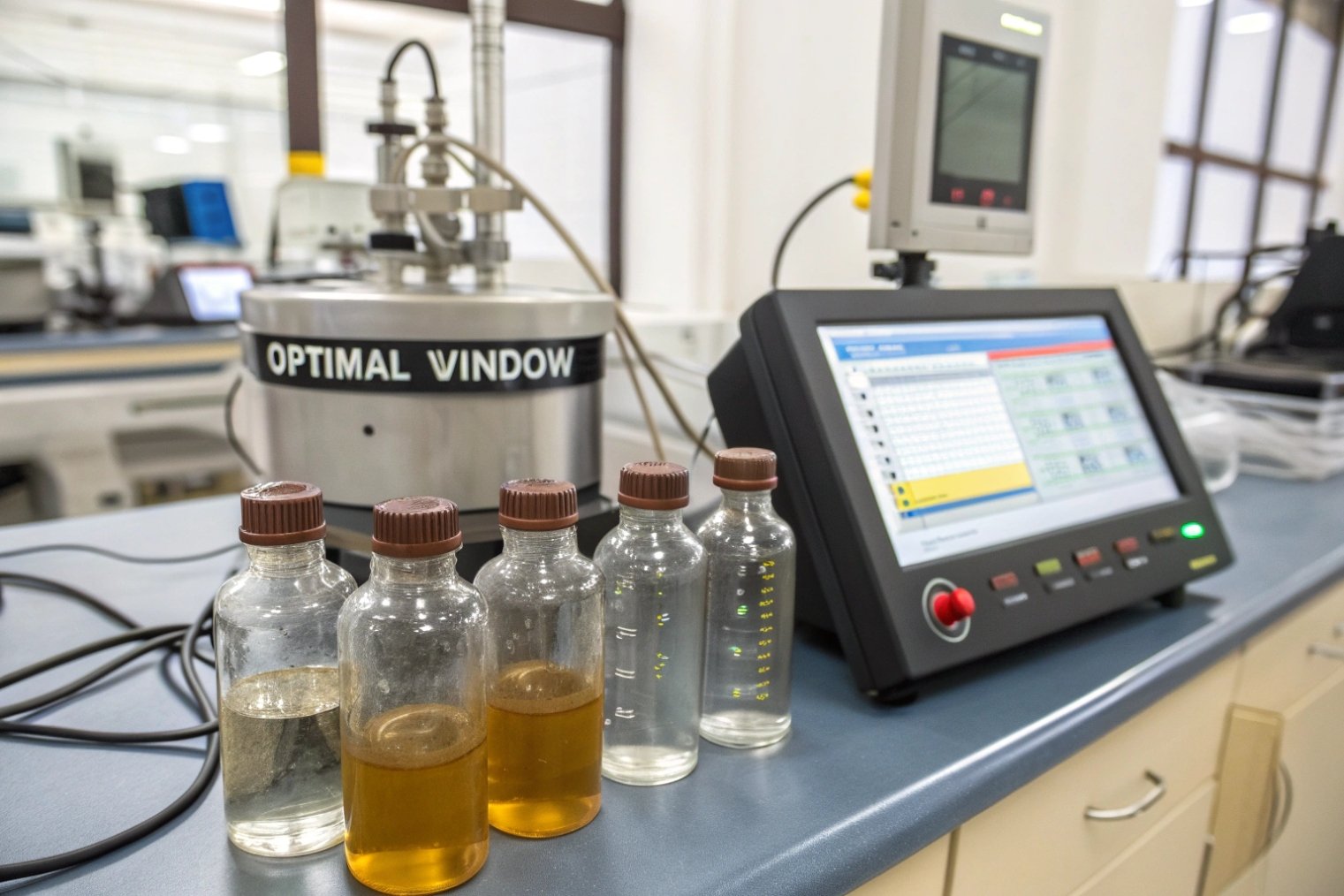
Torque windows that work on the line
Torque has two jobs:
- At least enough to compress the liner and form a seal.
- Not so high that threads strip, closures crack, or staff cannot open the container.
Core acceptance criteria usually cover:
- Applied torque range from the capping machine (for example, a window such as 0.5–3.0 N·m for screw caps, tuned to your closure and liner).
- Removal torque after sterilization and storage, within a defined band, so pharmacists and patients can still open the bottle without tools.
- Torque retention after cycles of temperature and humidity (for example, after autoclave or hot-fill and subsequent cool-down).
These numbers are not universal; they come from design qualification:
- Run a torque study across a range of applied torques.
- Perform leak, vibration, and thermal tests at each level.
- Choose a safe window where all samples pass seal tests and the closure is still user-friendly.
That window then becomes part of your core acceptance criteria for both bottles and closures.
Seal integrity and leak performance
Acceptance is not only about torque; it is about container–closure integrity (CCI) 6.
Common tests include:
- Vacuum or pressure leak tests (for example, headspace pressure decay).
- Dye ingress testing at defined pressure differential for low-risk oral products.
- More sensitive CCI methods (helium leak, high-voltage, headspace gas analysis) for sterile or modified-atmosphere products.
Criteria might look like:
- 0% leakage at a set differential pressure or vacuum for the sample size.
- No dye ingress under specified conditions.
- Leak rate below a defined threshold in high-sensitivity CCI tests.
On top of that, you verify fit with the finish:
- Neck/finish dimensions within tolerance, confirmed by go/no-go gauges.
- Liner compression in the expected range when torqued correctly.
- No cap “rocking”, tilting, or cross-threading in inspection samples.
For crimped or snap-on systems, you adjust the language but keep the logic: controlled crimp height and diameter instead of thread torque, plus leak tests and CCI as above.
Once this system is validated, your ongoing acceptance criteria for bottles and closures focus on:
- Finish dimensions and visual defects.
- Routine torque and leak tests on combined samples.
- Trending of line rejects for unders or overs torque, backed by supplier feedback when trends worsen.
Which sterilization compatibility claims require validation data?
Suppliers often say “autoclavable” or “depyrogenizable” in a catalog, but in pharma those words must be backed by data that match your real process, not a generic cycle.
Any claim that a bottle/closure system is compatible with steam, dry heat, EtO, gamma, or e-beam sterilization must be supported by validation data showing the container and closure survive the defined cycles without loss of integrity or unacceptable change in properties.
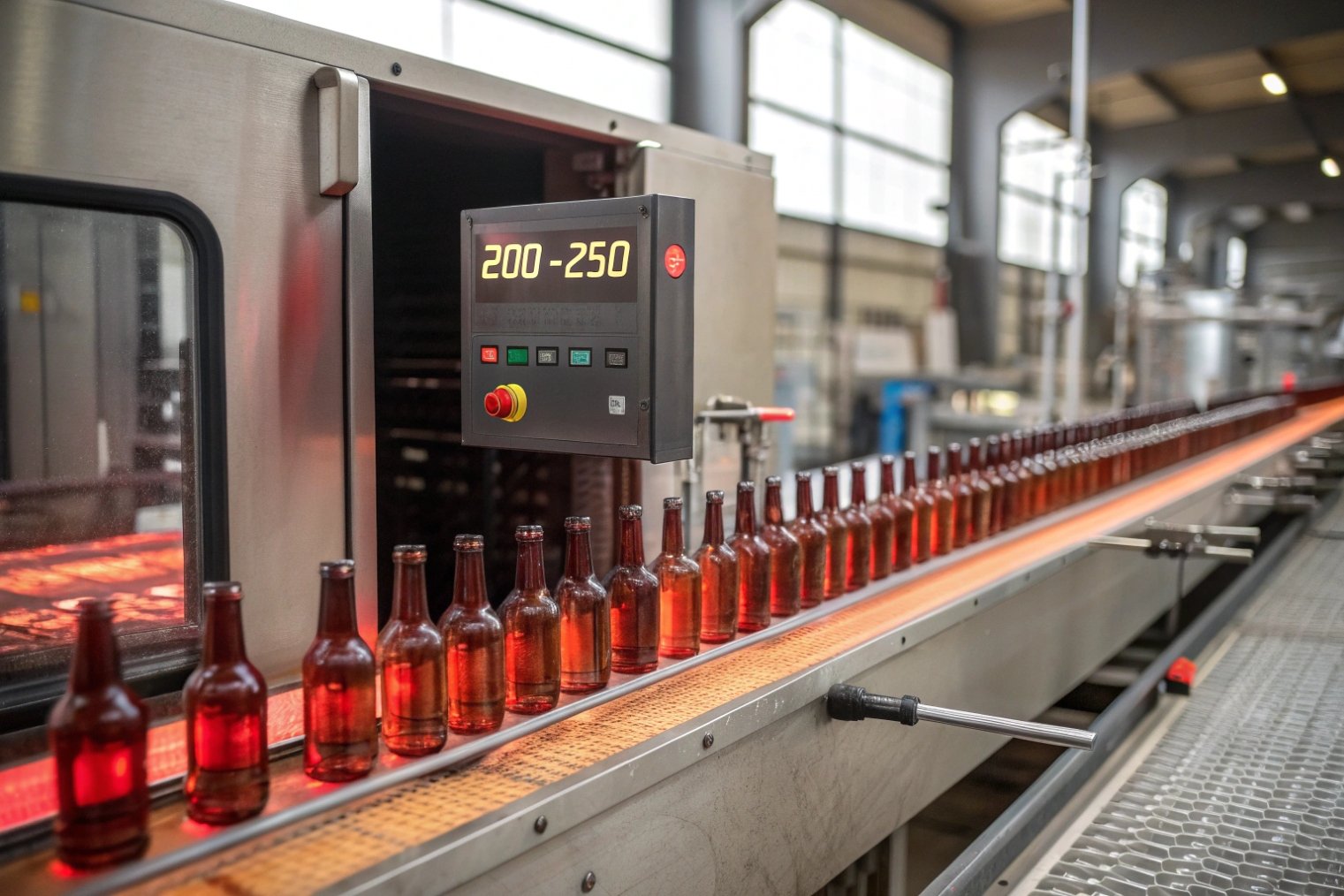
Linking claims to real sterilization processes
Key sterilization or decontamination methods for glass bottles and closures include:
- Steam sterilization (autoclave) – for example 121 °C or 134 °C cycles.
- Dry heat depyrogenation – often 200–250 °C for glass only.
- Gamma or e-beam irradiation – often for closures or pre-assembled systems.
- EtO sterilization – more common for closures and medical devices than for bulk glass bottles.
For each method you use, acceptance criteria should require:
- A defined cycle (time, temperature, pressure, and cooling).
- Demonstrated sterility or depyrogenation level, where applicable.
-
Evidence that the glass and closure show no unacceptable:
- Cracking, breakage, or deformation.
- Loss of hydrolytic performance or unacceptable pH drift.
- Loss of torque or seal integrity.
- Colour change, label damage, or coating degradation.
What validation data you should expect or generate
From the supplier, you can request:
- Statements of compatible sterilization methods and typical max conditions.
- Internal test data for thermal shock and mechanical strength after those cycles.
- Any known limits (for example, maximum number of autoclave cycles for reusable bottles).
From your own side, you must still:
- Run a formal validation of your exact process on your container–closure system, including worst-case cycles.
- Check CCI, torque, visual appearance, and hydrolytic tests before and after sterilization.
- Confirm that the full system (glass + closure + any coatings or labels) meets your stability and sterility requirements over shelf life.
If you are translating these requirements into filing-ready expectations, many teams align the documentation bundle to the FDA Container Closure Systems guidance 7 so the “evidence package” stays audit- and submission-friendly.
A simple way to capture it in acceptance criteria:
- Only accept bottles for steam sterilized products if the supplier and your validation both show survival of at least the validated cycle plus safety margin.
- For dry heat processes, require proof that annealing and stress limits remain acceptable and that no deformation or excessive sag occurs.
- For irradiated closures, control extractables/leachables and mechanical performance before and after irradiation.
In other words, any time you see a sterilization or “ready-to-sterilize” claim in a datasheet, treat it as a starting point, not as finished evidence. Your core acceptance criteria should insist on matching data for your own process.
Conclusion
Core acceptance criteria for pharma bottles turn vague catalog claims into hard rules on defects, hydrolytic and stress performance, sealing, and sterilization, so every lot supports safe, stable medicines instead of adding hidden risk.
Footnotes
-
Use this to standardize AQL sampling, switching rules, and acceptance/rejection numbers for attribute inspection. ↩ ↩
-
Reference ISO’s AQL-indexed sampling schemes to define lot-by-lot acceptance decisions consistently across sites. ↩ ↩
-
Verify glass type definitions and hydrolytic performance expectations used in pharma specifications and incoming acceptance. ↩ ↩
-
Understand how Ph. Eur. frames glass-type tests and hydrolytic resistance characterization for pharmaceutical glass containers. ↩ ↩
-
See the standardized 121 °C water-attack approach for evaluating and classifying inner-surface hydrolytic resistance. ↩ ↩
-
Learn established concepts and methods for demonstrating and maintaining sterile package integrity via container–closure integrity testing. ↩ ↩
-
Align your container/closure documentation package with FDA expectations for CMC submissions and lifecycle control of packaging materials. ↩ ↩






