
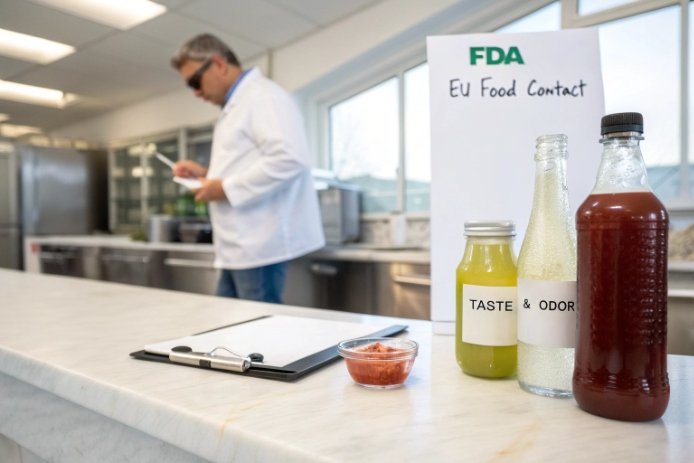
Food-contact glass looks “safe” until a buyer detects off-taste or metal release. Then one shipment becomes a recall-level headache.
Food-contact glass bottles should use a stable soda-lime recipe with tight impurity control, clean cullet governance, and test evidence that migration is low and taste–odor stays neutral under real use.
Food-contact compliance is a chemistry target plus a proof package
Food-contact glass is judged by outcomes, not by a single oxide number. The bottle must not release harmful substances, must not change the food in an unacceptable way, and must not create taste or odor issues. That pushes formulation decisions toward stability and repeatability. In practice, the “right” composition is the one that keeps alkali release low, keeps the surface smooth, and stays consistent across continuous production.
Most food bottles are soda-lime-silica glass 1 because it melts fast, forms well, and is strong. Still, soda-lime glass can release small amounts of alkali into water or acidic simulants. So the recipe needs a durability bias. That means SiO₂ and Al₂O₃ must be steady, Na₂O must be controlled, and CaO/MgO must be balanced so devitrification and cords do not create a rough inner surface. A smooth inner surface often reduces apparent migration more than a small recipe tweak, because leaching is surface-driven.
I like to treat food-contact compliance as a triangle:
1) Composition window that is easy to hold in mass production
2) Raw material and cullet purity that prevents heavy metal spikes and organics
3) Verification tests that match the customer’s real food and real use temperature
What “good” looks like for a standard food bottle base
A practical soda-lime bottle window that usually supports low leaching (while keeping production stable) sits near:
- SiO₂: 72–74%
- Na₂O: 12.5–14%
- CaO: 9–10.5%
- MgO: 2.5–4%
- Al₂O₃: 1.5–2.5%
These are not legal limits. They are a manufacturing window that tends to reduce alkali mobility and keep the melt stable.
What buyers should request in one page
| Item | What to specify | Why it matters |
|---|---|---|
| Base oxides | Target window + max drift per lot | Leaching and taste issues often come from drift |
| Impurities | Pb/Cd/As/Hg + Cr/Ni/Co limits in COA | Prevents spikes from cullet and colorants |
| Cullet control | Approved cullet sources + CSP and metals limits | Most compliance failures start with contaminated cullet |
| Proof tests | Migration + organoleptic + durability suite | One test never tells the full story |
A bottle can be “food-safe” on paper and still fail taste–odor. So the proof package must cover both chemistry and sensory risk.
Now it helps to go deeper, question by question.
Which oxide ratios and purity levels best minimize leaching for food contact?
Leaching becomes a problem when the recipe is tuned only for fast melting. The bottle looks fine, but the liquid tells a different story.
To minimize leaching, keep Na₂O tightly controlled, hold SiO₂ and Al₂O₃ steady to strengthen the network, and balance CaO/MgO to avoid devit skins and surface roughness that increase apparent migration.
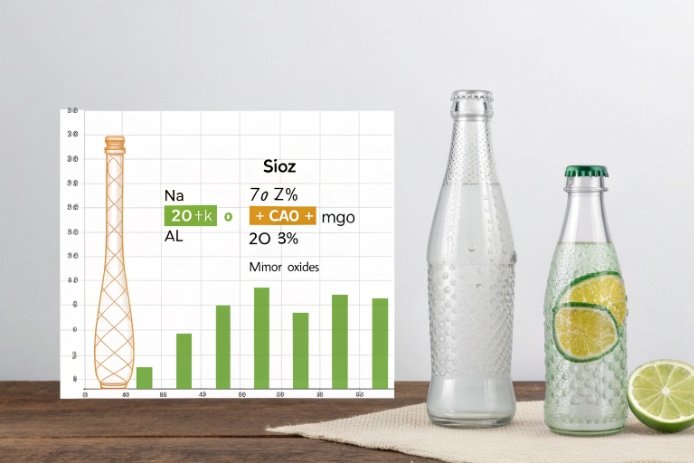
A durable food-contact bottle recipe aims to slow two pathways: fast alkali ion exchange and slower network dissolution. Na₂O is the main driver of pH rise in water extraction, so it should not swing. Many plants can run safely near the lower half of their Na₂O window if melting energy and fining are strong. SiO₂ is the backbone. It supports chemical durability 2, but it pushes viscosity up. So the best move is often “stable SiO₂” rather than “highest SiO₂.” Al₂O₃ is a practical durability tool because it strengthens the network and can reduce long-term ionic release, but it must remain in a range that the furnace can melt cleanly.
CaO and MgO matter most through surface quality. Too much CaO or a poor MgO/CaO balance can raise devitrification 3 risk in colder zones. Devit flakes and surface skins increase effective surface area and create micro-roughness that leaches faster. That is why a durability recipe is also a devit-resistant recipe.
Purity is the second half. Even if bulk glass is chemically stable, trace contaminants can create stones, cords, and local weak zones. For food-contact bottles, the priority impurities are:
- heavy metals 4 (Pb, Cd, As, Hg) as a compliance and brand risk
- Cr and Ni as both color drift and trace metal risk
- organics in cullet that create odor and redox instability
Buyer-ready composition and purity checklist
| Control target | Preferred direction | Typical risk if uncontrolled |
|---|---|---|
| Na₂O | tight band, avoid spikes | higher pH rise and more alkali release |
| Al₂O₃ | modest increase, stable | better durability, but too high can raise seeds |
| CaO/MgO | balanced ratio, stable | devit skins and rough inner surface |
| Cr/Ni | very low and stable | green tint drift + trace metal profile changes |
| Pb/Cd/As/Hg | low ppm in batch + low migration | audit failure and customer rejection |
A recipe that melts clean and stays smooth on the inside often beats a “harder” recipe that creates devit or cords. Surface wins the leaching game.
What heavy-metal limits and colorant rules apply under FDA and EU food-contact law?
This is where many teams get confused. They expect one table of numbers, but the rules are split across frameworks, packaging rules, and product type.
In the EU, glass falls under the general food-contact framework and GMP rules, with many companies also using ceramic-style Pb/Cd migration limits as a practical benchmark; in the US, FDA focuses on safety and has specific enforcement guidance for leachable lead and cadmium in foodware, especially when decorations or glazes are involved.

For the EU, the core requirement is that food-contact materials must not transfer constituents in quantities that could endanger health, must not cause unacceptable food composition change, and must not harm organoleptic properties 5. That is a performance rule, not a recipe rule. EU 10/2011 6 is widely quoted, but it is a plastics-specific measure. For glass, there is no single harmonized EU “glass regulation” that gives one universal migration table for all metals. So many brands and labs rely on practical benchmarks, national guidance, and industry practice.
A common benchmark is the ceramic directive system for lead and cadmium migration using 4% acetic acid under defined time and temperature. Many glass supply chains use these limits for decorated or colored glass, or as a conservative proof point for clear bottles, even if the bottle is not “ceramic.” This is especially relevant when bottles have enamels, inks, or external decorations that may contact the lip or the inside.
For the US, FDA does not publish a single “glass bottle oxide recipe.” The compliance story is usually built through safety, good manufacturing control, and—where relevant—specific enforcement guidance 7 for leachable lead and cadmium from food-contact surfaces (most often discussed for pottery/ceramicware and decorated items). For plain container glass, the risk is usually low. For decorated glass, the risk can jump, so buyers often apply stricter limits.
Practical rule for colorants in food bottles
Fe, Cr, Co, and Se are common colorants 8 or decolorizers in container glass. In a well-melted glass network, they are usually strongly bound. The higher risk often comes from:
- enamel decorations and inks
- recycled cullet containing crystal glass or unknown additives
- batch carryover that concentrates trace elements
| Item | “Safe practice” expectation | Why it protects you |
|---|---|---|
| Pb/Cd | control in batch + verify low migration | prevents regulatory and customer failures |
| As/Hg | avoid intentional use + keep ppm very low | reduces toxicological risk profile |
| Cr/Ni/Co/Se | use controlled sources only | prevents trace spikes and color drift |
| Decorations | keep off food-contact zones | reduces the most common real-world migration issue |
When the bottle is undecorated, heavy metals are mostly a cullet and raw material governance issue. When it is decorated, it becomes a surface chemistry issue.
How much recycled cullet can be used while still meeting migration and taste–odor requirements?
Cullet lowers cost and emissions. It can also be the fastest way to lose taste neutrality and trace metal stability.
High cullet rates can still meet migration and taste–odor requirements if the cullet stream is food-grade, well sorted, low in ceramics/metals/organics, and kept separate by color; the real limit is not the percentage, but the variability.
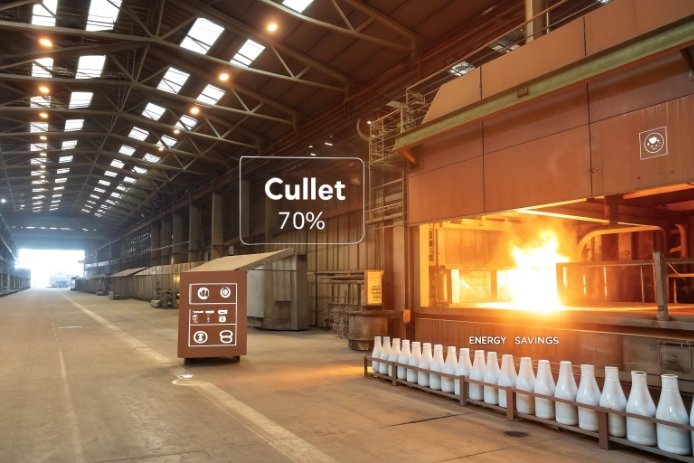
In many container plants, cullet can run from 30% up to 70%+ depending on furnace design, availability, and color. For food-contact bottles, the practical ceiling is often set by two things: contamination and odor. Post-consumer cullet 9 can carry ceramics, stones, metals, and organics. Those do not just create defects. They also create local chemistry spikes and redox swings that can increase alkali release and produce off-odor risks.
Taste–odor complaints often trace back to organics in cullet (labels, glues, residual contents) and unstable combustion. If organics enter the doghouse, they can create reducing pockets and change fining behavior. That can leave more seeds, more cords, and more surface micro-roughness. Even when migration is low, odor perception can still fail the market.
A strong cullet program looks like this:
- prioritize internal cullet and pre-consumer clean cullet where possible
- use color-separated streams with strict “no mix” rules
- set hard limits for CSP (ceramics/stone/porcelain), ferrous and non-ferrous metals
- control moisture and organics to avoid redox swings and odor
For EU packaging, heavy metal concentration limits exist for packaging components, and special conditions can apply to glass packaging with recycled content. This matters because the chemistry in recycled streams can raise the heavy metal sum even if nothing is intentionally added. So cullet governance must include both legal and customer limits.
Cullet acceptance controls that keep food-contact stable
| Cullet factor | What to control | What it prevents |
|---|---|---|
| Color purity | strict flint/amber/green separation | shade drift and trace metal spikes |
| CSP level | low ppm target + continuous monitoring | stones, surface flaws, higher leaching |
| Metals | magnets + eddy current separation | inclusions and scratch/flaw starters |
| Organics | washing + moisture control | odor, redox instability, foaming |
| Supplier change | formal approval + re-testing | surprise drift in migration and taste |
If a buyer wants “maximum recycled content,” the supplier must answer with a control plan, not with a single percentage. A stable 60% can be safer than an unstable 35%.
Which tests prove compliance for food-contact glass bottles?
A single certificate is not enough. Food contact is a chain of proof: chemistry, migration, and real-use durability.
A strong compliance pack combines framework proof (DoC/GMP), migration testing for relevant metals and simulants, hydrolytic resistance as a durability indicator, and performance testing for taste–odor and repeated-use conditions like alkali/acid and dishwasher exposure.
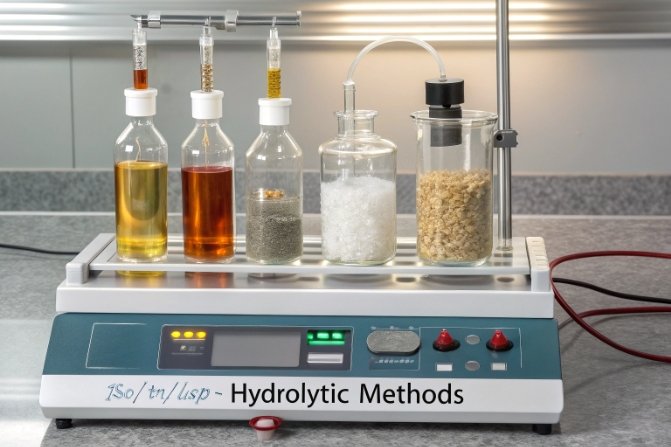
For food-contact glass, the test plan should match the product. Water, acidic drinks, salty brines, and oily foods behave differently. Glass is usually very inert, so overall migration is often low. Still, brands and retailers may demand it as a broad screen. For non-plastics, many labs use established simulant methods as a conservative check, even when the core regulation is framework-based.
Hydrolytic resistance 10 tests are often discussed in pharma, but they are also useful for food bottles because they measure alkali release under controlled hot-water extraction. They do not replace migration tests in acidic simulants, but they provide a repeatable durability indicator. For acid and alkali durability, standards that measure chemical attack under strong conditions help screen reusable bottles and bottles that see aggressive cleaning.
Dishwasher resistance matters for reusable glassware and some refill systems. It can also matter for decorated bottles used as reusable containers. The key is to test decoration and surface performance, not only the bulk glass.
A practical compliance test matrix for food-contact bottles
| Test category | What it shows | When to require it |
|---|---|---|
| Framework + GMP docs | legal readiness and process control | always for EU supply chains |
| Pb/Cd specific migration | heavy metal release in acidic simulant | decorated glass, colored glass, high-risk markets |
| Multi-element screen (ICP) | trace metals profile (Cr, Ni, Co, etc.) | when cullet is high or risk is unknown |
| Hydrolytic resistance | hot-water alkali release indicator | water products, long shelf-life risk checks |
| Acid/alkali resistance | durability under harsh chemistry | cleaning reuse, aggressive foods |
| Dishwasher resistance | combined thermal/chemical/mechanical wear | refill, reusable, decorated articles |
| Organoleptic test | taste–odor neutrality | water, beer, sensitive beverages |
A clean pass requires stability across lots. So the best practice is to tie tests to incoming cullet QC, furnace redox control, and fining stability. When the process is calm, compliance becomes repeatable.
Conclusion
Food-contact glass compliance comes from a stable soda-lime window, tight impurity and cullet governance, and a proof package that covers migration, durability, and taste–odor under real use.
Footnotes
-
Explains why this specific glass family is the industry standard for food. ↩
-
Details how the glass network resists breakdown from water and acids. ↩
-
Defines the crystallization defect that can cause surface roughness and failure. ↩
-
Official safety information on toxic metals commonly regulated in packaging. ↩
-
Describes sensory qualities like taste and smell that glass must preserve. ↩
-
The key EU regulation often used as a reference for safety limits. ↩
-
FDA policy guide detailing limits for lead and cadmium in foodware. ↩
-
Overview of the chemicals used to add or remove color in glass. ↩
-
Information on recycled glass usage and its environmental benefits. ↩
-
Standard methods for testing glass surface stability against water attack. ↩






