
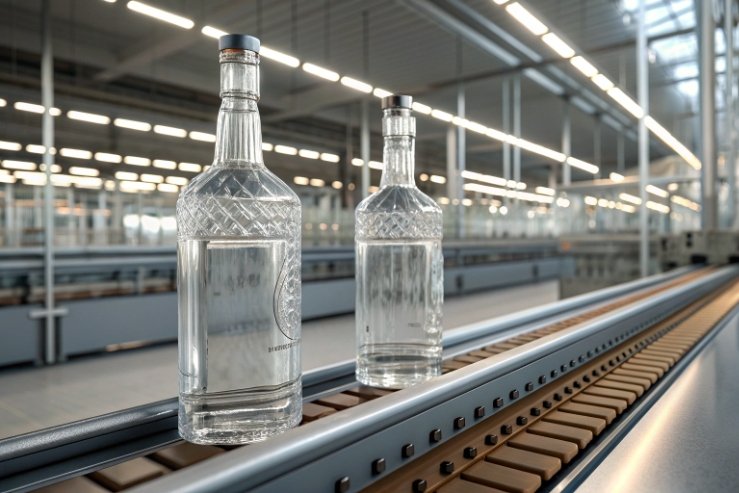
Heavy glass can look premium at first. But it can also burn freight budgets, raise breakage risk in long routes, and hurt sustainability scores.
Lightweight glass bottles cut material and freight emissions while keeping glass’s barrier and recyclability. With right-weighting, better coatings, and smarter geometry, many brands keep line performance and strength even at lower grams.
The key is to treat lightweighting as engineering, not dieting. A lighter bottle must still survive your filler, your conveyors, your cases, your pallets, and your retail reality. When those pieces are planned together, gram reduction becomes one of the fastest packaging wins.
How much freight and carbon can gram-reduction save?
Freight costs rarely fail in one big moment. They creep up with every shipment. Then finance asks why the same volume now costs more.
Every gram removed from a glass bottle saves weight across millions of units. That reduces transport fuel and emissions, and it can improve pallet efficiency or help stay under truck and container weight limits.
The simple math that keeps projects honest
Gram savings feel small until they scale. The clean way is to convert grams into tonnes, then connect it to distance. For defensible emission factors, many teams reference the UK Government GHG Conversion Factors 1.
- Per bottle saving (tonnes) = grams saved ÷ 1,000,000
- Ton-km saved = tonnes saved × km shipped
- CO₂ saved = ton-km saved × your transport emission factor
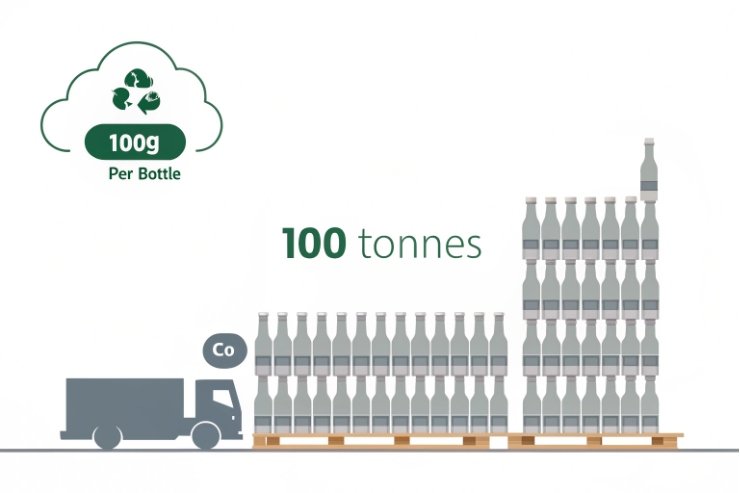
A realistic example for a 750 ml bottle:
- Weight reduction: 100 g per bottle
- Volume: 1,000,000 bottles
- Total glass saved: 100 g × 1,000,000 = 100,000,000 g = 100 tonnes
- Route: 800 km average truck distance
- Ton-km saved: 100 × 800 = 80,000 ton-km
If a typical truck factor is around 0.10–0.15 kg CO₂ per ton-km, the savings are roughly:
- 80,000 × 0.10 = 8,000 kg CO₂
- 80,000 × 0.15 = 12,000 kg CO₂
That is 8–12 tonnes of CO₂ for one million bottles on one route. When a brand ships 10–50 million bottles, the carbon and fuel story stops being small.
Freight cost savings depend on the limit you hit
Some lanes price by pallet. Some price by weight. Some price by container max payload. Lightweighting helps in all three, but in different ways:
- If the lane is weight-limited, lighter bottles let more saleable units ship per load.
- If the lane is volume-limited, lighter bottles still cut emissions, but cost savings may be smaller unless pallets can be optimized.
- If the lane is handling-limited, lighter bottles reduce strain and can lower damage from rough manual moves.
What a buyer should track during the business case
A good lightweighting proposal usually includes a short table like this:
| Input | What it changes | Why it matters |
|---|---|---|
| grams saved per bottle | tonnes shipped | the core lever |
| annual bottle volume | scale of savings | turns grams into money |
| average route km by mode | ton-km | links to real emissions |
| max payload constraints | units per load | controls freight cost impact |
| damage rate today | risk buffer | protects savings from breakage claims |
The best projects do not chase the biggest gram reduction. They chase the best total outcome: lower cost, lower carbon, and stable breakage performance.
Can optimized distribution maintain strength at lower weights?
Lightweight bottles fail when glass is removed from the wrong place. Then the bottle becomes sensitive to impacts, scuffs, or top-load. That is when people say, “Lightweight equals fragile.”
Yes. Strength can be maintained when glass is redistributed into the right zones and the process stays stable. Modern forming methods and tighter controls often let a lighter bottle perform like an older heavier bottle.
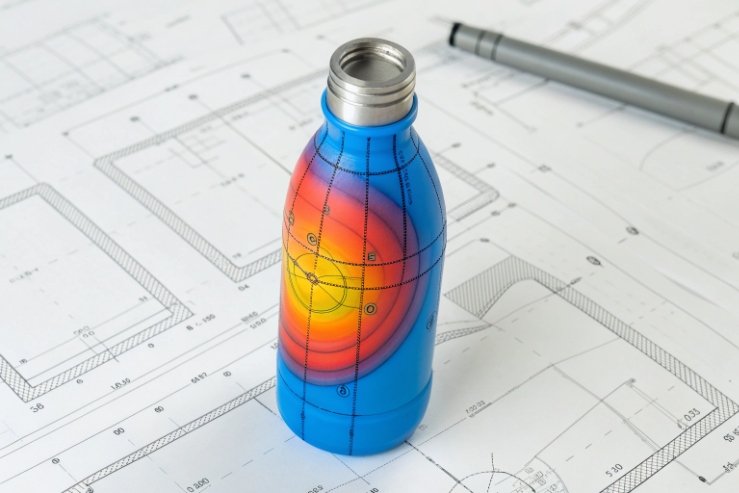
Strength is not only about total grams
Glass strength is driven by stress and flaws. The flaws are mostly surface damage and micro-cracks. The stress comes from internal pressure, top-load, and impact.
So the strategy is simple:
- reduce stress peaks by improving geometry
- reduce flaw creation by improving handling and coatings
- keep thickness where the stress is highest
In practice, the most important zones are:
- heel and base edge (impact and standing stress)
- shoulder (impact and pressure interaction)
- finish and neck (capping load, sealing integrity, side hits)
How “optimized distribution” is done in production
The main tools are:
- better parison control so thickness goes where it should
- tighter mold and IS machine stability
- improved annealing to reduce residual stress
- design changes that remove sharp transitions
The narrow-neck press-and-blow (NNPB) process 2 is often used for better thickness control in some bottle families. Blow-and-blow can still work well, but it may need tighter control windows to avoid thin spots when weight is reduced.
The real test is the route, not the CAD file
A bottle can pass lab tests and still fail on a real line if:
- conveyors scuff it
- guides pinch it
- cases allow glass-to-glass knock
- pallets shift and crush lower layers
When lightweighting is paired with packaging and line tuning, the strength story improves fast. A controlled line with clean guides and correct lubrication will protect a lightweight bottle better than a rough line will protect a heavy bottle.
| Strength risk | What causes it | Lightweighting fix that actually works |
|---|---|---|
| heel cracks | base edge impacts | stronger heel radius + better case separation |
| shoulder fractures | side hits + thin shoulder | redistribute thickness + guide tuning |
| top-load collapse | poor stacking or weak geometry | improve column stacking + design for vertical load |
| random breakage | scuff damage + residual stress | better annealing + stronger surface protection |
The best proof is a structured trial: run a controlled pilot, measure damage, and compare performance by route. That approach turns “fear” into data.
Do coatings and geometry offset impact losses?
A lighter bottle has less mass, but that does not automatically mean it survives impacts better. Impact damage is about contact force, contact area, and surface flaws. If scuffs rise, breakage rises.
Yes. Smart geometry and strong coatings can offset much of the impact risk. Coatings reduce surface damage, and geometry reduces stress concentration. Together, they protect real-world strength more than extra grams often do.
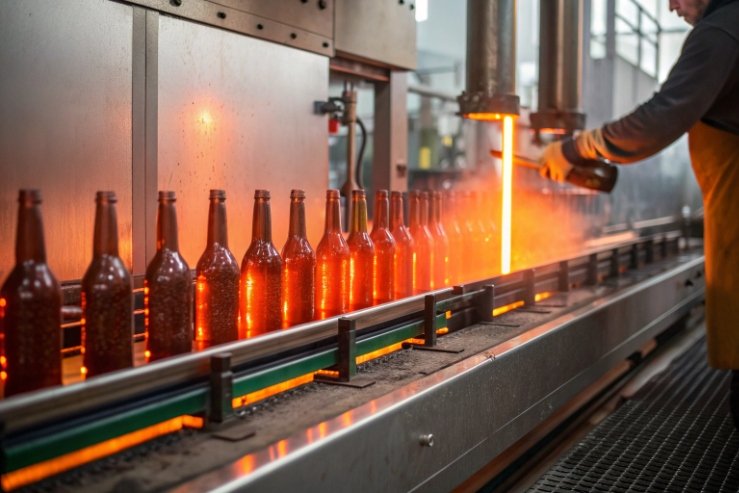
Geometry changes that protect strength without adding weight
The most useful geometry moves are not dramatic. They are small and practical:
- smoother shoulder transitions
- improved heel radius
- controlled push-up/base design for stability
- removal of sharp corners near embossing or panels
These changes reduce stress concentration. Stress concentration is where cracks start. A crack does not need a big excuse.
Lightweighting also benefits from designing the bottle to “travel well”:
- stable standing ring
- consistent contact points in conveyors
- less rocking and less chatter at high speed
Coatings are not decoration. They are strength insurance
Most breakage in distribution starts with abrasion. A scuffed bottle has micro-damage. Then a small impact becomes a fracture.
Hot-end and cold-end coatings 3 are used to reduce abrasion and improve lubricity. The practical outcome is fewer scratches and fewer scuffs. That protects strength retention across the route.
In lightweighting projects, coatings matter more because the margin is tighter. A heavy bottle can “hide” poor handling for a while. A lightweight bottle will expose it quickly.
Where the limits are
Coatings cannot fix bad case packing or unstable pallets. Geometry cannot fix bottles knocking glass-to-glass in a loose shipper. Lightweighting works best when it is paired with:
- dividers or cells that prevent glass contact
- consistent pallet wrapping and corner protection
- line guides that do not pinch bottles
- correct conveyor setup so bottles do not rub aggressively
| Lever | Helps most with | What it does not fix |
|---|---|---|
| improved heel/shoulder geometry | impact survival | poor pallet stability |
| smoother transitions | stress reduction | harsh guide pressure |
| stronger surface coating | scuff and scratch reduction | bottles rattling in cases |
| better secondary packaging | glass-to-glass prevention | weak annealing or defects |
A lightweight bottle is often safer than expected when the line is clean and the pack is stable. That is the part many teams miss.
Which microbiological or product-safety checks matter when lightweighting?
Some buyers worry that thinner glass changes safety. In reality, glass barrier performance stays excellent at lower weights. The risk is not permeation. The risk is breakage and defects.
Safety checks for lightweight bottles focus on mechanical performance: top-load, impact resistance, internal pressure (when relevant), thermal shock, and inspection for defects. The bottle must also stay compatible with closures and capping torque without finish damage.

The usual validation set for beverage and food bottles
A practical qualification plan includes:
- vertical load (top-load) using methods aligned to ISO 8113:2004 4
- internal pressure tests when relevant (commonly referenced via ASTM C147 5 for glass containers under sustained pressure)
- impact testing focused on heel and shoulder zones
- thermal shock if hot-fill or temperature swings occur
- finish checks to ensure sealing and torque performance
- scuff/abrasion simulation to confirm strength retention after handling
On top of this, modern lines rely on automatic inspection to remove defects. Lightweighting makes inspection even more valuable because thin spots and checks must be caught early.
What changes when the bottle is for carbonated loads
For beer, soda, or sparkling products, pressure margin must be protected. Lightweighting can still work, but it typically needs:
- more conservative glass removal in the shoulder and base
- a finish that supports consistent capping without micro-cracks
- packaging that reduces side impacts
What to document for a buyer or retailer
Retailers and large brand owners often want a simple, repeatable validation pack:
- drawings and weight tolerance
- test method list and acceptance criteria
- trial results and damage rate tracking
- process controls for coatings and annealing
| Validation area | Why it matters | What “pass” looks like in the field |
|---|---|---|
| top-load | pallet and conveyor survival | fewer crushed cases and fewer line falls |
| impact | real handling knocks | stable damage rate by route |
| pressure (if carbonated) | consumer safety margin | no burst events under spec |
| abrasion resistance | strength retention | fewer scuffs and fewer random breaks |
| closure compatibility | leak prevention | stable torque and seal performance |
When lightweighting is validated like this, the bottle becomes an upgrade, not a gamble.
Which retailers favor lightweighting targets?
Lightweighting is no longer only a producer choice. Retailers and alcohol monopolies are now setting expectations. That changes buyer behavior fast.
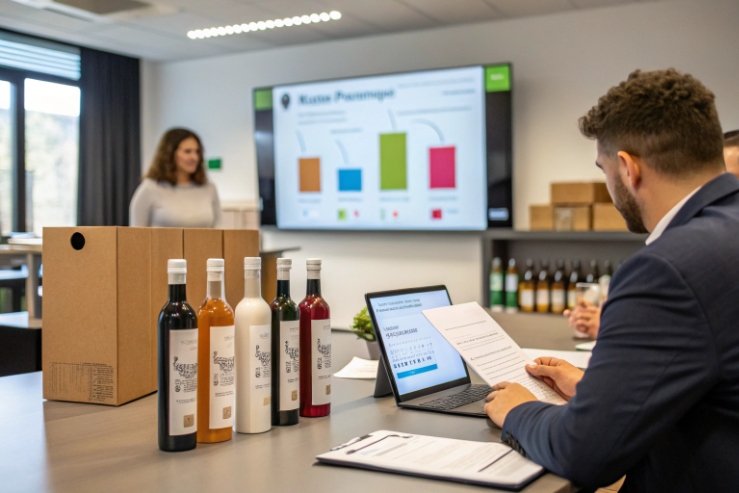
Retail pressure is strongest in wine and spirits today. Groups like the Sustainable Wine Roundtable’s Bottle Weight Accord push ranges toward an average below 420 g for 750 ml still wine bottles by the end of 2026. Some monopolies also set limits or rules by product segment and price tier.
Retailers want measurable targets, not vague claims
The most common request from large retailers is simple:
- show the bottle weight
- show year-on-year progress
- avoid unnecessary heavy bottles for standard SKUs
This trend is visible in:
- UK retail programs tied to industry accords
- Nordic monopoly rules and limits
- Canadian provincial policy that pushes lightweight glass
Examples that signal where the market is going
Several large buyers now use bottle weight as part of their sustainability scorecards. Examples include:
- Retailers involved in the Sustainable Wine Roundtable’s Bottle Weight Accord 6, aiming for sub-420 g averages for 750 ml still wine bottles.
- Norway’s buyer policy such as Vinmonopolet’s weight packaging requirements 7 for certain wines and price tiers.
- Sweden’s Systembolaget setting maximum weights for very heavy bottles.
- Quebec’s SAQ pushing lightweight bottle policies for many wines and setting compliance timelines.
Even when these rules are not applied to beer bottles directly, they still influence glassmakers and supply chains. Once a plant is tuned for lightweighting, other categories often follow.
What this means for brands that sell globally
If a brand sells into these channels, lightweighting becomes a commercial requirement, not only a sustainability choice. The smartest move is to build a bottle portfolio:
- a lightweight default bottle for high-volume SKUs
- a stronger bottle for high-risk routes and carbonated loads
- premium cues (embossing, decoration, color) that do not rely on heavy glass
| Buyer type | What they care about | How to prepare |
|---|---|---|
| major retailers | average bottle weight targets | track weights across the range |
| alcohol monopolies | compliance limits and reporting | follow their packaging specs early |
| premium retail | look + sustainability balance | use design cues, not mass, for premium |
| e-commerce channels | drop survival + weight | pair lightweight bottles with protective packs |
Lightweighting is becoming a language buyers speak. When a brand speaks it back with data and stable performance, approvals get easier.
Conclusion
Lightweight glass bottles save material, freight cost, and carbon. With right-weighting, strong coatings, and route-based validation, lower grams can keep strength while meeting retailer sustainability targets.
Footnotes
-
Official emission factor tables for converting freight activity into CO₂e for carbon and cost models. ↩ ↩
-
Explains how NNPB improves glass distribution for right-weighting and reducing thin spots. ↩ ↩
-
Overview of hot-end and cold-end coatings and how they reduce scuffing and preserve strength. ↩ ↩
-
Defines the ISO vertical load test method used to qualify top-load performance of glass containers. ↩ ↩
-
Standard reference for internal pressure strength testing of glass containers for carbonated or pressure-forming products. ↩ ↩
-
Details the Bottle Weight Accord target and signatory commitments for lighter 750 ml still wine bottles. ↩ ↩
-
Shows Vinmonopolet’s bottle-weight requirement and dismissal policy for non-compliant wines, useful for market planning. ↩ ↩






