
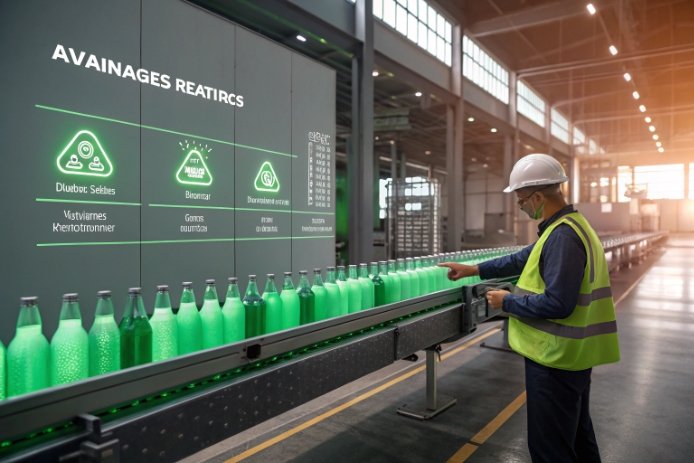
A chromium-green bottle can boost shelf impact fast, but one wrong furnace shift can turn that “premium green” into an ugly yellow-green and trigger returns.
Chromium green bottles offer strong brand appeal and better light protection than clear glass, and they usually tolerate higher recycled cullet. The main risks are shade drift, cord defects, and the need to prevent any Cr(VI) formation by tight redox control.
Designing chromium-green bottles is a balance of optics, chemistry, and compliance
Why chromium green is popular in containers
Chromium is a powerful green colorant in soda-lime glass. It can deliver a clean “emerald” look when chromium stays mainly in the trivalent state. But chromium is multivalent, so the furnace redox state decides the final tone. In simple terms, chromium green is not only “add Cr2O3.” It is “add chromium and keep the melt in the right oxygen balance.”
The two big reward areas
Brand + performance. Green glass reduces light transmission compared with flint, which helps beverages, oils, and some cosmetics that dislike light. Darker bottles protect products better against light-driven changes, which is why wine is often packaged in dark green glass.
Recycled-content tolerance. Green bottles can accept more mixed cullet because small iron and tint variation is less visible than in flint. This can lower cost and CO₂ without fighting “slight green” complaints every week.
The two big risk areas
Shade drift. Highly oxidized chromium glass can shift toward a yellow-green that looks cheap and inconsistent.
Compliance and trust. Customers worry about heavy metals. Chromium is not automatically unsafe, but Cr(VI) is a headline risk. Even if the actual risk is low in container glass, buyers will ask for proof.
| Design goal | What helps | What can hurt |
|---|---|---|
| Deep emerald green | stable Cr(III) dominance | over-oxidation → yellow-green shift |
| High recycled content | strong cullet sorting + blending | mixed glass families and ceramic contamination |
| Low defects | strong homogenization + stable redox | redox gradients → cords and streaks |
| Easy compliance | documented controls + traceability | missing paperwork and unclear testing scope |
A chromium-green program wins when the color target is defined in numbers, redox control is steady, and documentation is ready before the buyer asks.
Now I will break the topic into the four questions that buyers and production teams care about most.
Chromium green is chosen because it solves more than one problem at once. It protects, it sells, and it makes recycling goals easier.
Brands choose chromium green because it improves light protection compared with clear glass, signals quality and tradition, and hides small cullet-driven tint variation better than flint. This makes it a strong choice for wine, oils, sauces, and light-sensitive personal care.
Light protection without going “full amber”
Many product teams want better UV and visible-light protection than clear glass, but they do not want the heavy look of amber. Green is a middle path. Darker bottles reduce light exposure, which helps products like wine and oils where light can trigger aroma and flavor changes. (See light protection data 1)
Premium look that fits many categories
Green packaging signals “heritage” and “natural” in many markets. It also makes label colors pop. For cosmetics, green can signal botanical positioning and feel more premium than clear when the formula color is not visually attractive.
Recycled-content tolerance is a real advantage
In flint, small iron variation shows as green tint and becomes a complaint. In green, that same variation can be invisible. This is why green furnaces often push higher cullet faster than flint furnaces. A brand can hit recycled-content goals without constant shade fights.
Where chromium green is the best fit
| Product category | Why green helps | What the brand usually wants |
|---|---|---|
| Wine/spirits | light protection + tradition | consistent deep green across lots |
| Olive oil/vinegar | protects flavors from light | strong premium appearance |
| Food sauces | hides product discoloration risk | stable color and low defects |
| Cosmetics | premium shelf look + light control | low heavy-metal concern and traceability |
This is the advantage story. The buyer will also ask about safety and compliance. That is where chromium must be handled with care and clarity.
What are the main safety and compliance concerns with chromium colorants, including the risk of hexavalent chromium (Cr(VI)) formation?
A buyer may accept “chromium green,” but they will not accept uncertainty. The compliance question is not optional in B2B.
The main concern is Cr(VI) risk, because chromium can exist in multiple oxidation states. Under highly oxidizing conditions, Cr(VI) can be stabilized in soda-lime glass and can shift color toward yellow-green. Even if release risk is low in many container uses, customers still want documented proof that chromium is controlled and compliant.

What can go wrong in real production
- Wrong chromium source: Using chromate-containing pigments (Cr(VI) salts) is a worker-exposure and compliance risk. Container color is normally achieved with Cr2O3 (Cr(III)), not chromates. (Read ECHA chromium safety 2)
- Over-oxidation in the furnace: Chromium can shift toward hexavalent forms under strongly oxidizing conditions, which can change shade and raise buyer concern.
- Paperwork gaps: Even if the glass is safe, missing declarations can block approvals.
Cr(VI) is mainly a control problem, not a destiny problem
Chromium in soda-lime glass can show both Cr(III) and Cr(VI) contributions to color. Highly oxidized glass tends to look unpleasant yellow-green, while reducing the hexavalent share gives a more attractive green. This is why redox control is not a “nice to have.” It is a color and compliance lever. (See Cr(VI) in glass 3)
What buyers usually ask for (and why)
- REACH: Is chromium oxide registered and are SVHC substances controlled?
- RoHS: Some buyers request it even if the bottle is not electrical equipment. It becomes a contract checkbox.
- Food contact: Under EU framework rules, the bottle must not transfer harmful substances into food. Even if glass is generally inert, buyers may still ask for migration-style evidence for peace of mind. (See EU food contact rules 4)
- Cr(VI) statement: Many buyers want a statement that Cr(VI) is not intentionally added and is controlled in the melt.
| Concern | Why it matters | Typical evidence buyers accept |
|---|---|---|
| Cr(VI) presence | headline toxicity perception | periodic Cr(VI) testing + redox controls |
| Worker exposure | powder handling risk | SDS + closed handling + LEV procedures |
| Food-contact suitability | legal and brand risk | FCM documentation + risk assessment + testing if needed |
| Restricted substances | customer policy | REACH/RoHS declarations + supplier COA |
The most reliable way to reduce compliance risk is to control chromium chemistry so it stays in the stable Cr(III) state and produces the intended green. That is the next question.
How can manufacturers control furnace redox and batch chemistry to keep chromium in the stable Cr(III) state and avoid shade shifts or defects?
Chromium green can be stable for years, or it can drift every week. The difference is the redox system.
To keep chromium in the Cr(III)-dominant state, manufacturers hold a stable redox band, avoid strongly oxidizing conditions, control sulfur and reducer balance, and prevent redox gradients that create cords. Stable combustion control, clean cullet, and slow corrections beat aggressive additive changes.

Step 1: choose the right chromium raw material and keep it clean
For container glass, chromium is typically added as Cr2O3 or as chromite-type materials. The goal is to avoid any intentional Cr(VI) input and to keep impurities low. A consistent pigment quality matters because chromium is strong and shade windows are tight.
Step 2: run a “stable redox” strategy, not a “more reducing” strategy
If the melt becomes too oxidizing, chromium can shift toward hexavalent forms and the green can turn yellow-green. If the melt becomes too reducing, other issues can rise: sulfur behavior changes, foam can increase, and cords can appear if gradients develop.
The most useful rule is:
- hold the oxygen activity steady,
- avoid fast swings,
- and stop unplanned reducers (dirty cullet) before touching the furnace setpoints.
Step 3: control cullet because cullet is a redox input
Labels, inks, and organics in recycled cullet push the melt reducing in bursts. Those bursts create local redox pockets. Those pockets create cords. A clean, blended cullet feed is the easiest way to stabilize chromium green. (Read cullet impact 5)
Step 4: manage sulfur and fining chemistry so it does not fight chromium
Sulfate fining is common, but sulfur chemistry is redox sensitive. If sulfur balance swings, foam and reboil risk rises, and shade can look “dirty” due to scattering. The best chromium programs keep sulfate dosing stable and tune combustion and cullet quality first. (See sulfate issues 6)
Step 5: prevent gradients with mixing and temperature uniformity
Cords are often a mixing problem. With chromium, cords become visible because chromophore balance differs by stream. Practical controls include:
- adequate melting and fining time for homogenization,
- bubbling or mixing support where available (see bubbling systems 7),
- forehearth uniformity to avoid late redox changes.
| Control lever | What it stabilizes | What defect it prevents |
|---|---|---|
| Clean cullet + blending | reducer spikes | cords and shade waves |
| Stable combustion oxygen | melt oxygen activity | yellow-green drift |
| Slow batch trims | avoids oscillation | batch-to-batch variation |
| Mixing/finer residence | composition uniformity | streaks and striae |
| Forehearth uniformity | late redox shifts | reboil and shade banding |
When redox and mixing are stable, chromium green becomes one of the most forgiving colors for high recycled content. But none of this matters if buyers cannot verify it. So the last section is about what documentation and testing a B2B buyer should request.
What testing and documentation should B2B buyers request (heavy metal release tests, REACH/RoHS declarations, food-contact compliance, and traceability)?
A buyer does not only buy a bottle. They buy risk reduction. The right documents speed approvals and prevent disputes.
Buyers should request a clear compliance pack: REACH statement, RoHS statement if required by the customer, food-contact framework documentation, and lot traceability. For chromium green, it is also smart to request periodic Cr(VI) screening and a practical leaching test plan for Cr and other metals when the application is sensitive.
The core documents that should exist for every B2B program
1) SDS + COA for chromium raw material
The COA should state chemistry, impurities, and whether Cr(VI) is present as an impurity (if measured). The SDS supports safe handling.
2) REACH declaration
A statement that materials comply with REACH obligations and disclose SVHC if applicable. Buyers often want a written declaration even if the risk is low. (See ECHA REACH guide 8)
3) Food-contact documentation (EU framework)
In the EU, food contact materials must comply with the general framework requirements and GMP expectations. For glass, there is not one single harmonized “glass-only” migration rule like plastics, so buyers often rely on a documented risk assessment plus supporting test data when needed.
4) RoHS declaration (only if the customer contract requires it)
RoHS is aimed at electrical equipment, but some brands use it as a general restricted-substance checklist. The key is to state the scope clearly so there is no confusion.
Tests buyers may request for chromium green
- Cr(VI) content screening in glass: periodic checks, especially after major furnace changes or new cullet sources.
- Targeted leaching test for metals (application-driven): a controlled extract (often acidic) followed by ICP-MS for Cr, Pb, Cd, and other metals. This is most common in pharma-like cosmetics or very cautious food brands. (See leach testing 9)
- Color compliance testing: Lab* or transmission at a standard thickness, with documented tolerances.
- Defect and cord controls: cord rate tracking, stone count, and QA inspection records. (Guide to glass defects 10)
Traceability is the difference between trust and arguments
A strong traceability pack includes:
- batch records and colorant lot IDs,
- cullet supplier and lot IDs,
- redox and temperature logs,
- bottle colorimetry by time window,
- corrective actions when drift happens.
| Buyer request | What it protects | What a good supplier provides |
|---|---|---|
| REACH statement | chemical-policy risk | signed declaration + SVHC process |
| RoHS statement | customer checklist risk | scoped declaration (if required) |
| Food-contact evidence | legal and brand risk | framework compliance statement + risk assessment |
| Cr(VI) control evidence | chromium-specific concern | redox plan + periodic Cr(VI) testing |
| Traceability | dispute resolution | lot mapping from cullet to pallets |
When this pack is ready, approvals move faster. It also reduces price pressure, because the supplier is not selling “green glass.” The supplier is selling “stable green glass with evidence.”
Conclusion
Chromium green bottles win on protection, premium look, and high-cullet tolerance. The key risks are Cr(VI) perception and shade drift, and both are controlled by stable redox, clean cullet, and strong documentation.
Footnotes
-
Technical article on redox control and its impact on glass color and light transmission. ↩
-
ECHA substance information for Chromium Trioxide and safety classifications. ↩
-
Research on chromium redox states in glass and their effect on color. ↩
-
European Commission legislation on food contact materials. ↩
-
FEVE report on cullet quality and its role in sustainable glass production. ↩
-
Article discussing sulfate fining and foam control in glass furnaces. ↩
-
Overview of furnace bubbling systems for melt homogeneity. ↩
-
Official ECHA guide to understanding REACH regulations. ↩
-
Information on extractables and leachables testing services for packaging. ↩
-
Guide to identifying and troubleshooting common glass defects like cords and stones. ↩






